
2026/6/25 · 6:13
When materials became promptable: TrussGPT, engineered matter, and four signals to watch
Promptable inverse design is moving from lab curiosity into a practical software layer for advanced manufacturing. This issue explains TrussGPT’s 1000x speed claim, maps the startup whitespace around verification and manufacturing translation, then tracks signals in molecular data storage, grid storage, RNA delivery, and photonic packaging.

A materials engineer can already ask software for a part that is stiff in one direction, compliant in another, and capable of absorbing a specified load curve. The harder step has been turning that intent into a manufacturable architecture without weeks of topology optimization, finite-element loops, and expert interpretation.
The new signal is that the interface is starting to look like language. In npj Computational Materials, researchers introduced TrussGPT, a language-model framework for inverse design of truss metamaterials. The headline numbers are unusually concrete for this field: more than 99% structural validity, target errors below 5%, and design generation up to 1000 times faster than gradient-based or heuristic generative methods. The same system handled single-property targets, multi-property optimization, and stress-strain curve conditioning. 1
That does not make materials design a chatbot problem. It does suggest a useful business lens: the next software layer in advanced manufacturing may be less about drawing parts and more about translating performance intent into physical microstructure.
The flagship signal: promptable architected matter
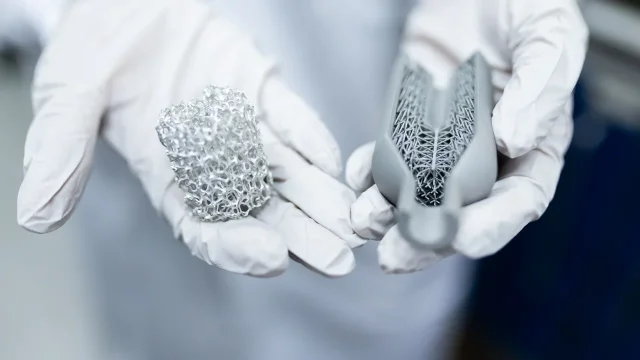
Mechanical metamaterials get their useful behavior from geometry rather than chemistry alone. A lattice, shell, or truss can be designed to buckle, recover, stiffen, absorb shock, filter vibration, or distribute heat in ways a bulk material cannot. That is why the category matters for lightweight aerospace parts, protective equipment, robotics end-effectors, medical implants, battery casings, heat exchangers, and acoustic structures.
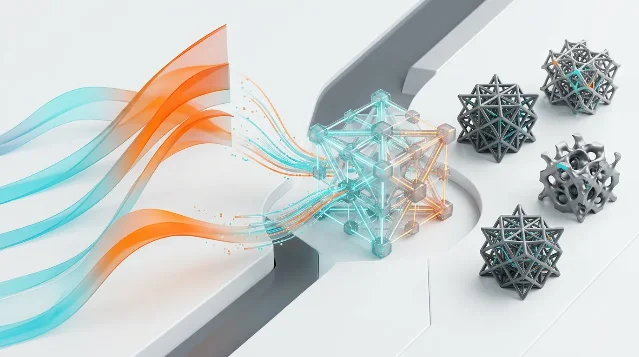
The bottleneck is inverse design. Forward design asks, "What happens if I build this geometry?" Inverse design asks the more commercially useful question: "What geometry gives me this behavior?" TrussGPT attacks that second question by encoding truss topologies into language-model-compatible sequences, generating structures conditioned on mechanical targets, and decoding those sequences back into geometry. 1
A related Nature Machine Intelligence paper points in the same direction from a different representation. DiffuMeta encodes three-dimensional shell geometries as mathematical sentences, then uses diffusion transformers to generate shell metamaterials with target stress-strain responses, including large-deformation behavior such as buckling and contact. The authors also released datasets and code through research repositories. 2
Put the two papers together and the pattern is clear: high-value physical design is being converted into tokenizable search space. Once geometry becomes a language, the product opportunity shifts from one-off simulation to reusable, domain-specific design systems.
What changed technically
The commercial importance is not that an LLM appears in the method name. It is that the design loop is being compressed at the point where expert labor is scarce.
| Design problem | What the new research changes | Why builders should care |
|---|---|---|
| Expressing requirements | Mechanical intent can be represented as target properties or stress-strain behavior rather than a hand-specified lattice. 1 | Product teams can start from job-to-be-done constraints: absorb this impact, bend this much, stay below this weight. |
| Searching geometry | TrussGPT reports valid structures at high rates and much faster generation than older optimization approaches. 1 | The first software products can be fast screening tools, not fully autonomous certification engines. |
| Handling nonlinear behavior | DiffuMeta targets stress-strain responses under large deformation and can produce diverse solutions for the same target. 2 | Multiple viable geometries let manufacturers optimize for cost, printability, material choice, or available equipment after the mechanical target is met. |
| Making the system auditable | DiffuMeta published its dataset and source code through external repositories. 2 | Open baselines make it easier for startups to build validation, benchmarking, and vertical tooling around the research rather than starting from scratch. |
This is a narrow but meaningful shift. CAD generalized the drawing of parts. Simulation generalized testing before fabrication. Promptable inverse design aims at the earlier decision: what should the internal architecture of the part be?
Business angles opening up
1. Vertical design copilots for high-cost parts
The first buyers are unlikely to be hobbyist 3D-printing users. The better wedge is any team already paying for simulation engineers, custom lattice design, and expensive physical testing: aerospace suppliers, defense contractors, high-end sports equipment makers, robotics hardware teams, orthopedic implant companies, and battery-pack safety groups.
A credible product would not promise "AI-designed materials" in the abstract. It would start with a single repeatable class of part: crash absorbers, shoe midsoles, vibration isolators, lightweight brackets, implant porous structures, or heat-exchanger cores. The workflow would turn performance targets into candidate architectures, then export geometry into the customer's existing CAD, simulation, and manufacturing stack.
2. Verification before generation
The research result is exciting, but a generated lattice is not a certified component. That gap is a company-shaped hole.
Every promptable-materials workflow needs an independent verification layer: simulation checks, manufacturability rules, sensitivity to process variation, fatigue estimates, and documentation for engineering review. A startup that sells "trust infrastructure" for generated physical designs may have a cleaner procurement path than one selling a black-box generator.
The photonics field shows the same pattern. A June 2026 npj Nanophotonics paper used topology optimization to design 14 micrometer by 14 micrometer grating couplers on silicon-on-insulator, with measured peak coupling efficiencies of -0.92 dB and -0.86 dB in the telecom C-band. The authors emphasize compatibility with standard single-mode fibers and applications such as spatial-division multiplexing and photonic quantum technologies. 4
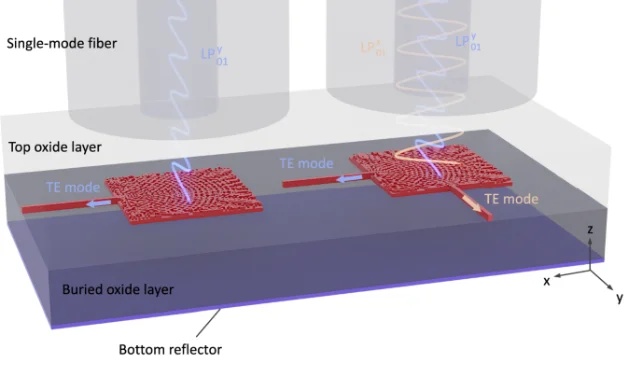
The lesson is broader than photonics: inverse-designed structures need packaging, alignment, fabrication tolerance, and test data before customers trust them.
3. Manufacturing translation as the moat
The obvious demo is a beautiful lattice. The durable product is the translation layer between a generated structure and a specific process: selective laser melting, polymer additive manufacturing, CNC hybrid workflows, wafer fabrication, or composite layup.
That layer needs material constraints, minimum feature sizes, surface roughness limits, thermal distortion models, and post-processing assumptions. The science papers show that representation and generation are improving. The business moat will sit in the messy process data that tells a customer which generated design can actually be made on Tuesday.
4. Proprietary materials libraries
Promptable inverse design also favors proprietary libraries. A startup can build domain-specific datasets of validated geometries, measured outcomes, failed prints, and process recipes. Over time, the system's advantage is not the general model; it is the closed loop between proposed architecture, fabricated part, measured performance, and customer-specific constraints.
That is especially important because many metamaterial applications are regulated or safety-critical. The winner may look less like a pure AI company and more like a simulation-software company with a manufacturing data flywheel.
The near-term wedge
If I were building here, I would avoid the broad claim that "engineers can now prompt materials into existence." The more plausible wedge is narrower:
- Pick one part family where geometry drives performance more than chemistry.
- Build a generator that proposes candidate lattices or shells from measurable targets.
- Add verification that customers can audit.
- Integrate into existing CAD and simulation workflows rather than replacing them.
- Collect fabrication and test feedback until the model knows the difference between mathematically valid and factory-useful.
The timing looks good because the enabling pieces are converging: generative representations for complex geometry, cheaper additive manufacturing, better simulation automation, and customers under pressure to reduce weight, improve thermal performance, or pack more function into smaller parts. The remaining friction is not imagination. It is evidence.
Four other signals worth tracking
| Signal | What happened | Builder angle |
|---|---|---|
| Molecular data storage | Science Advances published work on long-stranded XNA-cssDNA hybrids for robust data storage. The abstract reports a FANA polymerase evolved with a temperature-guided language model, about 4.4 times faster than Tgo D4K, synthesis of strands exceeding 7500 nucleotides, and 100% data recovery after degradation in the reported framework. 5 | The opportunity is not consumer storage. It is archival infrastructure for data that must survive decades with low energy cost: labs, governments, cultural archives, and compliance-heavy enterprises. |
| Grid storage | A Nature Energy perspective published on June 23, 2026 argues that vanadium flow batteries must overcome scale bottlenecks to become reliable, cost-effective long-duration storage at multi-hundred-megawatt scale. 6 | The buildable layer may be less about inventing a new battery chemistry and more about stack diagnostics, electrolyte management, project finance tools, and operations software for long-duration assets. |
| Animal health RNA delivery | A 2026 Trends in Biotechnology paper indexed by PubMed engineered a probiotic Bacillus subtilis strain to deliver dsRNA-loaded extracellular vesicles against H9N2 avian influenza, with the abstract reporting about a 70% reduction in viral burden after oral administration. 7 | If the approach translates beyond the study setting, it points to residue-free antiviral tools for livestock and poultry, with product questions around strain stability, dosing, regulation, and farm-channel distribution. |
| Photonic packaging | The ultracompact grating-coupler result above reached sub-decibel measured coupling in a 14 micrometer by 14 micrometer footprint on a silicon-on-insulator platform. 4 | AI datacenters and quantum systems both need better ways to move light on and off chips. Packaging, testing, and yield software may be as valuable as the photonic device itself. |
The common thread is that research tools are getting closer to product interfaces. Materials can be generated from intent, molecular archives can be read after damage, RNA payloads can ride engineered microbes, and photonic components can shrink without giving up too much performance. None of that removes the hard part of commercialization. It just moves the frontier from discovery to translation.
参考ソース
- 1TrussGPT: large language model-driven inverse design framework for truss metamaterials
- 2Algebraic language models for inverse design of metamaterials via diffusion transformers
- 3Pexels photo by ThisIsEngineering
- 4Ultracompact low-loss grating couplers
- 5Long-stranded XNA-cssDNA hybrids for robust data storage
- 6Scaling vanadium flow battery for long-duration energy storage
- 7Engineered Bacillus subtilis to deliver dsRNA via extracellular vesicles against the H9N2 avian influenza virus


このコンテンツについて、さらに観点や背景を補足しましょう。