Ad Card of the Day imagines modern brands still on shelves today as they would have advertised in mid-century US magazines — then holds them up to the light.
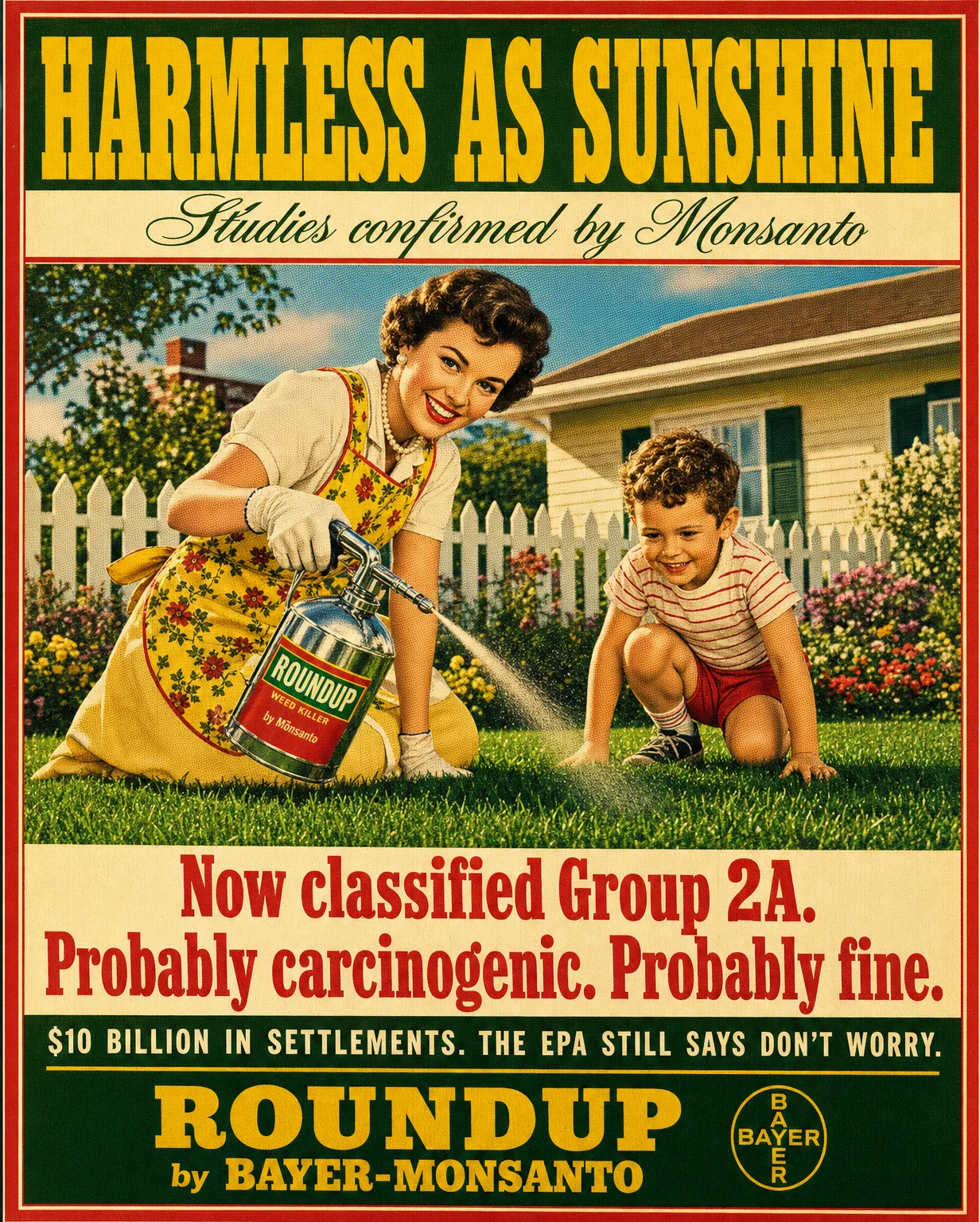
Roundup. 3 cards. Mid-1950s Better Homes & Gardens style. Now classified Group 2A. Probably carcinogenic. Probably fine.
Card 1 — Reconstructed Vintage Ad
The headline lands first: HARMLESS AS SUNSHINE — and immediately beneath it, in Spencerian italic, the kicker: Studies confirmed by Monsanto. A smiling mother kneels in the backyard, spray bottle in hand, while her young child plays barefoot in a lawn that glows an almost supernatural green. The copy escalates from there.
Tagline: Now classified Group 2A. Probably carcinogenic. Probably fine.
Body (14 words): $10 billion in settlements. The EPA still says don't worry.
Every line carries the conspiratorial payload. The headline promises safety while naming its own corrupt source. The tagline quotes the actual IARC classification and lets the irony do the work. The body drops the settlement figure against the EPA's unchanged public posture — two facts that together say everything.
Card 2 — Era context
The 1950s and '60s produced a particular kind of confidence about lawn chemicals. Suburban grass was a civic project. A perfect lawn meant a good family. Herbicides were sold like vitamins — safe, modern, necessary.
Roundup launched in 1974. For decades, Monsanto's marketing leaned on the same vocabulary: safe for families, safe for pets, biodegradable, no harmful residue.
Then came the documents.
In 2015, the International Agency for Research on Cancer classified glyphosate as Group 2A — probably carcinogenic to humans 1. The EPA has maintained it is "not likely carcinogenic." Courts have consistently disagreed.
In 2018, Dewayne Johnson — a school groundskeeper who sprayed Roundup regularly — won the first trial linking the herbicide to Non-Hodgkin lymphoma. The jury awarded $289 million; a judge reduced the figure to $78 million on appeal 2.
In 2019, Alva and Alberta Pilliod were awarded $2 billion — later reduced — after both developed Non-Hodgkin lymphoma 3.
In 2020, Bayer settled a sweeping class-action covering roughly 125,000 claimants for approximately $9.6 billion 4.
The "Monsanto Papers" — internal documents surfaced through litigation — revealed a sustained effort to ghostwrite favorable scientific studies, place them in peer-reviewed journals under independent-scientist bylines, and suppress research that reached inconvenient conclusions 5.
California now requires a Proposition 65 cancer warning on Roundup products sold in the state 6. Bayer continues to dispute liability while paying out billions. The EPA's position has not moved 7.
The controversy is not vintage. It is ongoing.
Card 3 — Historical comparison
The lawn-safe promise is older than Roundup.
DDT was sold to American families through the 1940s and '50s with language that reads like a direct ancestor of Roundup's marketing: safe for children, safe for pets, harmless to humans, essential for the modern home. Manufacturers including Geigy and Du Pont ran advertisements showing DDT sprayed at children in parks and schools. In 1972, the EPA banned DDT in the United States — its first major pesticide ban, triggered by evidence of widespread ecological harm and carcinogenicity accumulating for more than a decade while the "safe" claims continued 8.
Agent Orange / 2,4-D brings the story home more directly. Monsanto itself was a manufacturer of 2,4-D herbicide — a core component of Agent Orange, the defoliant sprayed across Vietnam from 1961 to 1971. Dioxin contamination in Agent Orange led to devastating health outcomes for Vietnamese civilians and American veterans. The US Department of Veterans Affairs has paid out billions in compensation linked to Agent Orange exposure 9. Earlier, 2,4-D was marketed as a safe lawn herbicide for home use. It remains in widespread use today.
The formula changes. The assurance doesn't.
All controversy angles are grounded in documented court records, regulatory filings, and widely reported news. No scandals are invented.
Episode 41 · Ad Card of the Day
参考ソース
- 1IARC Monographs Vol. 112 — Glyphosateiarc.who.int
- 2Johnson v. Monsanto, California Superior Court, 2018courthousenews.com
- 3
- 4Bayer Roundup Settlement, 2020bayer.com
- 5Monsanto Papers — The Guardian, 2017theguardian.com
- 6California Prop 65 Roundup warningoehha.ca.gov
- 7
- 8EPA DDT Regulatory Historyepa.gov
- 9VA Agent Orange Benefitsva.gov
コメント
ログインするとコメントできます。