Geopolitics Daily Brief - July 28, 2026
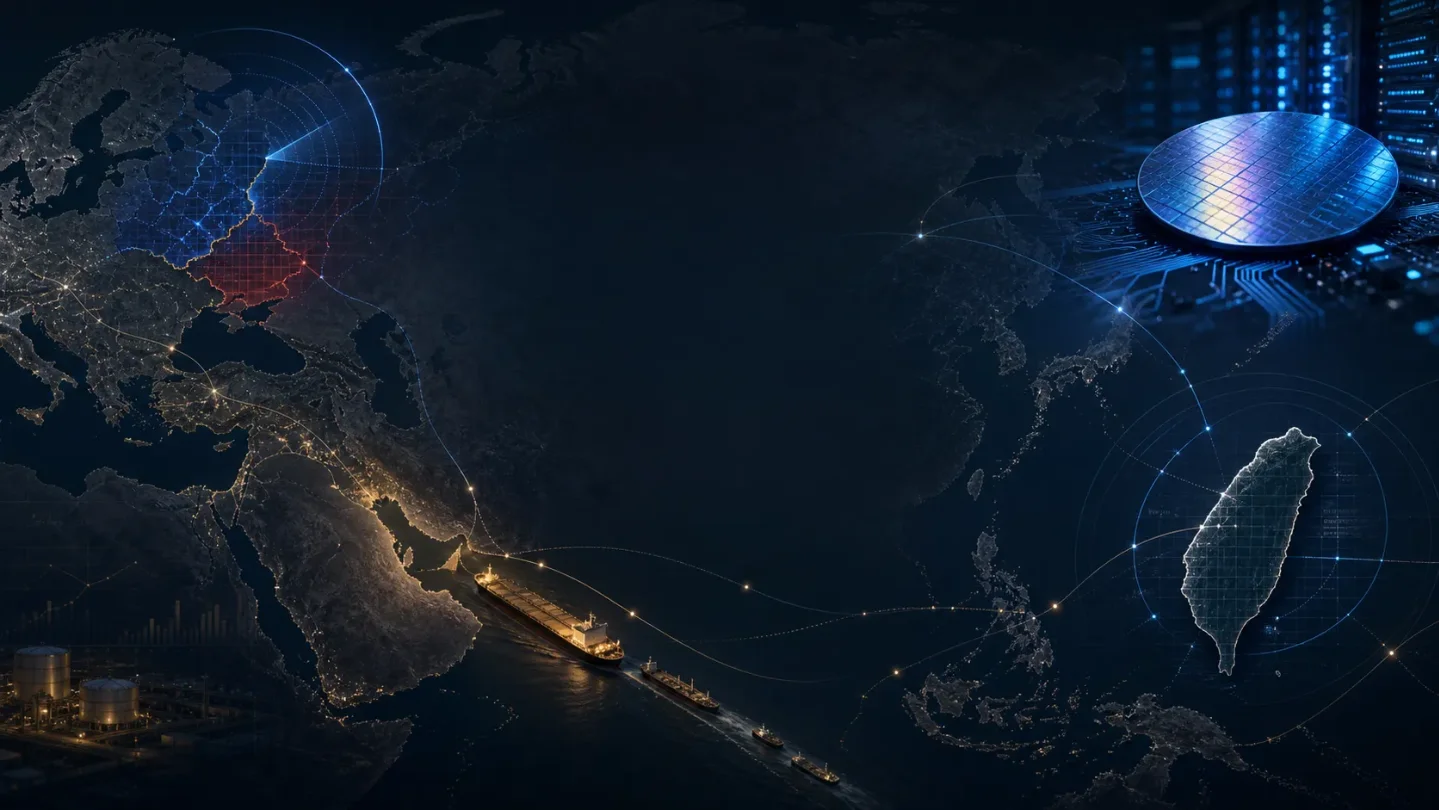
Five developments link a new U.S.-China AI enforcement dispute, Ukraine air-defence diplomacy, two Hormuz and Saudi oil-route risks, and Taiwan's plans for resilient defence production to practical market and supply-chain exposure.

What matters this morning
The strongest commercial signals are about continuity rather than an immediate shutdown. Washington and Beijing are widening an AI enforcement dispute, Oman is testing a governance idea for the Strait of Hormuz, and both Ukraine and Taiwan are asking whether defence production can keep running when transport and industrial nodes are attacked. The Houthi claim against Saudi oil infrastructure is the most important uncertainty in the energy section because Reuters could not independently verify damage.
1. US-China technology: Beijing threatens countermeasures over possible AI probes
- China's commerce ministry accused the United States of "AI hegemonism" and threatened countermeasures after senior U.S. officials said Chinese AI companies could face investigations, sanctions and trade restrictions over alleged theft of U.S. technology. 1
- The dispute concerns model distillation, a technique that can use the output of a more capable model to train another system. U.S. officials said they distinguish legitimate distillation from large-scale extraction that amounts to intellectual-property theft, while Beijing said the allegations lacked factual and legal grounds. 1
- Reuters said the immediate focus was Beijing-based Moonshot AI and its recently released Kimi K3 model, whose coding performance has intensified the argument in Washington over copying versus faster Chinese research. 1
Market and supply-chain impact. No new U.S. measure is reported as already in force, and the article gives no affected-company revenue or share-price figure. The near-term exposure is policy risk around model access, cross-border commercialization and the ability of Chinese AI firms to use U.S. technology; procurement teams should not treat the report as evidence of a new blanket restriction.
2. Russia-Ukraine: Trump and Zelenskiy prepare talks on air defence and production
- U.S. President Donald Trump was due to host Ukrainian President Volodymyr Zelenskiy in Washington on Tuesday, with the White House saying they would discuss the Russia-Ukraine peace process. 2
- Zelenskiy said his top priorities were ballistic-missile defence and strategic cooperation. A Ukrainian source said Kyiv needs U.S. approval to buy Patriot interceptors, while Zelenskiy is also expected to press for a drone agreement. 2
- Zelenskiy is expected to seek permission for Ukraine to produce Patriot interceptors, a commitment Trump made at a NATO summit, but Reuters reported no delivery quantity, contract value or production timetable. 2
Market and supply-chain impact. Patriot access remains an immediate procurement question because the reported request concerns approval to buy interceptors, not a confirmed shipment. Domestic production would be a longer-cycle supply option, but the public record in this report contains no capacity, price or delivery date; defence buyers should separate a political commitment from available inventory.
3. Middle East: Oman proposes a regional mechanism for the Strait of Hormuz
- Oman has presented Iran with a proposal for a joint regional mechanism to manage the Strait of Hormuz, a Gulf source told Reuters; the source said the plan had regional support and would not leave Iran as the sole controller of the waterway. 3
- The proposal is modelled on the Malacca Strait and would use voluntary fees to fund navigation management, environmental protection and search-and-rescue work. The report did not disclose the fee level, participating governments or an implementation date. 3
- The proposal follows a U.S. pause in airstrikes and talks that Trump described as "good"; Iran's foreign minister discussed the strait with his Omani and Saudi counterparts. Before the conflict, Hormuz carried about one-fifth of global energy supplies. 3
Market and supply-chain impact. A workable mechanism could reduce the governance uncertainty that is keeping tanker operators cautious and could support a return of traffic, but this is a proposal rather than an agreement. Because the report provides no implementation terms or restored-flow data, shippers should not price it as a reopening announcement.
4. Middle East: Houthis claim strikes on Saudi crude-transport sites
- Yemen's Iran-aligned Houthis said they targeted sensitive crude-oil supply and transport sites linking eastern Saudi Arabia with Yanbu, the Red Sea export hub. Military spokesperson Yahya Saree said the action responded to what he described as a Saudi drone intrusion into Yemen's airspace. 4
- Saudi Arabia had rerouted crude through its East-West pipeline to Yanbu to bypass Iranian attacks on shipping in the Strait of Hormuz, Reuters reported. Saudi Aramco did not immediately respond to a request for comment. 4
- Reuters reported no independent damage assessment or quantified loss from the claimed Houthi attack. Saudi Arabia said it had carried out airstrikes on Houthi military facilities at Hodeidah and would protect shipping. 4
Market and supply-chain impact. The claim matters because it points to risk against the land-based route being used to bypass Hormuz, but the absence of an independent damage assessment means no throughput loss can be booked. The reported rerouting provides an alternative export path; a confirmed hit would instead raise exposure to crude scheduling, security and insurance costs across both the sea-lane and pipeline network.
5. Taiwan Strait: Han Kuang drills will test dispersed defence production
- Taiwan's defence ministry said its annual Han Kuang war games, scheduled for August 5 to 14, will test moving weapons-production lines and converting civilian factories for military use if China attacks supply hubs. 5
- The exercise will simulate China using a routine military drill as cover for an invasion, then test whether Taiwan can disperse industrial production while maintaining output for its armed forces. The scenario includes attacks on command centres, ports, logistics stations and defence-industry facilities. 5
- Major General Lu Wen-yuan said the exercise will simulate relocating the Taipei-based 202nd Arsenal and mobilising civilian factories for whole-system assembly. Taiwan's navy and coast guard will also practise protecting critical-material shipments, while the island will test deliberately slowing mobile internet during the 10-day drill. 5
Market and supply-chain impact. This is a readiness test, not evidence of a current blockade or production stoppage. It gives manufacturers a concrete checklist for alternate sites, port access, escorted cargo and communications resilience, but the report provides no estimate of relocation capacity or expected trade disruption; the immediate commercial effect is planning work rather than a measured freight or semiconductor shock.
Watchpoints
- Whether the U.S.-China AI dispute produces a named investigation, sanction or trade restriction, rather than a warning of possible action.
- Whether Trump's meeting with Zelenskiy yields approval for Patriot purchases, a drone agreement or a production licence with quantities and dates.
- Whether Iran accepts Oman's Hormuz mechanism and whether any participating governments publish operating rules or fees.
- Whether authorities confirm damage to Saudi crude-transport infrastructure, or whether tanker traffic and export routing change.
- Whether Taiwan's August exercise discloses industrial relocation results, convoy procedures or new restrictions affecting ports and communications.
This brief reflects reporting available by 08:00 on July 28, 2026.
参考ソース
- 1China accuses US of 'AI hegemonism'
- 2Trump to host Netanyahu, Zelenskiy as Ukraine, Iran wars reach critical stages
- 3Oman presented regional mechanism for Hormuz to Iran, source says
- 4Houthis say they targeted Saudi east-west oil transport
- 5Taiwan drills to test relocating arms production under Chinese attack
関連コンテンツ
- ログインするとコメントできます。