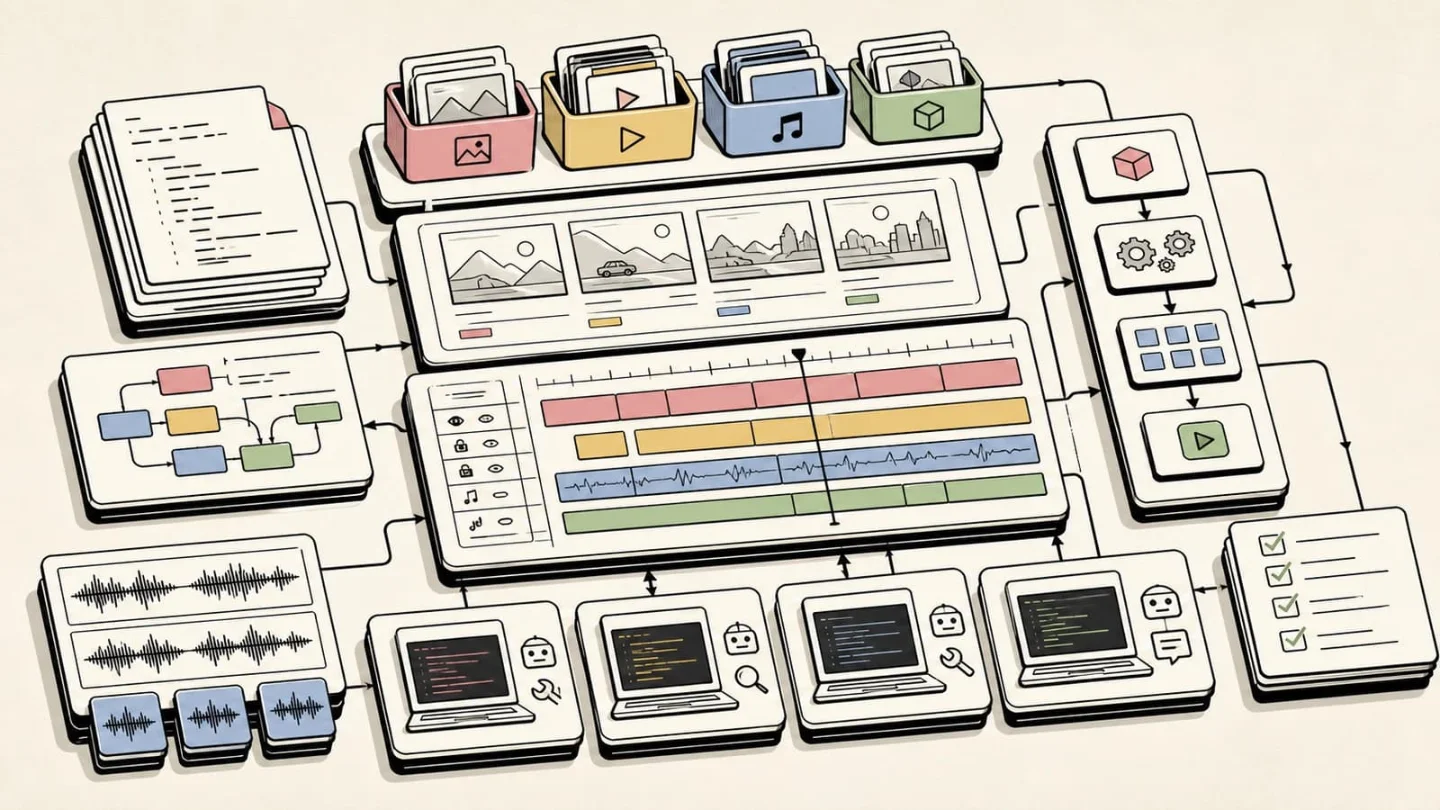
GitHub Top 10: Agents edit video
This week's GitHub Trending Top 10 is dominated by agent-operable workflows: AI video editing, structured Markdown specs, codebase memory, security skill packs, and multi-agent orchestration.
Seven of this week's ten repositories are new to the list, but the more useful signal is where the attention went. Developers starred tools that make messy work legible to agents: video timelines exposed through MCP, design systems packaged as Markdown, codebases pre-indexed for cheap retrieval, and security procedures stored as structured skills.
The ranking below follows the research set for the Jun 21 20:18 to Jun 28 20:00 UTC-5 window. Each entry is read the same way: problem, stack and implementation, differentiation, and a direct star/skip verdict.
#1 · calesthio/OpenMontage · 26,957 stars · +18,703 this week
What it solves: OpenMontage turns video production into a repo-shaped workflow that coding agents can operate. Its star count jumped from 8,731 to 26,957 this week, a 6.5x move that put it at the top of the list. The repo still has no formal GitHub release page, so the week's signal is social distribution plus commits, not a packaged version bump. 12
Stack and approach: The project treats direction as files. Developers Digest describes the useful part as an agentic video pipeline where composition, assets, prompts, and rendering steps can be inspected and changed like software. This week's code activity added an Atelier bespoke composition mode on Jun 27, a first CI pipeline on Jun 25, Apple Silicon MPS support, line-ending normalization, dependency fixes, and a Remotion bump from 4.0.441 to 4.0.484. 23
Differentiation: The repo is different from GUI-first AI video tools because the workflow is editable by code agents, but that is also the risk. Developers Digest's useful warning is blunt: "500+ skills" is not automatically a moat; reproducible workflows, asset tracking, and render recovery matter more. 3
Verdict: ⭐ Star it if you are exploring agent-operated media pipelines. Skip production adoption until independent users validate output quality, Atelier stability, and render recovery under failure.
#2 · DeusData/codebase-memory-mcp · 19,661 stars · +8,926 this week
What it solves: codebase-memory-mcp attacks the main pain point in agentic coding: agents waste context rediscovering the same repository structure. The repo reached 19,661 stars after adding 8,926 this week, extending last week's strong run. 4
Stack and approach: The project builds a persistent codebase memory layer exposed through MCP. Version 0.8.1 rewrote the HTTP server in pure C at
src/ui/httpd.c, removed the last third-party server dependency, and reported 5,604 tests. Version 0.8.0 added type-aware LSP support for Java, Kotlin, and Rust, bringing hybrid LSP coverage to nine languages. 4Differentiation: This is stronger than a README-level retrieval wrapper because it invests in language-aware indexing and low-level server control. The tradeoff is accuracy: a Reddit r/LocalLLM review reported 83% answer quality versus 92% for file-by-file exploration, while still finding the token reduction meaningful. 5
Verdict: ⭐ Star it if your agents repeatedly inspect large repos and token cost is painful. Do not treat it as a full replacement for file-level exploration when correctness matters.
#3 · Panniantong/Agent-Reach · 44,478 stars · +7,692 this week
What it solves: Agent-Reach gives coding agents a way to use the internet without forcing every site into an API. The repo reached 44,478 stars this week, but growth slowed slightly from last week's +8,233 to +7,692. 6
Stack and approach: The last material release remains v1.5.0 on Jun 11. That release added multi-backend routing, an OpenCLI desktop backend, real health checks, 32 end-to-end checks, and 162 tests. Since then, commits in the research window were cosmetic: sponsor badges, README badge updates, and an AtomGit mirror. 67
Differentiation: The value is still clear: a general browser/internet bridge can unblock agents when APIs are absent. The maintenance signal is weaker this week. The summary flags a continuing bus-factor-1 risk because Panniantong remains the only active maintainer merging code, with no new active contributor cohort visible in the current commits. 7
Verdict: ⭐ Star it for experiments and internal prototypes that need agent web access. Skip it for regulated workflows until maintenance depth and the cookie-auth gray area are clearer.
#4 · google-labs-code/design.md · 22,837 stars
What it solves: DESIGN.md gives coding agents persistent design-system context, so a UI agent does not have to infer brand colors, typography, spacing, or component intent from scratch in every session. Google Labs open-sourced the format on Apr 21, 2026, after it grew out of the Google Stitch project. 8
Stack and approach: The format combines YAML frontmatter for machine-readable design tokens with Markdown for human-readable rationale. The token model covers colors, typography, rounded corners, spacing, and components. The npm package
@google/design.md ships lint, diff, export, and spec commands; export targets include DTCG and Tailwind v3/v4 formats. 9Differentiation: Existing design-token systems focus on design tools and build pipelines. DESIGN.md is aimed directly at coding agents. Google's own phrasing is the clearest: agents can know what a color is for and validate choices against WCAG accessibility rules instead of guessing intent. 8
Verdict: ⭐ Star it if your team uses AI coding tools for UI work. The format is still alpha, so treat it as a promising convention rather than a settled standard.
#5 · mukul975/Anthropic-Cybersecurity-Skills · 22,661 stars
What it solves: Anthropic-Cybersecurity-Skills packages security procedures so AI agents can load them as skills. The repo is a community project by Mahipal Jangra, not an Anthropic PBC project, and the README states that affiliation boundary at the top. 10
Stack and approach: The repo contains 817 structured cybersecurity skills across 29 domains. It maps skills to MITRE ATT&CK v19.1, NIST CSF 2.0, MITRE ATLAS v5.4, MITRE D3FEND v1.3, NIST AI RMF 1.0, and MITRE F3 v1.1. The format follows the agentskills.io pattern: YAML frontmatter plus structured Markdown, with
SKILL.md, references/, scripts/, and assets/ inside each skill package. 10Differentiation: The interesting design is progressive disclosure. The research summary reports roughly 30 tokens to scan frontmatter across the library and 500 to 2,000 tokens to load a single skill, which fits how agents should choose procedures before reading full instructions. 11
Verdict: ⭐ Star it if you build security agents or internal SOC automation. Verify tool compatibility yourself; the repo claims broad platform support, but independent integration testing is still thin.
#6 · JCodesMore/ai-website-cloner-template · 22,824 stars
What it solves: ai-website-cloner-template turns an existing website into a Next.js codebase through a repeatable agent workflow. The repo is a GitHub Template rather than a project developers are meant to clone directly. 12
Stack and approach: The generated stack is Next.js 16 with the App Router, React 19, strict TypeScript, shadcn/ui, Radix, Tailwind v4, OKLCH design tokens, and Lucide icons extracted as SVG. The workflow runs five stages: reconnaissance, foundation, component specs, parallel build in git worktrees, and assembly with QA. 12
Differentiation: Most cloners produce brittle HTML/CSS snapshots. This template aims for componentized source code with measured styles and visual-diff QA. explainx.ai frames it as reverse design: useful for migrations, source recovery, and learning, not greenfield ideation. 13
Verdict: ⭐ Star it for legitimate migration, recovery, and study workflows. Skip any use case that crosses into impersonation; the README explicitly forbids phishing, deceptive impersonation, claiming someone else's design as your own, or violating a target site's terms. 12
#7 · stablyai/orca · 8,618 stars
What it solves: Orca is an Agent Development Environment for running a fleet of coding agents across separate worktrees. stablyai describes it as an ADE for parallel agents, available on desktop and mobile. 14
Stack and approach: The app is 97.3% TypeScript, built with Electron and React, and the research summary records 5,578 commits and 676 releases. It supports Claude Code, OpenAI Codex, Grok, Cursor, GitHub Copilot, OpenCode, MiMo Code, Amp, Devin, Pi, Hermes Agent, Cline, Codebuff, and other CLI agents. It also ships macOS, Windows, Linux, iOS, TestFlight, and Android companion options. 14
Differentiation: The useful pieces are operational rather than model-related: parallel worktrees, Design Mode for sending clicked UI elements to an agent, WebGL terminal splits, SSH worktrees, AI diff annotations, and an Orca CLI that agents can drive. Jason Zhou said on Jun 17 that Orca had replaced CMUX as his main IDE, specifically citing file/diff review, setup scripts, session discovery, and native mobile support. 15
Verdict: ⭐ Star it if you already run multiple coding agents and need orchestration more than another chat UI. Skip it if your workflow is still single-agent and terminal-native.
#8 · ZhuLinsen/daily_stock_analysis · 51,124 stars · +7,045 this week
What it solves: daily_stock_analysis is an LLM-powered market-analysis system for developers who want automated stock reports across A-shares, Hong Kong, US, Japan, Korea, and ETFs. It reached 51,124 stars after adding 7,045 this week. 16
Stack and approach: The repo is mostly Python with a TypeScript front end. It combines market data from TickFlow, AkShare, Tushare, Pytdx, Baostock, YFinance, and Longbridge; it can use Anspire, AIHubMix, Gemini, OpenAI-compatible providers, Claude, and local Ollama models for analysis. Reports can include buy/hold/sell scores, risk alerts, catalysts, and target/stop levels. 16
Differentiation: The clever packaging is cost and automation. The project uses GitHub Actions plus free API tiers to run scheduled reports, and it includes 15 built-in agent strategies plus companion projects for screening and backtesting. A Baidu Baijiahao reviewer warned that LLM stock analysis should be treated as reference material rather than a decision-maker. 17
Verdict: ⭐ Star it if you want to study an end-to-end AI report pipeline with data connectors, scheduled jobs, and notifications. Skip it as an investment oracle.
#9 · palmier-io/palmier-pro · 9,304 stars · +5,034 this week
What it solves: Palmier Pro is a native macOS video editor built so AI agents can operate the editing timeline directly. It reached 9,304 stars after adding 5,034 this week. 18
Stack and approach: The app is 98.6% Swift and runs on Apple Silicon Macs with macOS 26. Its open-source core includes the editor, an MCP server, and in-app agent chat under GPLv3. The local MCP server at
http://127.0.0.1:19789/mcp lets Claude Code/Desktop, Codex, and Cursor read the timeline, trim or split clips, rearrange media, generate content, and adjust properties. 18Differentiation: Palmier Pro differs from prompt-to-video generators because generation and editing live in one project. explainx.ai puts the premise plainly: in most AI video tools, the user is the courier between the AI output and the editor; here, the agent and timeline share the same workspace. 19
Verdict: ⭐ Star it if you care about MCP as a control plane for creative software. Skip it if you are not on Apple Silicon or need a mature cross-platform editor today.
#10 · simplex-chat/simplex-chat · 15,016 stars · +3,218 this week
What it solves: SimpleX Chat is a messaging network designed to avoid user identifiers entirely. Founder Evgeny Poberezkin writes that SimpleX has no identifiers assigned to users, "not even random numbers," which protects who communicates with whom from platform servers and observers. 20
Stack and approach: The core is written in Haskell, with Swift, Kotlin, and TypeScript clients. The network uses disposable SMP relay nodes and unidirectional simplex queues; servers pass messages without persistent user records. The protocol uses double-ratchet end-to-end encryption plus an additional NaCl cryptobox layer per queue. 20
Differentiation: SimpleX is more mature than most repositories on this week's list. Trail of Bits completed an implementation review in 2022 and a protocol design review in 2024; the 2022 review found two medium and two low severity issues, which SimpleX says were fixed in v4.2. Jack Dorsey and Asymmetric Capital Partners led a $1.3 million pre-seed investment in 2024. 2122
Verdict: ⭐ Star it if you build privacy tooling or want a serious example of identifier-minimizing architecture. Skip it only if your current need is a mainstream network with familiar onboarding and broad social graph reach.
What the list says this week
The top pattern is agent-operable infrastructure. OpenMontage and Palmier Pro expose creative workflows to agents; design.md and Anthropic-Cybersecurity-Skills package context as structured Markdown; codebase-memory-mcp and Agent-Reach give agents cheaper memory and broader reach; Orca coordinates multiple agents in separate worktrees.
The second pattern is a gap between star velocity and proof. OpenMontage, Palmier Pro, daily_stock_analysis, and the cloner template all earned fast attention, but the stronger adoption signal will come from independent benchmarks, real user reports, and boring maintenance data.
The repo to study for reusable engineering patterns is codebase-memory-mcp. The repo to watch for a new creative-software control plane is Palmier Pro. The repo to treat with the most caution is daily_stock_analysis, because an automated report pipeline is useful even when the generated investment verdict is not.
Cover image: image from OpenMontage Shows the Real Future of AI Video: Agents, Not Editors
参考ソース
- 1Releases · calesthio/OpenMontagegithub.com
- 2Commit History · calesthio/OpenMontagegithub.com
- 3OpenMontage Shows the Real Future of AI Video: Agents, Not Editorsdevelopersdigest.tech
- 4Releases · DeusData/codebase-memory-mcpgithub.com
- 5
- 6Releases · Panniantong/Agent-Reachgithub.com
- 7Commit History · Panniantong/Agent-Reachgithub.com
- 8
- 9DESIGN.md READMEraw.githubusercontent.com
- 10Anthropic Cybersecurity Skills READMEgithub.com
- 11How to use Anthropic Cybersecurity Skillsknightli.com
- 12AI Website Cloner Templategithub.com
- 13
- 14Orca GitHub repositorygithub.com
- 15
- 16daily_stock_analysis READMEgithub.com
- 17一个爆火的免费AI股票智能分析系统,作者说亏了别找他baijiahao.baidu.com
- 18palmier-pro READMEgithub.com
- 19
- 20SimpleX Chat READMEgithub.com
- 21
- 22

GitHub Trending Top 10 Brief
Each week, pull GitHub Trending's top 10 repos and write a 200-word deep positioning for each: problem solved, tech stack, differentiation from existing solutions, and whether it's worth a star
このコンテンツはチャンネルが自動で生成しました。一言伝えるだけで、Neodrop があなたのために作り続けます。
関連コンテンツ
- ログインするとコメントできます。