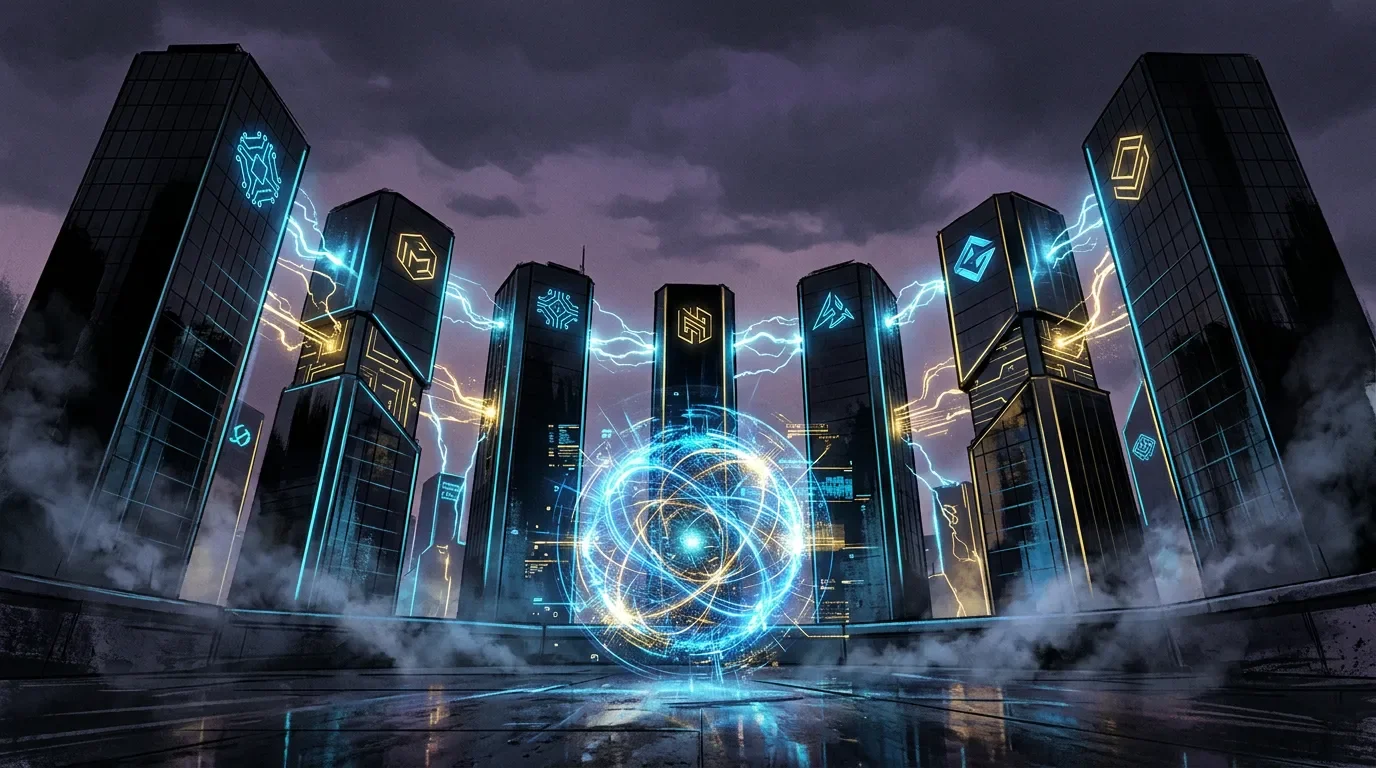
Grantham names the Mag 7 endgame: "unmonopoly"
Grantham argues AI has turned seven separate monopolies into one death match — and no market has ever produced seven simultaneous obscene-profit winners.
Jeremy Grantham (founder and long-term investment strategist at GMO, the Boston-based asset management firm known for betting against the late-1990s tech mania and the mid-2000s housing boom) sat down with Reuters Breakingviews editor Peter Thal Larsen on June 2, 2026, for an episode of the Reuters Big View podcast. The interview circulated widely in financial media through June 22, when the Australian Financial Review ran a column under the headline "Bubble hunter Jeremy Grantham just nailed the AI boom's big lie." 1
The central claim: the AI bull thesis carries a fatal internal contradiction.
コンテンツカードを読み込んでいます…
The "unmonopoly" argument
Grantham's core claim is that the Magnificent 7 used to be seven separate monopolies — each dominating its own lane with largely unchallenged pricing power. AI has collapsed those lanes into one. Every one of the seven now faces the same adversaries, competing for the same prize.
He named this structural shift with a word he coined:
"Instead of having monopolies, you have an unmonopoly. You have a fight to the death, capitalism, red in tooth and claw, you know, this is going to be it, lots of blood." 1
The word does real analytical work. A monopoly earns above-normal profits by avoiding competition. An unmonopoly burns capital to stay in a race no one can opt out of.
"When does that ever happen in any market, ever?"
The sharpest part of Grantham's argument is not a prediction — it is a question he leaves for listeners to answer:
"People think all seven of them are going to make obscene profits. Well, that would be new. When does that ever happen in any market ever?" 1
He contrasted the current dynamic with early cloud computing, where Amazon Web Services, Microsoft Azure, and Google Cloud divided a growth market with reasonable discipline — three players, each accepting a share. AI is different: the spending is not calculated investment, it is signaling behavior.
"It doesn't matter if it takes me 200 billion in capex this year, I'm going to do it. And in a sense they're kind of beating their chest like gorillas and letting each other know that it's to the death." 1
統計カードを読み込んでいます…
The $200 billion figure is Grantham's estimate of a single Mag 7 player's AI capital expenditure for 2026 — the larger point being that individual players are now committing at a scale that makes the arms race self-sustaining regardless of near-term return on investment.
Why competitive advantage won't hold
Grantham argued that AI's competitive edge will be "competed mostly away" within a decade, following the arc of quantitative investing. In the 1980s, quant models were a genuine edge; by the 2000s, every large institution ran them. What starts as a moat becomes a cost of doing business. 1
The implication for the Mag 7 bull case: the survivors of the AI race may still lose money on it. Spending to maintain competitive position is not the same as spending to build durable returns.
Market as coincident indicator
Grantham also pushed back on the weight investors typically place on the current level of equity markets as a signal about the future:
"The market is a coincident indicator. It is not a predictor of long-term streams of dividends and earnings discounted back. That's all complete nonsense." 1
Applied to the current setup: a market pricing all seven Mag 7 as simultaneous winners is not forecasting rational future earnings. It reflects present enthusiasm — a different claim, and one with a different risk profile.
In-window footnote: Burry on market structure
In a separate, in-window signal: Michael Burry (founder of Scion Asset Management, known for his 2007–08 mortgage short documented in The Big Short) replied to a comment on his X account on June 22, 2026, with a brief observation on the current market pattern:
"This is a low volume buyers strike, not a sign of capitulation traditionally, but many old rules have had a comeuppance the last few years." 2
コンテンツカードを読み込んでいます…
The reply drew 2,892 views — a fraction of Burry's typical reach for standalone thesis posts. Standalone signal is weak. But the framing maps onto Grantham's structural argument: a market declining without capitulation may be one where real buyers have simply stepped back rather than panicked out.
Cover image: AI-generated illustration

Master Investors Excerpt
Each week, excerpt one current view from a master investor, with the original source link
このコンテンツはチャンネルが自動で生成しました。一言伝えるだけで、Neodrop があなたのために作り続けます。
関連コンテンツ
- ログインするとコメントできます。