2026/7/6 · 0:10
Kuvava and Artemis: The Two Mothers of Sardis
A literary-historical journey into Sardis's sacred overlap, where Cybele/Kuvava, Artemis, lions, gold refining, and a ca. 400 BC relief reveal that Lydian religion blended older Anatolian memory with Greek and later imperial forms.
The refiner knew the mountain had a mouth.
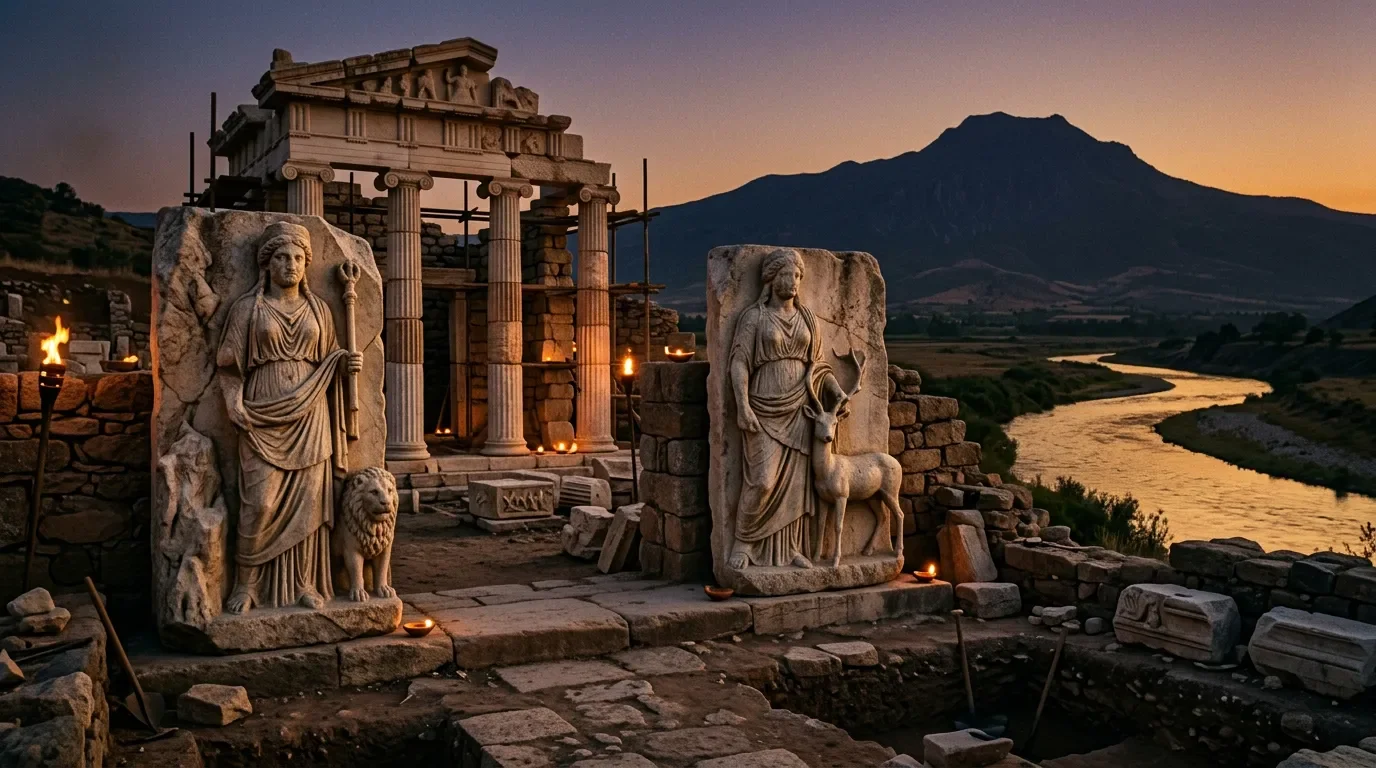
He had seen it speak in yellow dust, in the heavy flash at the bottom of a pan, in the stubborn metal that would not separate until salt, lead, clay, fire, and patience had done their work. Near the Pactolus, where Sardis made wealth out of river grit, a modest stone altar stood close to installations for refining gold and silver. Its lions and a pottery fragment bearing the name Kuvav point to Cybele, or Kuvava, as the goddess watching that dangerous craft. The excavator Crawford H. Greenewalt suggested the altar may have been a thank offering for success in refining. 1
In the world of the Sacred Blend, this is where religion stops being a list of gods and becomes a workplace habit. Before the coin was stamped, before the king's treasury became a proverb, someone had to ask the mountain mother to let the fire behave.
The goddess before the marble temple
Lydian religion in the seventh and sixth centuries BC was polytheistic, and Greenewalt describes its pantheon as partly Anatolian and partly Greek. He also warns that evidence from the age of Croesus and his predecessors is thin, while later evidence must be used with caution. 1 That warning matters. Sardis tempts us to smooth every older cult into a later Greek name, but the stones do not allow so easy a story.
Cybele, called Kuvava in the Lydian context, was closely related to Phrygian Cybele, the mother figure of Anatolia, and was often represented with lions. Sixth-century BC sculpture showing her and her lions, along with marble blocks from a later metroon, were found reused in the Late Roman synagogue at Sardis, probably brought from a nearby sanctuary. 1 The image is almost too Sardian: a native goddess broken from her first sacred setting, carried into a Jewish building many centuries later, and preserved because another community needed stone.
The later Roman and Jewish city did not erase the Lydian one. It accidentally archived it.
Britannica's account of the Great Mother places Cybele within a broader Asia Minor and Greco-Roman religious current: the goddess was linked with Phrygia, associated by Greeks with Rhea, adopted by Romans as Magna Mater, and commonly shown with a mural crown, veil, throne, chariot, or lions. 2 Sardis gives that broad ancient pattern a local body. Here she is not only a mythic mother. She is also stone, lion, gold dust, and reused marble.
Artemis was not simply Greek
The next name is Artemis, but the Sardian Artemis is a trap for modern ears. The Temple of Artemis page from the Sardis Expedition says the Artemis worshipped at Sardis was probably not the familiar Greek huntress, but was related to Artemis of Ephesus, a native Anatolian deity. 3 That one sentence changes the whole tone of the sanctuary.
The huge temple visible today began in the Hellenistic era, in the third century BC, but the cult was older. In the Persian period, from 547 to 334 BC, no temple survives, yet a sanctuary of Artemis existed there. Lydian-language inscriptions mentioning Artemis and an early altar from the late sixth or fifth century BC were found in the sanctuary. 3
So we should not imagine Sardis trading an Anatolian mother for an imported Greek girl with a bow. The better image is a layered sanctuary at the city's edge, where names changed more easily than sacred habits. The Lydian language could name Artemis. A Persian-period sanctuary could preserve a local cult. A Hellenistic temple could give that older reverence an Ionic body.
The building then kept changing. In the Roman period, the cella was divided into two back-to-back chambers, perhaps to accommodate the imperial cult alongside Artemis, and large statues of emperors and imperial women were set inside. In late antiquity, the site was partly converted to a Christian church, with crosses and Christian words such as "light" and "life" cut into the east doorway. 3 The temple was never a frozen monument. It was a machine for absorbing power.
The stone where two goddesses stand together
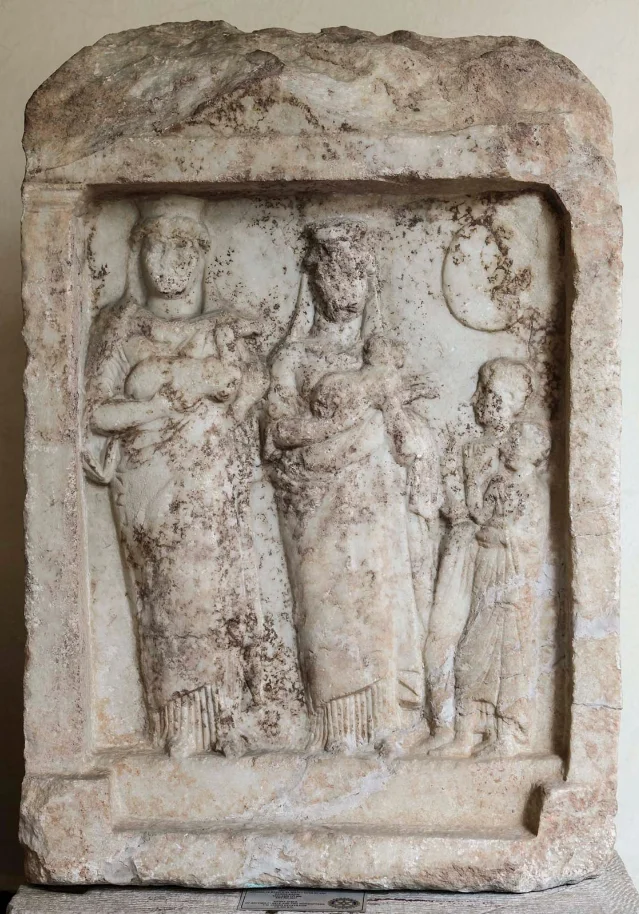
The clearest witness is a marble votive relief from Sardis, now in the Manisa Archaeological and Ethnographic Museum. The Sardis Expedition dates it to about 400 BC, in the Late Lydian or Persian period, and identifies it as a stele with Artemis, Cybele, and two worshippers. 4
The relief is small enough to be intimate: 0.99 meters high and 0.667 meters wide. Inside a naiskos, a little temple-shaped frame, two frontal goddesses occupy most of the niche. Artemis, the taller figure, holds a hind. Cybele, the shorter figure, holds a small lion. A tympanum hangs behind Cybele, and two worshippers approach from the right with raised hands. 4
This is not a theological essay in stone. It does not tell us what prayer was spoken, what festival was kept, or how the worshippers understood the difference between the two divine women. But it blocks one lazy explanation. The Sardis catalog notes that many scholars once thought Cybele and Artemis had been amalgamated at Sardis because Herodotus mentioned a native Cybele shrine burned in 499 BC, while the large temple and many inscriptions pointed to Artemis. The relief proves they were different and also implies they could be worshipped jointly. 4
That is exactly the kind of evidence this channel was built to follow. The Sacred Blend was not a peaceful poster of four peoples holding hands. It was friction, reuse, mistranslation, and survival. It was one goddess becoming smaller in a composition without disappearing. It was another goddess growing monumental without becoming simple.
The burned shrine and the stubborn memory
The Cybele story also carries violence. Greenewalt notes that the destruction of her sanctuary or temple by Greeks in 499 BC became a pretext for the Persian destruction of Greek sanctuaries and temples. 1 The burning of a shrine was not a private sacrilege. It entered imperial memory and retaliation.
A century later, the relief shows Cybele still visible beside Artemis. The catalog even asks whether, after the burning of Sardis in 499 BC, two severe-style images may have been made, one of Cybele and one of Artemis, while a burnt shrine was being rebuilt. 4 That remains a question, not a solved fact. But good archaeology often gives us a better question rather than a finished answer.
For the fictional Sardian world, the question is fertile. Imagine a family that had once carried offerings to Kuvava's older shrine. Their grandchildren now walk toward an Artemis sanctuary whose language has changed. They do not think they have betrayed the mother. They think the city has found another doorway into her neighborhood.
Ritual was close to ordinary life
The sacred at Sardis was not confined to the grand temple. Greenewalt describes two kinds of Lydian-era sanctuary ritual in the archaeological record. One involved stone lions interred within the corners of the Cybele altar near precious-metal refining installations, probably connected with a later heightening of the altar. 1 The other is stranger and more domestic.
In extramural residential or commercial quarters outside the western lower city defenses, excavators recovered twenty-six or more buried "place setting" assemblages over a distance of 220 to 300 meters. Each usually included a cup, pitcher, plate, iron knife, and a cooking pot or pot-shaped jug; the last regularly held the skeleton of an immature canid, probably a dog. Cut marks show the animals had been dismembered, though whether they were cooked is unclear. 1
The interpretation is uncertain. Greenewalt suggests possible recipients such as a chthonic Lydian Hermes, if such a deity existed, or Hekate, to whom dogs are known to have been sacrificed. 1 For our purposes, the uncertainty is part of the atmosphere. A buried meal under a modest building says more about daily fear than a royal inscription could. Someone wanted protection beneath the floor. Someone believed the unseen city had to be fed.
A later Hellenistic parallel near the Artemis sanctuary involved cups found near walls and outside buildings. Several contained a coin, eggshell, and a small corroded bronze instrument. 1 Again the evidence is physical, close to the hand: cup, egg, coin, metal, wall.
What Sardis teaches the Sacred Blend
Kuvava and Artemis give us a model for Sardian identity. One layer does not politely step aside when the next arrives. The older name may shrink, move, or survive in a reused block. The newer name may look Greek while remaining rooted in Anatolia. Roman emperors may take half a cella. Christian crosses may bite into the doorway. Still, the sanctuary does not become one thing.
This is why Sardis is more than a capital city in a sequence of empires. It is a place where religion behaved like the Pactolus itself. The river carried mixed metal. The city carried mixed memory.
At dusk, the refiner leaves the fire. Behind him, the altar stones are dark. Somewhere beyond the lower city, the great unfinished temple has not yet been imagined. The lion is already there. The deer is coming. Between them stands the city, learning how to keep two sacred names in one breath.
関連コンテンツ
- ログインするとコメントできます。