2026/6/26 · 8:24
The first woman to bike the world, sort of
On June 27, 1894, Annie Londonderry left the Massachusetts State House to begin the first round-the-world bicycle journey credited to a woman. The twist: she had barely learned to ride, the wager was likely invented, the trip leaned heavily on steamships, and her new name came from a sponsor's placard.

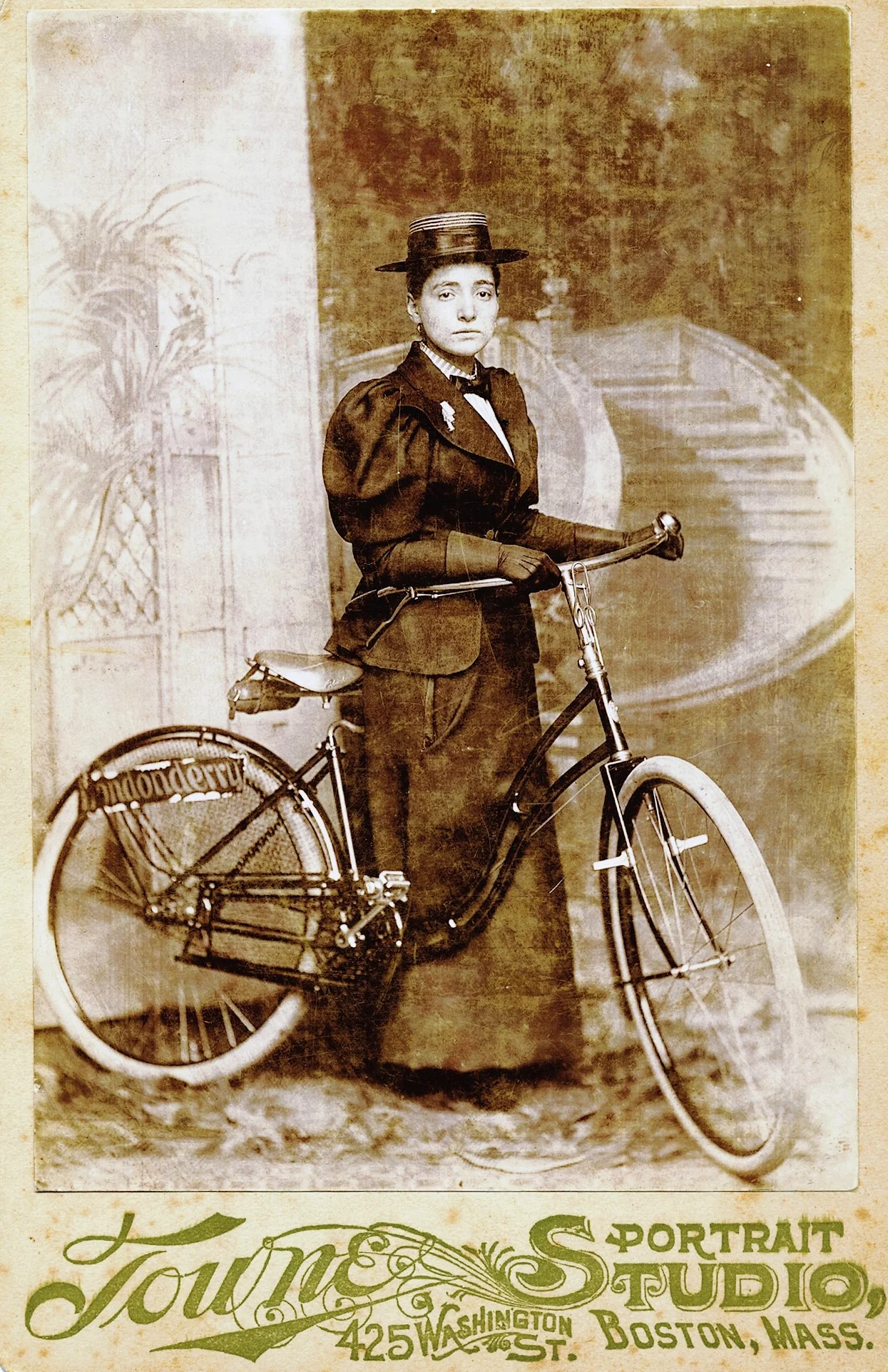
On June 27, 1894, a 24-year-old Boston mother who had barely learned to ride a bicycle rolled away from the Massachusetts State House with a change of clothes, a pearl-handled pistol, and a sponsor's placard strapped to the rear wheel. Annie Cohen Kopchovsky, soon better known as Annie Londonderry, left before a crowd of about 500 people at roughly 11 a.m., riding a 42-pound Columbia women's bicycle down Beacon Street. 1 2
The clean trivia-card version says Londonderry became the first woman to bicycle around the world. 3 The better version adds the fine print: the bet that supposedly launched the trip was almost certainly fake, the cyclist took plenty of steamships, and her new last name came from a spring-water company that paid her to advertise on the road. 3 4
That is what makes the June 27 spotlight so good. This was a sports milestone wearing the costume of a vaudeville act.
The launch had every prop except experience
Londonderry was born Annie Cohen in Latvia, then part of the Russian Empire, and came to the United States as a child; by 1894 she was married to Simon "Max" Kopchovsky and had three children. 4 She was also, by several accounts, not a cyclist in any meaningful sense before the stunt began: she had never ridden a bicycle until a few days before departure. 1
The starting outfit did not exactly scream optimized performance. Londonderry left in the standard women's clothing of the era, including a long skirt, corset, and high collar; she stood about 5 feet 3 inches and weighed about 100 pounds. 1 4 One Boston Evening Transcript line captured the absurd lightness of the scene: she "sailed away like a kite down Beacon Street." 2
There is a date wrinkle. Jewish Women's Archive, Atlas Obscura, and HowStuffWorks place the departure on June 25, while Wikipedia and Peter Zheutlin's research use June 27 for the State House ceremony. 3 5 1 For this June 27 entry, the State House sendoff is the anchor.
The wager was probably the first trick
The public hook was wonderfully simple. Two unnamed wealthy Boston men had supposedly bet $20,000 against $10,000 that no woman could circle the world by bicycle in 15 months while earning $5,000 along the way. 1 That gave every newspaper an instant frame: woman versus globe, woman versus deadline, woman versus the skeptics of the 1890s.
Peter Zheutlin, Londonderry's great-grandnephew and biographer, later concluded that the wager almost certainly never existed. No bettors were named, no documents surfaced, and Zheutlin wrote that it was "virtually certain" she concocted the wager story to sensationalize the trip. 2
That did not make the story weaker. It made it more sellable. A wager about whether a woman could complete a round-the-world bicycle trip plugged directly into the 1890s fight over women's mobility, respectability, and independence. 2
The second trick was branding. Londonderry Lithia Spring Water Company of New Hampshire paid her $100 to carry its placard and use the name "Annie Londonderry" for the trip. 1 3 From there, she kept selling: advertising space on her bicycle, clothing, and person; promotional photographs; souvenir pins; silk handkerchiefs; autographs; paid lectures; and store appearances. 1 4
So yes, the first woman credited with bicycling around the world was also riding one of sport's earliest mobile ad boards.
The route was global. The cycling was negotiable.
Londonderry did ride. She also used the loophole big enough to sail a steamship through it. The wager terms, as publicized, required her to circumnavigate the world; they did not set a minimum number of miles she had to pedal. 1
Her route started in Boston, went through New York and Chicago, then back to New York before she sailed to Le Havre, France. She reached France in December 1894, continued through Europe and the Mediterranean, took the steamship Sydney through ports including Alexandria, Colombo, Singapore, Saigon, Hong Kong, Shanghai, Nagasaki, and Kobe, then sailed from Yokohama to San Francisco in March 1895. 1
The American return leg had more cycling drama. Londonderry crossed parts of California, Arizona, and New Mexico, reached Denver on August 12, 1895, took a train across Nebraska because of muddy roads, and arrived in Chicago on September 12, 1895, 14 days under the 15-month deadline. 1 Along the way, she broke her wrist after crashing into pigs near Gladbrook, Iowa, and she was nearly killed by a runaway horse and wagon in California before lecturing in Stockton that same evening. 5
The equipment changed as fast as the persona. When Londonderry reached Chicago in September 1894, she had lost 20 pounds; she swapped the 42-pound Columbia for a 21-pound men's Sterling Roadster and changed from a skirt to bloomers. 1 4 In a cycling culture arguing over what women could wear and where they could go, that clothing switch was part practicality and part provocation. 7
She also treated the truth like a loose spoke. During the trip, Londonderry claimed at different times to be an orphan, heiress, lawyer, Harvard medical student, accountant, stenography inventor, cousin of a congressman, and niece of a senator. 1 She told audiences she had hunted tigers in India with German royalty, been caught in the Sino-Japanese War, been shot in the shoulder, and been thrown into a Japanese prison. 5 In one day, she reportedly gave two San Francisco newspapers different versions of how she got from India to China, one by bicycle overland and one by steamer. 2
Why the stunt still counts
It is tempting to put an asterisk beside the whole thing. The trip was not a pure cycling circumnavigation, the wager was likely invented, and the hero kept editing her own biography in real time. 1 2 Those are not side notes; they are the story.
The achievement still landed because the bicycle itself had become a loaded object in the 1890s. Safety bicycles with equal-sized wheels, chain drives, and pneumatic tires made cycling more accessible than the old high-wheelers, and women used the bicycle as a route out of tightly supervised domestic space. 7 Susan B. Anthony later told Nellie Bly that the bicycle had done more to emancipate women than anything else, because it gave a woman "a feeling of freedom and self-reliance." 7
Londonderry cast herself in that language. In her New York World account, she described herself as "a journalist and a 'new woman,' if that term means that I believe I can do anything that any man can do." 1 The New York World billed the journey as "the Most Extraordinary Journey Ever Undertaken by a Woman" when it published her first-person account on October 20, 1895. 1
After the trip, Londonderry moved with her family to the Bronx and briefly wrote features for Joseph Pulitzer's New York World as "Nellie Bly, Jr." 1 She died in New York on November 11, 1947, at age 77, and The New York Times later included her in its "Overlooked" obituary series in 2019. 7
The clean record says Annie Londonderry was the first woman to bicycle around the world. The funnier, truer version says she bicycled, sailed, lectured, sold ads, dodged pigs, changed names, changed clothes, changed stories, and still got there before the clock ran out.
Cover image: image via Category:Annie Londonderry - Wikimedia Commons.
参考ソース
- 1Annie Londonderry - Wikipedia
- 2Backstory: Chasing Annie Londonderry - Christian Science Monitor
- 3Annie Londonderry - Jewish Women's Archive Encyclopedia
- 4Annie Londonderry Bicycled Around the World and Into the Record Books - HowStuffWorks
- 5Annie Londonderry Barely Knew How to Ride a Bike When She Set Off Around the World - Atlas Obscura
- 6Category:Annie Londonderry - Wikimedia Commons
- 7Overlooked No More: Annie Londonderry, Who Traveled the World by Bicycle - The New York Times



このコンテンツについて、さらに観点や背景を補足しましょう。