"You cannot light the house": Tagore's fire test for zeal
A close read of Bimala's first rush of Swadeshi feeling in Tagore's The Home and the World: how storm, blood, bonfire, and house-fire metaphors test the line between political energy and destructive excitement.

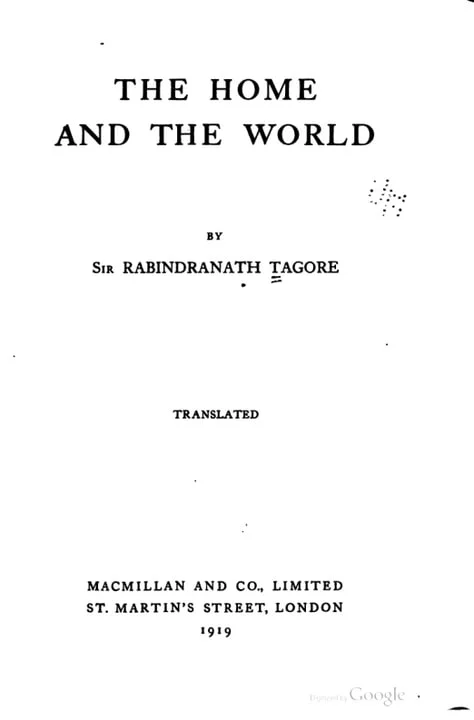
Rabindranath Tagore's The Home and the World puts political passion in a domestic room, then asks what kind of heat it has become. Tagore was born in Calcutta, wrote in Bengali and English, and won the 1913 Nobel Prize in Literature; this novel's English version was translated by Surendranath Tagore and revised by the author for its 1919 Macmillan edition. 1 2
The historical pressure behind the scene is the Swadeshi movement, formally launched in 1905 after the partition of Bengal, which promoted indigenous goods and boycotted British products. 3 Tagore lets that public movement enter Bimala's private language before she quite understands what it is asking of her.
Today's passage
Rabindranath Tagore, The Home and the World, English translation by Surendranath Tagore, revised by the author, London: Macmillan, 1919; Chapter One, Bimala's Story, section III. 2
One day there came the new era of Swadeshi in Bengal; but as to how it happened, we had no distinct vision. There was no gradual slope connecting the past with the present. For that reason, I imagine, the new epoch came in like a flood, breaking down the dykes and sweeping all our prudence and fear before it. We had no time even to think about, or understand, what had happened, or what was about to happen.My sight and my mind, my hopes and my desires, became red with the passion of this new age. Though, up to this time, the walls of the home—which was the ultimate world to my mind—remained unbroken, yet I stood looking over into the distance, and I heard a voice from the far horizon, whose meaning was not perfectly clear to me, but whose call went straight to my heart.From the time my husband had been a college student he had been trying to get the things required by our people produced in our own country. There are plenty of date trees in our district. He tried to invent an apparatus for extracting the juice and boiling it into sugar and treacle. I heard that it was a great success, only it extracted more money than juice.As soon as the Swadeshi storm reached my blood, I said to my husband: "I must burn all my foreign clothes.""Why burn them?" said he. "You need not wear them as long as you please.""As long as I please! Not in this life …""Very well, do not wear them for the rest of your life, then. But why this bonfire business?""Would you thwart me in my resolve?""What I want to say is this: Why not try to build up something? You should not waste even a tenth part of your energies in this destructive excitement.""Such excitement will give us the energy to build.""That is as much as to say, that you cannot light the house unless you set fire to it."
Gloss
- Swadeshi: literally "of one's own country." In this context it means both buying or making indigenous goods and refusing British goods; the movement made everyday objects, including cloth, politically charged. 3
- "The walls of the home": Bimala has been living within the household world of the novel's title. The phrase matters because the passage turns political awakening into a pressure on the boundary between inner life and public life.
- "Bonfire business": Bimala's proposed burning of foreign clothes echoes a real tactic of the movement: Britannica notes that British goods were publicly consigned to bonfires. 3
Close read
The passage works by letting one metaphor correct another. Bimala first experiences history as weather: a "flood" breaks the dykes, a distant voice crosses the horizon, and a "storm" reaches her blood. These images make the movement feel natural, bodily, and almost blameless. A flood does not argue; it arrives. A storm does not ask permission; it enters the nerves.
Nikhil's reply changes the physical model. He does not deny energy. He asks what kind of energy it is. Bimala believes excitement will supply the force to build, but Nikhil shifts from weather to architecture: "you cannot light the house unless you set fire to it." The sentence turns her vocabulary against itself. Light is good; fire can warm, illuminate, and purify. But in a house, fire also destroys the structure that makes shelter possible.
That is the mechanical force of the exchange. Tagore lets the same element, fire, carry two moral weights at once. Bimala hears flame as consecration and resolve. Nikhil hears it as a test of proportion. The question is not whether love of country can burn hot. It is whether heat has become a substitute for making anything that can stand after the blaze.
Reflection question
When have you mistaken intensity for commitment? What would it mean, in that situation, to "build up something" rather than prove sincerity by burning something down?
関連コンテンツ
- ログインするとコメントできます。
More from this channel
- "He simply shrugged": Machado's unbelief without reasons
- "It makes me tired to follow it": Gilman's wallpaper as mental labor
- "Get rid of your helmet": Flaubert's cap as social machinery
- "Forgotten all about the cuckoos": Sei Shōnagon's art of drifting
- "The songs of the slave": Douglass and the sound mistaken for joy
- "What a fine thing for our girls": Austen's market disguised as a maxim
- "Come and sing with me": The Kalevala's invitation to inherited song
- "Paradise enow": Khayyam's argument for the present