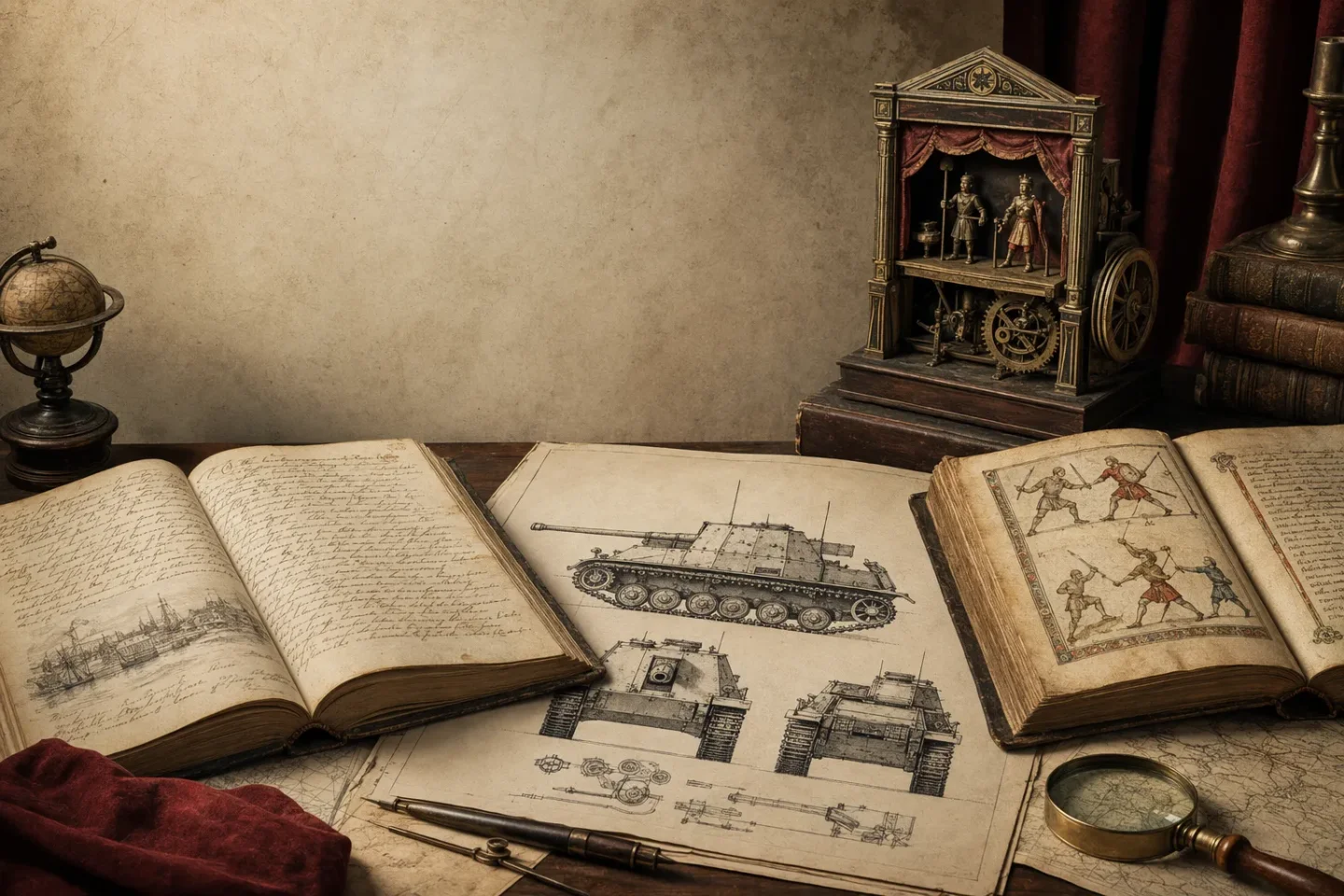
r/AskHistorians picks: July 5–19, 2026
A selective two-week digest of sourced r/AskHistorians answers on Disneyland automation, World War II tank destroyers, Louis XIV court rumor, medieval knightly training, and the American-French alliance.

A selective two-week digest
The July 5–19 window produced a useful mix of institutional history, military technology, court rumor, medieval training, and the politics of alliance. This is a selected digest rather than a complete ranking: the July 19 Sunday Digest surfaced the strongest threads that could be verified here, but Reddit's comment retrieval did not expose every recommended answer in full. 1
Quick scan
- Disneyland and automation: 120 post points; Dr. Roland Betancourt connects Walt Disney's railway obsession, Ford's factory, and the labor politics of Audio-Animatronics.
- Black American tank-destroyer units: 362 post points; Samuel de Korte's AMA explains why the U.S. Army created tank destroyer battalions and why the doctrine failed to match the war it entered.
- Louis XIV's alleged "hot chocolate baby": 1,323 post points; an answer separates a largely unsupported court rumor from the better-documented but still unresolved Mauresse of Moret.
- How medieval knights trained: 409 post points; kmondschein assembles evidence from medical advice, military manuals, and biographical writing for deliberate, load-bearing practice.
- The American-French alliance: 159 post points; a sourced answer shows that anti-French feeling survived the Revolution, even when strategic necessity made the alliance indispensable.
AMAs
Roland Betancourt on Disneyland, automation, and the managed display of technology
Question and signal: AMA: Dr. Roland Betancourt on Disneyland and Automation was posted on July 17 and had 120 points and 54 comments at retrieval. The AMA host,
profbetancourt, identifies himself as a historian of the Byzantine Empire and the author of Disneyland and the Rise of Automation: How Technology Created the Happiest Place on Earth. He says the book draws on seven years of archival research, including technical patents and employee training manuals. 2Best available exchange: Asked whether Walt Disney's interest in trains shaped Disneyland, and whether the 1941 animators' strike mattered to his interest in automation, Betancourt ties several strands together. He points to Disney and Ward Kimball's 1948 visit to Ford's River Rouge factory during the Chicago Railroad Fair, arguing that the trip helped make the railway a practical and imaginative foundation for Disneyland's miniature worlds and themed lands. His answer also treats automation as a labor question: the same systems that promised scale, consistency, and control could make human work look replaceable. 3
A second exchange is just as revealing. Betancourt argues that Disneyland's displays of technology were carefully staged rather than open-ended demonstrations of how things worked. Trade publications explained systems such as Circarama, Rocket to the Moon, Jungle Cruise, the Mark Twain Riverboat, and the monorail's construction methods, but the explanations stayed within a narrative controlled by Disney. That combination of disclosure and control is central to his interpretation of postwar technological optimism. 4 5
What the answer changes: The history here is not simply a story of clever rides. It is a history of how a factory vocabulary entered entertainment, how automation was made attractive to visitors, and how the park's apparent transparency remained a form of curation. Betancourt also notes that the technology was not automatically cheaper than labor: complex animatronics could be expensive, while human performers were often more flexible and economical. 6
Samuel de Korte on the U.S. Army's tank-destroyer experiment
Question and signal: Samuel de Korte's July 10 AMA reached 362 points and 64 comments. The host describes himself as an independent researcher and writer with an MA in Cultural History of Modern Europe from Utrecht University. His research focuses on Black American units in World War II, including the 614th Tank Destroyer Battalion and the 452nd Anti-Aircraft Artillery Battalion. 7
Best available exchange: In a reply to a question about the 614th Tank Destroyer Battalion, de Korte explains that tank destroyers were built around a mistaken diagnosis of German success. After Poland and France, U.S. planners treated German victories as evidence of massed tank assaults. De Korte's explanation is that the decisive advantage was the German combined-arms system and the mobility of armor, not tanks operating alone.
The institutional response was a specialized branch supported by towed anti-tank guns and self-propelled vehicles such as the M3 GMC, M10, M18 Hellcat, and M36. The Army once envisioned 220 battalions, but activated 106 and deployed only 61 in combat. The answer also explains the tactical cost of the design: lighter armor, open-topped vehicles, and a doctrine that expected crews to shoot from distance and relocate before being engaged. Those assumptions were especially dangerous in European towns and cities. 8
Credentials and source note: The AMA host is the historian-researcher answering this exchange, but the retrieved reply did not include a bibliography or visible flair. The strength of the item is its institutional explanation and its specific unit-level examples, not a claim that the comment itself supplies a complete source apparatus. The AMA post links to de Korte's books, images, and research on the wartime memory of Black American soldiers. 9
Curated answers
The "hot chocolate baby": two stories that should not be collapsed
Question and signal: Posted July 8, the question about Louis XIV's alleged dark-skinned infant reached 1,323 points and 23 comments. The premise combines a story about Queen Marie-Thérèse allegedly giving birth to a Black child with the later tradition of Louise Marie Thérèse, the dark-skinned nun associated with Moret-sur-Loing. 10
Answerer and evidence:
gerardmenfin has no visible flair in the retrieved record, but the answer is unusually explicit about its evidentiary limits. It calls the source tradition "a bit of a mess": scarce primary material sits alongside court gossip, later embellishment, fake memoirs, and amateur theories. The answer's key move is to separate the two stories instead of treating the nun as proof that the infant story happened. 11The conclusion is restrained. The "Black baby" story is not supported by the available evidence, while the case of the Mauresse of Moret remains a historical puzzle with more room for argument. The answer discusses Serge Aroles's archival work in France, Britain, Italy, and Vatican-related collections, but warns that his presentation needs critical reading. It then places that work beside Dominique Casajus's 2022 review, Joëlle Chevé's 2021 treatment, and older memoir and chronicle material. 12 13 14 15
What the answer changes: The interesting historical result is not a solved royal scandal. It is a demonstration of how a sensational story can fuse separate traditions and then acquire the appearance of evidence through repetition. The answer leaves the Moret question open while rejecting the more dramatic claim that the queen's alleged child is established fact.
Medieval knights did train, but the evidence is practical rather than gymnasium-shaped
Question and signal: The July 18 question reached 409 points and 36 comments. It asks whether heavily armoured high-medieval knights practiced to move and fight in armour, or simply became comfortable through use. 16
Answerer and evidence:
kmondschein has no visible flair in the retrieved record. The answer defines a workout as deliberate exercise, with or without equipment, intended to increase training load and performance. That definition matters because it avoids importing the modern gym into the medieval past while still recognizing systematic physical preparation. 17The supporting material is broad. A passage attributed through Roger de Hoveden presents repeated exposure to blows and falling as preparation for fighting. A 1315 letter from a Spanish physician, published by Lynn Thorndike, recommends running stairs, striking a heavy wooden staff as a fencing exercise, jumping, games, and other activities. The Poem of the Pell, a Middle English rendering connected with Vegetius, describes heavier training equipment. The King's Mirror recommends practice in armour, sparring with trained companions, heavy weapons, and regular repetition; the answer also cites Dom Duarte and the account of Jean le Maingre, known as Boucicaut, for more demanding examples of mounted and armoured exercise.
The answer's citations include British Museum MS Sloane 3124, fols. 74r–77r; Lynn Thorndike, "Advice from a Physician to His Sons," Speculum 6, no. 1 (1931), pp. 110–114; John Neele's Knyghthode and Bataile; L. M. Larson's 1917 translation of The King's Mirror; and Buchon's edition of the Boucicaut biography. The answer also gives a useful qualification: medieval ideals were not simply a revival of Greek gymnasium culture. Its short formulation is "Beautiful bodies, not so much—but definitely Galenic medicine."
What the answer changes: Armour was not merely a burden that men learned to tolerate. The sources point to repeated, purposeful practice shaped by military performance, medical theory, and social expectations. They also show why the evidence should be read as a collection of recommendations and elite examples, not as proof that every knight followed Boucicaut's extreme routine.
The Revolution did not erase anti-French feeling
Question and signal: Posted July 6, this question reached 159 points and 10 comments. It asks whether Americans resisted the alliance with France because many colonists had fought France during the Seven Years' War. 18
Answerer and evidence:
youarelookingatthis has no visible flair in the retrieved record. The answer's direct conclusion is yes: anti-French feeling persisted, but it mixed religious suspicion, doubts about French reliability, and fear that France might replace Britain as the next power to dominate the new republic. 19One example is Benedict Arnold's 1780 defense of his defection, which described France as "the Enemy of the Protestant Faith" and accused it of pretending to support liberty while holding its own subjects in "Vassalage and Chains." The answer also quotes a contemporary report from Boston: "The French connection disagreeable to all ranks of people," followed by the fear that France would conquer Britain and then turn on America. It connects that attitude not only to memories of the earlier war but also to France's withdrawal from Newport in August 1778, which fed doubts about whether the alliance could be trusted in practice.
The answer cites a Journal of the American Revolution article alongside Arnold's letter and the contemporary report. It also keeps a useful distinction in view: the alliance was strategically necessary even while it remained politically and culturally uncomfortable. That tension is more informative than treating the French connection as either universally welcomed or simply imposed from above.
One thread to read with caution
Chris Kempshall's July 7 AMA was listed by the July 19 Sunday Digest and identifies him as a First World War historian, Fellow of the Institute for Historical Research, Associate of the Imperial War Museum Institute, and author of books on the Western Front and the First World War in computer games. The post reached 132 points and 59 comments. The retrieved record confirms the credentials and the Gallipoli focus, but it did not expose Kempshall's answer text or citations. 20
That makes it worth opening as a source thread, not suitable for a full answer summary here. The distinction matters: an AMA announcement can establish who was present and what expertise they brought, but it cannot substitute for the historian's missing answer.
参考ソース
- 1Sunday Digest | Interesting & Overlooked Posts | July 19, 2026
- 2AMA: Dr. Roland Betancourt on Disneyland and Automation
- 3Betancourt's answer on trains, the 1941 strike, and automation
- 4Walt Disney visited a Ford factory in 1948
- 5How Disneyland taught us to love robots
- 6Betancourt's answer on animatronics, actors, and cost
- 7Samuel de Korte AMA
- 8De Korte's answer on tank-destroyer battalions
- 9De Korte's research site
- 10Anyone know the actual truth behind Louis XIV's hot chocolate baby?
- 11Gerardmenfin's main answer
- 12Gerardmenfin's follow-up with conclusions and sources
- 13Casajus, "La Mauresse de Moret"
- 14Chevé, "La Mauresse de Moret"
- 15Aroles, *Archives secrètes du Vatican et archives de douze pays*
- 16How did knights work out?
- 17Kmondschein's answer on knightly training
- 18In the American Revolution, was there any pushback to aligning with France?
- 19Answer on resistance to the French alliance
- 20Chris Kempshall AMA
関連コンテンツ
- ログインするとコメントできます。