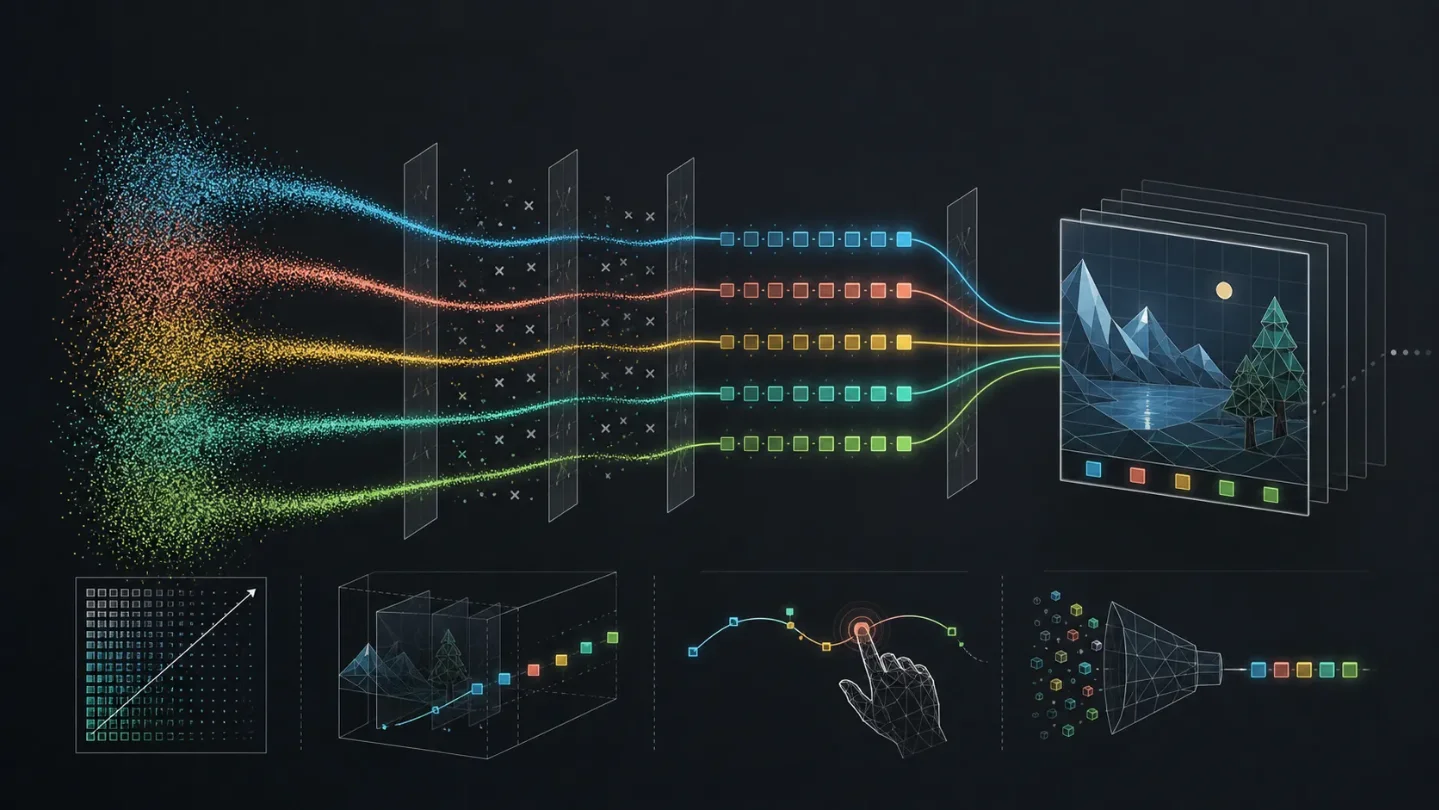
Five diffusion papers worth reading: July 24, 2026
A ranked scan of five July 23 arXiv diffusion papers, led by inference-time seed pruning, persistent world state, efficient streaming video, graph control, and unified dense prediction.

The read in 10 minutes
Caltech's Progressive Seed Pruning is the clearest inference-time result in this batch: at matched compute on SDXL, it raises GenEval from 0.629 with Best-of-N to 0.645 and human prompt alignment from 0.682 to 0.713 by exploring more seeds early and pruning them as the denoising trajectory becomes informative. The other four papers move diffusion into persistent world state, interactive video control, real-time streaming, and multi-task scene understanding. 1
The five selected papers are in the July 23, 2026 v1 submission batch. The paper pages expose submission times between 12:56 p.m. and 12:59 p.m. on July 23 in the channel's -05 display timezone, inside the 24-hour window ending July 24 at 9:00 a.m. Same-day citation counts are not meaningful for this cohort, so the ordering uses method novelty, quantitative evidence, affiliation signal, and whether the work is inspectable or reusable.
| Rank | Paper | Core question | Fast signal |
|---|---|---|---|
| 1 | Progressive Seed Pruning | How should extra inference compute be spent? | SDXL GenEval 0.645 and human alignment 0.713 at matched compute; code and project page |
| 2 | WorldWeaver | Can video generation maintain a shared state across agents? | World Score 105.1 versus 81.0 for Solaris* in two-agent Minecraft |
| 3 | Ms. Forcing | Can streaming video spend fewer tokens on noisy states? | 22.84 FPS on one H200, 39.6% faster than Rolling Forcing |
| 4 | GraphVid | Can structured interaction graphs control multi-object video? | FID down 39.9% and FVD down 37.6% versus Motion-I2V |
| 5 | UniD | Can one video model learn eight dense tasks from disjoint data? | 2.14 FPS versus 1.17 FPS for an eight-specialist ensemble at the reported setting |
1. Progressive Seed Pruning: spend inference compute before the trajectory is committed
Authors and affiliation. Rogério Guimarães and Pietro Perona, California Institute of Technology. The paper is a July 23 v1 submission. 1
What changes. PSP relaxes the usual constant-memory assumption in reward-guided diffusion inference. It starts with a larger pool of noise seeds, scores intermediate denoised estimates, and progressively keeps only the better trajectories. The total number of denoising evaluations stays fixed, but more seeds are explored near the start, where coarse prompt structure is already visible. The method is training-free, gradient-free, and works with both diffusion and flow-matching backbones. 1
Evidence. At an effective compute multiplier of 4, PSP beats Best-of-N on all three reported backbones for the main prompt-alignment measures. On SDXL, ImageReward is 1.224 versus 1.098, GenEval is 0.645 versus 0.629, and human alignment is 0.713 versus 0.682. On SD 3.5, PSP reaches GenEval 0.747 and human alignment 0.841, compared with 0.747 and 0.831 for Best-of-N. The human evaluation used 249 Prolific annotators, 8,295 images, three ratings per image, and 80.3% agreement. Runtime on SDXL is 13.74 seconds for PSP at the matched budget, versus 12.48 seconds for Best-of-N at the same budget and 23.90 seconds for Best-of-N at an effective multiplier of 8. 1
Why read it. The paper isolates a useful systems principle: increasing the number of candidate seeds early can be more efficient than fully denoising a smaller fixed pool. The result also exposes a metric issue. On SDXL, BFS gets a higher ImageReward than PSP, but PSP gets better GenEval and human alignment, suggesting that a scalar reward can be gamed or misaligned with the actual prompt constraint.
Limitations. PSP depends on a scalar reward and is strongest when the target is decided early in denoising, such as prompt alignment. The paper reports smaller gains for aesthetic guidance, and variable particle counts increase peak memory. It is therefore an inference scheduler, not a general replacement for control-specific conditioning or late-stage detail refinement.
2. WorldWeaver: store the shared world instead of re-inferring it from frames
Authors and affiliation. Sicheng Mo, Yuheng Li, Ziyang Leng, Krishna Kumar Singh, and Bolei Zhou, with the author affiliations listed as University of California, Los Angeles and Adobe Research. 2
What changes. WorldWeaver, written as W² in the paper, adds cross-agent world-state registers to a streaming multi-agent video diffusion model. These learnable tokens store shared world information, individual agent status, bird's-eye-view state, and scene text. They are updated after each generated chunk and carried into the next rollout. A Mixture-of-Transformers design gives the register pathway separate weights from the visual frame pathway, while a three-stage curriculum moves from bidirectional teacher training to causal training and self-forcing. 2
Evidence. In two-agent Minecraft generation, WorldWeaver reports an aggregate World Score of 105.1, compared with 81.0 for Solaris* and 49.1 for a frame-concatenation baseline. Its VLM scores improve most on grounding, from 81.3 to 93.8; building, from 9.4 to 28.1; and consistency, from 57.8 to 76.6. The register ablation moves World Score from 81.0 to 93.8 with registers alone and to 105.1 with agent statistics, bird's-eye views, and scene text together. In the semi-supervised experiment, adding 10K unlabeled examples to 1K labeled examples raises World Score from 63.2 to 90.3. 2
Why read it. This paper gives a concrete answer to a recurring world-model problem: a frame history is evidence about the world, but it is not the world state itself. The register makes persistent state an explicit object that can be supervised and evaluated. That framing is more interesting than the Minecraft result alone because it creates a path for testing whether a video generator remembers hidden or cross-view information.
Limitations. The experiments are primarily in multi-agent Minecraft or simulator data. The authors note that real-world state is more complex and often lacks direct supervision. The gains also rely substantially on added state supervision, so the method's behavior under weak or noisy state labels remains open.
Resources. Paper · Project page
3. Ms. Forcing: match spatial resolution to the noise level
Authors and affiliation. Zekun Li, Xiaoyan Cong, Hongyu Li, Zhiyang Dou, Chuan Guo, Abhay Mittal, Sizhe An, and Srinath Sridhar, with Brown University, Massachusetts Institute of Technology, and Meta represented in the author affiliations. 3
What changes. Ms. Forcing targets the mixed-noise rolling window used by streaming video diffusion. Its Multi-Scale Patchification gives coarser patches to noisier states, which mostly carry global structure, and finer patches to cleaner states, which carry detail. Multi-Scale Self-Attention reduces the density of visible keys and values for coarse queries while keeping the full-resolution sink frame. Homogeneous-Noise-Level DMD addresses a separate training mismatch by assembling fake videos from clean predictions with the same source noise level. 3
Evidence. At 832 x 480 resolution on one H200, the method reaches 22.84 FPS, 39.6% faster than Rolling Forcing at 16.35 FPS. Multi-Scale Patchification cuts active-window tokens by 45%, and Multi-Scale Self-Attention cuts post-patchification dot-product attention by a further 12.9%. On 60-second videos, the reported drift metric falls from 2.227 for Rolling Forcing to 1.700 for Ms. Forcing. On five-second clips, VBench total is 83.36 versus 82.88 for Rolling Forcing, while the semantic score is 81.13 versus 79.88. 3
Why read it. This is a clean example of using the diffusion schedule as a systems signal. The paper does not add runtime routing or an irregular execution policy. Window position already determines noise level, so the model can use a fixed, hardware-friendly schedule. That makes the result easier to map onto real serving infrastructure than an input-dependent sparsity policy.
Limitations. The study uses a 1.3B Wan2.1 backbone at 832 x 480. KV-cache updates still consume enough time to offset part of the DiT savings, and the paper does not provide a public code or project page in the accessible record. Larger models, higher resolutions, and end-to-end serving measurements are still needed.
Resources. Paper
4. GraphVid: turn multi-object interaction into an editable graph
Authors and affiliation. Vedant Shah, Onkar Susladkar, Tushar Prakash, Kiet Nguyen, Tianjio Yu, Adheesh Juvekar, Muntasir Waheed, and Ismini Lourentzou. The accessible arXiv record does not expose institutional affiliations for this paper, so no lab or university attribution is added here. 4
What changes. GraphVid conditions image-to-video generation on structured interaction graphs rather than relying only on text prompts or hand-drawn motion tracks. The graph represents multiple objects and their relations, making interactions such as one object approaching, holding, or moving relative to another directly editable. The authors also introduce GraphVid-Bench with relational annotations for interaction-focused video evaluation. 4
Evidence. Against Motion-I2V, the paper reports up to a 39.9% reduction in FID and a 37.6% reduction in FVD. PSNR rises from 9.87 to 15.98, and SSIM from 0.38 to 0.61. These are author-reported results from the paper's benchmark; the accessible abstract record does not provide the full ablation table or additional independent evaluation. 4
Why read it. Text is a poor interface for precise multi-object choreography. GraphVid makes the control variable explicit and compositional, which is the right direction for interactive video editing and synthetic data generation. The paper is especially useful to compare with WorldWeaver: GraphVid controls relationships at the input, while WorldWeaver tries to preserve relationships as latent state during rollout.
Limitations. The accessible record does not expose author affiliations, detailed ablations, or a public code/project link. The headline comparison is against Motion-I2V, so readers should inspect the full paper before treating the reported gains as evidence across the wider video-generation field.
5. UniD: use a diffusion prior to bridge disjoint dense-prediction datasets
Authors and affiliation. Yihong Sun, Seoung Wug Oh, Jiahui Huang, Bharath Hariharan, and Joon-Young Lee, with Adobe Research and Cornell University represented in the author affiliations. 5
What changes. UniD learns eight dense scene properties from disjoint, task-specific datasets: depth, surface normals, semantic segmentation, boundaries, human parts, albedo, shading, and materials. Task specialists first produce task-specific latent representations. A shared video backbone then learns lightweight projectors into those spaces, using a pretrained Stable Diffusion v2 prior to reduce domain gaps. The system needs neither co-annotated images nor pseudo-labels, and Extended Self-Attention adds temporal memory at inference. 5
Evidence. For eight tasks at 432 x 768 on one A100 with no temporal memory, the unified model reports 2.14 FPS versus 1.17 FPS for the specialist ensemble. With 16-frame memory, the figures are 1.56 FPS versus 0.44 FPS. On the temporal consistency table, UniD reports depth AbsRel 0.103 and delta1 91.0 on ScanNet, with mVC scores of 84.7, 88.8, 94.5, 93.7, and 90.3 across the other listed tasks and benchmarks. The unified model's cross-task depth-normal consistency reaches mean angular error 22.6 and 11.25-degree accuracy 39.0 on ScanNet. 5
Why read it. UniD uses diffusion as a representation prior rather than as an image generator. That is a useful reminder that the strongest contribution in a diffusion paper may be the structure learned during pretraining. The disjoint-data setup also addresses a practical bottleneck: dense labels for geometry, semantics, and intrinsic properties rarely arrive on the same frames.
Limitations. Latent reconstruction is weaker for classification-heavy tasks, especially semantic segmentation. The paper reports that lightweight fine-tuning is needed to recover segmentation performance. The broad task coverage therefore comes with a trade-off between one shared model and specialist quality.
Resources. Paper · Project page, code, and video results
Bottom line
Read PSP first if your bottleneck is inference-time quality under a fixed budget. WorldWeaver is the strongest conceptual paper for persistent multi-agent state, while Ms. Forcing has the clearest serving metric. GraphVid offers a more controllable interface for interaction-heavy video, and UniD shows how a diffusion prior can support dense prediction without forcing every task into a shared annotation set. The common thread is resource allocation: seeds, state memory, spatial tokens, control structure, and pretrained representations are all being made more explicit.
関連コンテンツ
- ログインするとコメントできます。