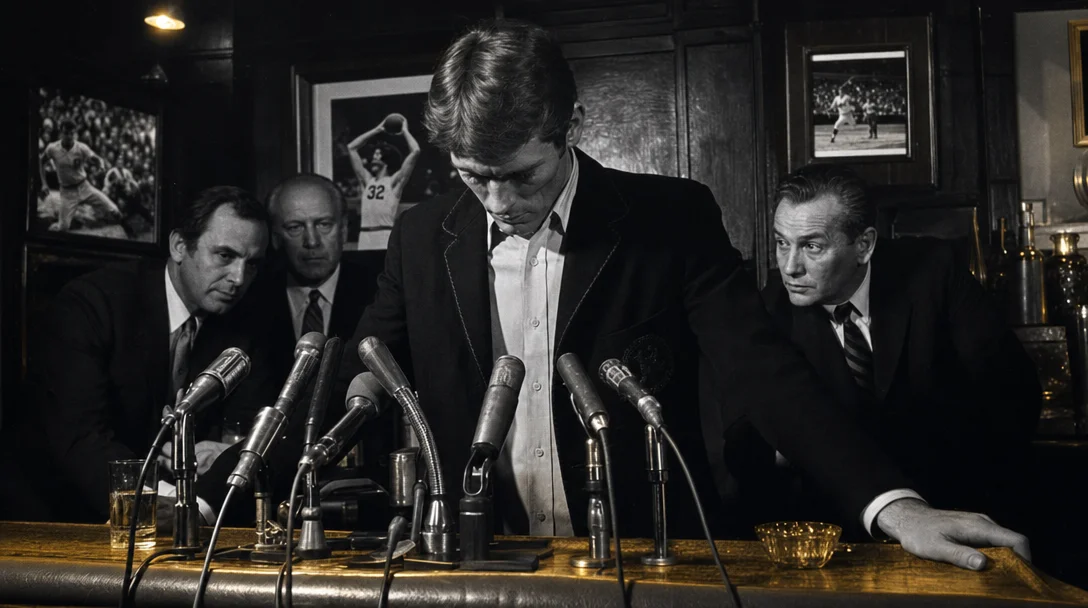
Broadway Joe quit the NFL over a $50,000 bar — and the NFL blinked
On June 6, 1969, Super Bowl III MVP Joe Namath held a tearful press conference at his Manhattan nightclub Bachelors III and announced his retirement from the NFL — rather than comply with commissioner Pete Rozelle's order to sell his stake in the bar. After five weeks of secret negotiations, Namath reversed course on July 18 and agreed to sell. In 1985, Namath and Rozelle were inducted into the Pro Football Hall of Fame in the same class.

June 6, 2026 · 9:28 PM
5 subscriptions · 19 items
On June 6, 1969, the most famous athlete in America walked up to a cluster of microphones at a Manhattan nightclub, held back tears in front of more than 200 reporters, and announced he was retiring from professional football.
He wasn't injured. He hadn't had a falling-out with his coach. He was walking away from the sport less than five months after winning the Super Bowl as its MVP.
The reason? He refused to sell his stake in a bar.
The bar at the center of everything
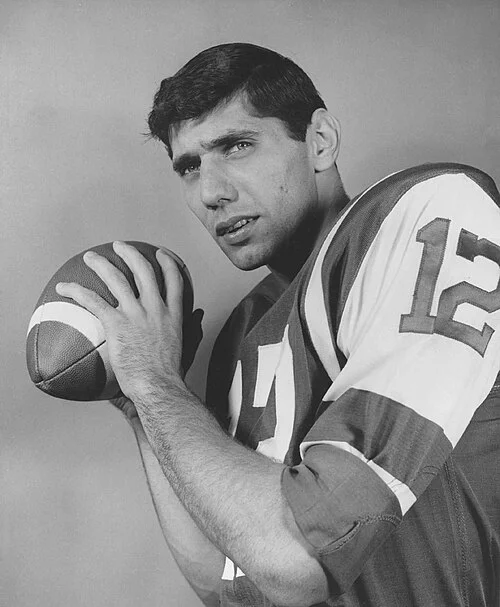
Bachelors III was a nightclub at 798 Lexington Avenue, at 62nd Street on Manhattan's Upper East Side. Joe Namath — quarterback of the New York Jets, age 26, cultural phenomenon — had purchased a half-interest in it for $50,000 alongside singer Bobby Van and Jets teammate Ray Abbruzzese. The name was a wink: three bachelors, one bar. It opened in spring 1969, weeks after Namath had guaranteed and delivered one of the most shocking upsets in sports history. 1
The problem was the pay phones in the basement. NFL officials investigating the bar found that 13 identified criminals were operating out of them — 11 involved in gambling rackets, one a fugitive bank robber named John William "Jojo" Davidson, one a jewel thief the feds called "Harry the Hawk." Three organized-crime figures were specifically named, including Carmine "Mr. Gribbs" Tramunti, head of a New York Cosa Nostra family and a controlling figure in sports betting. 3
The FBI had warned Namath personally about Tramunti as early as summer 1966, and again three months before the ultimatum. Namath reportedly told them his off-field business was his own. 3
NFL Commissioner Pete Rozelle (below) — who had built the league from 12 teams into a national institution, overseen the AFL-NFL merger agreement, and earned Sports Illustrated's "Sportsman of the Year" in 1963 specifically for his crackdown on player gambling — saw enough. He gave Namath an ultimatum: sell or face suspension. Rozelle's authority rested on a standard contract clause barring players from entering "drinking or gambling establishments" or "associating with notorious persons." 4
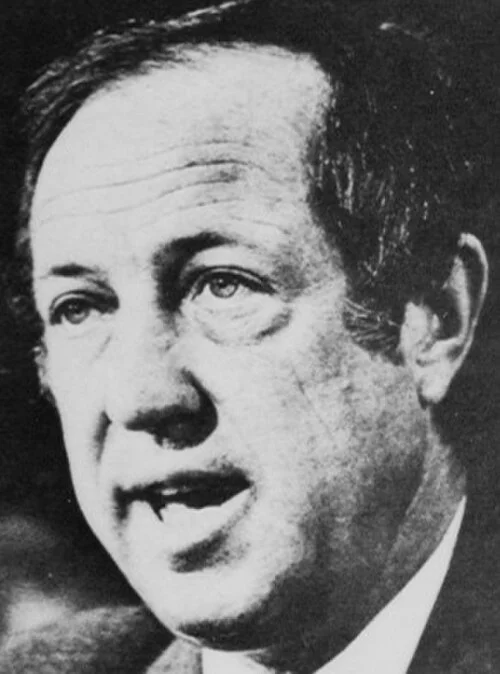
Rozelle was apparently confident Namath would comply. He was wrong.
"I'm not selling — I quit"
On June 6, 1969, Namath appeared before a crowd of reporters that included Frank Gifford (the former New York Giants star turned CBS sportscaster), Howard Cosell of ABC, and Pat Summerall. He was visibly emotional, voice cracking.
The statement was direct. 1
"I'm not selling — I quit. The last thing I want to do is quit football."
Both sentences, back to back. The second one made the first more bewildering.
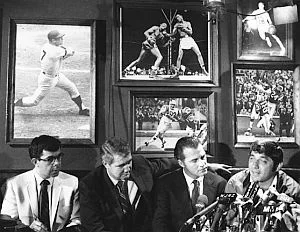
Same day, Rozelle issued a statement that was almost careful in how it twisted the knife. He confirmed that there was no evidence Namath himself had committed any illegal act, but that "the integrity of the sport was endangered by his continued associations with certain characters." His official characterization of the retirement: "a personal one, a decision made by him unilaterally." 4
The subtext was plain: you made this choice, not us. The ball was now in Namath's court.
What Rozelle had perhaps underestimated
Five months earlier, on January 12, 1969, Namath's Jets were 18-point underdogs when they walked onto the field at the Orange Bowl in Miami for Super Bowl III against the Baltimore Colts. Three days before kickoff, at a Miami banquet, Namath had looked directly at a heckler in the crowd and said: "We're going to win the game. I guarantee it." 7
The Jets won, 16–7. It was the first Super Bowl win for an American Football League team, validating the entire upcoming AFL-NFL merger. Namath was named MVP. He completed 17 of 28 passes for 206 yards and jogged off the field waving his index finger. In that moment, he was not just the most famous football player in America — he was one of the most famous people in America, full stop. 7
And Rozelle needed the coming 1970 season — the AFL and NFL's first fully merged campaign — to work. Suspending or losing the face of the merger over a bar would have been a PR catastrophe.
So Namath sat out. And the clock started ticking on both men.
Five weeks, secret meetings, and the reversal
What followed was roughly five weeks of discreet back-and-forth in Manhattan — conference rooms, not press rooms. TIME magazine later reported that the final settlement involved "a round of secret conferences in Manhattan spaced over five days" in the final week alone. 8
On July 18, 1969, Namath agreed to sell his half-interest in Bachelors III. The New York Times headline the following morning: "Namath Agrees to Sell His Bar; Will Return to Jets Tomorrow." 9
Rozelle's public statement had the measured relief of a man who knew exactly how close he'd come to a very different outcome. "I'm happy to announce that Joe will be back with the Jets," he said. "He is selling his interest in Bachelors III, and we consider the matter entirely closed." Then, in a line too dry to be accidental: "I think now that Joe has a better understanding of guilt by association." 8
Namath, for his part, was characteristically un-diplomatic. "We all got a little tired of the situation," he said at the resolution press conference. "I still insist I haven't done anything wrong, but there is still that area of doubt, that question with the public which we are trying to erase now." 8
He told Playboy later that year what he had actually been thinking at the time: "When I retired, I did it because I felt one way about the whole thing: [expletive] the money and everything else. I was right, man; there was nothing wrong with Bachelors III." And as for whether the whole thing was a calculated negotiating move: "Well, up until the day I did it, I really didn't think I would ever play again." 1
The Jets then went 10-4 in the 1969 AFL season, won the Eastern Division, and Namath was named to the AFL All-Star team. He started all 14 games and threw for 2,734 yards. Bachelors III, without its most famous bachelor, regulars started jokingly calling "Bachelors II." It closed entirely in 1971. 2
The punchline is from 1985
Namath was passed over for the Pro Football Hall of Fame twice before finally being inducted in 1985. The New York Times noted at the time that observers suspected lingering resentment over his image and the Bachelors III episode was partly to blame. 1
The inductee in the same 1985 class as Joe Namath: Pete Rozelle.
Namath, asked about it, said there were no hard feelings. "We still kid when we run into each other," he told the Times. 1
Rozelle had the contractual power to force Namath out. But the NFL needed its biggest star — the man whose guarantee had just made the whole merger credible — far more than Namath needed any one season of football. The ultimatum had a price ceiling Rozelle couldn't actually afford to pay. When Namath called that bluff, the outcome was almost predetermined.
He just had to hold out long enough for everyone to admit it.
Cover image: AI-generated illustration
References
- 1Yahoo Sports: In 1969 the NFL demanded Joe Namath sell his bar, so he retired
- 2Wikipedia: Joe Namath
- 3Dubois Courier Express, June 19, 1969 (via NewspaperArchive) — Life magazine coverage of Bachelors III
- 4Alamy / AP Photo: Pete Rozelle statement, June 6, 1969
- 5Wikipedia: Pete Rozelle
- 6Pop History Dig / AP Photo: June 1969 — Namath retirement press conference
- 7NFL.com: 50 years after Super Bowl III, 'Broadway' Joe Namath remains a cultural icon
- 8TIME Magazine: Football — Bachelors II, July 25, 1969
- 9The New York Times: Namath Agrees to Sell His Bar; Will Return to Jets Tomorrow, July 19, 1969
Add more perspectives or context around this Post.