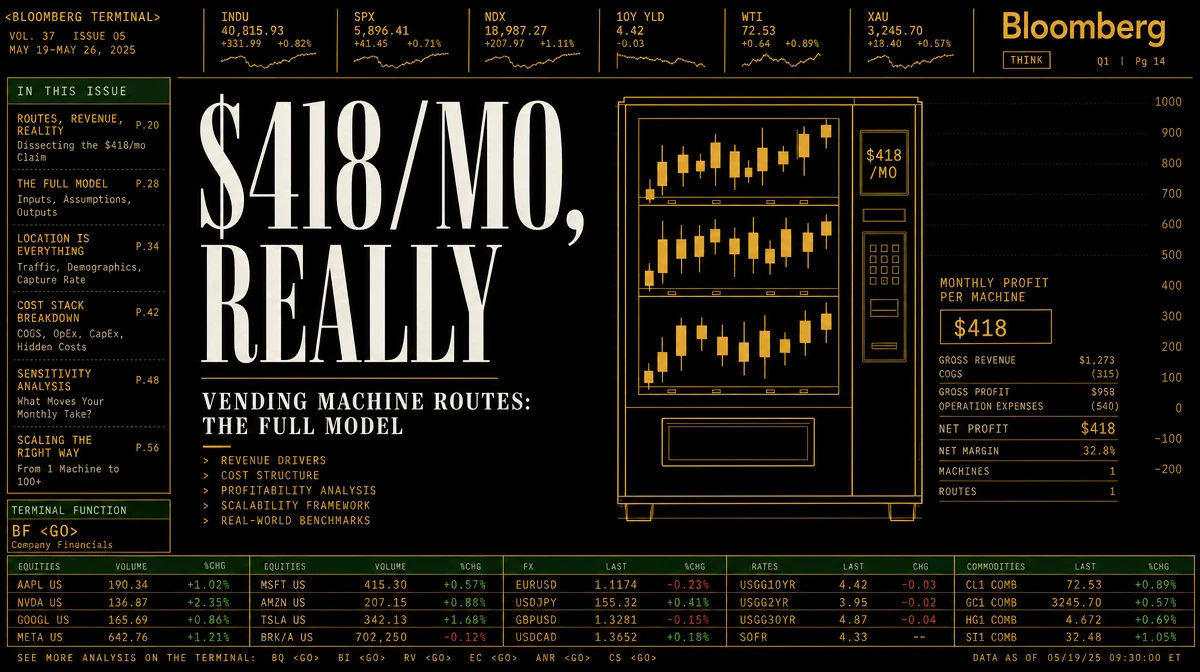
$418/Mo, Really — Vending Machine Routes: The Full Model

$418/Mo, Really — Vending Machine Routes: The Full Model

A no-hype deep-dive into the real economics of owning a snack-and-beverage vending route: verified startup costs, a full 28-machine P&L, location tier benchmarks, time commitment, and the single mistake that kills most new operators.

Boring Business CashFlows
June 10, 2026 · 8:20 PM
1 subscriptions · 1 items

Issue #1 — Vending Machine Routes

This week's asset: Snack and beverage vending routes — the unglamorous cash-flow machine that has been quietly minting small operators since the 1960s. Not passive. Definitely not sexy. Potentially worth your time, if the numbers hold up.
They do — under specific conditions. Below is the full model.

The capital requirement

There are two ways in: build from scratch or buy an existing route.
Building from scratch means buying machines one or a few at a time, then hunting for locations yourself. A new snack-and-beverage combo unit runs $3,500–$8,500; a refurbished 2019–2023 machine runs $2,800–$4,800. Add a cashless card reader ($349–$429 per machine), remote telemetry ($8–$12/month/machine), and a security camera ($99–$128 per site), and you're looking at $6,000–$12,000 per placed machine, all-in.1 Ten machines = $60k–$120k, before product inventory.
Buying an existing route is a faster path for most people. The national average asking price is roughly 70–100% of gross annual revenue, or 2.2–3.1× trailing 12-month net profit.2 BizBuySell's current median asking price for a vending business is $135,000.3 The difference from scratch-build: you're buying verified cash flow and signed location contracts, not machines sitting in a storage unit while you cold-call break rooms.
For a first-time buyer, buying a 20–30 machine route with seller financing (50–70% carried by the seller at 6–9%) is the most common entry structure. Your cash out of pocket can be as low as $25,000–$50,000 on a $120,000–$150,000 deal.1

The monthly cash flow model

Here's an honest P&L for a 28-machine route in the Midwest — real operator data from 2025, primarily serving auto parts factories and distribution warehouses.1
Loading chart…
Line itemMonthlyAnnual
Gross revenue$12,800$153,600
COGS — product (Vistar)−$5,600−$67,200
Location commissions (15% avg)−$1,920−$23,040
Card processing + telemetry−$658−$7,896
Gas + vehicle−$650−$7,800
Repairs + maintenance−$350−$4,200
Net profit (pre-tax)$3,622$43,464
That's a 28% net margin on $457/machine/month gross — in line with industry ranges of 20–35%.4 Notice what the gross-revenue cheerleaders leave out: COGS alone consumes 44% of revenue before you touch a single operating cost.
The range across location types is wide:
Loading stats card…
The difference between an S-tier and a C-tier machine can be $800–$1,800/month — from the same equipment. Location is not one factor among many. It is the factor.14
Stated assumptions for all estimates above: machines are cashless-enabled, serviced on a data-driven schedule (not fixed calendar), placed in contracted locations with 12+ months of verified transaction history, and include a Nayax/Cantaloupe telemetry subscription. Remove any one of those conditions and the numbers compress.
These are estimated ranges, not guarantees. This is not investment advice.

Time commitment — the honest version

The phrase "passive income" gets attached to vending constantly. It's not quite a lie, but it's mostly a lie.
At 10–15 machines, expect 6–10 hours per week: restocking runs, one emergency repair per month, bookkeeping, supplier ordering. Driving eats most of this. The machines don't call you, but the route still needs physical presence every 1–2 weeks per machine.
At 50 machines, most operators work 12–20 hours per week — less per machine due to pre-kitting and route optimization, but more total.1 At this scale, the business starts to feel like a part-time logistics job, not a portfolio asset.
At 100 machines, the documented operator weekly cycle looks like this:1
DayTaskHours
MondayPre-kitting at home + wholesale run2.5
TuesdayRoute 1 — factories4.0
WednesdayRoute 2 — warehouses, apartments4.0
ThursdayRoute 3 — mixed + emergency fills2.5
FridayBookkeeping, commissions, ordering1.0
Total14 hrs/week
Fourteen hours for $200k–$300k annual net isn't bad. It's also not passive. And it requires the route to be geographically dense — if your 50 locations are spread across 80 miles, those four-hour days become eight-hour days.

The operational reality nobody puts in the highlight reel

Machine failures are frequent and annoying.
Vending machine profit factors: location, product mix, and technology impact on monthly net
Profit drivers across a typical vending operation — location quality accounts for up to 70% of revenue potential. 5
Motor jams, bill validators eating cash, refrigeration units failing in summer. Annual maintenance per machine runs $100–$300 in normal years, plus $50–$200 per service call for anything beyond routine.5 Breakdowns don't care about your schedule. A 500-person factory with a jammed machine on a Monday morning generates phone calls.
Theft and vandalism exist. Industry 2025 data puts it under 1.5% of revenue for equipped operators — meaning $99 Wi-Fi cameras and GPS trackers are standard equipment, not optional.1 Without cameras: one vandalized machine in a bad location can eat 3 months of net profit from that site.
Product expires. Healthy and premium SKUs have shorter shelf lives. Overstocking a slow machine means you're throwing money in the trash — literally.
Location relationships require maintenance. Plant managers change. Leases expire. A building with 400 employees can lose its contract six months after you place two machines there, leaving you with equipment in a warehouse and no revenue. Good operators document every location contract and renegotiate proactively.
Driving is the hidden cost. Gas runs $500–$800/month at 20–30 machines if your route is geographically spread out. Every service trip is time you're not doing something else. Route density — machines clustered within a 20–30 mile radius — is almost as important as location tier.

The #1 way operators lose money

They buy machines before they have signed location contracts.
This single mistake accounts for 31% of vending business failures, with average financial damage of $28,000–$110,000.1 The sequence matters: you find the location, get a signed agreement, then buy or deploy the machine. Reversing it leaves you with equipment depreciating in your garage while you spend months trying to convince factory managers to let you in.
When buying an existing route, the equivalent mistake is trusting the seller's revenue numbers without verifying them yourself. The standard due diligence is not optional: ride along for three full service days and count the money collected in person; pull 12 months of raw telemetry data directly from Nayax or Cantaloupe; call 8–10 of the listed locations posing as a vendor. The seller says machines average $1,400/month? Verify it before you wire $250,000.
Never pay more than 2.9× trailing 12-month net without a specific, documented justification (locked 5-year contracts, recently upgraded machines with warranties, a single S-tier anchor location with ten years of history). Routes priced above 3.2× net are almost always priced for a seller's optimism, not yours.

Who this actually works for

This is not a business for someone who wants to deploy capital and check a dashboard once a month. It's a business for someone who wants to build a small logistics operation — gradually, methodically, with their hands involved — and extract steady, inflation-resistant cash flow from it over years.
It works well for: people with a van and flexible weekday time, people within 30 miles of industrial zones, people who are good at systems (pre-kitting, scheduling, supplier relationships), and people willing to start with an existing route rather than scratch-building.
It works poorly for: people who romanticize "passive income," people who need immediate liquidity (payback is 12–24 months minimum), and anyone whose first move is buying machines without locations lined up.
The cash flow is real. The "passive" part is not.

Next issue: laundromats — the coin-operated asset that looks like a simple cash register and turns out to be a real estate play in disguise.

Add more perspectives or context around this Post.

  • Sign in to comment.