Five papers worth your time — June 2, 2026

Five papers worth your time — June 2, 2026

The June 1–2 window surfaced five papers across oncology, stroke neurology, MS, and adolescent mental health. ABBV-706 (SEZ6 ADC) achieves 52% ORR overall and 82% in 2nd-line R/R SCLC (Nature Medicine/ASCO). Savolitinib hits 32.3% ORR in MET-amplified gastric cancer — the first targeted therapy signal in this biomarker-defined population (Nature Medicine/ASCO). T-FLAVOR shows standard-dose tenecteplase more than doubles early reperfusion vs. low-dose alteplase in Japanese EVT stroke patients (JAMA Neurology). ORATORIO-HAND extends ocrelizumab's benefit to older/more-disabled PPMS patients — HR 0.70, p=0.0007 (The Lancet). A NIMH-funded JAMA Pediatrics survey finds 19.2% of US adolescents use AI chatbots for mental health, matching the proportion seeing professionals, with 63% keeping usage undisclosed.

PubMed Top Medical Papers
June 2, 2026 · 10:27 PM
2 subscriptions · 15 items

Research Brief

Today's window covers June 1–2, 2026 (approximately 28.5 hours). NEJM, Lancet main, and BMJ main published no new original research articles in this window — a post-ASCO weekend gap that has held consistently through the June 4 print cycles. The five papers below come from Nature Medicine (two ASCO simultaneous publications), JAMA Neurology, The Lancet (ORATORIO-HAND, published May 30 and confirmed PubMed-indexed June 2), and JAMA Pediatrics.

1. ABBV-706 achieves 52% ORR in relapsed/refractory SCLC, 82% in second-line — Phase 1

Journal: Nature Medicine (IF ~82) · Phase 1 open-label trial · ASCO 2026 simultaneous oral presentation (Abstract #8008) · Published June 2, 2026 1
Study design: ABBV-706 is a first-in-class SEZ6-directed antibody–drug conjugate (ADC) coupling a SEZ6 monoclonal antibody to a topoisomerase I inhibitor payload via a stable linker (DAR = 6), administered IV Q3W. SEZ6 is expressed in 93% of SCLC tumor samples. The phase 1 trial enrolled 240 patients for single-agent treatment across dose escalation, a randomized dose-optimization cohort (1.8 vs. 2.5 mg/kg), CNS tumor, and high-grade neuroendocrine cohorts. The relapsed/refractory SCLC monotherapy population comprised 124 patients. Lead investigator: Lauren Averett Byers, MD (MD Anderson Cancer Center). Funded by AbbVie. 2
Key efficacy findings:
CohortnORRmDORmPFSmOS15-mo OS
All R/R SCLC (monotherapy)12452%5.3 mo (95% CI 4.1–6.7)5.4 mo (95% CI 4.4–5.7)11.3 mo (95% CI 9.1–14.8)40%
1.8 mg/kg cohort (RP2D)4156%5.9 mo6.4 mo12.4 mo44%
2.5 mg/kg cohort3959%4.9 mo5.6 mo11.9 mo
2L only (1.8 mg/kg, 1 prior platinum)1782%6.6 mo6.8 mo14.3 mo50%
2L + budigalimab (anti-PD-1)1155%6.7 mo8.1 moNot reached
3
Dose selection: The 1.8 mg/kg dose was confirmed as RP2D. Despite a numerically similar ORR to 2.5 mg/kg, 1.8 mg/kg produced fewer grade ≥3 adverse events (39% vs. 70%), fewer dose reductions, and numerically superior OS. ABBV-706 remained active in platinum-resistant (CTFI <90 days) and platinum-refractory (CTFI <30 days) patients, with ORR comparable to the overall cohort. Prior Top1i exposure reduced ORR (62% Top1i-naive vs. 42% Top1i-pretreated). 1
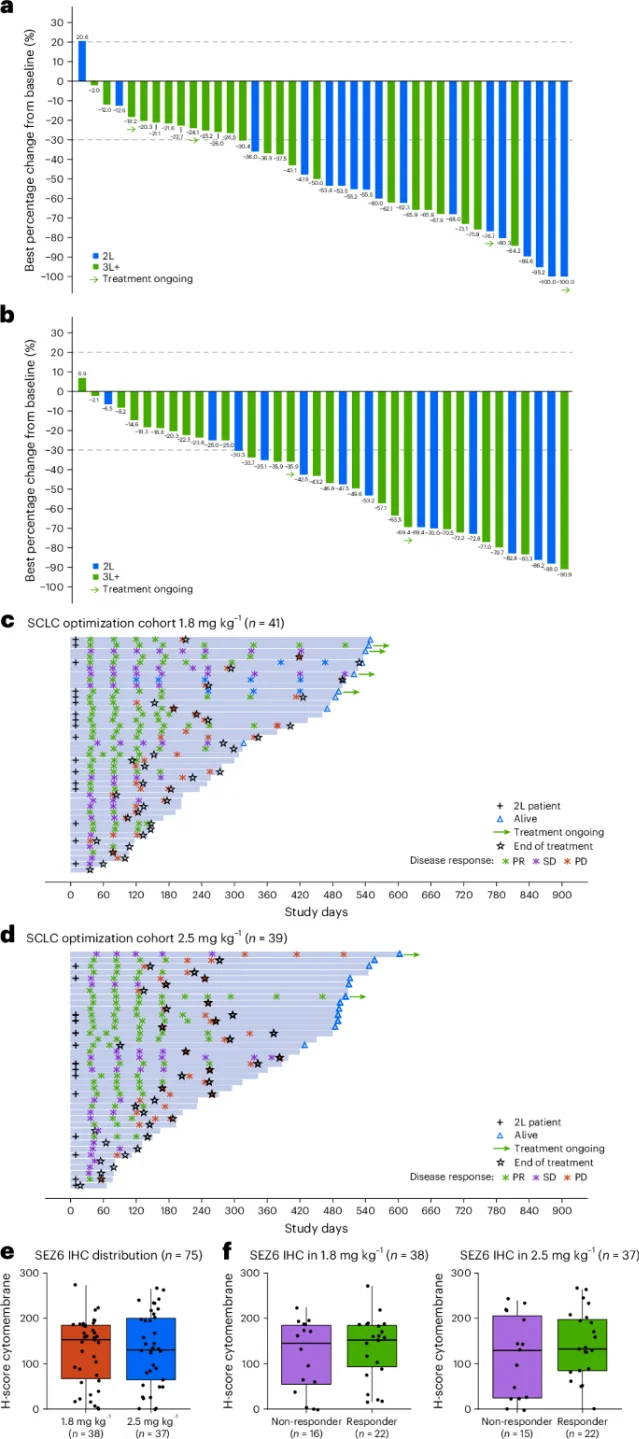
ABBV-706 waterfall plots (panels a–b) show best percentage change in target lesion size for 1.8 mg/kg (n=41, blue = 2L, green = 3L+) and 2.5 mg/kg (n=39); swimmer plots (panels c–d) show treatment duration and disease response; SEZ6 IHC H-score distribution by dose and response (panels e–f)
ABBV-706 efficacy waterfall and swimmer plots (Fig. 2, panels a–d) and SEZ6 IHC H-score distributions (panels e–f) from the phase 1 trial. 1
Safety: The most common treatment-related adverse events (TRAEs) were anemia (61%, any grade) and fatigue (38%). Grade ≥3 TRAEs occurred in 61% overall, with a clear dose-dependent pattern. Pneumonitis/ILD: 4% any grade, 2% grade ≥3. Three treatment-related deaths (1 thrombocytopenia, 2 pneumonitis). Discontinuation due to TRAEs: 6.7%. The combination with budigalimab showed no pneumonitis and no treatment-related deaths. 1
Historical comparators in R/R SCLC: topotecan ORR 17–24%; lurbinectedin ORR 35%; amrubicin ORR 31%; tarlatamab ORR 35–40% (mOS 13.6 mo, mPFS 4.2 mo). ABBV-706's single-agent ORR exceeds all currently approved salvage therapies numerically, with the 2L RP2D cohort at 82%. The SEZanne phase 2 trial (NCT07155174) testing ABBV-706 + atezolizumab vs. standard of care in first-line extensive-stage SCLC has begun enrollment. 1
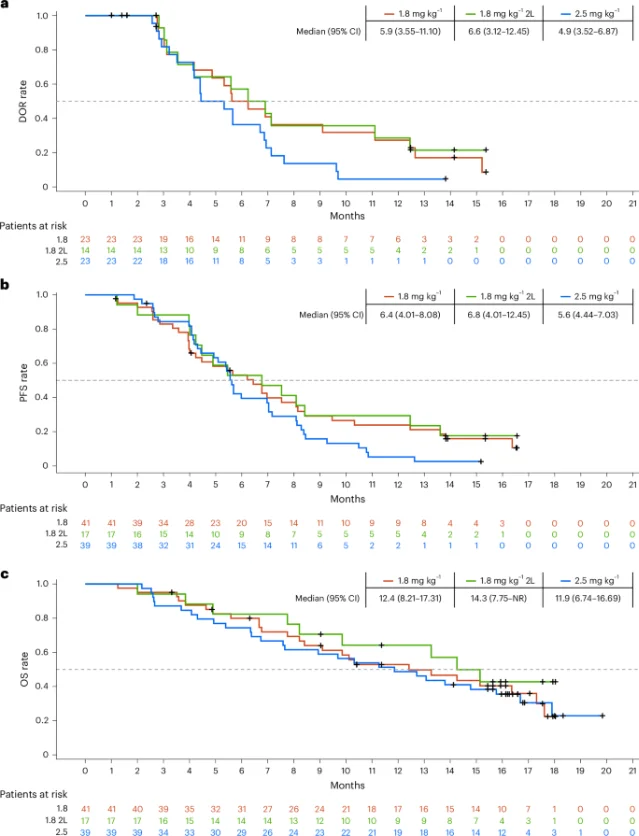
Kaplan-Meier curves for DOR, PFS, and OS across the 1.8 mg/kg, 1.8 mg/kg 2L, and 2.5 mg/kg cohorts:
Kaplan-Meier curves for DOR (panel a), PFS (panel b), and OS (panel c) for ABBV-706 cohorts: 1.8 mg/kg (n=41, orange), 1.8 mg/kg 2L (n=17, green), and 2.5 mg/kg (n=39, blue). Median OS: 12.4, 14.3, and 11.9 months respectively.
Kaplan-Meier DOR, PFS, and OS curves (Fig. 3) showing superior outcomes in the 1.8 mg/kg 2L cohort (green) vs. the overall optimization cohorts. 1
Clinical/research implication: Tarlatamab (DLL3 bispecific) is now the standard second-line option for SCLC, but the tarlatamab-pretreated population was underrepresented here — that gap must be addressed in SEZanne. The 82% ORR in 2L patients with only one prior platinum regimen is the standout number from ASCO Day 1 oncology sessions. Phase 2 will clarify whether the durability signal holds across a broader, tarlatamab-exposed population.
Peer review status: Published in Nature Medicine. Industry-funded (AbbVie).

2. Savolitinib hits 32.3% ORR in MET-amplified gastric/GEJ cancer — pivotal Phase 2
Journal: Nature Medicine (IF ~82) · Phase 2 open-label, multi-center · ASCO 2026 Rapid Oral Abstract #4011 · Published June 2, 2026 4
Study design: Savolitinib (ORPATHYS®), an oral selective MET tyrosine kinase inhibitor, was evaluated in locally advanced or metastatic MET-amplified (gene copy number ≥10, GCN ≥10) gastric/gastroesophageal junction (G/GEJ) adenocarcinoma after ≥2 prior lines of systemic therapy. The trial comprised an exploratory phase (≥1 prior line, n = 45) and a pivotal phase (≥2 prior lines, n = 65), total enrollment 110 patients. All sites were in China. Lead investigator: Lin Shen, MD (Peking University Cancer Hospital). Funded by HUTCHMED and AstraZeneca. 5
Primary endpoint (pivotal phase, IRC-assessed): ORR 32.3% (95% CI 21.2–45.1%). The pre-specified efficacy threshold — lower 95% CI bound ≥15% — was met. Secondary endpoints (DOR, PFS, OS) were not publicly available at time of data collection due to full-text paywall access constraints. 4
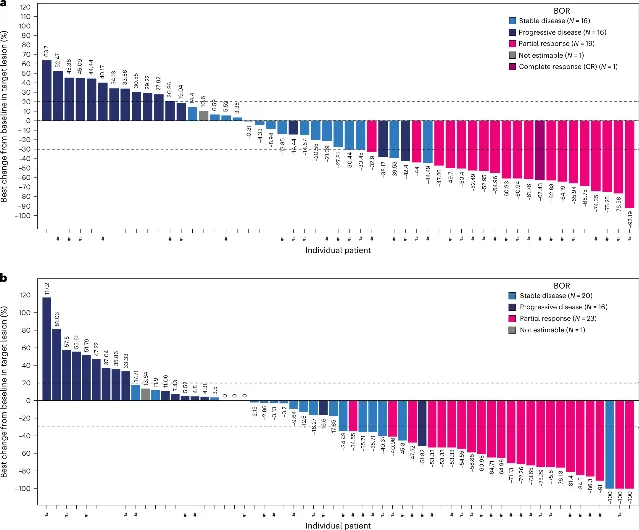
Savolitinib waterfall plots showing best percentage change from baseline in target lesion size in the exploratory phase (panel a, n=45) and pivotal phase (panel b, n=65); pink = partial response, dark blue = progressive disease, light blue = stable disease, dark purple = complete response (CR), grey = not estimable.
Savolitinib tumor response waterfall plots (Fig. 2) in MET-amplified G/GEJ cancer; 1 complete response visible in the exploratory cohort. 4
Safety (all enrolled, n = 110): Grade ≥3 TRAEs in 34.5% (38 patients); 1 treatment-related death (0.9%). The safety profile was described by the investigators as tolerable. 5
Context: MET amplification occurs in approximately 4–10% of G/GEJ cancers and correlates with poor prognosis. No targeted therapy is currently approved for this biomarker-defined population. Existing salvage options (apatinib, TAS-102, nivolumab in third-line) carry ORRs in the 3–12% range, though direct cross-trial comparisons are limited by different entry criteria. Savolitinib already holds regulatory approval in China for MET exon 14 skipping mutation NSCLC, and for the combination with osimertinib in EGFR-mutant, MET-amplified NSCLC (SACHI trial, The Lancet 2026). 4
The authors concluded that savolitinib "showed encouraging antitumor activities and a tolerable safety profile in heavily treated, later-line METamp G/GEJ cancers, supporting further investigation in randomized controlled trials." 4
Clinical/research implication: A 32.3% ORR with the lower CI clearing 15% in a biomarker-enriched, heavily pretreated population is a signal strong enough to justify a randomized trial. The single-arm, China-only design means generalizability to Western populations requires confirmation. DOR, PFS, and OS data from the full text — not available at collection — will be the key numbers to read before assessing regulatory candidacy.
Peer review status: Published in Nature Medicine. Industry-funded (HUTCHMED/AstraZeneca).

3. Tenecteplase beats low-dose alteplase for bridging before thrombectomy in Asian stroke patients (T-FLAVOR)

Journal: JAMA Neurology (IF ~29) · Randomized controlled trial · Published ~June 1, 2026 6
Study design: The T-FLAVOR trial compared standard-dose tenecteplase (TNK) with low-dose alteplase (tPA 0.6 mg/kg — the dose commonly used in Japan given the observed higher hemorrhagic risk in Asian populations) as bridging thrombolysis before endovascular thrombectomy (EVT) in patients with large vessel occlusion (LVO) stroke. Lead investigator: Kazunori Toyoda, MD, PhD (National Cerebral and Cardiovascular Center, Suita, Japan). The trial was conducted in Japan. 6
Key findings:
EndpointTenecteplaseLow-dose alteplaseResult
Early reperfusion (primary)10.3%3.6%Met pre-specified superiority threshold
90-day mRS (favorable outcome)Numerically higherCommon OR 1.47 (95% CI 0.92–2.35), not statistically significant
Symptomatic ICH2.8%1.8%No significant difference
90-day mortality6.5%9.9%No significant difference
6
Clinical/research implication: Standard-dose TNK more than doubled the early reperfusion rate vs. low-dose alteplase (10.3% vs. 3.6%) — a finding with direct relevance to stroke protocols in Japan and other East Asian centers that have defaulted to 0.6 mg/kg alteplase out of concern for hemorrhage in Asian populations. The 90-day functional outcome (mRS) trended in favor of TNK (OR 1.47) but did not reach significance, which may reflect the trial's statistical power rather than absence of a functional benefit. Mortality numerically favored TNK (6.5% vs. 9.9%), but again without significance. These results support reconsidering low-dose alteplase as the default bridging strategy in Asian EVT-eligible patients — pending full publication details and a larger confirmatory trial.
Note: The JAMA Neurology paper details (DOI, full author list, exact publication date, final enrollment) were identified via MedPage Today secondary coverage; direct access to the original article was not available at the time of collection. Key metrics above are sourced from the secondary report and should be verified against the published paper.
Peer review status: Published in JAMA Neurology. Peer-review status confirmed; funding not reported in available secondary coverage.

4. Ocrelizumab reduces disability progression 30% in broader PPMS population (ORATORIO-HAND)

Journal: The Lancet (IF ~168) · Phase 3b randomized, double-blind, placebo-controlled trial (NCT04035005) · Published May 30, 2026; confirmed PubMed indexed June 2, 2026 (PMID 42208561) 7
Study design: ORATORIO-HAND enrolled 1,013 patients with primary progressive multiple sclerosis (PPMS) aged 18–65 years, EDSS 3.0–8.0, across 138 centers in 22 countries. This extends the original ORATORIO trial population (2016) by including older patients (up to age 65) and those with more advanced disability (EDSS up to 8.0). Ocrelizumab (anti-CD20) vs. placebo. Primary endpoint: 12-week composite confirmed disability progression (12W-cCDP). Funded by F. Hoffmann-La Roche. 7
Key findings:
EndpointOcrelizumabPlaceboResult
12W-cCDP (primary)HR 0.70 (95% CI 0.57–0.86), p = 0.0007
Relative risk reduction in disability progression30%
Hand function protectionGreaterStatistically significant
7
Safety: The infection rate in the ocrelizumab group was slightly higher, though after excluding COVID-19 infections the rates were similar to placebo. Serious adverse events and serious infection rates were comparable between arms. 7
Clinical/research implication: Ocrelizumab was first approved for PPMS in 2017 based on the ORATORIO trial, which enrolled patients up to age 55 with EDSS ≤6.5. ORATORIO-HAND extends that evidence to the older and more disabled PPMS population that makes up a substantial portion of real-world neurology practice. The composite endpoint includes upper limb function (hand function) as a co-primary component — meaningful because hand function affects daily independence more than many ambulatory measures at higher EDSS levels. A 30% relative risk reduction (HR 0.70, p = 0.0007) in this harder-to-treat population is a clinically actionable result for neurologists managing advanced-stage PPMS.
Peer review status: Published in The Lancet. Industry-funded (F. Hoffmann-La Roche); multiple authors disclosed financial relationships with Roche.

5. One in five US adolescents uses AI chatbots for mental health advice — JAMA Pediatrics

Journal: JAMA Pediatrics (IF ~26) · Cross-sectional survey · DOI: 10.1001/jamapediatrics.2026.2015 · Published June 1, 2026 8
Study design: McBain et al. surveyed 1,009 US residents aged 12–21 via the RAND American Youth Panel in November 2025 (national probability-based panel). Primary outcome: self-reported use of AI chatbots (ChatGPT, Gemini, Character.AI, Meta AI) for mental health advice when feeling sad, angry, nervous, or stressed. Lead investigator: Ryan K. McBain, PhD, MPH (RAND Corporation). Co-investigators: Jonathan H. Cantor, Joshua Breslau, Melissa Diliberti (RAND); Fang Zhang, Benjamin Rader, Hao Yu (Harvard Medical School); Pat Pataranutaporn (MIT Media Lab); Ateev Mehrotra (Brown University School of Public Health). Funded by the National Institute of Mental Health (NIMH). 8
Key findings:
  • 19.2% of respondents reported using an AI chatbot for mental health advice — approximately 8.2 million US young people. 8
  • This represents a >40% relative increase from the 2024 RAND estimate of 13.1%. 8
  • The 19.2% figure is nearly identical to the proportion receiving mental health advice from a professional (19.8%). 9
  • 63% of chatbot users had not disclosed this to anyone. 8
  • 43% used chatbots for mental health at least monthly; 92% rated the advice as somewhat or very helpful — though McBain et al. note this may reflect chatbot sycophancy rather than actual guidance quality. 8
  • Use was higher in females than males, higher in ages 18–21 than 12–17, and higher among those who had recently discussed mental health with a physician. 8
Expert reactions: McBain stated: "The speed of growth is attention-grabbing, but so is the fact that most young people who use these tools for mental health advice say they are not telling anyone." 8 Co-author Jonathan H. Cantor (RAND) noted the implication for clinicians: many adolescents are using these tools privately, without their parents, clinicians, or other adults being aware, making it important for adults to proactively open conversations about AI chatbot use and its appropriate role. 9 Jodi Halpern, PhD (co-director, Kavli Center for Ethics, Science, and the Public, UC Berkeley; not involved in the study) flagged the developmental risk: "I never want to see the chatbots pretend that they're human or care about you or have feelings for you... [Adolescence through early 20s is] the time in human life when we form the strongest attachments, and teenagers are particularly vulnerable to forming parasocial relationships with AI." 9
Clinical/research implication: For clinicians seeing adolescent and young adult patients, this survey signals that AI chatbots have entered the de facto mental health toolkit for this age group — and that most of this use is invisible to providers. Asking about chatbot use as part of mental health intake assessments is now warranted. The study's cross-sectional design and self-report methodology limit causal inference, and it cannot assess whether chatbot use substitutes for, complements, or delays professional care. Federal regulatory frameworks for AI in mental health contexts remain minimal; the authors note AI chatbots are "essentially self-regulated" with no established federal safety or quality standards.
Peer review status: Published in JAMA Pediatrics. Funded by NIMH.

Cover image: AI-generated illustrative image.

Add more perspectives or context around this Post.

  • Sign in to comment.