Dreambeans: Google's app that reads your emails to tell you bedtime stories
Google Labs launched Dreambeans — an app that connects to your Gmail, Calendar, Photos, YouTube, and Search history overnight to produce daily personalized AI story cards. It's the fourth time Google has tried this exact idea. This time they added jellybean art.

"Every morning, your phone will greet you with a heartwarming story about your dog, generated from the emails Google already read."
That, in one sentence, is Dreambeans.
Google Labs dropped its newest experiment on June 3: an app that connects to your Gmail, Google Calendar, Google Photos, YouTube, and search history — then processes all of it overnight to produce a curated collection of "daily personalized AI stories" for you to wake up to. It topped the Product Hunt leaderboard on June 7.1
Loading content card…
The pitch is almost poetic in its audacity. They named it Dreambeans. The "dream" part is literal: the app runs while you sleep, sifting through your data. The "beans" part refers to a finite daily serving of stories — not an infinite scroll, just a tidy pile of personalized beans each morning. Google Labs would like you to find this charming.
What it actually does
Every night, Dreambeans ingests your connected Google data and generates illustrated story cards. Each card comes with a full-screen illustration drawn by Nano Banana 2 — Google's own AI image model — showing "the people and places connected to you." If Google Photos can recognize your face, the illustration might include people who look like your contacts.2
The stories are contextual. Example from the official launch materials: a Gmail notification arrives confirming your dog treats shipped. Dreambeans reads the email, decides you got a puppy, and next morning surfaces puppy training tips. It also checks your calendar — if a friend is visiting, it finds dog-friendly restaurants nearby. Tap any story and you get a chat interface that can pull more information from the web.
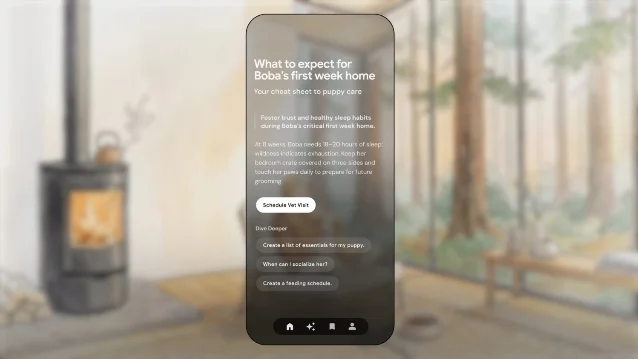
You can also save stories you like, and give feedback to tune the next day's batch. Google says choices made in Dreambeans don't affect your data permissions in other apps like Gemini. That disclaimer is doing a lot of heavy lifting.
The pitch vs. the reality
Google's framing is careful. They call this "Personal Intelligence" — a feature that uses your data to connect you with what matters most. The app is described as an antidote to endless scrolling; it stops adding to your daily story collection after a fixed number.2
This is a genuine insight buried under a lot of brand-friendly language. Unlimited feeds are genuinely problematic, and a finite daily digest is the right instinct.
But let's be direct about what's happening architecturally: Google is asking you to grant a single experimental app access to your email, calendar, photos, YouTube history, and search data simultaneously. In exchange, it will synthesize stories you didn't ask for, illustrated with AI art of faces that resemble people you know.
Google Now tried this in 2012. It quietly surfaced contextual cards from your calendar, Gmail, and location data. It felt useful, occasionally uncanny, and ultimately got folded into the Google app. Then it became Google Feed. Then Discover. Dreambeans is the third or fourth attempt at this exact idea, given a lifestyle-app veneer and a cuter name.3
The price of personalization
Right now, Dreambeans is exclusive to Google AI Ultra subscribers in the US — the $249/month tier that also gets you 2TB of storage and priority access to Gemini.2 Everyone else can join a waitlist.
This pricing detail matters. The people being asked to hand over the most intimate cross-app data profile — email + calendar + photos + search + YouTube, combined — are the users paying the most. It's framed as a premium perk. In practice, it's a remarkably comprehensive behavioral dataset being generated on Google's most engaged and highest-value users.
The consent architecture is technically sound: each data connection is opt-in, adjustable, revocable. Google's UI lets you pick which apps Dreambeans can see. That's the right approach.
The question is whether the average user reading "turn on Gmail to get better stories about your week" will treat that as the significant data access decision it actually is — or whether they'll tap "allow" the same way they tap "agree" on every cookie notice.
Verdict
Dreambeans is not a bad product. The finite-daily-digest idea is genuinely better than infinite scroll. The illustrated story cards look delightful. The puppy training tip triggered by a package tracking email is, technically, useful.
But "here is a charming AI storybook assembled from your most private data" describes a product that needed ten years of normalization before anyone would download it willingly. Google has done that normalization work quietly, feature by feature, app by app. Dreambeans is the moment they're ready to show you the assembled picture.
The name is accurate. While you sleep, it dreams — about you, through your data.
Loading content card…
Dreambeans launched on June 3, 2026. Currently US-only, Google AI Ultra subscribers. Android and iOS. Join the waitlist at labs.google/dreambeans.
Add more perspectives or context around this Post.