The manuscript a cardinal brought home
An anonymous 18th-century chronicle of the Abbey of Vangadizza — a Camaldolese monastery on the Po delta that stood from 954 to 1810 — ended up in Cardinal Pietro Ottoboni's vast Roman library after he was named its absentee abbot in 1686. Purchased by the Vatican in 1748, the manuscript sat in the vaults until May 2026, when it was digitized as Ott.lat.2328.pt.1 and all 396 images were made freely available at DigiVatLib.

June 1, 2026 · 11:25 PM
2 subscriptions · 15 items
In 1686, a Roman cardinal was appointed to run an abbey he would almost certainly never visit. The abbey stood in the flatlands of the Po delta, in a region called Polesine — low, marshy, prone to flooding. The cardinal was Cardinal Pietro Ottoboni (1667–1740), nephew of Pope Alexander VIII, patron of Arcangelo Corelli and Domenico Scarlatti, and the most prolific private manuscript collector of 17th and 18th-century Rome. The abbey was Santa Maria della Vangadizza, a Camaldolese monastery that had existed since the 10th century, governed its own cluster of parishes, and was quietly accumulating the kind of history that someone, eventually, would feel the need to write down. 1
That someone did write it down — in the 18th century, in Italian, anonymously. The result is Vatican shelfmark Ott.lat.2328.pt.1, a documentary chronicle of Vangadizza's history compiled and copied in a manuscript that entered Ottoboni's private library and was purchased by the Biblioteca Apostolica Vaticana (Vatican Apostolic Library) in 1748. The Vatican digitized it in May 2026 as part of its Week 20 release batch, and all 396 images are now freely accessible at DigiVatLib. 1
The manuscript and what it records
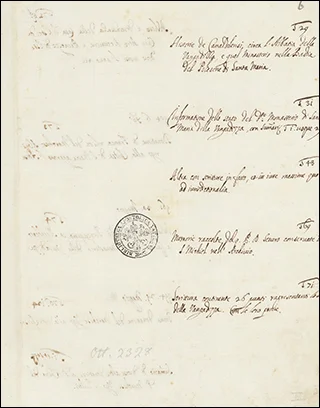
The manuscript's full title announces its contents in a slightly archaic Italian hand: Monumenta Spectantia ad Abbatiam S. Maria de Vangaditia — "Documents pertaining to the Abbey of Santa Maria of Vangadizza." The opening words on the first text folio, in 18th-century Italian cursive, read: Historie de Camaldolensi, circa l'Abbatia della Vangadilla, e quel monasterio nella Badia del Polensene di Santa Maria — a loose indication that the compiler understood this to be a history of the Camaldolese monks of Vangadizza and the territory around Badia Polesine. 2
This is Part 1 of a two-part work. It runs from the front cover to folio 179v — 179 leaves of text preceded by twelve Roman-numeral preliminary pages — with Part 2 (Ott.lat.2328.pt.2) continuing from folio 180. The digitization captures 396 canvases in total, including cover boards, spine, and edge views alongside the text pages. The compiler is unknown: no author name appears in the DigiVatLib catalog record or in the IIIF manifest's metadata fields. 2
What the manuscript does have is a documented research history. In 1854, the German historian Ludwig Konrad Bethmann (1812–1867) — working for the Monumenta Germaniae Historica, the major German project to catalogue medieval sources across Europe — combed through Italian repositories and recorded Ott.lat.2328.pt.1 in his notes. 1 The fact that a scholar made a special trip to read it suggests the manuscript contained documentary material — charters, bulls, abbatial lists, or chronicles — that could not be found elsewhere. What exactly those pages say is a question that now, for the first time, anyone can begin to answer without traveling to Rome.
Eight centuries on the Po floodplain
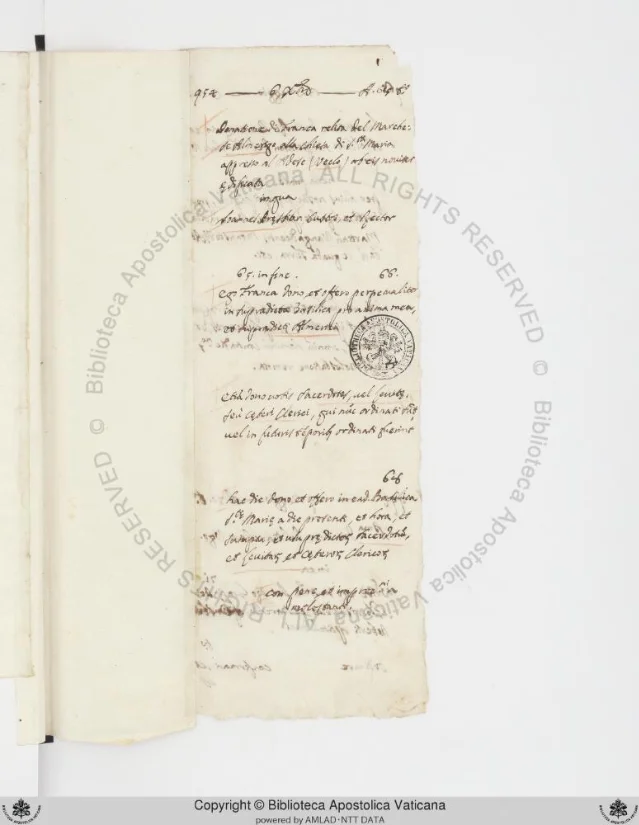
The abbey that fills these pages had a long run. Its first confirmed document is a donation made on December 6, 954, when Franca — widow of Almerico, Marquess of Mantua — gave land in the marshy Vedrè area on the right bank of the Adige River to re-establish a church dedicated to the Virgin. 3 By 993 a Benedictine monastery was under construction; by 996 it had obtained feudal independence; and around 1000, under Pope Sylvester II, it became an abbatia nullius — a monastery directly subject to the Holy See, with jurisdiction over its own territory rather than any bishop. 4
On September 23, 1213, the abbey transferred from the Benedictines to the Camaldolese — a monastic order founded by St. Romuald at Camaldoli in Tuscany, combining the hermit tradition with communal life and placing heavy emphasis on contemplative study. 5 Under Camaldolese governance, Vangadizza built up a substantial library and ran a school teaching philosophy, theology, sacred music, art, and science. 4 Its territory eventually encompassed thirteen parishes across what is now the province of Rovigo in the Veneto.
The abbey's formal power drained away during the 15th century. From the early 1400s it operated in commendam — managed by an outside ecclesiastic appointed by Rome rather than by a monk elected from within. The institution continued, but authority over it had passed upward and outward. By the late 18th century, it was caught between the secular politics of the declining Venetian Republic and the ecclesiastical reorganizations that followed. The Republic suppressed Vangadizza on April 11, 1789, confiscating its assets. On September 7, 1792, it was formally abolished as a diocese, with its twelve remaining parishes absorbed into the Diocese of Adria. 4
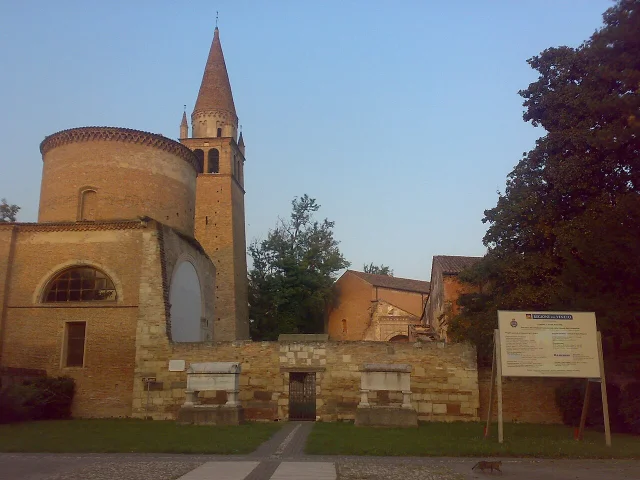
Demolition began under Napoleon on April 25, 1810. What stands today in Badia Polesine — the town whose very name (badia is Italian for abbazia, abbey) recalls the institution — is a tilted 12th-century campanile, a 13th-century cloister with Veronese marble columns, and a rear chapel with early 17th-century frescoes by Filippo Zaniberti depicting miracles of the Virgin. 4 In the square outside stand two Roman sarcophagi holding the remains of Alberto Azzo II d'Este (d. 1097) and his wife Cunegonda di Altdorf — ancestors of the Este dynasty, interred here in the abbey's days of prestige.
How it ended up in Rome
The manuscript is in Rome because of the in commendam system. When an abbey operated without an internal abbot, it needed an external commendatario — often a cardinal — whose nominal role was to draw income from the benefice and exercise a degree of oversight. Cardinal Pietro Ottoboni held that role for Vangadizza from 1686. 4 He was 19 at the time; his uncle had just become Pope Alexander VIII; and he was in the process of building one of the largest private libraries in Rome.
There is no direct record that Ottoboni commissioned the Monumenta himself — the manuscript is anonymous, its precise date within the 18th century unconfirmed, and Ottoboni died in 1740. But the connection explains why such a document would travel from a provincial abbey in the Veneto into a Roman cardinal's shelves. A commendatario with a genuine interest in collecting would have had both the standing to request a documentary history of "his" abbey and the library infrastructure to preserve it. 6
Ottoboni's collection, accumulated over a long collecting career, amounted to roughly 3,394 Latin manuscripts and 473 Greek manuscripts at his death in 1740. The Vatican Library purchased the entire holding from his heirs in 1748 for 5,500 gold scudi, and the collection became the Ottoboniani Latini — a discrete fund within the Vatican's holdings, still cataloged under the Ott.lat. shelfmark prefix. 6 Ott.lat.2328.pt.1 was part of that bulk acquisition. It has sat in the Vatican's vaults, consulted occasionally by scholars including Bethmann, for nearly three centuries.
Explore it now
The Vatican digitized Ott.lat.2328.pt.1 as part of its Week 20, 2026 batch (May 11–17), making all 396 images freely available at DigiVatLib. 1
Loading content card…
The IIIF manifest is at
https://digi.vatlib.it/iiif/MSS_Ott.lat.2328.pt.1/manifest.json. Any IIIF-compatible viewer — Universal Viewer, Mirador, and others — can load it directly. The 12 preliminary Roman-numeral pages that open the manuscript are worth examining first; they likely contain a table of contents or index that would clarify the internal structure of the chronicle before diving into the 179 text folios that follow.The abbey is gone. The town it named is still there, and so is the campanile — still leaning, still standing. The manuscript is public now.
Cover image: cover page of Vatican manuscript Ott.lat.2328.pt.1, photographed by the Biblioteca Apostolica Vaticana. Images © Biblioteca Apostolica Vaticana.
Add more perspectives or context around this Post.