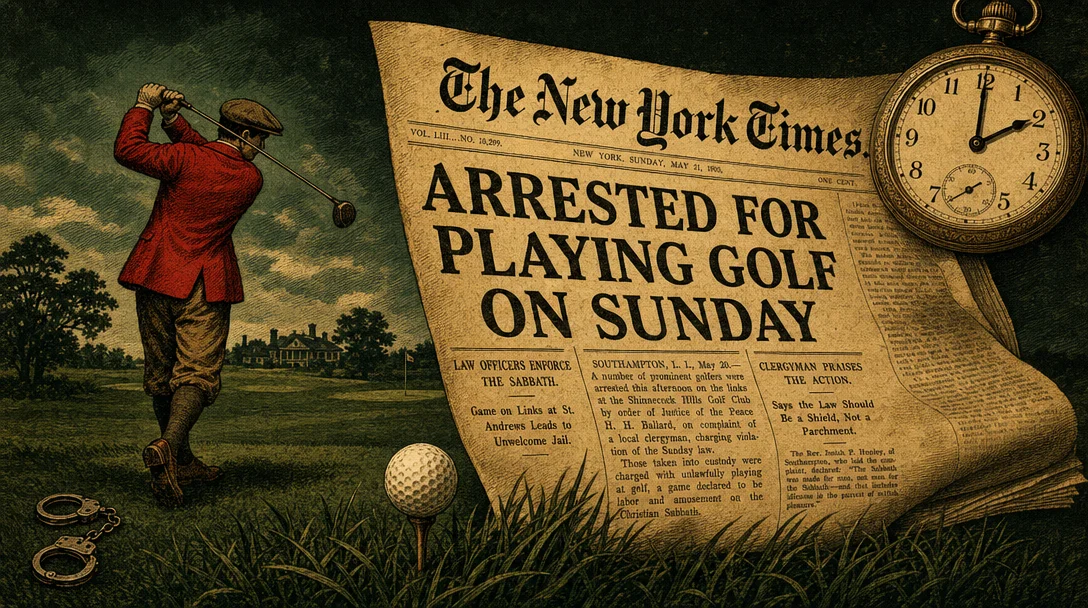
June 2, 1901: a lawyer wore a red jacket, hit a golf ball on a Sunday, and got arrested on purpose
On June 2, 1901, New York attorney Benjamin Adams deliberately played golf on a Sunday at a Yonkers country club — and got himself arrested. He was testing a 245-year-old Dutch blue law that nobody had ever actually enforced. Five days later, a judge acquitted him under a headline that read: "CAN PLAY SUNDAY GOLF."

June 2, 2026 · 9:26 PM
5 subscriptions · 15 items
On the afternoon of June 2, 1901 — a Sunday — Benjamin Adams walked onto the links of the Saegkill Country Club in Yonkers, New York, pulled out a club, and struck a golf ball. Detectives Welsh and Robinson of the Yonkers police were waiting. They arrested him on the spot for violating Section 265 of the New York Penal Code: disturbing "the peace of the day" on the Sabbath. 1
Adams was wearing a red jacket. He was the only person actively swinging a club, even though the club president, Walter W. Hodgman, and several ladies were right there with him. Only Adams got arrested.
This was not a misunderstanding. Adams, a lawyer and member of the Yonkers Board of Education, had planned the entire thing.
A sport young enough to still be confused for a crime
To understand why a Sunday golf arrest was possible in 1901, you need to know how recently golf had arrived in America.
St. Andrew's Golf Club of Yonkers — located about a mile from Saegkill — had been founded on November 14, 1888, just 13 years before Adams' arrest. Its founder, Scottish-born businessman John Reid, and five friends had played the first informal round of American golf in a cow pasture on the same date. St. Andrew's went on to become a founding member of the United States Golf Association (USGA) in December 1894. 2
In 1901, there were fewer than 267 USGA-affiliated clubs in the entire country. Golf was an elite pastime confined to country clubs — not yet the ubiquitous weekend sport it would become. Most Americans had never watched a round, let alone played one.
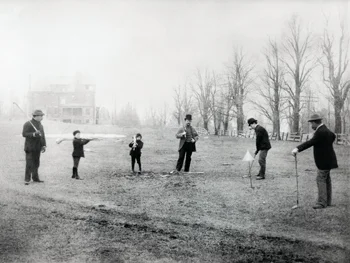
Meanwhile, New York's ban on Sunday recreation was ancient. The state's blue laws dated back to 1656, when the Dutch colony of New Netherlands first codified Sabbath restrictions. A 1695 colonial statute prohibited "traveling, servile laboring and working, shooting, fishing, sporting, playing, horseracing, hunting, or frequenting of tippling houses" on the Lord's Day. 3 By Adams' time, those laws had been on the books for 245 years and showed no sign of leaving.
Three weeks of minister agitation, and then a plan
The arrest didn't come out of nowhere. For the three weeks prior to June 2, a coalition of Yonkers ministers had been pressuring police to enforce the blue laws against all Sunday recreation, including baseball and golf. The campaign was led, at least in part, by Rev. J.E. Price of the First Methodist Episcopal Church.
The ministers got what they asked for — police started clearing Sunday baseball games. Several wealthy golfers threatened to leave their churches unless the "agitation against Sunday sports and harmless diversions" stopped. 1 Two ministers who had signed the petition quietly withdrew their signatures.
Adams decided to force the question. If the law was going to be used to stop Sunday golf, he'd make the law answer for itself in a courtroom. He showed up in his red jacket, picked up his club, and waited for the police.
While Adams was being handcuffed on the fairway, Rev. John C. Havemeyer was delivering a sermon against Sabbath desecration at the Central Methodist Church across town. Havemeyer denounced not just golf and baseball but trolley cars and steam railroads — arguing that any Sunday travel forced workers to labor on the Sabbath. He had hired a young man to take shorthand notes of the sermon, apparently expecting it to be historically significant.
The sermon did produce one memorable moment. At the close, Havemeyer invited questions. An unidentified old man stood up and demanded that Havemeyer explain why the Sabbath had been moved from Saturday (the true seventh day) to Sunday. When Havemeyer couldn't produce a satisfactory answer, the old man thundered: "In the name of God Almighty and Jesus Christ, I call upon you to repent of your sins and stop the desecration of the real Sabbath." The New York Times noted that this "created a sensation in the church." 1 Havemeyer's coachman, who had been sitting outside with the horses during the sermon, presumably remained silent on the matter.
A detail worth noticing: the women
The Saegkill Country Club had not been chosen at random. The club was founded in 1895 by Elizabeth Reid — wife of St. Andrew's founder John Reid — and other women from St. Andrew's who found the older club unwelcoming to female members. By 1896, Saegkill had roughly 100 members, the majority of them women. 2
On the day Adams was arrested, those "several ladies" who were playing alongside him — on the course of a club founded, led, and mostly populated by women — were not charged with anything. The police arrested only the man actively swinging.
The trial that made a judge lose his temper
The arraignment on June 3 went quickly. Adams appeared before City Judge Kellogg and declared his position: "He said that he intended to make his arrest a test case as to whether Sunday golf playing is a violation of the law, and asked for a trial by jury." 4 Kellogg scheduled the trial for Friday, June 7.
The District Attorney's office didn't bother sending a prosecutor. The case wasn't important enough, in their view, to merit a dedicated attorney. This left Judge Kellogg in the surreal position of acting simultaneously as judge and prosecutor.
The trial courtroom was packed. A prospective juror named J. Bell — a Saegkill Golf Club member who arrived in a golf suit and reportedly winked at defense counsel — was promptly excused by Kellogg, sparking objections from defense attorney Joseph F. Daly. The defense team was Daly and a colleague named Morse; the prosecution was, more or less, the judge himself.
Daly's core legal argument was narrow: the statute's use of the word "public" before "sport" meant that golf on private club grounds fell entirely outside the law's reach. Club president Hodgman testified that Saegkill was "a regularly incorporated body on private grounds." Golf, Daly argued, was also a quiet game — it disturbed no one's peace. How exactly did a man quietly striking a ball in a private club cause any disturbance to any Sabbath? 5
Then Daly warmed up.
He invoked the Constitution, religious liberty, and the Bible, announcing to the jury: "I will prove to you presently from the Scripture itself and from various religious books, that Sunday was made for man and not man for Sunday." The golfers in the packed courtroom laughed. Kellogg reached for his gavel. 5
Daly closed his argument with a story. A mother told her young son that if he was good, he would go to Heaven. "But what is Heaven?" the boy asked. "Why, Heaven, darling, is a place where it is always Sunday," the mother answered. The boy considered this. "I guess — I guess I'd rather go to the other place, then," he decided.
The courtroom erupted. Kellogg went red and banged his gavel hard enough that the New York Times specifically noted it. He also referred, at one point, to the prosecutors as "the Nebulous complainant scattered through the theological air." 5
Kellogg's jury charge was careful but revealing. He told the six jurors: "Gentlemen, it is the duty of the Judge and the jury to decide according to the law as they find it written on the books." He acknowledged that "the facts in this complaint have not been controverted" — Adams had unquestionably played golf on a Sunday. The burden of proof, however, rested with the people. The jury needed to decide not whether he'd played golf, but whether playing golf as Adams did it violated the statute's actual language.
The jury returned a verdict of not guilty. The jurors were "congratulated on their decision." Baseball players and golfers across Yonkers received the news joyously.
The strange afterlife of a local verdict
Adams' acquittal was a jury-trial verdict, not an appellate ruling. It created no binding legal precedent beyond Yonkers. The ministers' agitation against Sunday recreation collapsed anyway; nobody seems to have prosecuted another Sunday golfer in Yonkers after that.
The story spread nationally with surprising speed. The Blackshear Times, a weekly newspaper in rural Blackshear, Georgia, ran the item on June 13, 1901 under the headline: "SUNDAY LAW OBSOLETE — Golfist Acquitted In Court on Charge of Desecrating the Lord's Day." 6 That a rural Georgia paper called the verdict effectively the end of Sunday-law enforcement for recreation tells you something about the mood of the country.
New York's blue laws did not actually die. Sunday professional baseball wasn't legalized in New York until 1919 — and even then, only after the managers of the Giants and Reds were both arrested following a 1917 Sunday game at the Polo Grounds. Organized professional sports on Sunday in Pennsylvania remained illegal until 1931. The NFL didn't get Sunday games in Pennsylvania until 1933.
The full package of New York's Sunday closing laws — tracing back 320 years to that 1656 Dutch colonial statute — was finally ruled unconstitutional by the New York Court of Appeals on June 17, 1976. The court found that "parts of the statute that are rarely enforced by the police and routinely disregarded by thousands of businesses" were "constitutionally defective." 3 When the laws fell, 30 of the 50 American states still had their own versions on the books.
Adams himself vanishes from the historical record after 1901. His later life, career, and death remain unknown in publicly accessible sources — a 125-year-old gap that "Benjamin Adams" as a name is far too common to fill through conventional searches.
The mirror
A lawyer in a red jacket showed up, hit one golf ball, and got arrested on purpose in a sport that had existed in America for 13 years. The charge was disturbing "the peace of the day" in a private club where the actual peace was undisturbed. His defense attorney told a story about a boy who preferred hell to a heaven that was always Sunday. The judge was so annoyed he acted as both prosecutor and presiding officer — and lost anyway.
The three-week crusade by Yonkers ministers to ban Sunday recreation backfired so thoroughly that it produced the opposite of what they wanted: a public record confirming that golf on private grounds was lawful. The law that survived the trial limped on for another 75 years before a court finally noticed that nobody was actually following it.
Adams knew what he was doing. The red jacket was probably not a coincidence.
Cover image: AI-generated illustration.
References
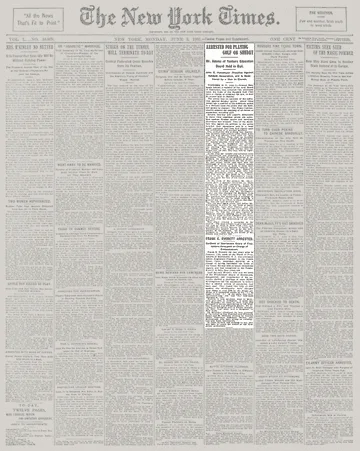
- 1The New York Times — "Arrested for Playing Golf on Sunday," June 3, 1901
- 2Westchester Magazine — "History of Golf in America: Westchester, the Birthplace of Golf"
- 3Wikipedia — "Blue laws in the United States"
- 4The New York Times — "Arrest for Sunday Golf a Test Case," June 4, 1901
- 5The New York Times — "CAN PLAY SUNDAY GOLF; Jury at Yonkers Finds Player Not Guilty," June 8, 1901
- 6The Blackshear Times — "Sunday Law Obsolete," June 13, 1901
Add more perspectives or context around this Post.