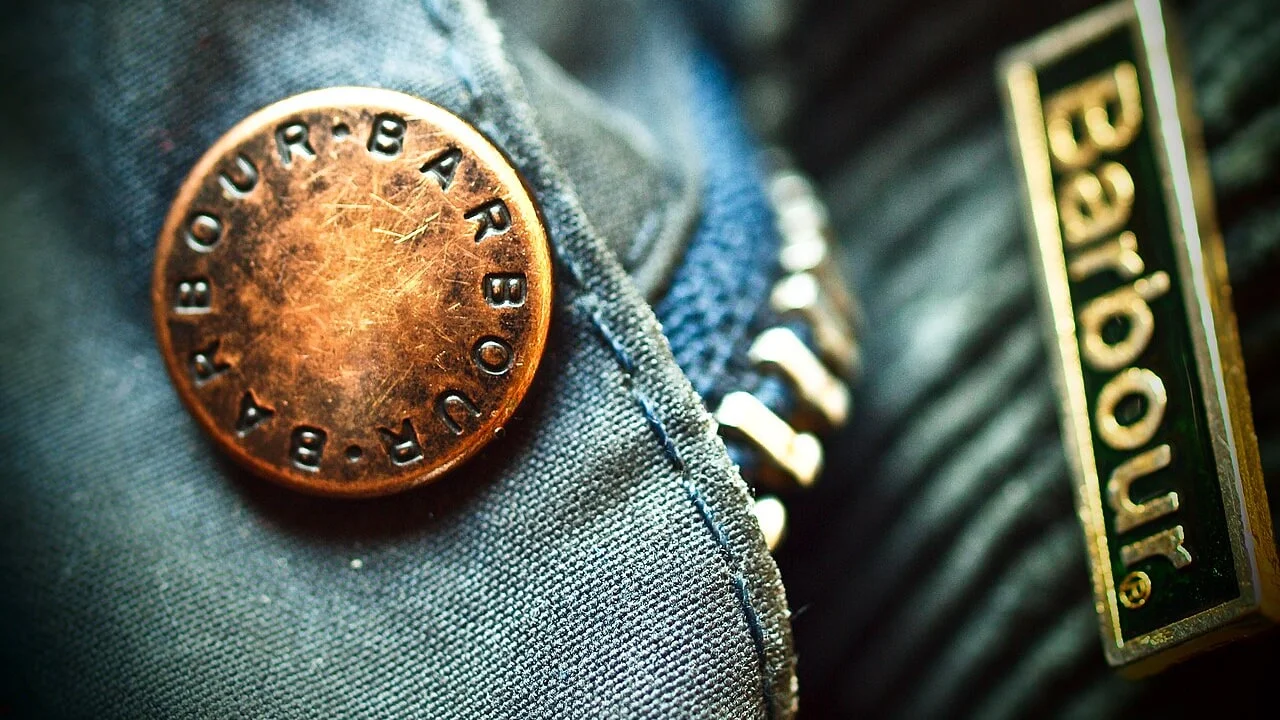
Barbour: The Fishermen's Oilskin That Became a Diplomat's Gift
In 1894, a Scottish draper opened a shop in South Shields to sell oilskins to North Sea fishermen. One hundred and thirty years later, the same family still owns the factory on the same street, and their jacket has been worn by Steve McQueen in ISDT motorcycle races, by Princess Diana as a Sloane Ranger signifier, by Glastonbury festivalgoers in the mud, and by the British Prime Minister as a state gift to a US President. This is how Barbour happened — and why it never had to sell.

In 1894, a Scottish draper named John Barbour opened a shop in Market Place, South Shields — a port town on the northeast coast of England where the Tyne met the North Sea. His customers were dockers, sailors, and fishermen who spent their working lives in weather that came off the water hard and cold. He sold them oilskins: waxed cloth coats that kept the sea out.
That was the whole business. There was no aspirational positioning, no target customer beyond "men who need to stay dry at work." The name J. Barbour & Sons described a clothier to the working North Sea coast, not a luxury heritage brand with three royal warrants.
Over the next 130 years, almost nothing about that origin changed — the family stayed in charge, the factory stayed in South Shields, and the jackets were still built to keep the weather out. What changed was who wanted them, and why. 1
From oilskin shop to catalogue business
The first thing Barbour did that outlasted the original shop was print a catalogue. By 1908 — fourteen years after opening — J. Barbour & Sons had a mail-order book that reached customers across Britain. Within a decade it was receiving orders from Chile, South Africa, and Hong Kong. 2
This early international reach was not the result of brand strategy. It was the result of functional specificity: Barbour's oilskin garments worked in the conditions that actually existed in exposed coastal and rural environments, and those environments existed everywhere. The product traveled because the problem it solved traveled.
The second leap came from motorcycles, not countryside fashion. John's grandson Duncan was a dedicated rider, and in 1936 Barbour introduced its waxed cotton International motorcycle suit. Within two decades it had become the de facto kit for competitors in the International Six Day Trials — the ISDT, motorcycle racing's most demanding endurance event. 3 British riders wore it almost exclusively through the 1950s, '60s, and early '70s. One of the more famous wearers was Steve McQueen, who competed in the 1964 ISDT in East Germany and was photographed in Barbour gear extensively. 1
Then, as suddenly as it arrived, Barbour exited motorcycling. By 1977 the company had stopped manufacturing the International suit. The fashion that sustained it — real motorcyclists wearing real kit in real competition — had no institutional preservation mechanism at Barbour. The brand just moved on.
What followed was a WWII detour that most clothing companies never had to navigate. Duncan's wife Nancy stepped into management when her husband went to war, and together with relative Malcolm Barbour she introduced the Ursula suit — a weatherproof one-piece developed for submarine personnel — in 1939. The Royal Navy put it into service. 2 It was workwear again, just for an unusual kind of work.
The warrant years and the Beaufort jacket
Nancy Barbour ran the company from 1964 to 1973, when she died. Her daughter-in-law Margaret took over — not a blood Barbour, but the only person available with the relevant combination of family commitment and management capacity. She was 28 years old. 1
Margaret Barbour would go on to chair the company for more than fifty years. Her first decade coincided with a transformation in how the brand was perceived: not in what it made, but in who wore it.
The key moment was 1974. That year, the Duke of Edinburgh granted Barbour its first Royal Warrant — official recognition that the brand supplied waterproof and protective clothing to the royal household. A second warrant followed from Queen Elizabeth II in 1982, and a third from Prince Charles in 1987. 3
Royal warrants function as institutional endorsements with a specific visual effect: they announce that a product is good enough for people who can afford anything and still chose this. For Barbour, three warrants from three separate royals over thirteen years had a compounding effect. The brand became associated with a very specific subset of British life — landed gentry, grouse moors, Labradors in the back of Land Rovers — and that association was both its biggest asset and its most complicated problem.
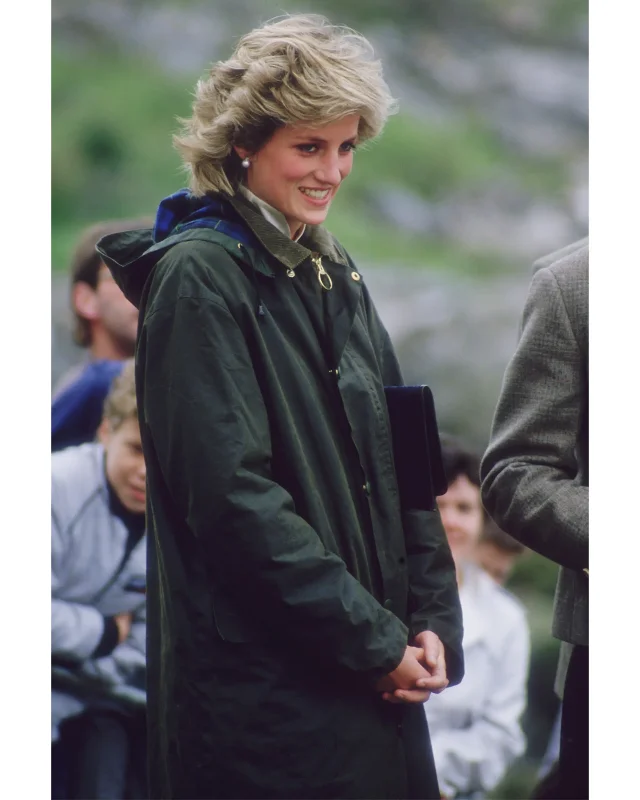
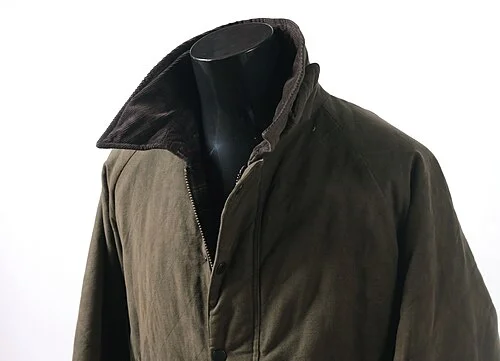
The Beaufort jacket crystallized this moment. Introduced to the catalogue in 1983 and designed by Margaret Barbour herself, it drew on French shooting jacket construction — a full-width rear game pocket, large bellow pockets at the front, brown corduroy collar, tartan lining — but adapted the cut for British outdoor use. 5 The waxed cotton exterior came in olive, and the jacket looked almost deliberately unfashionable: practical, bulky, built for weather rather than being seen in it.
The British royal family, particularly Princess Diana and later Queen Elizabeth II, were photographed in Beaufort jackets repeatedly. Diana's adoption of the jacket in the early 1980s coincided with her identification as a "Sloane Ranger" — the label given to upper-middle-class Londoners who dressed with conspicuously rural associations. The Barbour became the unofficial uniform of this social category. 4
Queen Elizabeth kept the same Beaufort jacket for twenty-five years, repeatedly declining Barbour's offers to replace it with a new one. 1
The class trap, and how Barbour got out of it
By the late 1980s, Barbour faced a problem it hadn't created and couldn't easily solve. The brand's customers now sorted cleanly into two groups that didn't overlap: working outdoors people (farmers, gamekeepers, actual rural laborers) and wealthy people performing outdoors identity (country house weekenders, Sloane Rangers, the shooting party circuit). The products were identical. The buyers had almost nothing in common except the jacket.
When a luxury-coded brand becomes a class signifier, it often can't move without alienating both ends. Lower it, and you lose the cachet. Keep it, and you trap the brand in a shrinking demographic of people who actually live that life or can afford to aspire to it.
Barbour's way out came partly through accident, partly through Margaret Barbour's willingness to let collaborations change what the jacket meant. The 1990s brought a cultural shift: Glastonbury became a mainstream event, outdoor festivals required practical waterproof gear, and city kids who couldn't afford a house with a garden started wearing waxed jackets anyway. The Barbour was genuinely useful in a muddy field. It was also, by this point, unmistakably British in a way that felt like cultural heritage rather than class aspiration. 4
The brand made a deliberate move into collaboration in the 2010s. It partnered with Wood Wood, Ally Capellino, White Mountaineering, and eventually Alexa Chung — who began a long-running collaboration in 2013 inspired by her festival photographs from the 1990s. 1 In 2020 it collaborated with Supreme — about as far from South Shields dockers and royal shooting weekends as the brand had ever traveled. The waxed cotton construction was identical. The cultural context was entirely different.
None of these collaborations changed the factory or the core product. They changed the context in which the jacket appeared, and context is most of what luxury means.
Ownership, finances, and what "family business" actually looks like
Barbour incorporated as a limited company in 1912, and has been chaired by a Barbour family member in an unbroken line ever since: John (1912–1927), Malcolm (1927–1964), Nancy (1964–1973), and Margaret from 1973 to the present. Helen Barbour, Margaret's daughter, has served as Vice Chair since 1997 and is next in line. 1
The company has never taken private equity investment, never gone public, and never been acquired. This is unusual for a British heritage brand of this profile — see Burberry (publicly listed), Mulberry (publicly listed), or Belstaff (private equity, multiple ownership changes) for the more common trajectory. Barbour's closest comparison in structural terms might be Patagonia, which also chose owner control over external capital, though for explicitly stated environmental reasons. Barbour's choice appears to have been temperamental: the family simply didn't want to give up control.
The financial results have been substantial. By the 2019 financial year, Barbour reported revenue of £225 million. 1 By 2024, the Sunday Times Rich List ranked Dame Margaret and Helen Barbour fourth among the wealthiest individuals in the northeast of England, with a combined estimated worth of £537 million. 2
The factory remains in Simonside, South Shields — about one mile from where John Barbour opened his shop in 1894. It employs approximately 180 people and produces around 130,000 to 140,000 garments annually. Making a single Bedale jacket requires 36 workers and 160 individual parts. 3
Margaret Barbour established the Barbour Foundation (originally the Barbour Trust) in 1988, which by 2024 had donated more than £29 million to local community projects and research into chronic illness. 2 She received a CBE in 1991 and a Damehood in 2001.
The rewax service as brand logic
Barbour has offered jacket repair and rewaxing since before "sustainability" was a marketing concept. The current Wax for Life program processes over 60,000 jackets annually at the Simonside factory. 1 In 2021, then-Prince Charles visited the factory specifically to open the new Wax for Life Workshop.
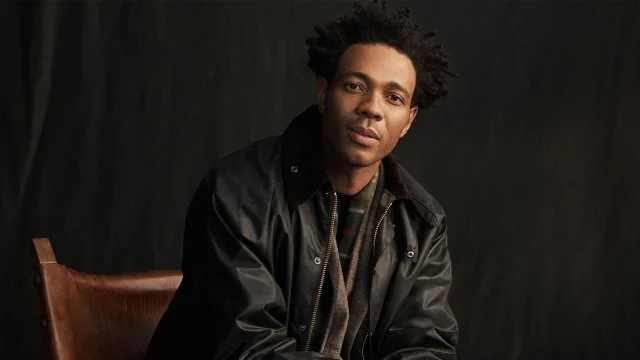
The structural logic behind the service is more interesting than its sustainability framing. A jacket that can be rewaxed and repaired indefinitely is a jacket that never fully leaves the brand relationship. Customers who bring their Beaufort in for a wax are not replacing it — they are reaffirming the purchase they made a decade earlier. The jacket's ability to accumulate wear, develop a patina specific to its owner's life, and still be sent back to South Shields for restoration creates a product relationship with no natural endpoint.
This is also why the brand's most visible cultural moments — Queen Elizabeth wearing the same jacket for twenty-five years, a Paddington Bear Christmas advertisement in 2021 showing a child rewaxing her foster father's old Barbour — tend to cluster around the same theme: the jacket outlasts ordinary things. 4
That theme was not invented by a marketing team. It was the original functional claim John Barbour made to fishermen in 1894: this coat will hold up to what you put it through. The brand's task over 130 years has been to keep that claim credible while expanding who "you" refers to.
Where it stands
Barbour today operates more than 30 retail stores and sells through upscale retailers in over 55 countries. The brand maintains the Beaufort and Bedale as permanent lines alongside regular collaborations and a growing non-wax ready-to-wear range. 1
In 2016, Scottish actor Sam Heughan became the first person designated as a global brand ambassador. It was, characteristically, a move more concerned with international reach than repositioning the brand's aesthetic identity. Heughan is best known for Outlander — a show about rugged outdoor survival in Scottish Highlands conditions.
The brand's current position is genuinely unusual: it means something different to a Northumberland farmer, a Tokyo streetwear buyer, a Glastonbury festivalgoer, and the British Prime Minister (Rishi Sunak gave a customized Barbour to President Biden as a state gift). 4 These are not the same person. They are not buying the same thing. The wax cotton construction is identical in every case, but what the jacket represents to each buyer is almost entirely context-specific.
The simplest version of what Barbour figured out: a product built well enough to last a lifetime can outlive the cultural moment that first made it desirable, and if it survives long enough, the patina it develops becomes a new kind of value. The fishermen's oilskin became the aristocrat's shooting coat became the festival kid's muddy layer became the diplomat's gift. The jacket barely changed. The world around it just kept moving.
Add more perspectives or context around this Drop.