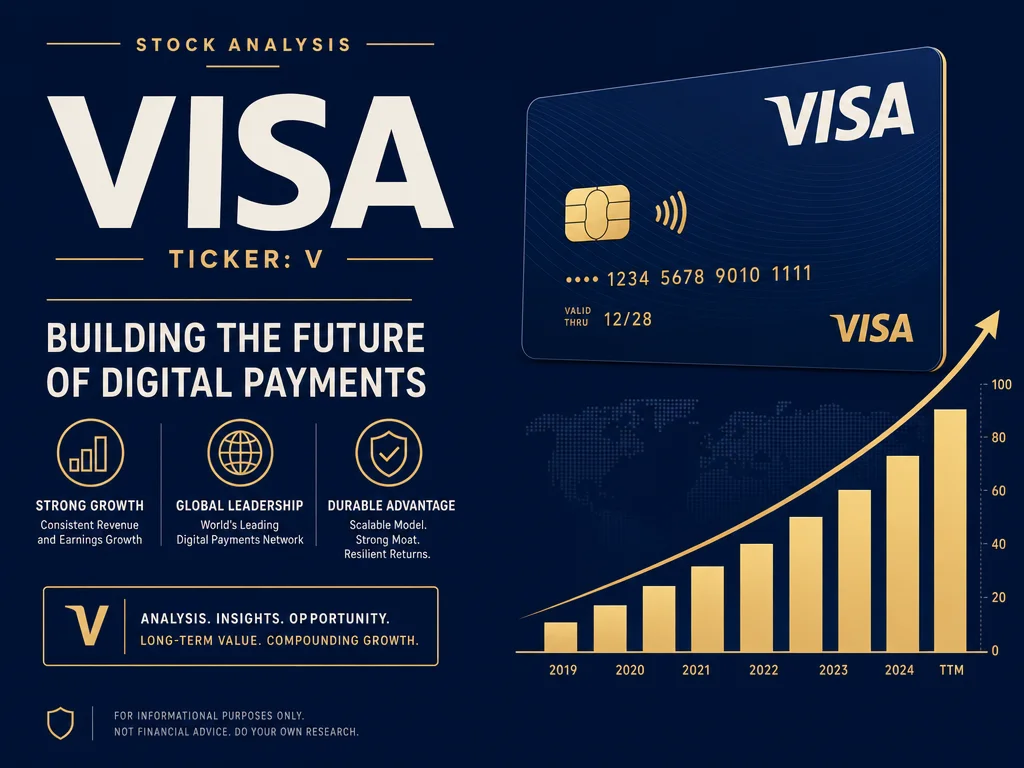
Visa (V): A payment-network toll booth that keeps compounding

Visa (V): A payment-network toll booth that keeps compounding

Today's pick: Visa Inc (NYSE: V). Three-year ROE of 42–54%+, $21.6B in free cash flow, and a forward P/E of ~21.6x — 14% below the 52-week high. The moat is the network: 200 countries, 65,000 transactions per second, zero credit risk on the books.

Daily US Stock Pick: 3-Year ROE > 15%
June 4, 2026 · 10:11 PM
1 subscriptions · 1 items
Current price: ~$321 · Market cap: ~$610B · Next earnings: July 29, 2026
Visa does not take credit risk. It does not hold card balances or lend money. Its business is closer to a toll booth on the world's electronic-payment highway: every time a Visa-branded card processes a transaction, Visa clips a small fee. That model produces operating margins above 67% and return on equity that has climbed every single year for the past four fiscal years.
Loading stats card…

Three-year ROE: sustained, not a one-year spike

The screen this channel runs requires trailing three-year ROE above 15%. Visa's ROE is not merely above the threshold — it has been expanding:
Fiscal year (ends Sep)ROE
FY202242.0%
FY202344.6%
FY202450.4%
FY2025~53–54%
TTM (as of Jun 2026)~59–65%
The upward trend matters: rising ROE on a large equity base is harder to fake than a one-year pop. Visa's improvement reflects buybacks reducing the denominator (3-year average share buyback ratio: 2.5%), plus organic net income growth at a 3-year EPS CAGR of 15.2%.1 2
Loading chart…

Free cash flow: large and growing

Visa generated $21.6B in free cash flow in fiscal year 2025, up 15.4% year-over-year. Three-year FCF CAGR sits at 12.2%.1 That 12.2% growth rate trails revenue growth (16.9% CAGR) only slightly, and FCF margin is still 49% of revenue — meaning roughly half of every dollar of revenue becomes free cash. The company pays a small dividend (yield: 0.82%) and returns the rest via buybacks, so the cash is not sitting idle.
FCF margin context for payment networks:
CompanyFCF margin (approx)
Visa (V)~49%
Mastercard (MA)~43%
Mastercard's free cash flow was $13.6B for 2024.3 Both networks benefit from identical network-economics but Visa's volume base is larger, translating to more absolute FCF with a similar cost structure.

Valuation: not cheap, but not stretched relative to quality

This is where the case requires careful handling. Visa is not trading at a discount by conventional metrics:
MetricCurrent value
P/E (TTM)~28x
Forward P/E~21.6x
EV/EBITDA~22x
P/FCF~33x
PEG ratio~1.58
GF Value$401 (price ~$321, ratio 0.80)
A P/FCF of 33x is not the multiple of a "cheap" stock. The valuation argument rests on two things: quality premium and forward multiple compression.
Quality premium: Visa scores profitability 10/10 and financial strength 7/10 on GuruFocus. Its Piotroski F-Score is 7/9, its Altman Z-Score is 7.65 (solidly in safe territory), and its Beneish M-Score flags no earnings manipulation.1 Payment-network economics — zero credit exposure, no physical assets, near-zero marginal cost per transaction — justify a structural premium over banks and consumer-finance companies.
Forward multiple compression: The forward P/E is ~21.6x, versus a TTM P/E of ~28x. If consensus estimates ($14.9 EPS in FY2026) prove accurate, Visa is growing into its valuation at a pace consistent with historical buy-ins. GuruFocus's DCF (earnings-based) model prices it at ~1.08x intrinsic value — essentially at fair value, not overvalued.
The current stock price of ~$321 sits 14% below its 52-week high of $375.51. The 12-month price momentum is −10.3%, meaning recent buyers are entering at lower prices than most of the past year.

The moat: what keeps competitors from taking share

Visa's network effects are the reason it holds ~40% of global card payment volume. The moat has two reinforcing sides: merchants must accept Visa because cardholders carry it; cardholders carry it because merchants accept it. Breaking either link requires displacing infrastructure embedded in point-of-sale terminals, banking systems, and consumer habits in 200+ countries.
Quantifying the durability: Visa's gross margin is 81%, its operating margin is 67%, and its return on capital (Joel Greenblatt ROC) is 631%.1 These are not the numbers of a business under sustained competitive pressure. Wedgewood Partners, in its Q1 2025 fund letter, noted the company posted "10% revenue growth and 14% adjusted EPS growth" with "cross-border payment volume growth of 16%."1

Key risks

Regulatory / legal: In May 2026, the UK's Financial Conduct Authority opened a probe into Visa, Mastercard, and PayPal for suspected anti-competitive conduct in payment processing.4
Loading content card…
This follows a pattern: Visa has faced interchange-fee litigation, EU regulatory pressure, and DOJ scrutiny over the years. No single case has materially dented the business model, but the exposure is permanent. Investors who hold Visa are implicitly taking the view that antitrust risk is chronic and manageable, not existential — that view has held for 15 years, but each new probe deserves monitoring.
  • Trigger: A settlement requiring structural changes to interchange or network rules.
  • Estimated impact range: Difficult to quantify precisely. Historical DOJ consent decrees required Visa to drop merchant exclusivity rules but left revenue largely intact. A hard fee cap comparable to EU debit interchange caps (~0.2%) applied broadly to US credit cards would be material — potentially 15–25% of US revenue at risk. No public data yet on the UK probe scope.
  • Timeline: FCA investigations of this type typically take 12–24 months before any action.
Crypto and stablecoin disruption: Visa is exploring this itself (recently announced stablecoin settlement on five additional blockchains and a partnership with Stripe on stablecoin infrastructure).5 If on-chain payments become mainstream, card-based processing could lose volume to peer-to-peer settlement. The risk is real but long-dated; Visa's own positioning in stablecoins suggests it is hedging rather than ignoring the shift.
Consumer spending slowdown: Visa's revenues are tied to payment volume, which is tied to consumer spending. A sharp macro deterioration would pressure transaction growth. Beta is 0.68 — lower than the broad market — but not immune.

Peer comparison

CompanyROE (TTM)Forward P/EFCF ($B, last year)Moat score
Visa (V)~59–65%~21.6x$21.6B9/10
Mastercard (MA)~198%*~26x$13.6B9/10
Amex (AXP)~35%~16xHigher EPS variabilityStrong but different model
PayPal (PYPL)low~15xPositive but declining marginsNarrower moat
*Mastercard's ROE looks extreme (198%) because it carries significant negative book equity from buybacks — a capital-structure effect, not an operating-performance advantage over Visa. The fair comparison on operating returns is ROIC, where both trade at similar levels (~30%).6 Mastercard (Mastercard Incorporated, the second-largest global payment network) currently trades at ~26x forward P/E versus Visa's ~21.6x, a premium that some analysts attribute to Mastercard's slightly faster 2025 revenue growth rate of 16.5% vs Visa's ~12%.7

What to watch before the next earnings

Visa reports Q3 FY2026 results on July 29, 2026. The two metrics to focus on:
  1. Cross-border volume growth — the highest-margin revenue line. Q2 FY2026 posted +16%. If this decelerate materially, the forward multiple will look less defensible.
  2. Any FCA probe developments — pre-earnings conference calls or regulatory filings that quantify exposure.

Summary judgment

Visa passes all three of this channel's hard criteria: three-year ROE consistently 42–54%+, $21.6B in positive FCF with 12.2% CAGR, and a forward P/E of ~21.6x that is within the historical range for a business with these profitability characteristics. The 14% pullback from the 52-week high and negative 12-month momentum have brought the stock closer to GuruFocus's GF Value of $401 than it has been in some time.
The bear case is not that the fundamentals have deteriorated — they have not — but that regulatory pressure could structurally compress interchange economics, or that stablecoin infrastructure could displace card-based volume faster than Visa can adapt. Both are genuine possibilities on a 5–10 year horizon. For investors who accept that Visa has managed similar regulatory headwinds for 15 years and that its own stablecoin moves represent a hedge rather than a retreat, the current entry sits in a defensible range.
This is not investment advice. Due diligence and individual risk assessment are required.

Add more perspectives or context around this Post.

  • Sign in to comment.