
The man who hadn't lost in 9 years, 9 months, and 9 days just lost
On June 4, 1987, Danny Harris ended Edwin Moses' 122-race win streak in Madrid — the longest in track history.

June 4, 2026 · 9:25 PM
5 subscriptions · 17 items
On June 4, 1987, Edwin Moses walked into a track stadium in Madrid as arguably the most invincible athlete on the planet. He'd won 122 consecutive races in the 400-meter hurdles — a streak that had swallowed two Olympic cycles, four world records, and nearly a decade of Saturday afternoons where the only interesting question was how far ahead he'd finish. 1
He walked out second.
What made the streak so absurd
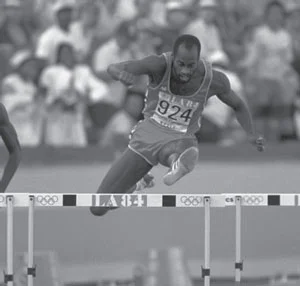
To understand why June 4, 1987 broke sports fans' brains, you need to grasp what 122 wins actually means in individual track and field. This isn't a team sport where a superstar can absorb a bad day by leaning on eight other guys. There's no overtime, no second game in the series. Every 400m hurdles race is a single 47-second sprint where one clipped hurdle, one bad lane draw, or one faster opponent on one specific afternoon ends everything.
Moses ran 107 consecutive finals from August 26, 1977 through June 4, 1987 — nine years, nine months, and nine days. 2 He also won 15 preliminary heats. Before Madrid, his last defeat had come in Berlin, where West Germany's Harald Schmid beat him. One week later in Düsseldorf, Moses beat Schmid by 15 meters (roughly 49 feet) and didn't stop winning for nearly a decade. 2
During those nine years, Moses set the world record four times: 47.63 at the 1976 Montreal Olympics (also an Olympic record), 47.45 in 1977, 47.13 in 1980, and 47.02 on his 28th birthday in Koblenz, West Germany in 1983. 3 That last mark stood for nine years until Kevin Young ran 46.78 at the 1992 Barcelona Olympics — using a 12-step approach between hurdles that Moses had publicly predicted would be necessary to break 47 seconds. 3
ESPN later ranked his streak #11 on its list of the 33 best streaks in sports history — ahead of Byron Nelson's 11 consecutive PGA Tour wins and Martina Navratilova's 74 straight singles wins. 4 For comparison, Joe DiMaggio's 56-game hitting streak in baseball — the record casual fans cite as the untouchable one — covers roughly two months of a team sport with a roster of 25 players. Moses did his thing alone, for nine years.
The kid who did it
Danny Harris was 21 years old, ten years younger than Moses and not exactly a stranger. At 18, Harris had already won the Olympic silver medal at the 1984 Los Angeles Games, finishing behind Moses with a time of 48.13 seconds. 5 His 48.02 from that year was the world under-20 record — a mark that stood until 2021 when Sean Burrell ran 47.85. 5
At Iowa State University, Harris had never lost a 400m hurdles race to another collegiate athlete. He arrived in Madrid ranked among the world's best, and at the Estadio de Vallehermoso on June 4 he ran a personal best of 47.56 seconds — the fastest he'd ever gone. Moses ran 47.69 (his season's best). Third place, American Nate Page, crossed at 50.12. 1
The margin was 0.13 seconds, or about six feet.
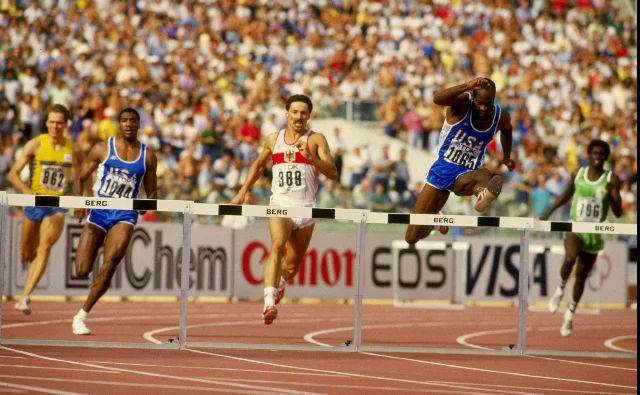
Moses led over the first two hurdles. Harris took the lead at the fifth and held it. Then came the final hurdle — the tenth — and Moses clipped it. "I hit the 10th hurdle and that really cost me the race," he said afterward. "I ran a good race and the guy that beat me is 10 years younger and ran the race of his life." 1
He also noted: "It's very early in the season for me to be running in Europe. I'm not as sharp as I would be normally." 1
Both things were probably true. Harris ran the race of his life. And Moses wasn't fully sharp. That's how 122-race streaks end — not with a dramatic decline or a dominant rival finally seizing power, but with a bad hurdle on an early-season afternoon in front of roughly 11,000 people in Spain.
The crowd knew what they'd just watched
After the race, the 11,000 fans at Vallehermoso chanted Moses' name for thirty minutes. Moses, smiling, completed a solitary lap of honor around the track. Then Harris shook his hand. "It's been a great day for me," Harris told reporters. "It makes me proud to have beaten an athlete of his caliber." 1
Moses won his next ten races in a row, including the gold medal at the 1987 World Championships in Rome on September 1 — 89 days after Madrid. The final in Rome was one of the closest in championship history: Moses crossed first in 47.46, Harris and Schmid both ran 47.48. Three men, two hundredths of a second. 6
Then at the 1988 Seoul Olympics, Moses ran his fastest Olympic final ever but finished third — bronze behind fellow American Andre Phillips, who had idolized Moses in high school and reportedly lost to him more than 20 times. Moses retired after Seoul with a career record of 178 victories in 187 races. 3
The physicist who reinvented the race
What made the streak possible wasn't just athletic talent — it was biomechanical architecture. Moses, a physics major at Morehouse College (which had no track; he jumped fences to use public school facilities and trained at General Dynamics while employed as an engineer), was the first athlete to consistently maintain 13 strides between all 10 hurdles throughout a 400m hurdles race. 7
Most competitors at the time used 15 strides, or switched patterns as they fatigued. At 6'2" (1.88m) with a 37-inch inseam and a natural stride of 2.70 meters, Moses could compress his stride to 2.30 meters and mathematically fit 13 consistent steps between hurdles. The advantage: he never had to switch his lead leg, which meant he pulled away decisively in the second half of races while rivals tired and stumbled into awkward alternating footwork.
When Moses told a coach he'd run 13 steps the whole way, the coach's reaction was blunt. "He said, 'Oh, that's impossible.' They thought it was impossible to do that. So I changed the way that the race was run," Moses recalled in 2024. 8
Today, Karsten Warholm (current world record holder at 45.94 seconds) and Sydney McLaughlin-Levrone (women's world record holder) both use the race model Moses established: get out fast, attack the hurdles, run it like a 400 without obstacles. 8
What happened to the man who ended the streak
Danny Harris's story took a different trajectory.
He finished fifth at the 1988 US Olympic Trials — missing the Seoul squad by one spot, behind Moses, Andre Phillips, and Kevin Young. That failure, he later said, cracked something. The cocaine addiction that followed derailed what might have been a dominant career in the early 1990s. 5 In 1992, Harris tested positive at the USA Indoor Championships and received a four-year ban from the IAAF. A second positive test after a 1996 race in Rio de Janeiro ended his career permanently. He lost his shoe contract, sold his house in Los Angeles, and spent years homeless. 9
His personal best — 47.38 seconds, set in Lausanne in July 1991 — is a reminder of just how good he was before things fell apart. 5
By 2008, Harris was working at the Midnight Mission homeless shelter on Los Angeles' Skid Row, the same place where he'd previously been a client. "I've gone through a particular kind of hell," he said. "But my story is proof that after the darkness there is a dawn, that there is redemption from our darkest moments. I feel good. I can breathe again." 9
Roger Black, the British 400m runner who trained alongside Harris, captured both the waste and the limits of the drug: "He was without doubt the most talented athlete I've ever trained with... The irony of the whole thing was, cocaine was not making him a better athlete, it was making him worse." 5
One number you can't get close to
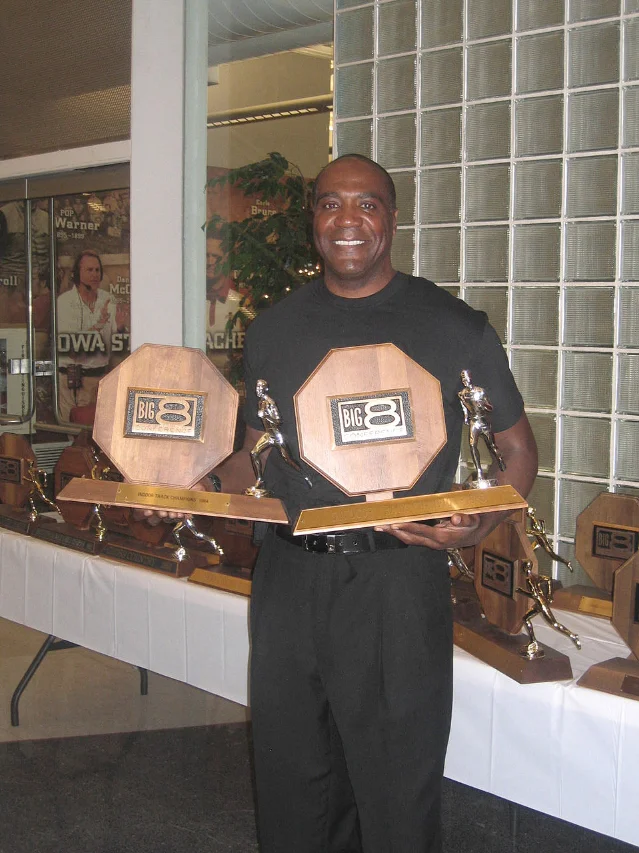
The 122-win streak remains the longest in any running event in track and field history. 4 No 400m hurdler since — not Kevin Young, not Felix Sanchez, not Karsten Warholm — has strung together anything that approaches it. The world record has fallen twice since Moses' 47.02 (Young took it to 46.78 in 1992, then Warholm obliterated it at the 2021 Tokyo Olympics with 45.94), 3 but winning 122 consecutive races in an individual sprint event remains in a category of its own.
Moses himself seemed to understand what he'd built. Asked how he wanted to be remembered, he told ESPN: "Hopefully, as the guy nobody could beat. Maybe in the years to come, people will understand the things I have accomplished and realize, 'Wow, this guy was really something. Nobody's ever going to do that again.'" 2
Leroy Walker, the U.S. Olympic track coach who saw Moses win in 1976, put it differently: "In an art gallery, do we stand around talking about Van Gogh? Extraordinary talent is obvious. We're in the rarefied presence of an immortal here. Edwin's a crowd unto himself." 2
The crowd in Madrid on June 4, 1987 agreed. They kept chanting his name for half an hour after he lost.
Cover image: AI-generated illustration
References
- 1The New York Times / AP — Moses' Streak Is Ended at 122
- 2ESPN SportsCentury — Moses made winning look easy
- 3Wikipedia — Edwin Moses
- 4ESPN — The 33 best streaks in sports history
- 5Wikipedia — Danny Harris
- 6Los Angeles Times — This Day in Sports: Edwin Moses' win streak comes to an end
- 7World Athletics Heritage — Moses–13 Steps documentary
- 8Andscape — Film reveals Morehouse alum Edwin Moses' imprint on today's stars
- 9Los Angeles Times — Addiction turned out to be his biggest hurdle
Add more perspectives or context around this Post.