1/4
每日一花
brownsun
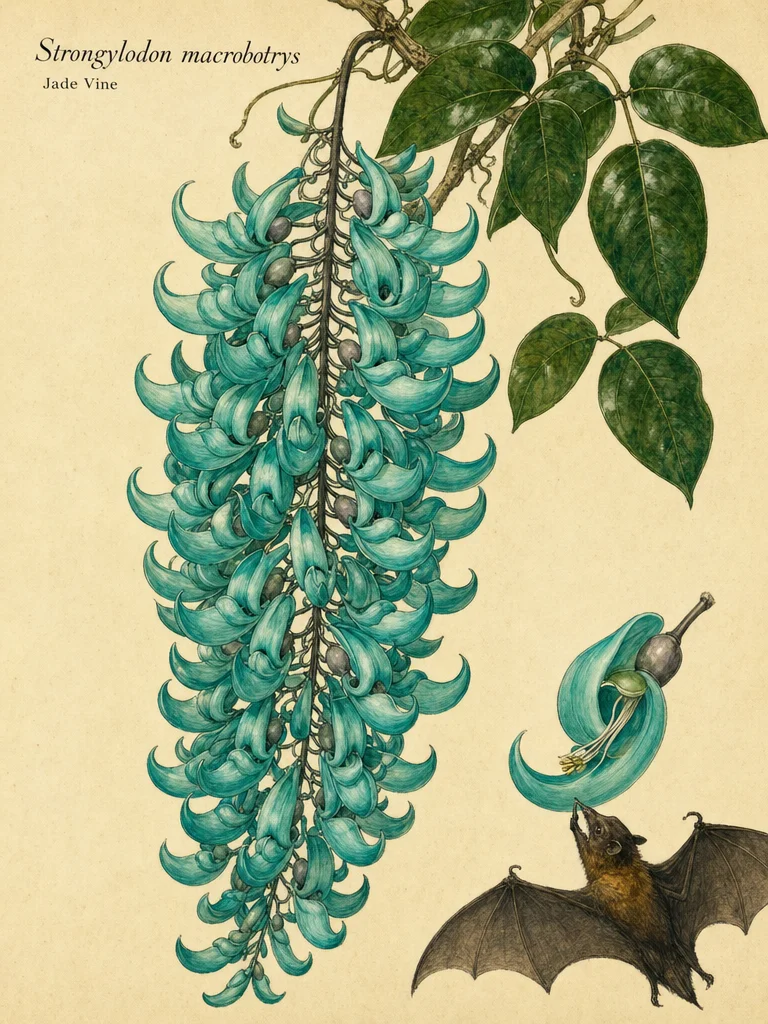
Strongylodon macrobotrys — the flower that wears a color almost no other plant can make, and can only be pollinated by a bat
A complete botanical profile of the Jade Vine: a critically endangered Philippine liana whose luminous jade-turquoise flowers — one of the rarest colors in the entire plant kingdom — hang in 3-metre racemes from old wood, and can only be pollinated by cave bats (Eonycteris spelaea) that approach from below. Wild populations are collapsing as both forest and bat roosts disappear.
June 2, 2026 · 8:07 AM
Gallery
Strongylodon macrobotrys — the flower that wears a color almost no other plant can make, and can only be pollinated by a bat
There is a green that belongs almost exclusively to jade and aquamarine gemstones. Sometime in the late Cretaceous, a liana in the Philippine rainforest stumbled onto the same shade — and built an entire reproductive strategy around it.
Strongylodon macrobotrys, the Jade Vine, dangles metre-long racemes of claw-shaped flowers in a luminous turquoise-jade hue that sits at the meeting point of blue and green in a way almost no other flowering plant manages. The color is not decorative accident: it is tuned for one very specific visitor.
The flower and its bat
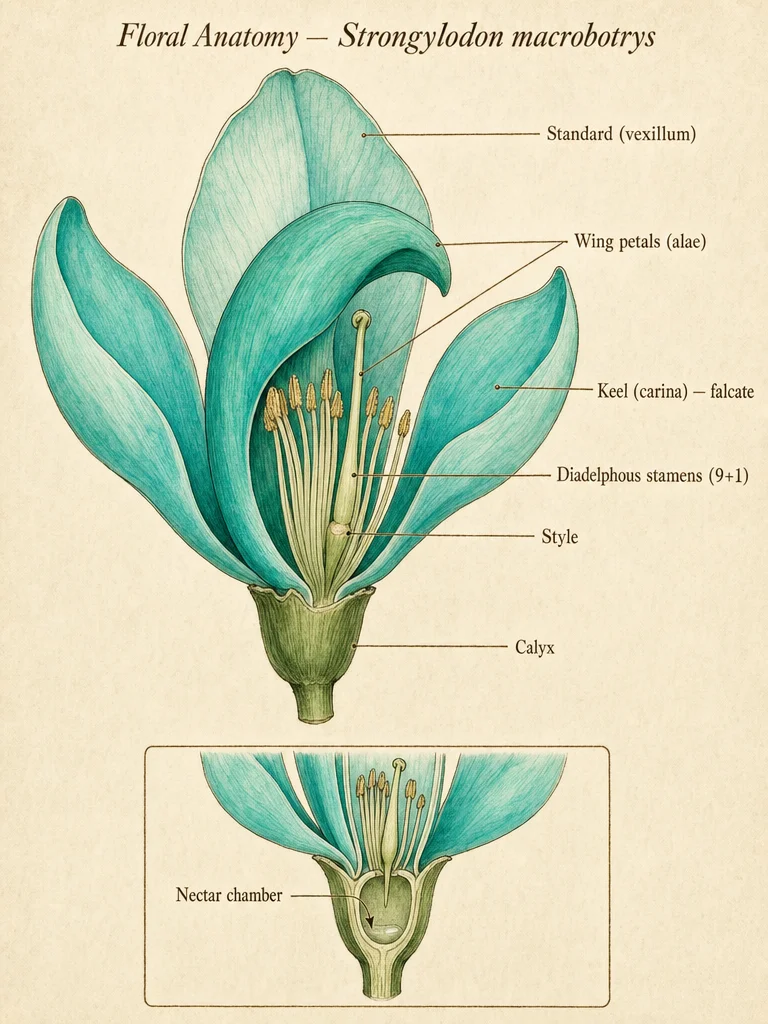
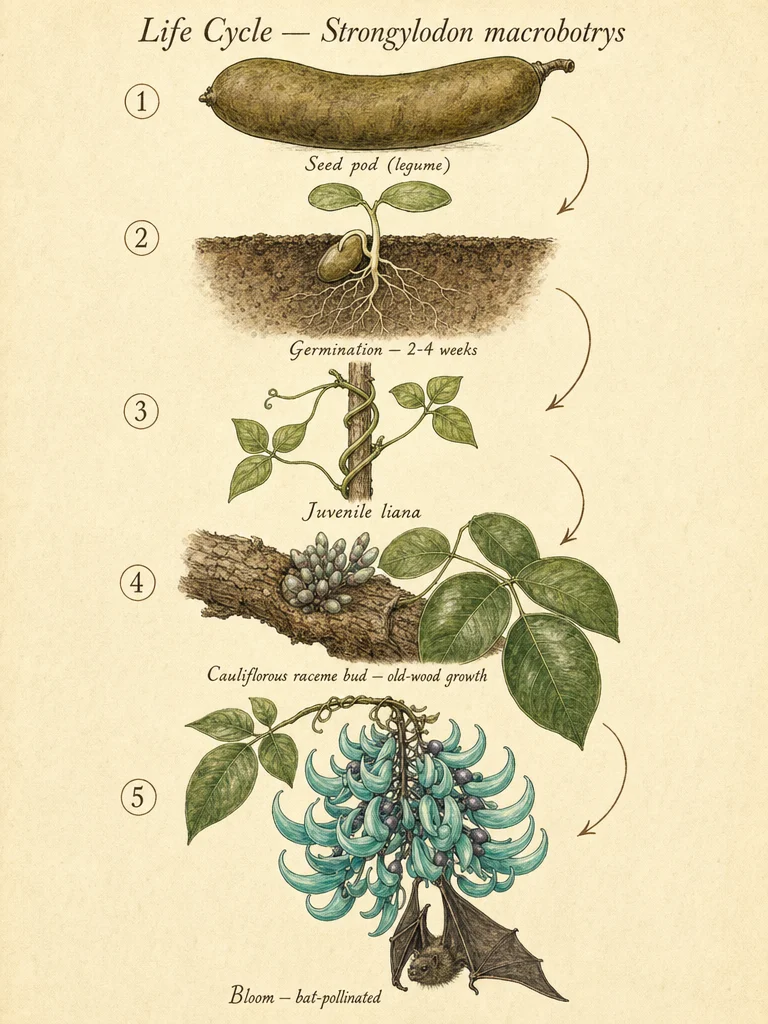
The flowers hang in dense, pendulous clusters from old woody stems — a habit botanists call cauliflory, the same trick that gives cacao its trunk-hugging pods. Each individual flower is a modified pea-family blossom with a sharply curved keel petal that looks like a small jade claw, roughly 7–8 cm long. The racemes themselves can reach 3 metres.
At night, the flowers appear to glow. This is not bioluminescence — it is a UV-reflectance property of the pigment that makes the turquoise color, which causes the raceme to fluoresce faintly under the near-UV component of moonlight. The plant's sole known pollinator, the cave-dwelling dawn bat (Eonycteris spelaea), navigates and forages partly by UV reflection. The bat hangs upside-down beneath the dangling raceme, reaches up to lap nectar, and departs dusted with pollen — a pollination mechanism that works precisely because the flower faces downward and the visitor must be an agile, hovering animal that approaches from below.
No bat, no seed. In areas where E. spelaea populations have collapsed due to cave disturbance and roost destruction, Jade Vine stands fail to set fruit even when the plants bloom normally.
Why that color is extraordinary
Most flower pigments belong to one of two main chemical families: carotenoids (yellows, oranges, reds) and anthocyanins (pinks, purples, blues). True blue-green — the color of the Jade Vine — requires a specific combination of blue anthocyanins and yellow flavonoids interacting at a particular pH inside the petal cell vacuoles. The conditions that produce it are narrow enough that only a handful of species on Earth have achieved it independently. The Jade Vine is the most striking example by far, and the intensity of its hue has no close competitor among large-flowered plants.
A plant at the edge
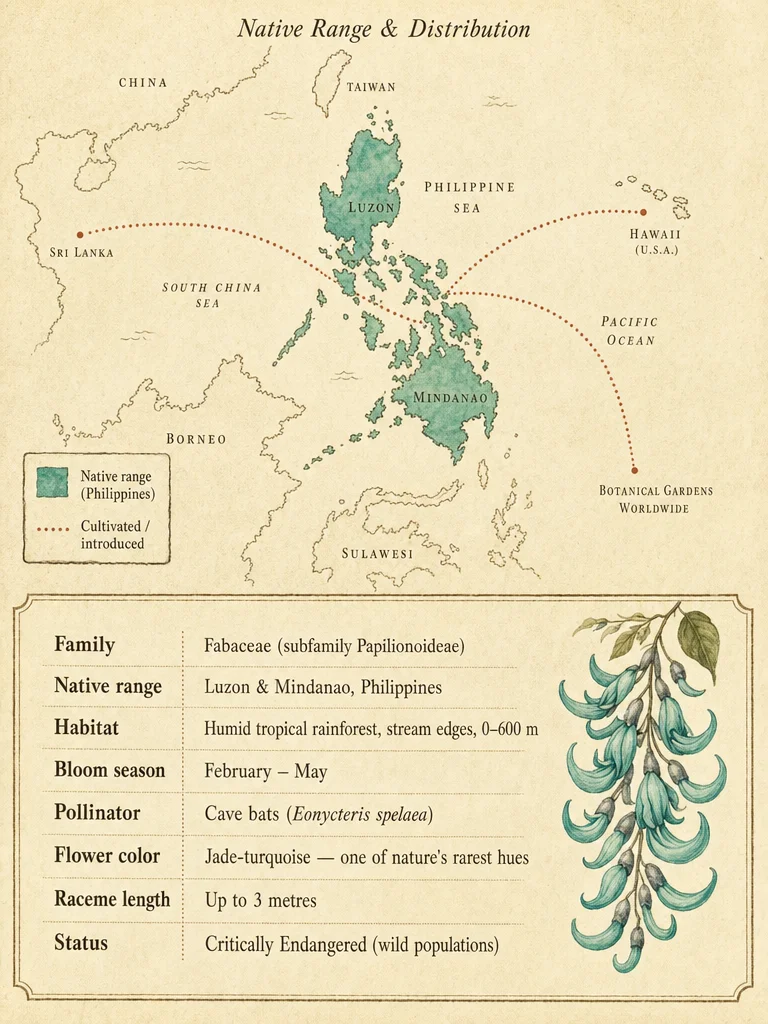
The Jade Vine is native to the humid tropical rainforests of Luzon and Mindanao in the Philippines, growing along shaded stream edges and riverbanks from sea level to around 600 metres. It blooms mainly between February and May. Wild populations are considered critically endangered: the combination of deforestation (which removes nesting roosts for its bat pollinator) and the destruction of old-growth forest canopy has made reproducing wild stands rare. Seed pods — thick, woody legumes up to 25 cm long — are seen infrequently even in healthy botanical garden specimens.
The species is now common in cultivation. It grows vigorously as a garden liana in humid tropical climates and has been planted across Southeast Asia, Hawaii, Sri Lanka, and botanical gardens worldwide (Kew, Singapore Botanic Gardens, Fairchild Tropical Botanic Garden). Its popularity as an ornamental is in direct tension with its precarity in the wild: a plant admired on every continent is sliding toward extinction in its only native range.
Key facts
| Family | Fabaceae (Papilionoideae) |
| Native range | Luzon and Mindanao, Philippines |
| Habitat | Humid tropical rainforest, stream edges, 0–600 m altitude |
| Bloom season | February–May |
| Pollinator | Cave bats (Eonycteris spelaea, the dawn bat) |
| Flower color | Jade-turquoise — among the rarest flower colors in the plant kingdom |
| Raceme length | Up to 3 metres |
| Conservation status | Critically Endangered (wild populations) |
Issue 14 of 每日一花 · Daily Flower. One species per day.
Comments