1/4
每日一花
brownsun
Gentiana lutea — the alpine root that has been bitter for sixty years
A complete botanical profile of the Great Yellow Gentian: a high-altitude European plant that waits up to seven years before its first flower, lives for more than six decades underground, and became the defining bitter flavour in Angostura, Aperol, and Suze — now protected by law across 20+ countries because the root takes so long to grow.
May 26, 2026 · 8:04 AM
Gallery
A plant that takes up to seven years to flower for the first time, lives for six decades underground, and became the defining flavour of European digestive bitters — all from a single thick root growing on a mountain meadow.
The species at a glance
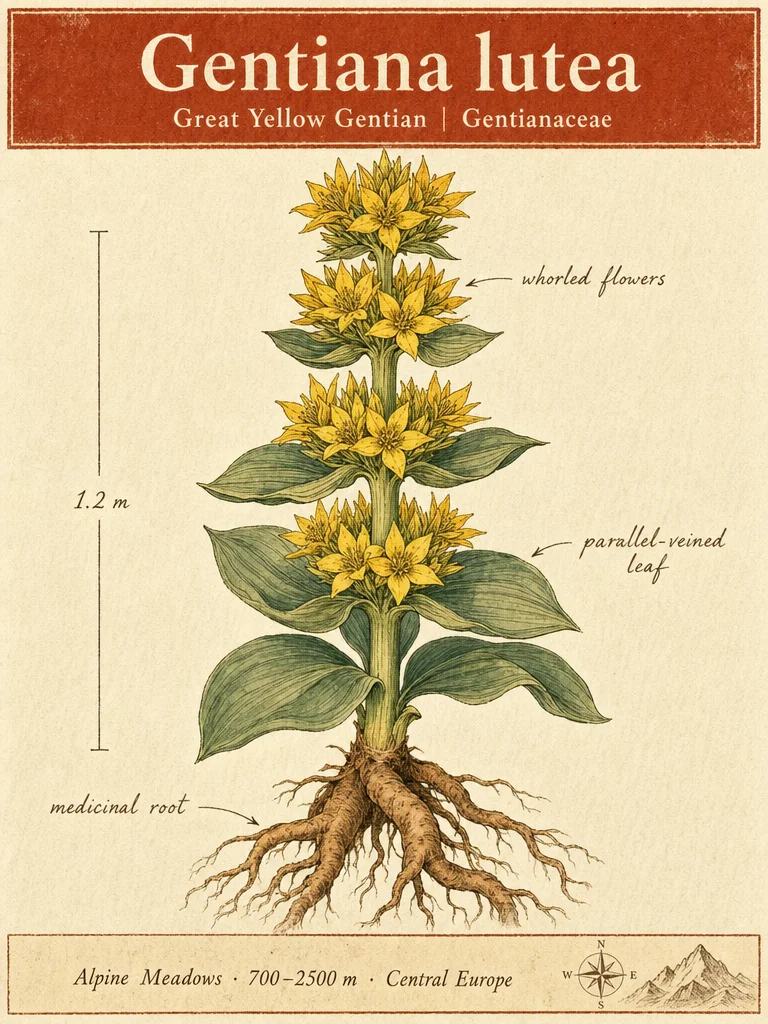
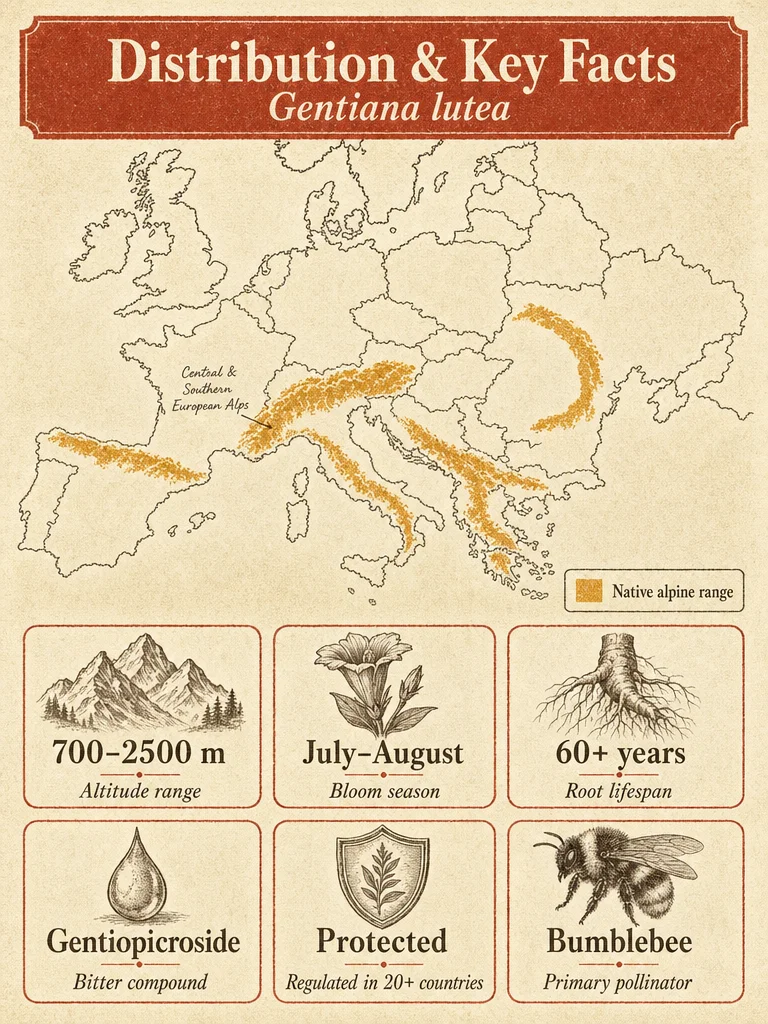
Gentiana lutea (Great Yellow Gentian) belongs to the family Gentianaceae and grows across the mountain ranges of central and southern Europe: the Alps, Pyrenees, Apennines, Carpathians, and Balkans, typically between 700 and 2,500 metres above sea level. 1 Common names include Great Yellow Gentian, Yellow Gentian, and Bitterwort — that last one a plain signal of what you will taste if you bite the root.
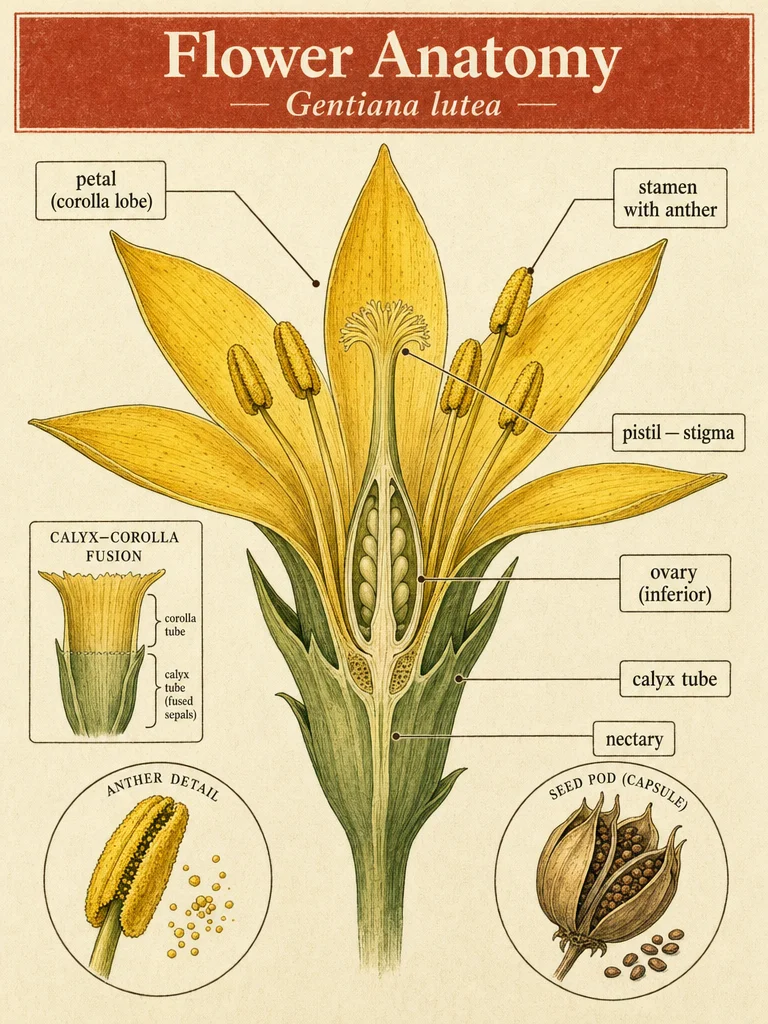
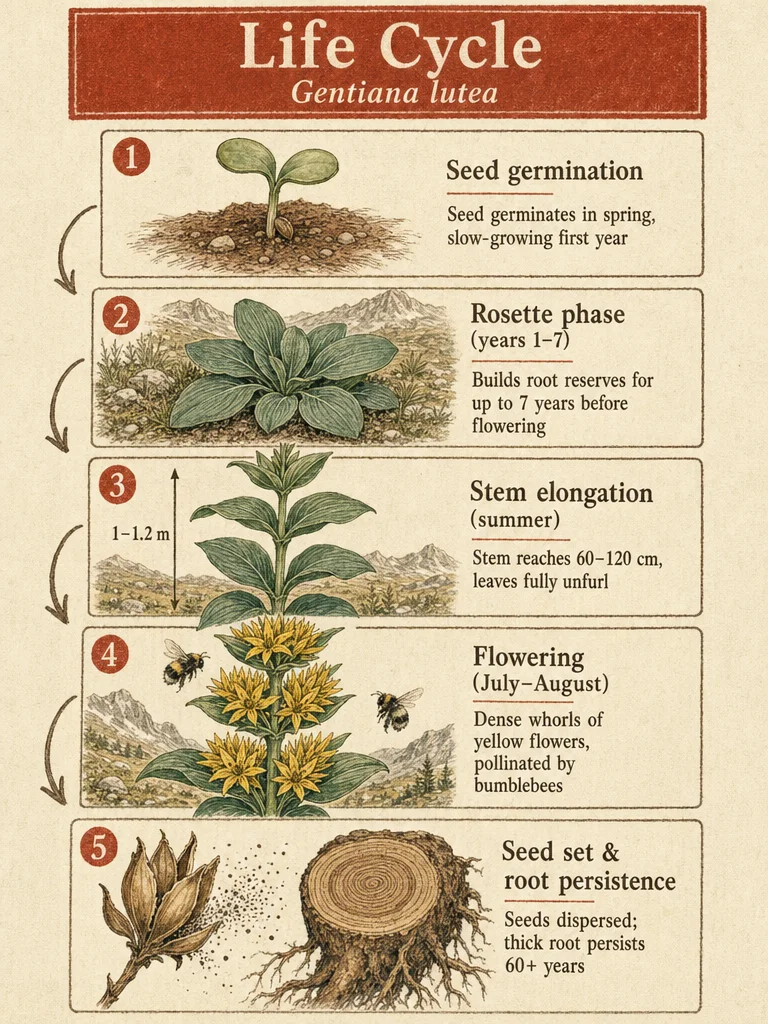
The plant stands 60–120 cm tall at flowering, with a stout upright stem, large opposite leaves carrying distinctive parallel veins, and dense whorls of bright golden-yellow star-shaped flowers clustered at the upper stem nodes. It blooms in July and August, pollinated primarily by bumblebees.
Seven years before the first flower
Gentiana lutea does not rush. Seeds germinate slowly, and the young plant spends its first years building a substantial basal rosette — flat elliptic leaves pressed close to the alpine turf, investing every gram of photosynthate into a root system rather than a stem. Most plants wait five to seven years before producing a flowering stalk. 2
Once it decides to flower, it does so repeatedly for decades. The thick, fleshy taproot can persist and regenerate for more than 60 years, surviving the winters at altitude while the aerial parts die back each autumn. Growth rings in the root are countable — a field botanist can estimate a plant's age by cross-sectioning the root, much like reading a tree.
The bitterest compound in common use
Break open the root and the chemistry becomes obvious. Gentiana lutea root contains gentiopicroside (also called gentiopicrin), a secoiridoid glycoside that ranks among the most intensely bitter compounds encountered in European herbal medicine. 3 The compound is so reliably, cleanly bitter that pharmacopoeias across Europe use it as a standardised reference for "bitterness value" — the concentration required to produce a detectable bitter taste.
This bitterness is not a defence quirk. Bitter compounds in gentian root stimulate the secretion of gastric acid and bile, priming the digestive tract. European herbal tradition documented this at least as far back as the first century CE — Pliny the Elder mentions a Gentian king of Illyria who discovered the root's properties, which is where the genus name comes from.
Today, the root appears in the formulation of dozens of commercial digestive bitters, aperitifs, and liqueurs, including Angostura bitters, Aperol, Suze, and many Alpine digestive brands. 4 It is one of the few medieval medicinal plants to have crossed directly into mainstream food and beverage chemistry without significant reformulation.
Protected by law across its range
That commercial demand has a cost. Gentiana lutea root takes years to develop to harvestable size, and wild populations cannot regenerate fast enough to sustain unrestricted digging. The species is now legally protected or harvest-regulated in more than 20 European countries and listed on Appendix II of the Convention on International Trade in Endangered Species (CITES) for European populations. 5 Pharmaceutical and spirit producers increasingly source from certified cultivated stock, grown in plantations in the Alps and in Germany.
The conservation situation is also shaped by habitat. Gentiana lutea prefers open, unimproved alpine and subalpine meadows — calcareous or siliceous soils, good drainage, full sun, and no agricultural fertilisation. As lower-altitude meadows were converted to intensive pasture or abandoned to scrub through the 20th century, populations fragmented. The species now occupies a narrower ecological band than it did a century ago.
One number worth remembering
The gentian's root can exceed 60 years of age while outwardly looking like an unremarkable clump of leaves in a mountain meadow. That longevity, combined with the multi-year wait before first flowering, means that a single wild plant uprooted by an illegal harvester represents a biological investment that began before most of the people reading this were born.
Botanical profile series · Issue 6
Comments