1/3
Your cat's "disgust face" isn't disgust. It's a second nose switching on.
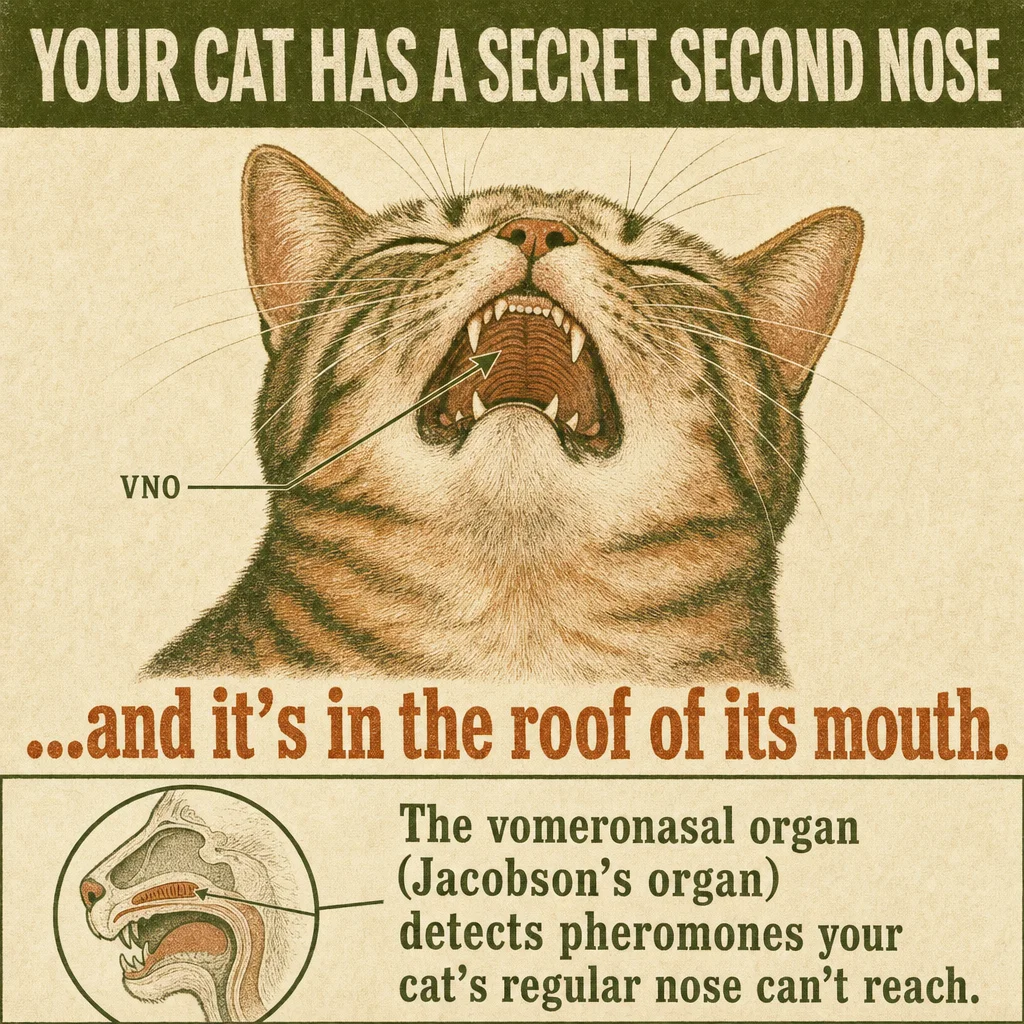
That weird lip-curl your cat makes when it sniffs something? That's the Flehmen response — the cat is routing pheromones into a separate organ called the vomeronasal organ (Jacobson's organ) in the roof of its mouth, which bypasses the regular nose entirely and sends signals straight to the brain's emotion and reproductive behavior centers.
May 30, 2026 · 11:05 PM
Gallery
That weird face your cat makes isn't disgust. It's a second nose switching on.
You've seen it: your cat sniffs something, then freezes with its upper lip curled back, teeth slightly showing, chin dropped, looking somewhere between baffled and insulted. That's called the Flehmen response — and it's one of the more extraordinary things happening inside your cat's skull right now.
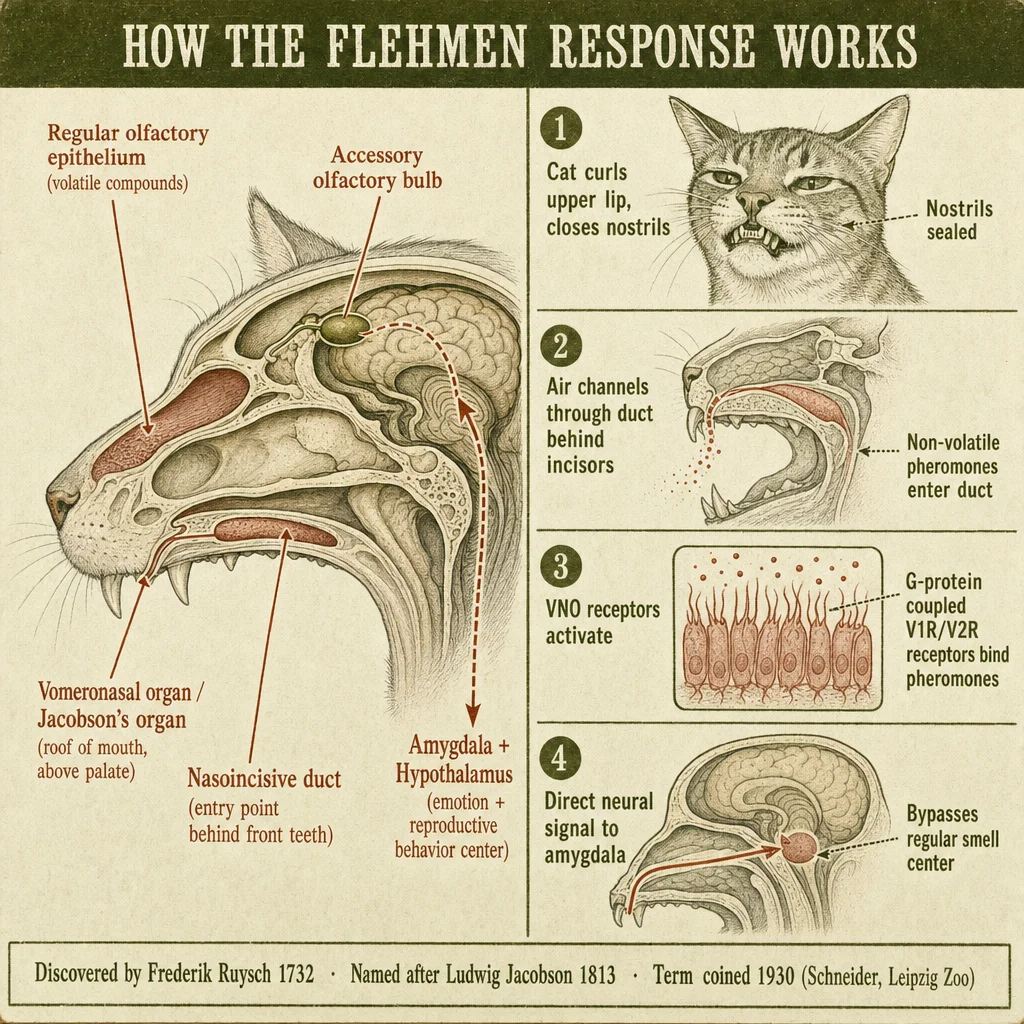
Here's what's actually going on. When a cat performs that grimace, it's not reacting to a bad smell. It's doing the opposite: it's deliberately routing scent molecules into a completely separate smell organ called the vomeronasal organ (VNO), also known as Jacobson's organ, tucked into the roof of the mouth just above the hard palate.
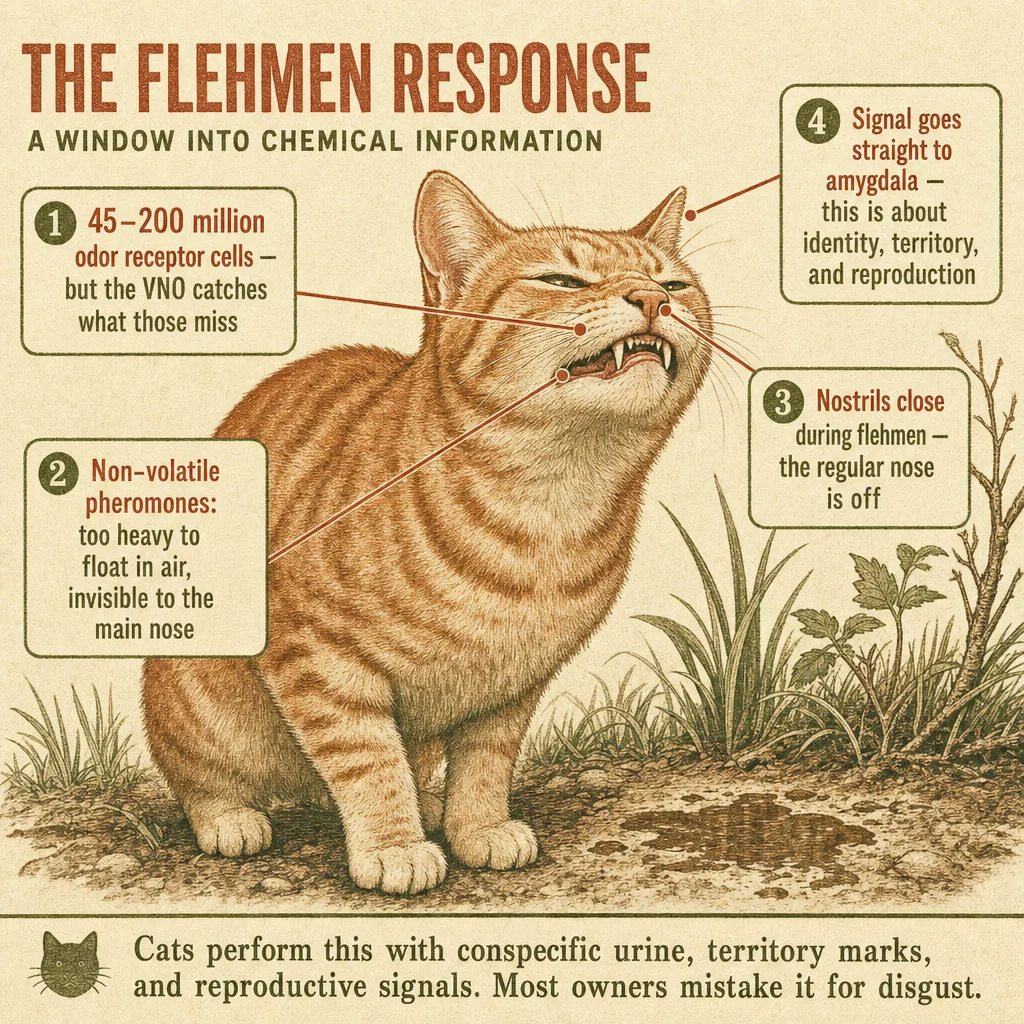
The organ accesses the outside world through a small duct that opens just behind the front teeth. By curling the lip back, closing the nostrils, and inhaling slowly, the cat channels non-volatile organic compounds — pheromones, hormones in urine, territorial markers, reproductive signals — directly into that duct. These are molecules too heavy to float freely in air. The regular nose, which detects volatile compounds, can't grab them. The VNO can.
What's unusual about the VNO's wiring is where the signal goes. Regular olfactory nerves route to the olfactory bulb and then to the cortex. VNO neurons project to the accessory olfactory bulb, which feeds directly into the amygdala and hypothalamus — the brain structures governing emotion, territorial behavior, and reproductive response. The cat isn't consciously "analyzing" what it smelled. The information goes somewhere older and faster than that.
Cats have somewhere between 45 and 200 million odor-sensitive cells in their noses (humans have about 10 million), and their olfactory epithelium covers roughly 20 cm². But the pheromone channel runs on different hardware entirely — and it's the one doing the important social work.
Most owners interpret the face as disgust. It isn't. Your cat has just found a chemical message in something — another cat's urine, a spot of territory, a trace of reproductive signal — and opened the back channel to read it properly.
The behavior was first described by anatomist Frederik Ruysch in 1732, later studied by Ludwig Jacobson in 1813 (whose name stuck to the organ), and the term "flehmen" was coined in 1930 by Karl Max Schneider, director of the Leipzig Zoo and a leading authority on big cats in captivity. It occurs across a wide range of mammals — cats, horses, tigers, lions, elephants, bison — and in each case serves roughly the same purpose: reading chemical signals too complex for the regular nose.
Sources:
Have you caught your cat doing this face? What had they been sniffing? Drop it in the comments — the answers are always either hilarious or deeply unsettling.
Daily Cat Fun Facts — one surprising cat truth, every day.
Comments