
When the rescuer walks: Enron, Dynegy, and the 26-day merger that collapsed

When the rescuer walks: Enron, Dynegy, and the 26-day merger that collapsed

In November 2001, Houston rival Dynegy announced an $8 billion rescue merger with the collapsing Enron Corporation — then walked away 20 days later, triggering the largest corporate bankruptcy in U.S. history. The case traces the 26-day negotiation through four critical junctures: the pipeline-collateral credit line that anchored Dynegy's BATNA, the MAC clause mechanics under rating-agency pressure, the due diligence revelation of $22 billion in hidden debt, and the triple junk downgrade that triggered $3.9 billion in cross-default accelerations.

Business Negotiation Classics: One Case a Day
June 6, 2026 · 9:27 PM
1 subscriptions · 19 items
On October 22, 2001, the Securities and Exchange Commission announced a formal investigation into Enron Corporation's related-party transactions. That afternoon, Enron's stock fell 20% in a single day — to $20.65. 1 Three days later, CFO Andrew Fastow was fired. One week after that, Enron discovered it could no longer roll its commercial paper, forcing a $3.3 billion emergency buyback that drained its revolving credit lines to near zero. 1
Twenty-six days later, Houston rival Dynegy announced it would rescue Enron for $8 billion in stock. Twenty days after that, Dynegy walked away.
Six days after that, Enron filed the largest corporate bankruptcy in U.S. history.
The Enron-Dynegy negotiation is one of the most compressed and instructive deal sequences in modern M&A history. It covers every failure mode in distressed-asset dealmaking: information asymmetry so severe the seller couldn't fully quantify its own liabilities, a MAC clause removed under rating-agency pressure that stripped the buyer of its exit ramp, a credit-rating tripwire that converted a solvency event into an instant liquidation, and a $10 billion lawsuit filed by a bankrupt company against the buyer who declined to complete the acquisition. It is taught at Harvard Business School, cited in the foundational academic literature on governance failure, and remains the reference case for why "turbo incentives require turbo controls." 2
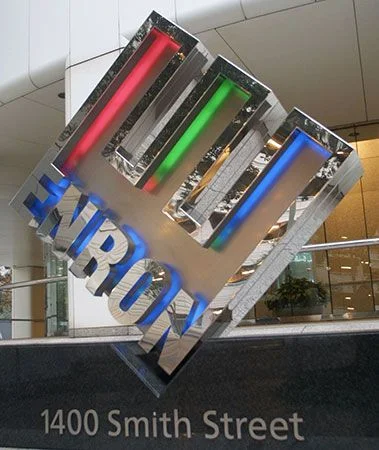
Enron's Houston headquarters complex at 1400 Smith Street, later sold as part of the bankruptcy estate. 3

The parties, their leverage, and what they actually wanted

EnronDynegy
Stated objectiveSecure a merger partner to restore market confidence and stay solventAcquire Enron's energy trading platform and pipeline assets at a distressed-asset discount
Hidden preferenceDelay disclosure of the full liability picture long enough to close a deal; preserve Ken Lay's legacy and Enron's trading franchiseKeep optionality to walk away; extract maximum asset value (the Northern Natural Gas pipeline) if the deal collapsed
BATNANone that was viable — the commercial paper market had closed, the credit lines were exhausted, and the SEC investigation was liveWalk away and absorb the $1.5B pipeline collateral in lieu of the merger premium
LeverageSystemic threat: Enron's energy derivatives book was large enough that Fox-Pitt Kelton raised the possibility of "material disruption" to the U.S. financial system if it failed 4ChevronTexaco's $2.5B cash backing; the deal was optional for Dynegy, existential for Enron 4
Hidden asymmetryEnron reported $10B in debt; actual debt was approximately $22B — a 50% understatement driven by off-balance-sheet SPEs 5Dynegy had three weeks of due diligence to evaluate a company that its own CFO hadn't fully understood. The buyer's information disadvantage was structural, not incidental
The power asymmetry looks obvious in hindsight. At the time, it was obscured by Enron's sheer scale — $100.7 billion in reported 2000 revenues, a Fortune 500 rank of sixth globally, a dominant electronic trading platform — and by the political and financial pressure to avoid a disruptive collapse. 1 The asymmetry that mattered was not Dynegy's leverage over Enron; it was Enron's own opacity about itself.

The accounting engine no one could read

Enron's transformation from a natural gas pipeline operator into an energy trading powerhouse was engineered by CEO Jeffrey Skilling, who joined as a consultant and later became COO. Skilling pioneered the use of mark-to-market accounting for Enron's long-term energy contracts — booking the estimated present value of multi-year deals as immediate revenue. 1 The practice, once limited to straightforward commodity contracts, was eventually extended to speculative broadband, water utility, and international power investments where "fair value" was essentially whatever Enron's models said it was.
The concealment machinery was built by CFO Andrew Fastow. Between 1997 and 2001, Fastow created a network of special purpose entities (SPEs) — off-balance-sheet vehicles that absorbed Enron's losing investments as nominal "sales," kept $22 billion in debt off the reported balance sheet, and generated fictitious gains through circular transactions. 5 His four Raptor SPEs — named after Jurassic Park's velociraptors — held over $1.2 billion in Enron assets using Enron's own stock as collateral, then entered derivative swap contracts with Enron worth a notional $2.1 billion. When Enron's stock fell, those swaps lost $1.1 billion in value; the Raptors owed Enron money they could never repay. 1 Enron booked a $500 million gain on those contracts in its 2000 annual report — nearly a third of that year's reported earnings.
Fastow received a board-approved exemption from Enron's own code of ethics to manage the LJM partnerships while serving as CFO, and personally earned over $30 million from those arrangements. 1
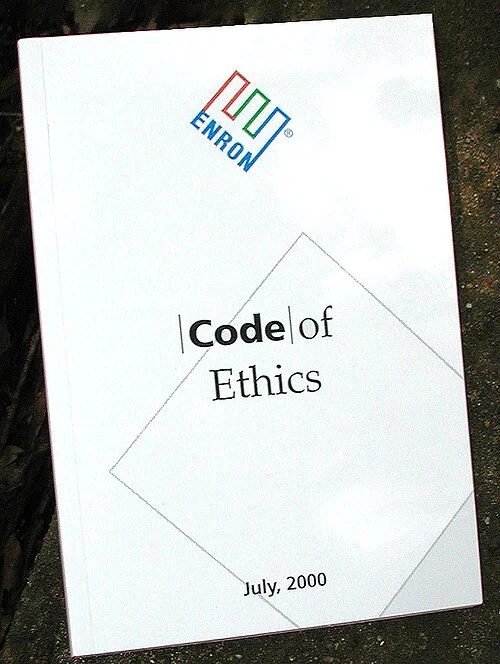
Enron's Code of Ethics booklet, dated July 2000 — one year before the collapse
Enron published a 64-page Code of Ethics in July 2000; the board suspended it to allow Fastow's SPE arrangements. 1
The first public signal came not from inside Enron but from Fortune magazine. Bethany McLean's March 2001 article "Is Enron Overpriced?" asked how exactly a company trading at 55 times earnings actually made its money. 5 The internal signal came in August 2001, when VP of Corporate Development Sherron Watkins sent an anonymous letter to CEO Ken Lay warning: "I am incredibly nervous that we will implode in a wave of accounting scandals." 6 Lay commissioned Enron's own law firm, Vinson & Elkins, to review the concerns. On October 15, Vinson & Elkins concluded Enron had done nothing wrong. 1
The board's failure was not ignorance. HBS professor Malcolm Salter, author of the three-part "Innovation Corrupted" case series on Enron, characterized the collapse as "ethical drift" preceded by "terminal incompetence": "Before fraud, there was terminal incompetence. As a matter of fact, if you look at a lot of the fraud cases, before fraud there was terminal incompetence." 2 The Powers Committee — the independent investigation commissioned by Enron's own board in February 2002 — found that Enron's actual debt was understated by 50%: roughly $10 billion reported against $22 billion actual. 5 It also found that 96% of Enron's reported fiscal 2000 net income was attributable to accounting violations. 5

The 26-day negotiation

November 2: the pipeline collateral

On November 2, 2001, Enron secured a $1 billion emergency credit line from Dynegy, collateralized against Enron's Northern Natural Gas pipeline — a 17,000-mile system connecting the Texas Gulf Coast to the upper Midwest. 4 That single transaction made the pipeline the most important asset in the negotiation — and set the stage for the post-collapse litigation.

November 7–9: the $8 billion announcement

On the evening of November 7, Dynegy's board voted to acquire Enron for approximately $8 billion in stock. 1 The deal terms reflected the power imbalance precisely: Dynegy CEO Chuck Watson would lead the combined company; Enron shareholders would receive a 40% stake in the enlarged Dynegy with three board seats; Ken Lay would hold no management role. ChevronTexaco, which held a 26% stake in Dynegy, committed $2.5 billion in total cash support — $1 billion upfront and the remainder at closing. Dynegy would assume nearly $13 billion of Enron's disclosed debt, plus whatever was still hidden. 1
The financing terms mattered as much as the economics. Moody's had planned to downgrade Enron below investment grade on November 8, which would have immediately triggered cross-default clauses. To prevent this, the parties negotiated a revised deal structure: the "material adverse change" (MAC) clause in the merger agreement was narrowed — retooled to make it significantly harder for Dynegy to invoke; rating triggers in Enron's financing agreements were eliminated; Dynegy committed an additional $1 billion in equity; and Enron and Dynegy bonds were made pari passu — equal in ranking. 7 Moody's held off. The announcement went forward.
The next day — November 8 — Enron announced its second major restatement: an additional $591 million reduction in reported profits from 1997 through 2000, virtually eliminating all profit for fiscal year 1997. 1 Dynegy reaffirmed its intent to acquire anyway. At this point, the MAC clause was already gone.

November 21: the cash burn revelation

By mid-November, Dynegy's due diligence teams were inside Enron's books. What they found accelerated their concern. 4 On November 21, Enron disclosed that nearly all of the $5 billion it had recently borrowed to buy back commercial paper had been exhausted in 50 days. 1 Fitch publicly warned on the same day that without the merger, Enron's financial position was unsustainable. Dynegy, alarmed by the cash burn rate and the volume of liabilities surfacing in due diligence, began renegotiating — lowering its offer from $8 billion to approximately $4 billion. 1

November 28: the credit cliff

On November 28, 2001, all three major credit rating agencies moved simultaneously. Standard & Poor's downgraded Enron to B-minus; Moody's cut it below investment grade; Fitch downgraded to CC, signaling probable default. 4 The junk designation triggered approximately $3.9 billion in cross-default debt acceleration clauses — payments that became immediately due. 7 EnronOnline, the company's electronic trading platform that had processed $335 billion in transactions in its first year, shut down the same day. Enron's stock fell to $0.61 per share — down from $85 twelve months earlier. 1
Dynegy's board voted that morning to terminate the merger. CEO Chuck Watson invoked the MAC clause — the clause the parties had narrowed but not eliminated in the November 8 amendments. Watson issued his now-famous statement: "Sometimes a company's best deals are the ones they did not do. We knew when to say no and this morning we said no." 4
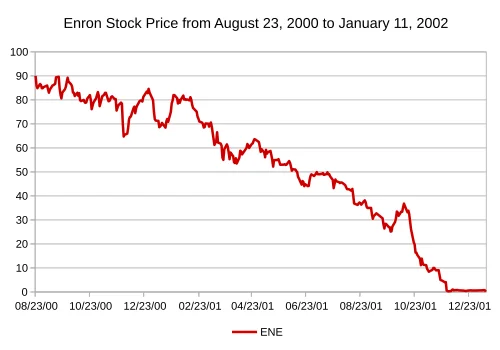
Enron's stock price from August 2000 to January 2002 — from $90 to near zero
Enron shares peaked above $90 in mid-2000; by November 28, 2001, they traded at $0.61. 1
Enron filed for Chapter 11 bankruptcy on December 2, 2001 — at the time the largest corporate bankruptcy in U.S. history, with approximately $63.4 billion in assets. 8 It simultaneously filed a $10 billion lawsuit against Dynegy for wrongful termination, claiming Dynegy had "full knowledge" of Enron's finances before November 9 and had waived its walkaway rights after the two-week due diligence period. Watson called the lawsuit "frivolous and disingenuous." 8

Enron's 20,000 employees lost their jobs. Nearly 62% of the 15,000 employees who held 401(k) plans had concentrated them in Enron stock — purchased at around $83 per share, now practically worthless. 1
Arthur Andersen, which had earned $25 million in audit fees and $27 million in consulting fees from Enron in 2000 alone, was convicted of obstruction of justice in June 2002 for shredding over a ton of Enron-related documents during the SEC investigation. 1 The conviction effectively ended the firm, costing 85,000 employees their jobs globally. In 2005, the U.S. Supreme Court unanimously overturned the conviction in Arthur Andersen LLP v. United States (544 U.S. 696), finding the jury instructions were fatally flawed — but by then, the firm had already ceased to exist. 9
Jeffrey Skilling was convicted on 19 of 28 counts in May 2006, including conspiracy, securities fraud, and insider trading. He was originally sentenced to 24 years and 4 months; a Fifth Circuit appeal reduced this to 14 years in 2013. He was released in 2019. 10 Andrew Fastow pleaded guilty to two conspiracy counts, served 6 years, and was released in 2011. 11 Kenneth Lay was convicted on all six fraud counts in May 2006 but died of a heart attack on July 5, 2006, before sentencing; his conviction was vacated under the abatement doctrine. 12
Shareholders filed a $40 billion class-action lawsuit. Through settlements with banks including Citigroup ($2 billion), JPMorgan Chase ($2.2 billion), and CIBC ($2.4 billion), they recovered $7.2 billion — the largest securities class-action recovery in history at that point. 13
The Sarbanes-Oxley Act was signed into law on July 30, 2002, passing the Senate 99-0 and the House 423-3. 14 Its six core pillars — the Public Company Accounting Oversight Board (PCAOB), auditor independence rules, independent audit committees, CEO/CFO financial statement certification, enhanced internal controls (Section 404), and criminal penalties for document destruction — were each a direct legislative response to a specific Enron failure mode. Michael Oxley, the Republican co-author, described seeing "the capital system that depends on honesty and integrity and on having investors believing in the companies they invest in" begin to dissolve before his eyes. 14
Loading link preview…

Frameworks you can use

The information asymmetry trap in distressed M&A

The canonical failure in the Enron-Dynegy negotiation was not that Dynegy walked away — it was that Dynegy signed a $8 billion deal before understanding what it was buying. Enron reported $10 billion in debt; the Powers Committee later established the actual figure was approximately $22 billion. 5 The gap existed not because Enron lied fluently in a data room — it existed because Enron's own management had structured the concealment so effectively that even internal executives could not reconstruct the true liability picture in real time.
For distressed-asset acquirers, this suggests a specific due diligence protocol for targets with mark-to-market accounting, SPEs, or related-party transactions: (1) independently map all off-balance-sheet vehicles and ask what happens to each when the underlying asset declines by 30%, 50%, or 100%; (2) identify all cross-default triggers in the financing stack and model the acceleration schedule under each rating scenario; (3) require the target's independent auditors to certify the liability reconstruction — not the target's external legal counsel. Enron's board hired its own law firm, Vinson & Elkins, to review Sherron Watkins' warnings; the result was a whitewash. External verification needs to be genuinely independent.
The acquirer who cannot independently verify a seller's liabilities is not buying at a discount — they are buying the unknown.

MAC clauses as negotiation currency — what Dynegy conceded and why

On November 8, Moody's agreed not to downgrade Enron immediately in exchange for deal amendments that included narrowing the MAC clause that allowed Dynegy to exit. 7 This was a rational decision under pressure: a junk downgrade on that day would have triggered the same cross-default cascade that ultimately ended Enron three weeks later. Removing the MAC clause bought three weeks of life.
But the removal created a structural problem Dynegy could only resolve by walking away entirely. Without a MAC clause, Dynegy had no graduated exit mechanism — it was committed to a deal whose economics deteriorated daily. The more due diligence revealed, the more the choice became binary: complete the acquisition at potentially catastrophic terms, or default on the merger agreement and absorb the resulting litigation. When the junk downgrade happened anyway on November 28, the binary resolved itself.
The lesson: MAC clause language is not a formality — it is negotiated under duress, and the precise wording determines whether a buyer can exit. Narrowing a MAC clause under rating-agency pressure may buy time, but it compresses the exit mechanism into an all-or-nothing binary. Acquirers in distressed situations should insist on building explicit repricing mechanics (earnout adjustments, price-step triggers) that do not depend on successfully invoking a disputed MAC clause. Dynegy had no such fallback after November 8.

Cross-default clauses as leverage destroyers

Enron's financing structure was a cross-default trap. When the junk downgrade arrived on November 28, it did not merely damage Enron's creditworthiness — it mechanically converted $3.9 billion of existing obligations into immediately accelerated payments. 7 That single event made any rescue negotiation pointless: no merger could close fast enough to prevent the acceleration, and no injected liquidity could cover $3.9 billion in demands within the relevant window.
This is the underappreciated lesson for workout negotiators: the credit-rating threshold is often not just a financing event — it is a governance event. Below investment grade, counterparties are contractually triggered to demand collateral or early payment. Trading partners suspend credit. Derivative counterparties call margin. The company that was negotiating from a position of operational leverage the previous week is suddenly managing a creditor stampede. In Enron's case, the cross-default cascade was triggered the same day the rescue collapsed, leaving no gap in which a new deal could have been structured.
For anyone managing distressed credits: model the cross-default schedule before the negotiation begins. The question is not "what happens if the deal fails?" — it is "how many days after the deal fails does the company have before the financing structure liquidates itself?"

"Turbo incentives require turbo controls" (Salter's principle)

HBS professor Malcolm Salter coined the phrase that best captures Enron's governance failure: "Turbo incentives require turbo controls." 2 Enron built one of the most aggressive incentive structures in corporate history — mark-to-market bonuses on deals booked years before they generated cash, rank-and-yank performance reviews that fired the bottom 15% of employees annually, stock-option packages that made executives wealthy on paper long before any operational results materialized. It built almost none of the corresponding control structures: no board-independent compensation determination, no meaningful audit committee review of related-party transactions, and an external auditor that earned more in consulting fees than audit fees. 1
The HBS case 903-084 "Broken Trust," written by Professor Ashish Nanda within a year of Enron's collapse, argued that the failure was systemic across Enron's entire professional ecosystem: auditors, lawyers, investment bankers, and securities analysts all faced conflicts of interest that prevented independent judgment. 15 Arthur Andersen earned $27 million in consulting fees from Enron in 2000 — the year it failed to flag the Raptor structures that accounted for nearly a third of reported earnings. The professional ecosystem that should have functioned as a distributed control system instead functioned as a distributed enablement system.
Peregrine and Elson, writing in the Harvard Law Forum twenty years after the collapse, concluded: "The Enron controversy remains fundamentally relevant as the spark behind the corporate responsibility environment that has reshaped attitudes about corporate governance for the last 20 years. It's where it all began — the seismic recalibration of corporate direction from the executive suite back to the boardroom, where it belongs." 5
The application for mid-level managers: when you see an incentive structure that rewards results significantly ahead of the cash or operational reality that produces them, ask what the corresponding verification mechanism is. If the answer is "management review" or "the auditors will catch it," the control is not turbo. The incentive is.

What to remember

  • A seller's leverage in a distressed negotiation depends on the buyer's inability to verify liabilities — not on the seller's actual strength. Enron had no real BATNA: its commercial paper market had closed, its credit lines were exhausted, and the SEC was investigating. But Dynegy signed an $8 billion deal anyway, because the liability picture was opaque enough to make the acquisition appear viable. Once due diligence made the actual debt visible, the deal's economics dissolved. In any distressed-asset negotiation, the buyer's primary obligation is to the liability-reconstruction problem, not the synergy model.
  • Narrowing a MAC clause under rating-agency pressure compresses your exit into a binary. Dynegy narrowed the MAC clause on November 8 to prevent an immediate junk downgrade. That concession bought three weeks — but it also compressed Dynegy's exit options into a binary: complete the acquisition or invoke a contested clause and absorb litigation. When the junk downgrade happened anyway on November 28, Dynegy invoked the clause; Enron challenged the invocation with a $10 billion lawsuit filed four days later alongside its bankruptcy petition. Acquirers in distressed deals should treat MAC clause language as the deal's crisis architecture: the protection you narrow to win the deal is often the protection you needed most.
  • Cross-default trigger schedules are not fine print — they are the negotiating deadline. The $3.9 billion in accelerated payments that Enron faced on November 28 were not a consequence of the Dynegy walkaway; they were a consequence of the junk downgrade. Any acquirer or workout advisor who enters a distressed negotiation without mapping which credit events accelerate which obligations — and in what sequence — is negotiating blind. The cross-default calendar is often more determinative than the deal terms.
  • The professional ecosystem around a fraud is part of the fraud. Arthur Andersen certified Enron's financial statements while earning more in consulting fees than audit fees. Vinson & Elkins reviewed Sherron Watkins' whistleblower memo and cleared Enron. Investment banks structured SPE transactions they knew were designed to misrepresent Enron's financials — and later paid $7.2 billion in settlements to say so. 13 Sarbanes-Oxley's most enduring reform was not Section 302 or Section 404 — it was the auditor independence rule that made it illegal for the same firm to audit and consult the same client. The Enron case is a reminder that institutional conflicts of interest do not merely create bad incentives; they actively suppress the information that governance depends on.
Cover image: Enron's corporate headquarters sign at 1400 Smith Street, Houston, Texas, photographed January 23, 2002, after the bankruptcy. Photo via Britannica / editorial use.

Add more perspectives or context around this Post.

  • Sign in to comment.