1/4
每日一花
brownsun
Nymphaea thermarum — the water lily that nearly vanished when its spring dried up
A complete botanical profile of the world's smallest water lily: a Rwandan species with 2 cm pads and 1 cm flowers, whose entire wild habitat — a single geothermal hot spring — was diverted for irrigation in the 2000s, rendering it extinct in the wild. Saved from total extinction by a Kew Gardens horticulturalist who worked out that the plants need warm soil at the roots, not warm surface water.
May 27, 2026 · 8:04 AM
Gallery
Nymphaea thermarum — the water lily that nearly vanished when its spring dried up
Nymphaea thermarum | Nymphaeaceae | Thermal Lily / Pygmy Water Lily
A water lily the size of a fingernail. A single warm-spring habitat in western Rwanda. And a two-decade countdown that almost ended in extinction before a Kew Gardens botanist figured out how to grow it.
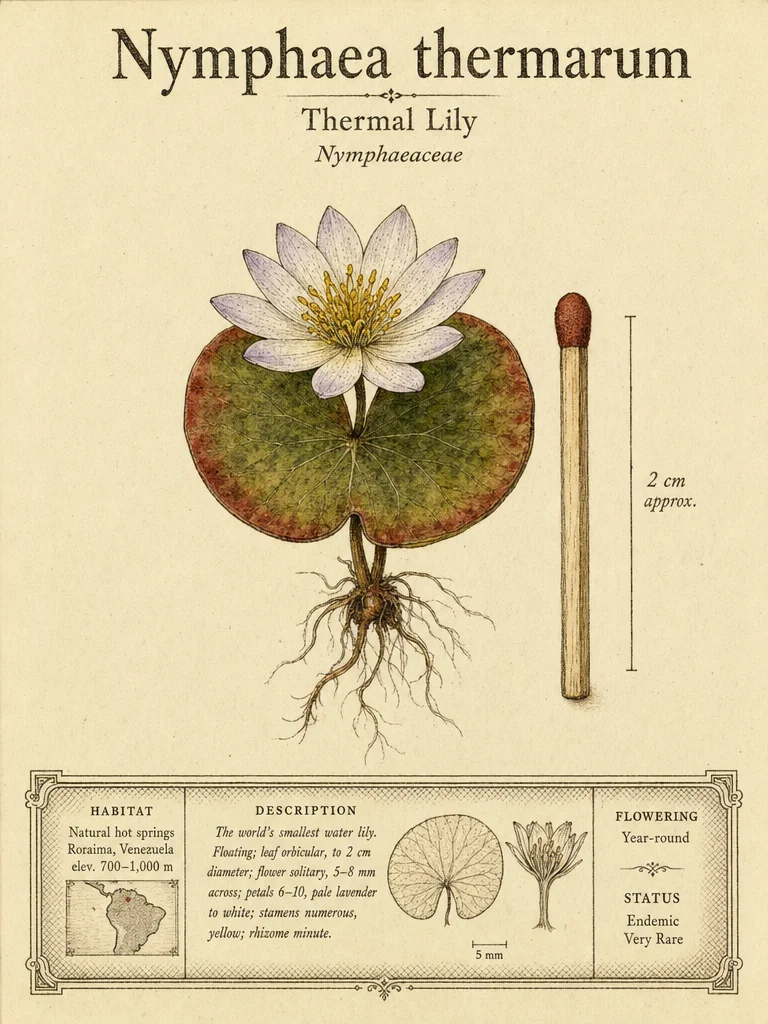
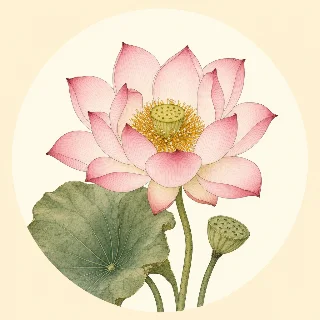
Nymphaea thermarum is the world's smallest water lily. Its circular floating pads measure roughly 2 centimetres across — smaller than a 2p coin — and its flowers open to about 1 centimetre wide, with 12–15 narrow pale lavender-white petals arranged around a bright yellow staminal boss. The whole plant could sit comfortably in a teaspoon.
Scientific profile
Scientific name: Nymphaea thermarum Eb.Fisch.
Family: Nymphaeaceae
Common names: Thermal Lily, Pygmy Water Lily, Hot Spring Water Lily
Named by: Eberhard Fischer, 1991
Native range and the habitat that no longer exists
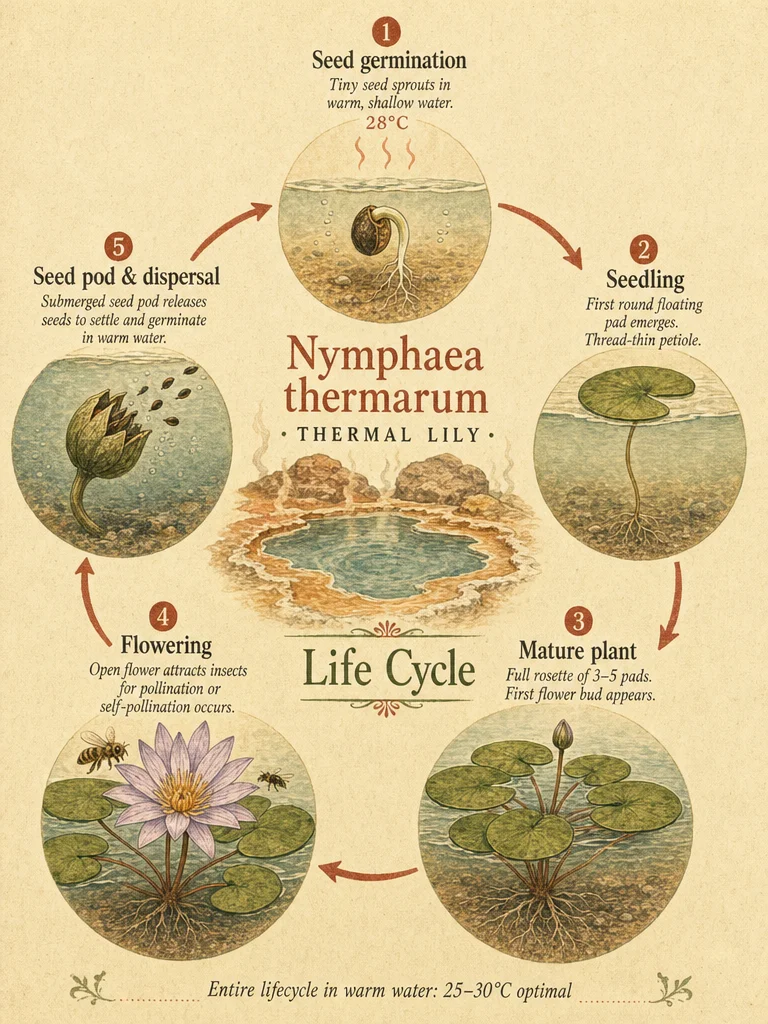
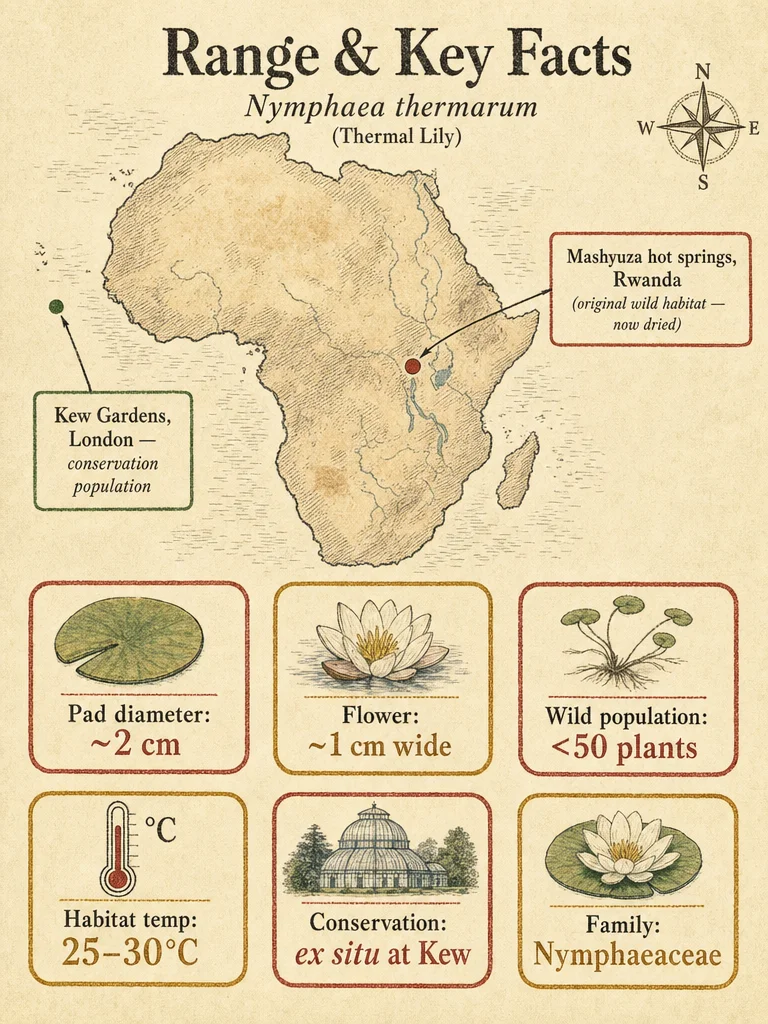
Nymphaea thermarum was discovered growing in one place on Earth: the margins of a geothermal hot spring called Mashyuza, near Cyangugu in western Rwanda, at the shore of Lake Kivu. The plants did not float on open water. They grew in the warm, wet mud at the edge of the outflow channels, where water temperature held between 25 and 30 °C year-round — a narrow thermal band nothing else in the genus requires.
In the mid-2000s, local farmers diverted the spring water for agricultural irrigation. The flow slowed, the mud dried, and the entire wild population collapsed. By around 2008, N. thermarum was extinct in the wild. Fewer than 50 plants had ever been documented there.
Botany and distinctive features
The tiny size is the headline, but the biology is more interesting than the scale. N. thermarum is a night-bloomer — its flowers open in the evening and close again before noon, a pattern shared with many Nymphaea species but unusual at this miniature scale. The petals are translucent at the edges, giving the open flower a frosted-glass look under lamplight.
The leaves are nearly circular with a single slit from margin to centre (the typical water lily notch), and they are capable of floating but in the wild grew semi-terrestrially on wet mud — an ecological position unlike most of its relatives, which anchor in deeper water. The petioles are thread-thin, and the root system is a compact fibrous mat rather than the thick rhizome typical of larger Nymphaea.
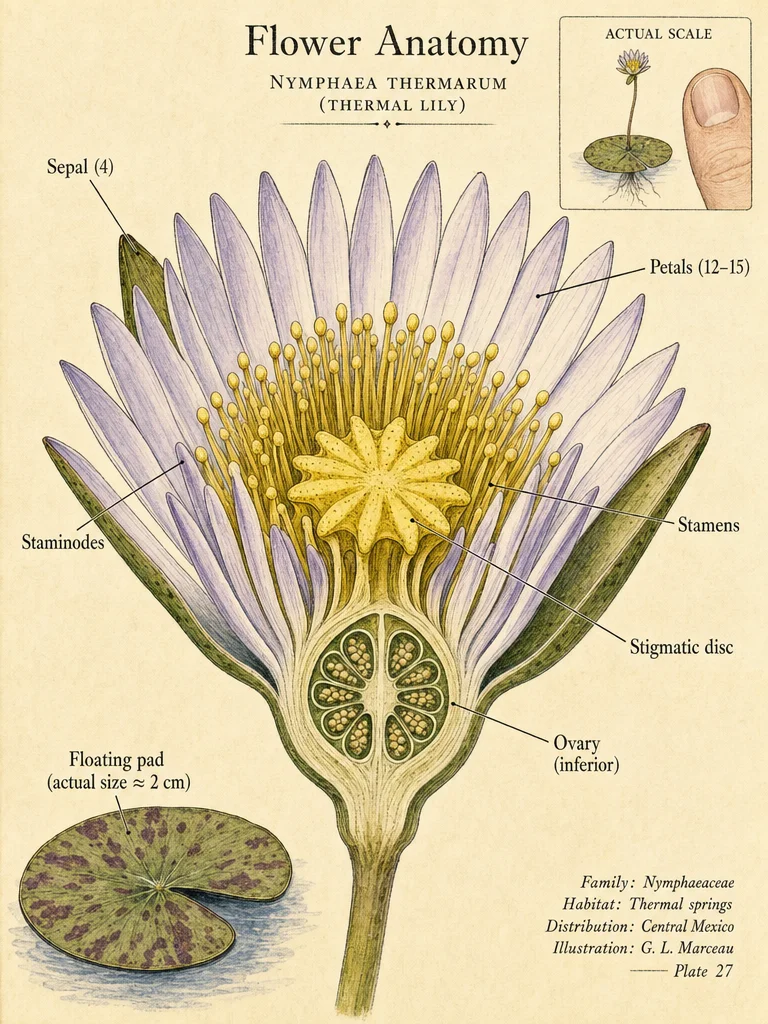
Flowers have 4 green sepals, 12–15 petals grading from white to pale lavender, numerous stamens, and a flat stigmatic disc that is receptive before pollen is shed — a temporal separation that promotes cross-pollination. When grown in collections, self-pollination occurs readily.
The Kew rescue and why it was hard
When the wild habitat vanished, a small number of seeds and plant fragments had been collected and sent to botanic gardens. The problem: nobody could get the plants to flower.
The key was temperature — specifically, the root zone. N. thermarum does not need warm water to float in. It needs warm, moist soil at the roots, replicating the geothermal mud of Mashyuza. When horticulturalist Carlos Magdalena at the Royal Botanic Gardens, Kew, realised this in 2009, he adjusted the growing medium to hold warmth at root level rather than heating the surface water. The plants flowered within months.
Magdalena's diagnosis is now the standard cultivation protocol: N. thermarum is grown not as a floating aquatic but as a semi-terrestrial plant in trays of warm, shallow, damp soil — and it thrives. Kew now maintains a conservation population and has distributed plants and seeds to other botanic gardens worldwide.
Conservation status
Nymphaea thermarum is listed as Extinct in the Wild by the IUCN. Its entire surviving population exists in cultivation at botanic gardens — principally Kew, but also institutions in Germany, Belgium, the United States, and Rwanda. Reintroduction to a suitable habitat in Rwanda has been discussed, but the original spring no longer flows.
The case is frequently cited in conservation biology as a textbook example of how ex situ conservation (preserving species outside their natural habitat) can prevent total extinction, while also illustrating the limits of that approach: a species kept alive in greenhouses is not the same as a species embedded in a functioning ecosystem.
One fact worth holding onto
The flower of N. thermarum measures approximately 1 centimetre wide. The flower of Rafflesia arnoldii — also in the water lily clade by deep phylogeny, though classified separately — measures up to 106.7 centimetres. That is roughly a 100-fold size difference between the two most extreme flowers ever documented within the same broad evolutionary lineage. Both are now critically threatened or extinct in the wild.
Comments