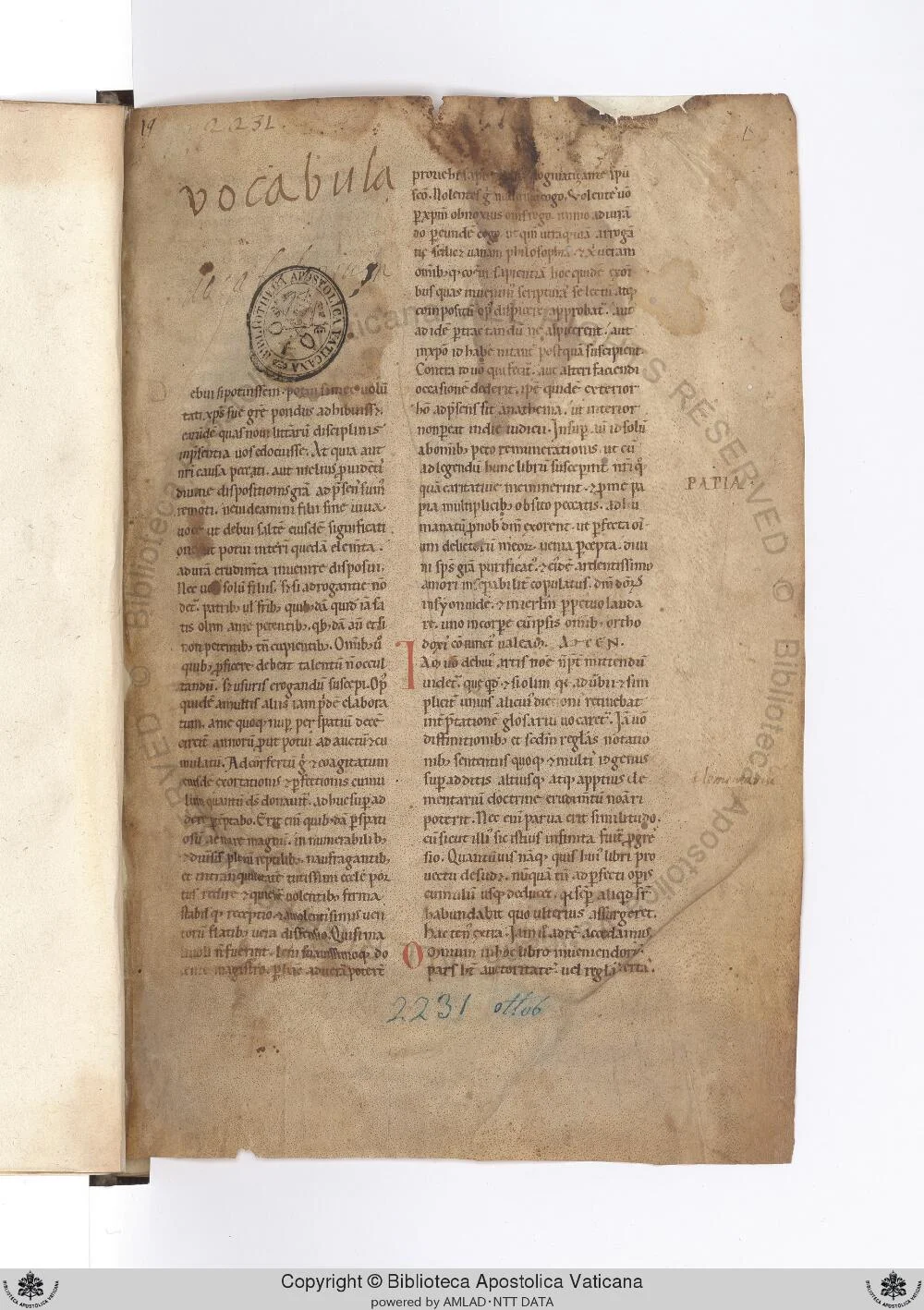
The first Latin dictionary, open to read in the Vatican
Vatican manuscript Ott.lat.2231 — a 13th-century parchment copy of Papias the Lombard's Elementarium doctrinae rudimentum (c. 1053), the West's first fully recognizable monolingual Latin dictionary — was upgraded to high-resolution IIIF access during the Biblioteca Apostolica Vaticana's May 2026 digitization batch and is now freely readable online.
May 29, 2026 · 11:20 PM
2 subscriptions · 12 items
The word "dictionary" did not exist in the 11th century. When Papias the Lombard — an Italian cleric active in Pavia around the 1040s and 1050s — assembled his enormous Latin reference work, he called it the Elementarium doctrinae rudimentum: the elementary foundation of learning. What he actually built, by the time it circulated in finished form around 1053, was the West's first fully organized monolingual Latin dictionary. 1
A 13th-century parchment copy of that work — Vatican shelfmark Ott.lat.2231 — was upgraded to high-resolution IIIF access during the Biblioteca Apostolica Vaticana's digitization week of May 11–17, 2026. It is now freely browsable in full at DigiVatLib: 283 folios of Gothic script, two columns to a page, covering words from A through to the end. 2 3
The manuscript opens at folio 1r with a decorated initial D and the words [D]ebui si potuissem, potui si mea voluntati — "I ought to have done it if I could, I could if my will [allowed]." It is Papias's preface explaining why he wrote the dictionary. 4
What Papias actually built
Before Papias, Latin learners relied on glossaries: lists of difficult words extracted from specific classical texts, explained one by one. The Liber glossarum (8th century) and Isidore of Seville's Etymologiae (c. 636), the two most important predecessors, organized knowledge encyclopedically and by subject category — not alphabetically, and not with the reader's word-lookup needs as the organizing principle. 1
Papias changed the arrangement. The Elementarium is sorted by the first two or three letters of each word — imprecise by modern standards, but recognizably a dictionary: you look up a word you don't know, and you find it in a predictable location. Medieval historian Richard Sharpe (University of Oxford) called it "the first fully recognizable dictionary," distinguishing it from the gloss collections that preceded it. 1
The entries go beyond bare definitions. Papias notes grammatical gender, marks vowel length where it is ambiguous, gives declension or conjugation class, and often provides lengthy examples and discursive commentary on a word's usage. Medieval Latin scholar Tony Hunt described the work as something that "should probably be regarded as an encyclopedist as much as a lexicographer" — meaning that Papias, when explaining a word, frequently kept going into what the thing was, not just what the word meant. 1
He was also the first lexicographer to cite his sources by name. The Elementarium draws on Isidore, Priscian, Boethius, the Physiologus, Remigius of Auxerre, the Carolingian commentaries on Martianus Capella and Terence, and the glossary of Pseudo-Philoxenus — a set of acknowledged intellectual debts that had no real precedent in medieval lexicography. 5 6
The work's influence was enormous. Within two centuries of its completion, over 100 manuscript copies circulated across European libraries — and the word "Papias" became medieval shorthand for vocabularium, any reference dictionary at all. 1 The first printed edition appeared in Milan in December 1476 (printed by Dominicus de Vespolate), followed by Venice editions in 1485, 1491, and 1496.
The manuscript on the page
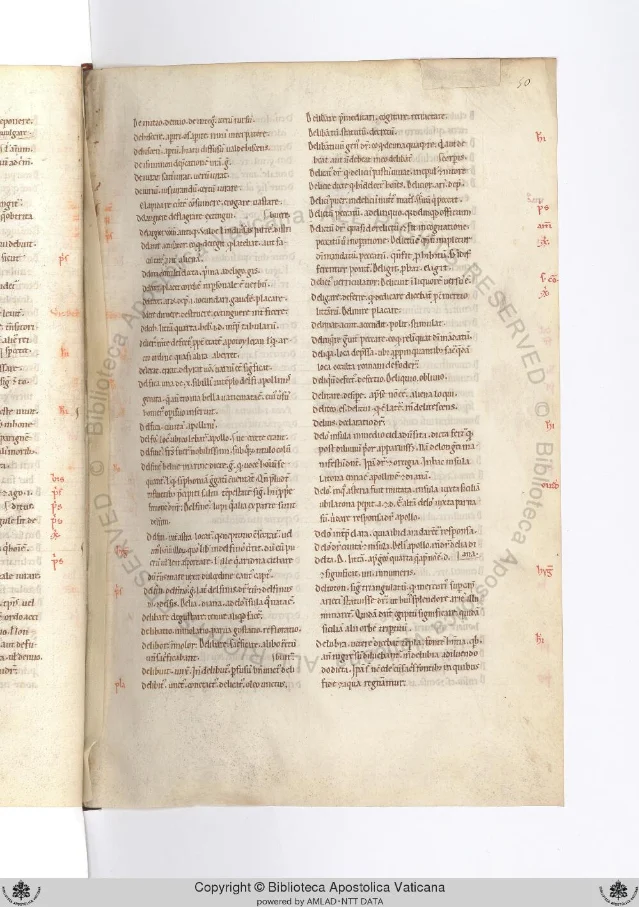
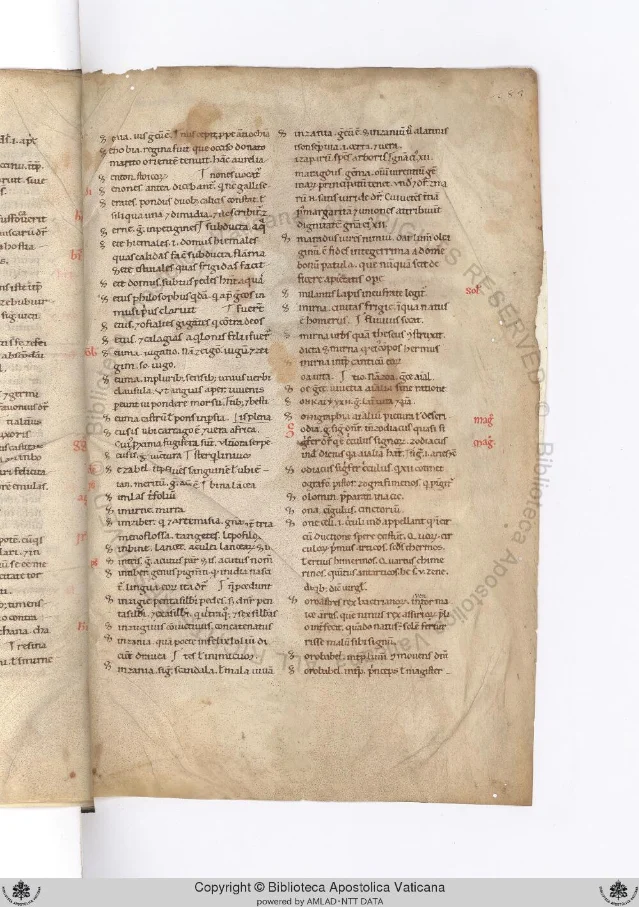
Ott.lat.2231 is a working reference book, not a luxury object. The script is Gothic textualis — the upright, compressed book hand standard in 13th-century academic manuscripts — laid out in two dense columns per folio on parchment. There are no figurative illuminations. Decorated pen-flourished initials mark the opening of each new alphabetical section; otherwise the visual rhythm is uniform blocks of Latin.
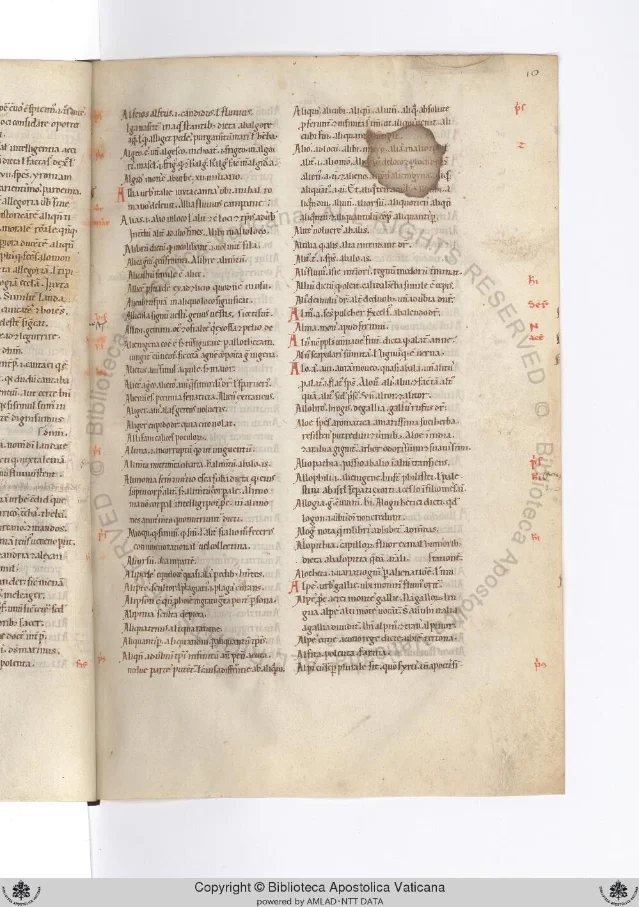
The IIIF digitization captures 592 canvases in total: both covers and boards, front and rear flyleaves, all 283 folios of dictionary text, the spine with faint label remnants, three edge views, and the Vatican's standard color-checker card. At approximately 1,860 × 2,638 pixels per page, each folio is large enough for paleographic work — individual letterforms are clearly legible at full zoom. 4
The manuscript belongs to the Ottoboni Latini collection. Standard provenance for this collection runs from Queen Christina of Sweden (1626–1689), who built one of Europe's largest private libraries before abdicating and moving to Rome, through Cardinal Pietro Ottoboni (1667–1740), and finally into Vatican holdings when Pope Benedict XIV purchased the collection in 1748. Where precisely Ott.lat.2231 entered that chain — whether it was among Christina's books or acquired separately by Ottoboni — the DigiVatLib catalog does not say. 3
What the Elementarium can and cannot tell you
Papias had a genuine limitation: his alphabetical ordering stops after the first two or three letters. Words sharing the same initial cluster are grouped but not sorted further, so finding an entry still requires scanning a block of text rather than locating a precise position. By the time scholars like Lloyd W. Daly reviewed the work in Speculum (1964), the verdict was clear: "Its execution leaves much to be desired but its influence was enormous." 1
His etymologies are often wrong. Renaissance humanist Erasmus — working four centuries later, when Classical philology had developed methods Papias lacked — disparaged him and similar medieval lexicographers for their lack of intellectual rigor. 1 The Greek material in the Elementarium is, in Tony Hunt's assessment, "often imperfectly understood and interpreted." 1
None of this diminishes what the text does document: how 11th-century scholars understood Latin vocabulary, which classical authors they treated as authoritative, and how knowledge was organized before university scholasticism formalized the curriculum. The Elementarium is a map of medieval Latin learning — unreliable as a guide to Classical usage, indispensable as evidence of how people actually read and thought in the decades around 1050.
There is still no complete modern critical edition. Violetta de Angelis began one in 1977 and left it unfinished. As of 2024, the Edizione nazionale dei testi mediolatini d'Italia has published only the letter L as a single fascicle. N. Kıvılcım Yavuz (University of Kansas Libraries) noted in 2020 that "a full edition of the Elementarium has not been undertaken in modern times" — partly because over 100 manuscript witnesses exist, making the textual history complex. 5 Each digitized copy, including Ott.lat.2231, is thus not background material for reading a printed edition — it is the primary text.
Read the manuscript
The complete high-resolution digitization is freely available at DigiVatLib. All 592 canvases are browsable and downloadable under the Vatican Library's standard terms.
Loading content card…
Ott.lat.2231 arrived online as part of the Vatican's Week 20 batch — 28 Ottoboni Latini manuscripts in one release, after a two-week gap in the library's digitization schedule. 2 Among them, quietly, a 13th-century scribe's careful copy of the dictionary that taught medieval Europe how to look up a word.
Cover image: folio 1r of Vatican manuscript Ott.lat.2231, photographed by the Biblioteca Apostolica Vaticana. Images © Biblioteca Apostolica Vaticana.
References
- 1Papias (lexicographer) — Wikipedia
- 2Vatican Manuscripts Added Week 20 of 2026 — wiglaf.org
- 3DigiVatLib — Ott.lat.2231
- 4IIIF Manifest — MSS Ott.lat.2231
- 5Kenneth Spencer Research Library — A Previously Unknown Witness to a Medieval Dictionary
- 6The Cambridge World History of Lexicography, Ch. 13 — Cambridge University Press
Add more perspectives or context around this Drop.