The hidden billing traps in your dental and vision plan
Three reader-reported stories expose the same structural flaw in dental insurance: coverage percentages mask calculations patients can't audit. This issue traces D-code upcoding, out-of-network PPO reimbursement friction, and the ACA pediatric dental loophole that left one family facing a $50,000 hospital bill — then builds out the 2026 PPO/HMO/indemnity comparison, ADA's May 2026 OON claim-filing guidance, FSA/HSA contribution limits and the Limited Purpose FSA strategy, and a guide to verifying embedded vs. standalone pediatric ACA coverage.

Three patient stories surfaced this week on r/HealthInsurance. Each involves a different mechanism — a misapplied billing code, an out-of-network reimbursement quirk, and an ACA coverage gap that hit a family with a $50,000 bill. What they share is the same structural problem: the percentage on your insurance card describes a calculation you're not allowed to audit, on a price your provider may not even be using correctly.
This issue breaks down what happened in each story, explains the plan-type mechanics that created the exposure, and gives you the specific steps — OON claim filing, FSA/HSA timing, pediatric ACA navigation — that close those gaps.
What readers reported this week
"They billed gum removal as bone surgery" — SF Bay Area, ~$1,400 out of pocket
A patient in the San Francisco Bay Area needed a crown. Before placing it, the dentist planned a minor gum removal procedure — no bone touched, no stitches, same-day. 1
The billing department submitted code D4249, which is "crown lengthening of hard tissue" — a procedure that involves reshaping bone. The insurance company's dental consultant denied the claim on the grounds that "there is sufficient bone to support the crown." The dentist agreed with that assessment; he said he only removed gum, no bone.
When the patient asked the billing department, the response was: "That's just the code we always use."
Out-of-pocket charge: $1,400 for the gum removal alone, plus partial costs for the crown and buildup. As the patient wrote: "It feels like fraudulent billing or upcharging." 1
The mechanism: D4249 (hard tissue crown lengthening) and D4211 (soft tissue gingivectomy) are not interchangeable codes. A soft-tissue-only gum removal is typically D4211 and is often partially covered or included in crown fees. When a practice uses the bone surgery code for a soft-tissue procedure, coverage is denied — and the patient absorbs the full charge. Always ask your dentist's office, before any ancillary procedure, what billing code they plan to submit. The ADA publishes the Code on Dental Procedures and Nomenclature; D-codes are public.
"The claim check came in $80 more than I paid — then they chased me at my next appointment"
A Delta Dental PPO member stayed with an out-of-network dentist for convenience. His semi-annual cleanings are "covered 100% even out-of-network," per the plan. The OON workflow: he pays the full fee upfront, Delta Dental mails a claim reimbursement check, he compares amounts, and follows up with the office to recover any overpayment. 2
For years, the check came in less than he paid at the office — meaning the practice kept the difference unless he explicitly asked for a refund. Then in late 2025, the check came in about $80 more than his upfront payment. At his next visit in May 2026, the front desk approached him in the dental chair with a card reader, asking him to pay the prior visit's difference on the spot.
He paid, but described the approach as "unprofessional at best, kinda slimy/greedy at worst." One commenter, u/Full-Ordinary-6030, made a point worth noting: "Your dentist office absolutely does not have to refund you since they're out of network. They chose to and they didn't need to do that." 2
Another commenter, u/l0rAxC, gave the cleaner advice: "I wouldn't settle that from memory while you're in the chair. Ask the office for a ledger for that exact date of service, then match it against the Delta EOB: amount billed, what you paid upfront, what Delta paid to you, and what the office says the remaining balance was." 2
The mechanism: With OON PPO coverage, the patient — not the dentist — is responsible for tracking the payment flow. The dentist has no contractual relationship with your insurer, so no single party owns reconciliation. If you're staying OON by choice, build a simple ledger: date of service, upfront amount paid, check amount received, net position.
"ACA plan paid nothing — hospital trying to collect $50k for my child's sedation dentistry"
A parent on an ACA/Marketplace PPO bought a separate dental plan through the same carrier, assuming the medical plan already covered pediatric dental for kids but not adults. The reverse turned out to be true: the ACA plan does require pediatric dental coverage to be offered, but not necessarily embedded in the medical plan — and in this case, the medical plan denied 100% of the hospital-based procedure. 3
The child, under age 5, required sedation dentistry at a children's hospital. The procedure ran over three hours, billed by the minute. The bill arrived in three parts: dental (covered by the dental plan, small amount), anesthesia (a few thousand dollars), and the surgery/procedure portion that made up the bulk of the $50,000 gross. After a "patient discount" of $25,000, the hospital's first mailed bill showed ~$25,000 due — marked "past due" despite being the first bill received. A commenter, u/wistah978, noted: "The area where medical and dental coverage overlap can be tricky. A 50k bill means this was more than routine dental care." 3
The same family had a similar but shorter procedure at the same hospital years earlier, covered 100% by employer insurance. The difference was the plan type, not the procedure.
The mechanism: This story runs deeper than it looks — the embedded vs. standalone pediatric dental structure under the ACA is one of the least-understood coverage rules for families. See Section 4 below.
Why plan type is the hidden variable: PPO, HMO, indemnity
The billing-code story above could only happen the way it did because the patient had a PPO (where the dentist is OON and the patient has no prior agreement on what codes will be submitted). In a dental HMO, the dentist has a fee schedule that defines the copay per procedure code — upcoding doesn't extract more money from you because you pay a fixed copay regardless. In an indemnity plan, you pay whatever the dentist charges and submit the claim yourself; the insurer pays a percentage of the "usual, customary and reasonable" (UCR) fee, regardless of which D-code the dentist used.
Each structure has different exposure:
| Feature | Dental PPO (DPPO) | Dental HMO (DHMO) | Indemnity |
|---|---|---|---|
| Network | Large; can go OON | Small; must stay in-network | No network — any dentist |
| Deductible | Yes (~$50–$100) | None | Yes (similar to DPPO) |
| Annual maximum | Yes (~$1,500+) | None or rare | Yes (similar to DPPO) |
| Preventive (cleaning, exam) | 100% in-network | 100% with $0–$25 copay | % of UCR fee |
| Basic (fillings, root canals) | ~80% in-network after deductible | Fixed copay (e.g., $20–$50) | ~80% of UCR fee schedule |
| Major (crowns, bridges) | ~50% in-network after deductible | Higher fixed copay | ~50% of UCR fee schedule |
| Premium (individual) | ~$30–$42/month | ~$15–$18/month | ~$36–$37/month |
| Balance billing risk | Not in-network; possible OON | No — copay only | Yes — patient pays difference |
| Billing code exposure | High OON; lower in-network | Low — copay is fixed | Medium — UCR cap is anchor |
DPPOs represent 89% of all commercial dental enrollment as of 2024, according to NADP. 4 5 6 Their popularity is real — a DPPO is more flexible — but that flexibility comes with audit responsibility that most patients don't realize is theirs. Less than 5% of DPPO enrollees hit their annual maximum in a typical year. 4 The bigger exposure is not the annual cap — it's the OON calculation and billing code accuracy on individual procedures.
Filing an OON dental claim: what the ADA said in May 2026

On May 22, 2026, ADA News published guidance from Dr. Lindsay Compton of the ADA Council on Dental Benefit Programs, specifically addressing OON billing. 8
The core principle: "In an out-of-network situation, the patient's benefits relationship is with the payer, not the dentist or dental office." 8 This matters because it defines who does the fighting when something goes wrong — and that party is you, not your dentist.
Practical steps for OON patients:
- Use the current ADA Dental Claim Form (2024 version). The 2019 version is superseded. Your OON dentist should provide an itemized receipt with D-codes and the 2024 claim form. 9
- Understand Box 37 (Assignment of Benefits). Signing Box 37 directs your reimbursement check to the dentist rather than to you. This only authorizes payment direction — it doesn't create a contract between your dentist and insurer. Twenty-three states have enacted Assignment of Benefits laws requiring insurers to honor this request. 8 If you're in one of those states and signed Box 37, the insurer should pay the dentist directly, not mail you a check to forward.
- Expect 2–4 weeks for processing. Most dental claims are processed within 14 to 30 days of receipt. 8 If you don't hear within 30 days, call your insurer's member services and ask for the claim status.
- If the EOB shows $0 patient responsibility but the insurer didn't pay the full fee — dispute it. According to the ADA, "the EOB is incorrect and should be challenged." 8
- The No Surprises Act does not cover routine dental. The federal law primarily protects patients from surprise bills for emergency medical services and from OON providers at in-network facilities. Routine dental OON billing is not covered. 10 State laws vary.
FSA and HSA: the 2026 limits, and how to use them for dental and vision

The IRS raised both limits for 2026:
- Healthcare FSA: maximum contribution $3,400 (up from $3,300 in 2025); maximum rollover into 2027 is $680 (up from $660). If your employer's plan permits a grace period instead of rollover, unused funds can be spent through March 15, 2027. 12 13
- HSA (self-only coverage): $4,400; family coverage: $8,750; catch-up for age 55+: $1,000. 12
Virtually every dental and vision procedure you'd find in your plan's coverage table is FSA- and HSA-eligible: cleanings, fillings, crowns, bridges, root canals, extractions, braces, eye exams, prescription glasses, contact lenses, and LASIK. Cosmetic procedures — whitening, purely cosmetic veneers — are generally excluded. 14
The strategy most people miss: if you have a high-deductible health plan (HDHP) and contribute to an HSA, you cannot also contribute to a full healthcare FSA in the same plan year. But you can use a Limited Purpose FSA — which covers dental and vision only — alongside your HSA. This lets you pay near-term dental and vision costs with pre-tax FSA dollars while your HSA balance grows (invested) for future major medical expenses.
Starting in 2026, more Marketplace enrollees qualify for HSAs: the IRS finalized that bronze and catastrophic ACA plans now count as HDHPs for HSA eligibility purposes. 12 If you're self-employed on a bronze plan, check whether you can open an HSA this year.
For scheduling major procedures: if you've already contributed the full FSA amount for 2026 but have more work queued up (crown, Invisalign phase 2, new glasses), schedule the additional procedure in early January 2027 and fund it with fresh 2027 FSA dollars. This effectively doubles your available pre-tax dental/vision spending across the calendar-year boundary.
Pediatric dental under the ACA: the embedded vs. standalone trap
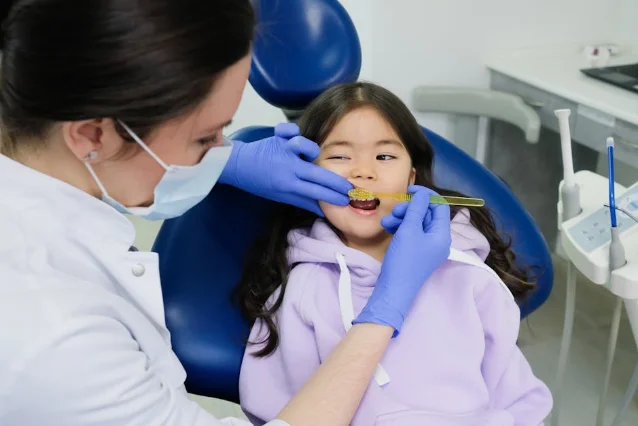
The community story above — $50k for pediatric sedation dentistry, ACA plan pays nothing — is not a billing error. It's a structural feature of how the ACA handles pediatric dental.
What the law requires: Pediatric dental care is one of the ten Essential Health Benefits (EHBs) under the ACA. All non-grandfathered individual and small-group plans must offer it for children 18 and under. 16
The critical loophole: Unlike every other EHB, a health plan does not have to embed pediatric dental coverage if certified stand-alone dental plans (SADPs) are available on the Marketplace in that region. CMS has confirmed SADPs are available nationwide as of 2023. 17 So a Marketplace health plan can — legally — exclude pediatric dental from its medical benefits, point you to a separate SADP, and still claim to offer the EHB.
Why this matters at the dollar level:
- An embedded pediatric dental plan wraps dental costs inside the medical deductible (up to ~$10,600 for a single person in 2026) and the combined out-of-pocket maximum. Hospital-based pediatric dental procedures billed through the medical side of the claim hit that higher OOP.
- A stand-alone pediatric dental plan (SADP) has its own, much lower out-of-pocket caps: $450 for one child, $900 for two or more children in 2026, per CMS. 17
In the r/HealthInsurance story, the family's medical plan did not embed pediatric dental. The separate dental plan covered the routine dental portion (small amount). The anesthesia and hospital procedure portions — which were billed through the medical side — were denied entirely. The family's total exposure tracked the medical OOP maximum, not the $450 SADP cap.
What changed in May 2026: CMS finalized a rule reinstating the ban on adult dental as an EHB, reversing a 2024 policy that would have allowed states to add adult dental starting in 2027. For the 2027 plan year, insurers may voluntarily include adult dental — but no state can require them to. 18
What to check if you have kids on a Marketplace plan:
- Call your health insurer and ask: "Does my plan embed pediatric dental, or does it point me to a stand-alone dental plan?"
- If embedded, ask what the dental-specific OOP maximum is, and whether hospital-based dental procedures are processed through the medical or dental side of the claim.
- If you're not enrolled in an SADP, Marketplace open enrollment or a Special Enrollment Period is when you add one. The SADP OOP cap of $450 per child is the exposure limit you want.
Quick notes
LASIK June 30 deadline — 29 days left. EyeMed members have until June 30, 2026, to complete LASIK and qualify for the $1,200 off ($600/eye) on Wavelight laser at LasikPlus, TLC Laser Eye Centers, or The LASIK Vision Institute. VSP's $1,100 off ($550/eye) offer carries the same deadline. Free pre-op consultations require no commitment and can be booked this week. 19 20
Delta Dental OON class action (Walsh v. Delta Dental, SDNY, filed January 2026). A federal class action filed in New York's Southern District (case no. 1:25-cv-10801) alleges Delta Dental advertises 50–100% OON coverage but calculates reimbursements against a proprietary internal price — almost always below what providers actually charge — without disclosing that internal number even when patients ask. The complaint states: "Through this scheme, Delta Dental has profited tremendously at the expense of its insureds, who are left holding the bag for often exceptionally high dental bills." 21 If you've had OON Delta Dental claims processed at amounts that appeared far below the provider's actual charge, document your EOBs.
Money.com June 2026 rankings place Denali Dental as best overall and Delta Dental as best for braces; Spirit Dental took best for value. 22 Investopedia's parallel ranking gives Delta Dental best overall as well as best for implants and older adults. The divergence in "best overall" between the two publications reflects different scoring methodology — both use publicly available plan data but weight flexibility, network size, and cost differently.
Community story details sourced from r/HealthInsurance and r/medicare posts from May 23–June 1, 2026. Individual experiences reflect specific plan terms and may not generalize to all carriers or states. Verify your plan's OON reimbursement methodology, billing code policies, and pediatric dental structure directly with your insurer before scheduling procedures.
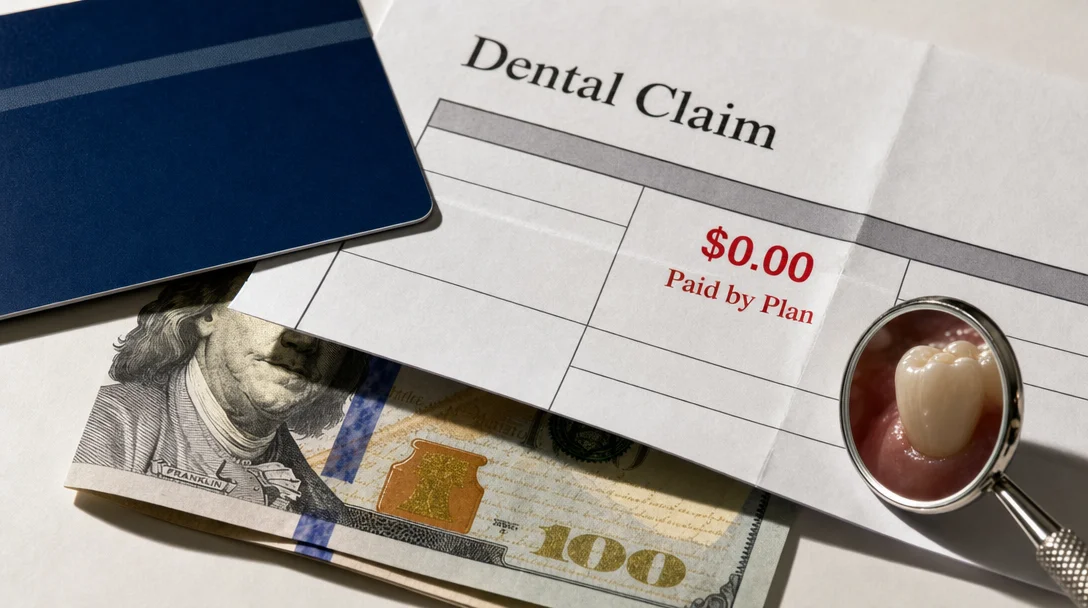
AI-generated cover image.
References
- 1r/HealthInsurance: Dental office using fraudulent billing?
- 2r/HealthInsurance: Delta Dental claim check for more than I paid
- 3r/HealthInsurance: $50k bill for pediatric sedation dentistry
- 4NADP: Understanding Dental Benefits
- 5ADA: Types of Dental Plans
- 6Humana: Dental HMO vs. PPO
- 7Pexels: Insurance claim form
- 8ADA News: Dear ADA — Out-of-network billing (May 2026)
- 9ADA: ADA Dental Claim Form
- 10CMS: No Surprise Billing
- 11Pexels: Savings piggy bank
- 12IRS Notice 2026-05
- 13EBC Insights: 2026 FSA and Commuter Limits
- 14IRS Publication 969
- 15Pexels: Pediatric dental exam
- 16healthcare.gov: Essential health benefits glossary
- 17healthinsurance.org: Is pediatric dental coverage included in Marketplace plans?
- 18ADA News: CMS finalizes rule on adult dental EHB (May 2026)
- 19EyeMed LASIK
- 20LASIK.com: EyeMed LASIK Discount
- 21Top Class Actions: Delta Dental OON class action
- 22Money.com: Best Dental Insurance Plans of June 2026
Add more perspectives or context around this Post.