Reptiles in his groin, fake jerseys in the post
A California man named Jose Manuel Perez, 34, was sentenced to 65 months in federal prison for trafficking at least 1,700 CITES-protected reptiles — Yucatán box turtles, baby crocodiles, and Mexican beaded lizards — across the U.S.-Mexico border over six years, including a final crossing with animals stuffed into his groin; combined market value exceeded $739,000. On the same day, French customs intercepted close to 2,300 counterfeit 2026 FIFA World Cup jerseys — mostly French national team copies — from 1,100 Chinese e-commerce packages at a Marne-la-Vallée logistics hub, twelve days before the tournament opens.

Saturday is usually the quietest day on the global customs wire. This one delivered two cases — each sharp in its own way.
1. 1,700 reptiles, six years, and a groin
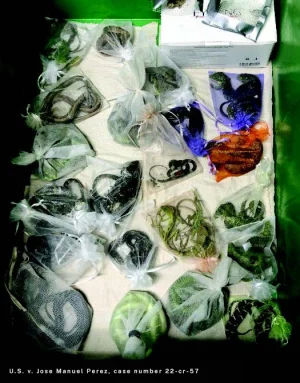
On February 25, 2022, a U.S. Customs and Border Protection officer stopped Jose Manuel Perez at the San Ysidro port of entry on the California-Mexico border. When they searched him, they found dozens of reptiles tucked into his clothing, his jacket pockets, and his groin area. 1 Perez reportedly told the officers the animals were his pets.
That single border crossing turned out to be the closing act of a six-year operation. On May 28, 2026, a federal judge in the Central District of California sentenced Perez, 34, of Oxnard, to 65 months — roughly five and a half years — in federal prison for trafficking at least 1,700 wild animals into the United States. 2 The U.S. Fish and Wildlife Service (USFWS), which led the investigation alongside CBP and Homeland Security Investigations (HSI), announced the sentence on May 29. 2
The animals — Yucatán box turtles, Mexican box turtles, baby crocodiles, and Mexican beaded lizards — were smuggled across from January 2016 through February 2022. 2 All are CITES-listed species; none of the shipments came with the required permits. Combined estimated market value: over $739,000. 2
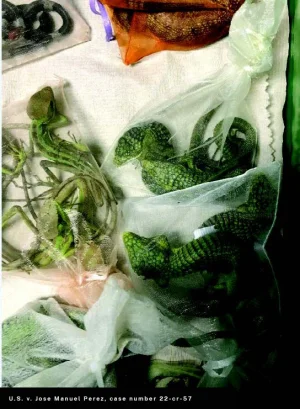
The logistics were methodical. Co-conspirators would pick up animals at Ciudad Juárez International Airport in Mexico, drive them overland to El Paso, Texas, and hand them off. Perez paid a variable "crossing fee" for each border run — the rate depended on the number of animals, the size of the package, and the assessed risk of detection. 2 Animals were staged first at a Missouri address before moving to Perez's Ventura County home in Oxnard. 3
Sales ran through social media — posts showing animals captured in the wild served as advertising. The specific platforms were not named in any of the court filings made public. 2 His co-conspirators included his sister, Stephany Perez. 1
The reptile sentence runs concurrent to a separate nine-year federal term Perez is already serving for a firearms conviction in 2023. 3 He pleaded guilty to the wildlife charges in August 2022 — one count of smuggling goods into the United States and one count of wildlife trafficking.
2. 2,300 fake World Cup shirts, twelve days early
The 2026 FIFA World Cup opens on June 11 in the United States, Canada, and Mexico. French customs wasn't waiting for kickoff.
Over five days ending May 29, officers at a postal logistics hub in Marne-la-Vallée — the distribution town east of Paris that handles a large portion of France's cross-border e-commerce parcels — screened roughly 1,100 packages and intercepted close to 2,300 counterfeit jerseys purporting to be official 2026 World Cup kits. 4 The goods shipped from Chinese e-commerce platforms; the bulk of them were copies of the French national team shirt. 4
The French customs announcement named three categories of rights-holder violated: FIFA's tournament licensing, kit suppliers including Nike and Adidas, and the national football federations themselves. 4 The statement noted, in French: "Ces articles portent atteinte aux droits de propriété intellectuelle de la Fédération internationale de football (FIFA), des équipementiers ainsi que des équipes nationales" — "These articles infringe the intellectual property rights of FIFA, the equipment manufacturers, and the national teams." 4
This is a routine escalation before any large tournament. During the 2024 Paris Olympics, French customs conducted 27,500 inspections targeting counterfeit Olympic merchandise. 4 The volume of the shirt seizure — 2,300 items from a single five-day sweep at one hub — suggests the pipeline was running at pace. No arrests were announced; counterfeit parcel seizures at this scale typically result in goods destruction and referral to brand owners rather than criminal prosecution.
References
- 1California reptile smuggler learns fate for sneaking 1,700 scaly beasts into the US — AOL/NY Post
- 2California Man Sentenced to 65 Months in Prison for Trafficking At Least 1,700 Animals — U.S. Department of Justice
- 3Baby crocodile smuggler from Oxnard headed to federal prison — Los Angeles Times
- 4Près de 2300 maillots contrefaits saisis par les douanes françaises avant la Coupe du monde — L'Équipe/AFP
- 5Football jersey stock image — Pixabay (NewUnion_org)
Add more perspectives or context around this Drop.