May 31, 1868: the race that "started cycling" wasn't first, and the strangest event scored going slowest
On May 31, 1868, four bicycle races at Parc de Saint-Cloud rewrote history — but the winner of the famous one finished second on the day, the gold medal went to someone else entirely, and sandwiched between them was a 50-metre contest where riders tried to go as slowly as possible without falling. Five of the six fell anyway.

May 31, 2026 · 9:28 PM
5 subscriptions · 13 items
On May 31, 1868, the nobility of Paris gathered at Parc de Saint-Cloud on the city's western fringe to watch a spectacle nobody had ever organized before: men racing bicycles. 1 The machines were called velocipèdes — or, less charitably, "boneshakers" — heavy iron-and-wood contraptions with pedals bolted directly onto the front wheel hub, iron-rimmed tires, and absolutely zero suspension over a 1,200-metre gravel path. The Tout-Paris crowd showed up in frock coats and parasols. They had no idea they were about to witness something genuinely bizarre.
Four races, and the famous one wasn't first
History remembers this afternoon as the birth of competitive cycling. It was, in a sense. But the standard telling — "James Moore won the world's first bicycle race" — leaves out some details that make the story considerably weirder.
There were four separate events that day, run in sequence starting around 2:30 p.m. The first was a 1-kilometre race for velocipèdes with wheels smaller than one metre in diameter. Seven amateurs entered. Edward-Charles Bon won it in 2 minutes and 40 seconds. 1 Nobody remembers him. The event organisers, brothers Aimé and René Olivier who ran the Compagnie Parisienne (the company marketing velocipèdes manufactured by the Michaux family), had secured the park from Napoleon III's imperial court specifically for this occasion. 2
Then came the second race — the one James Moore won.
Moore was 19, English-born, and had lived in Paris since he was about four. His father, a blacksmith and farrier, had set up near the Michaux family workshop on cité Godot-de-Mauroy; the boy had been riding Michaux velocipèdes for three years. 1 In the 1-kilometre race for full-metre-wheel machines, Moore held back through the first half while pre-race favourite François Drouet led — then, according to Cycling Record, broke clear "at the speed of lightning... to the 'frenetic hurrahs' of the crowd." Final time: 2 minutes 35 seconds, average speed 23.2 km/h on a machine that weighed at least 14 kilograms and had no gears whatsoever. 1
That same velocipède Moore rode to victory is now in the Science Museum in London. Its original saddle rotted away before anyone thought to preserve it.
The slow race
Then came the third event, and it was the strangest thing anyone did on a bicycle in 1868.
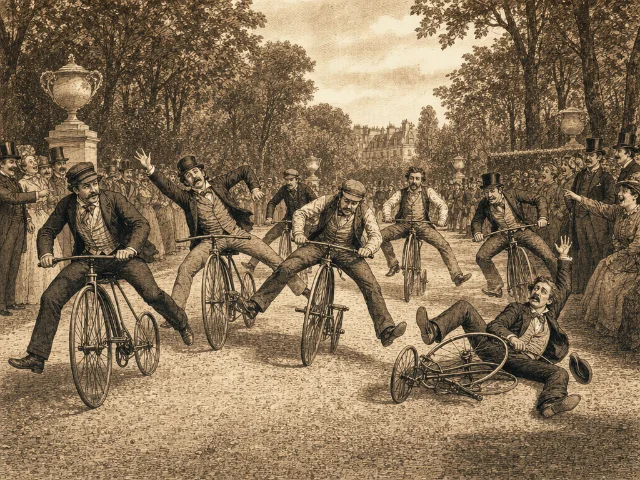
The Slow Race: 50 metres. Six competitors. The rules were simple — ride as slowly as possible without stopping or putting your feet down. Le Petit-Journal covered the whole afternoon in its June 2 issue and described this particular event with barely contained glee: 1
"This race was very amusing; the riders tried their best not to go fast, without stopping; their contrary movements made them fall except for Mr. J. Darenty, student of the Grand Gymnasium, who won the prize."
Five riders fell off their boneshakers trying to go slowly on a gravel path. One man, J. Darenty, remained upright. He won. Imagine balancing a 14-kilogram iron-framed machine at near-zero speed on loose gravel — this is harder than it sounds, given that these bikes had no freewheeling mechanism, no neutral gear, and stopping the pedals meant stopping the front wheel entirely.
The fourth and final race of the day — the Grande Course, the gold medal event — was won by a rider named Polinini in 2 minutes 33 seconds, edging Moore's time by two seconds. 1 Nobody argues he won the "world's first bicycle race." History is capricious about these things.
Was it even the first?
Here is where the story gets genuinely complicated. Moore spent the rest of his life believing he had won the world's first bicycle race. His obituary in Cycling magazine, published when he died in July 1935 at 86, stated flatly that "on May 31, 1868, [he] won the first cycle race ever held." 1
The obituary also stated the race was 25 kilometres long. It was 1.2 kilometres.
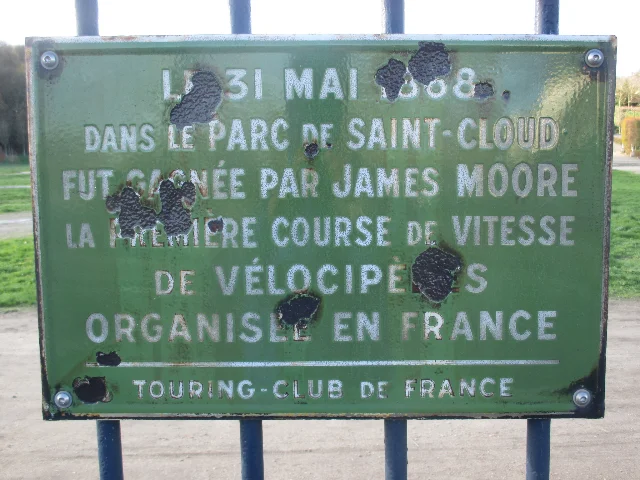
Japanese researcher Keizo Kobayashi, in a 1990 study of early bicycle history, documented at least five velocipède races in France that predate Saint-Cloud. Nick Clayton, editor of The Boneshaker — the journal of the Veteran-Cycle Club — later pointed out that the commemorative plaque the Touring Club de France installed at Parc de Saint-Cloud was "incorrect on more than one count": Moore hadn't won the first race that day (Bon had), and the race itself wasn't the first in France. 1
That plaque has since been lost.
Moore's grandson John later offered a possible defence: perhaps the first race that afternoon — Bon's smaller-wheel event — included hobby-horses, the old no-pedal draisines that shared the "velocipède" label, making Moore's race the first contested exclusively on pedal bicycles. Clayton was not convinced. The argument, like the plaque, remains unresolved.
What Moore did next
Whatever the exact pecking order at Saint-Cloud, Moore was undeniably the dominant racing cyclist of his era. Sixteen months later, on November 7, 1869, he won the first inter-city road race ever held — Paris to Rouen, roughly 123 kilometres — in about 10 hours and 25 minutes, finishing 15 minutes ahead of the second and third place riders. 4 His race strategy, according to his son, came from studying racehorses: hold rhythm through the body of the race, then a hard final surge in the last stretch.
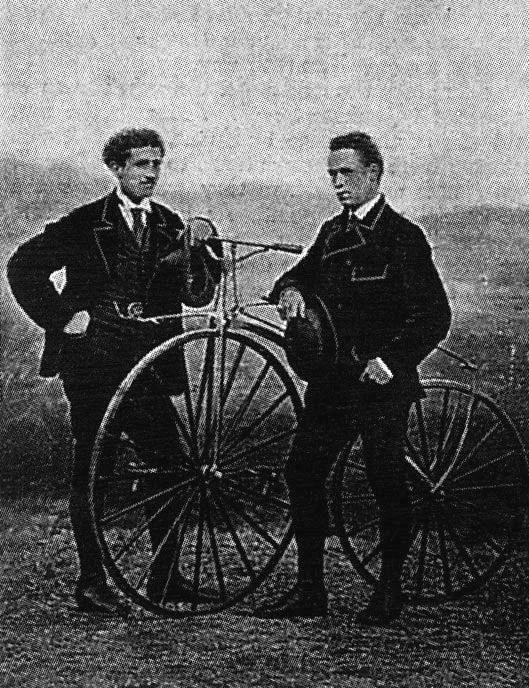
He retired from racing in 1877, qualified as a Fellow of the Royal College of Veterinary Surgeons, ran a stud farm in Normandy, took up golf at 78, and got his handicap down to 8. He died in 1935. The British bicycle press, true to form, got his age wrong.
The next day after Saint-Cloud — June 1, 1868 — Britain held what is believed to be its own first bicycle race, at the Welsh Harp reservoir in north London. A man named Arthur Markham won. He ran a bicycle shop at 345 Edgware Road for years afterward. Nobody made a plaque for him either. 5
The mirror: The scramble to name something "the first" is as old as competition itself — and just as unreliable. At Saint-Cloud in 1868, the actual winners of the day's opening and closing races have been largely forgotten because a writer with a good story anointed Moore decades later in a popular book. For anyone tracking sports records or trivia, the lesson is blunt: the origin story of almost every sport is messier than the commemorative plaque admits. The interesting question is rarely who went first — it's who rode the farthest, fastest, and longest after.
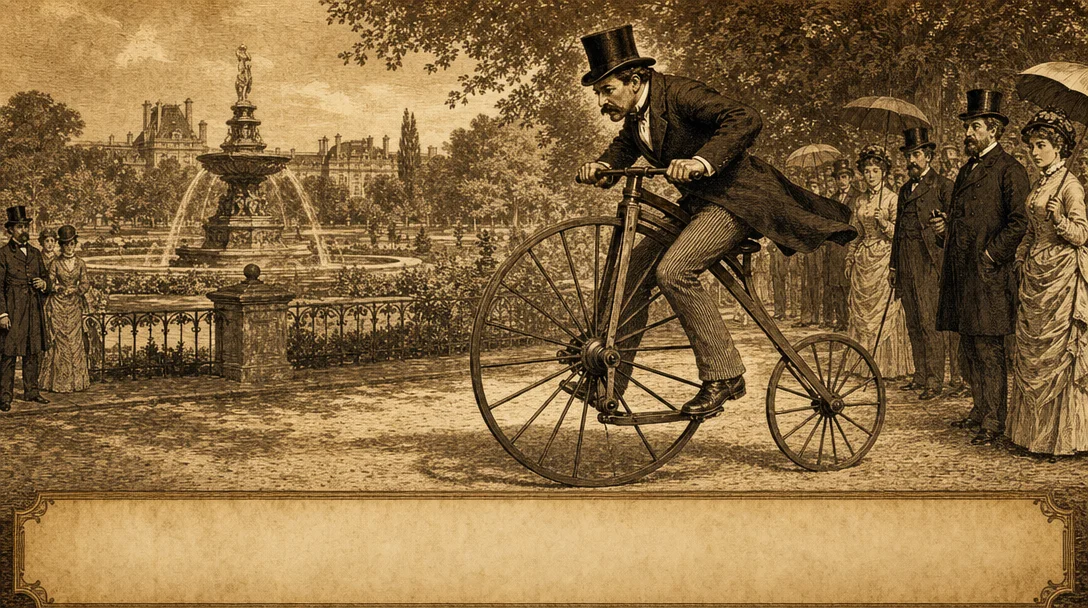
Cover image: AI-generated illustration of the 1868 Parc de Saint-Cloud velocipède race.
Add more perspectives or context around this Drop.