Heavy UPF eaters face a 14% higher risk of cognitive impairment — and the effect is sharper before 60
Zhang et al. 2026 (Journal of Neurology, 8 cohorts, n>250,000) links high ultra-processed food intake to a 14% higher hazard of cognitive impairment overall — and a 19% higher hazard in adults under 60. The actionable takeaway: cut UPF share of total diet in mid-life, starting with beverages and packaged snacks.

Research Brief
A meta-analysis published June 2 in Journal of Neurology pooled data from 8 prospective cohort studies with more than 250,000 participants and found that high ultra-processed food (UPF) consumption is associated with a 14% higher hazard of cognitive impairment compared to low UPF intake (HR = 1.14, 95% CI: 1.04–1.25). 1
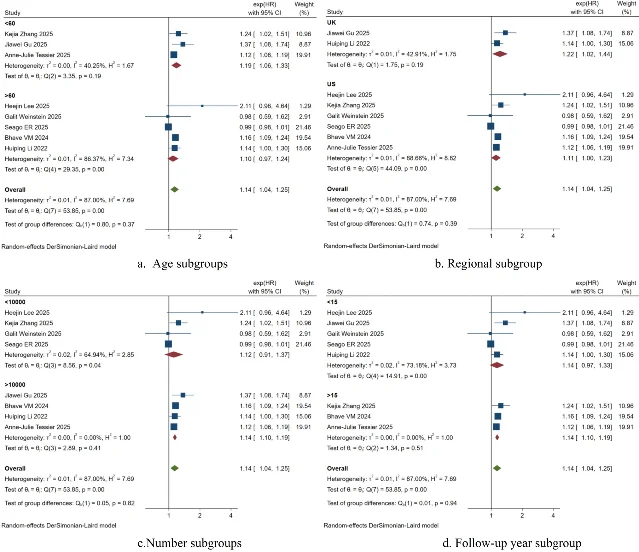
The association held after leave-one-out sensitivity analysis and was tighter in larger, longer-running cohorts. The study's more consequential finding, though, is buried in the subgroup data: in participants under 60, the pooled hazard rose to HR = 1.19 (95% CI: 1.06–1.33) with near-zero heterogeneity (I² = 40%), while in those over 60 the estimate dropped to HR = 1.10 and the confidence interval crossed 1. 1 Mid-life UPF habits appear to carry more risk than late-life ones — a pattern consistent with emerging evidence that neurodegeneration begins decades before symptoms appear.
The study is observational throughout. It cannot establish that UPF causes cognitive decline, and the overall I² = 87% signals substantial between-study heterogeneity that limits how confidently anyone should interpret the pooled number. Those caveats matter and are addressed below. Still, this is the first meta-analysis to pool UPF as a combined dietary pattern — rather than isolating individual food categories — against cognitive impairment outcomes, and it fills a gap that Lane et al.'s 2024 BMJ umbrella review of 45 UPF meta-analyses identified as missing from the evidence base. 2
Study design and population
Study type: Systematic review and meta-analysis of prospective cohort studies (observational) · Journal: Journal of Neurology (Springer Nature, Q1) · DOI: 10.1007/s00415-026-13889-9 · Published: June 2, 2026 · Peer-review status: Published (full text behind paywall; all data below are from abstract and figures)
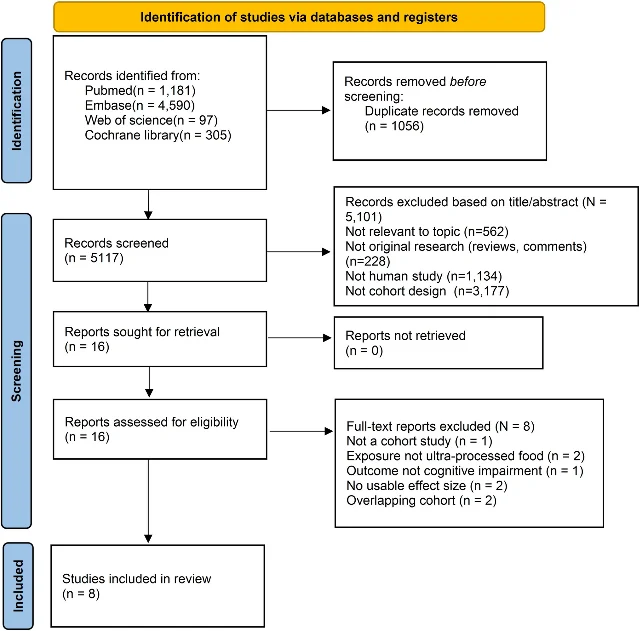
Shipeng Zhang, Xiulian Zhuang, and Fu Li from Chengdu University of Traditional Chinese Medicine searched PubMed, Embase, Web of Science, and the Cochrane Library, identifying 6,173 candidate records. 1 After deduplication and screening, 16 reports were assessed for eligibility; 8 were excluded (wrong study design, n=1; exposure not UPF, n=2; outcome not cognitive impairment, n=1; no usable effect size, n=2; overlapping cohort, n=2), leaving 8 cohort studies with a combined sample exceeding 250,000 participants.
The 8 included cohorts (Heejin Lee 2025; Kejia Zhang 2025; Jiawei Gu 2025; Galit Weinstein 2025; Seago ER 2025; Bhave VM 2024; Huiping Li 2022; Anne-Julie Tessier 2025) span UK and US populations and a range of follow-up durations. UPF was classified using the NOVA system — a food classification framework that categorizes products by degree of industrial processing rather than nutrient composition, placing foods like packaged snacks, ready meals, flavored yogurts, reconstituted meat products, and sugar-sweetened beverages in the highest-processing category. 1 Cognitive outcomes included Alzheimer's disease, dementia broadly, and composite cognitive impairment.
All effect estimates were pooled using a random-effects DerSimonian-Laird model, appropriate for meta-analyses with anticipated between-study variance.
What the data show
The headline result: HR = 1.14 (95% CI: 1.04–1.25), p = 0.01, I² = 87%. 1
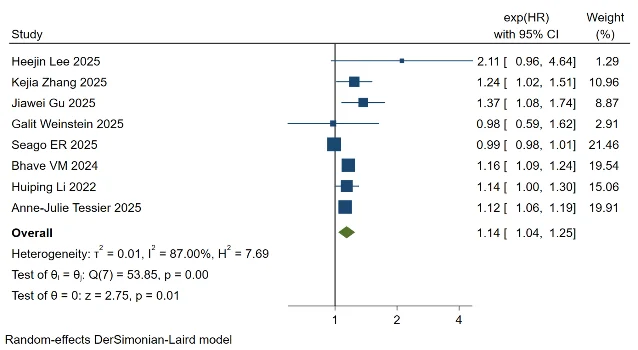
Two individual studies deserve attention. Seago ER 2025 (weight 21.46%, HR = 0.99 [0.98–1.01]) is the largest single contributor and effectively null — its tight interval pulls the overall estimate toward the null and accounts for a substantial portion of the heterogeneity. Bhave VM 2024 (19.54% weight, HR = 1.16 [1.09–1.24]) is the most internally precise positive-direction result, consistent with the separate finding from that cohort reported in Smith et al.'s 2025 systematic review that a 10-percentage-point increase in UPF proportion of total diet was associated with a 16% higher hazard of cognitive impairment (HR 1.16). 3
Subgroup analyses
The subgroup data add the most interpretively useful information in the paper.
By age — this is the most striking finding in the entire analysis:
| Age group | Pooled HR | 95% CI | I² |
|---|---|---|---|
| Under 60 | 1.19 | 1.06–1.33 | 40% |
| Over 60 | 1.10 | 0.97–1.24 | 86% |
| Overall | 1.14 | 1.04–1.25 | 87% |
The under-60 estimate is tighter (I² = 40%, vs. 86% in the over-60 group), meaning the cohorts contributing to that subgroup are more consistent with one another. The over-60 confidence interval crosses 1.0, meaning the association is not statistically significant in that age bracket. 1
By cognitive outcome type, within the under-60 subgroup: Alzheimer's disease HR = 1.13 (1.05–1.23), dementia HR = 1.17 (1.04–1.32). Both positive and statistically significant, with very low heterogeneity (I² = 0% for Alzheimer's). In the over-60 subgroup, the Alzheimer's association becomes non-significant and heterogeneous (I² = 79%), while the dementia estimate is positive but wide (HR = 1.24, 95% CI: 0.74–2.10). 1
By region: UK cohorts pooled at HR = 1.22 (1.02–1.44); US cohorts at HR = 1.11 (1.00–1.23), just clearing statistical significance. 1
By sample size: studies with more than 10,000 participants pooled at HR = 1.14 (1.10–1.19), I² = 0% — the tightest and most internally consistent result in the paper. Studies under 10,000 showed HR = 1.12 (0.91–1.37), non-significant.
By follow-up duration: studies with more than 15 years of follow-up pooled at HR = 1.14 (1.10–1.19), I² = 0%. The signal is driven by the longer, larger cohorts.
Sensitivity and publication bias
The leave-one-out sensitivity analysis shows that removing any single study shifts the pooled estimate to between 1.02 and 1.29, with no study individually responsible for the statistical significance — the finding is not an artifact of one outlier study. 1
The funnel plot shows a slight rightward asymmetry (more positive studies), suggesting possible publication bias toward positive results. The trim-and-fill method added two imputed studies on the left side; the adjusted estimate shifts toward the null but the exact corrected value is not reported in the abstract. This is a caution flag, not a disqualifier.
Context within the UPF-brain evidence base
Zhang et al. 2026 is the fourth independent piece of evidence linking UPF to cognitive outcomes published since 2022.
Henney et al. 2023 (Journal of Neurology, same journal) meta-analyzed 10 observational studies (n = 867,316) on UPF and dementia and found a pooled RR of 1.44 (95% CI: 1.09–1.90) for high vs. low intake, with I² = 97%. 4 Their conclusion was direct: "High UPF consumption is associated with dementia. Public health measures to reduce overconsumption of UPFs are imperative to reduce the burden of dementia." The very high I² in Henney limits the interpretive weight of their pooled figure, but the directionality is consistent with Zhang 2026.
Gu et al. 2025 (Journal of Nutrition, Health & Aging) used UK Biobank data (n = 58,423, ages 40–70) and found high UPF intake associated with dementia HR = 1.37 (1.08–1.74), Parkinson's disease HR = 1.76 (1.22–2.53), and reductions in gray matter volume across 6 of 7 subcortical regions including the hippocampus, amygdala, and caudate nucleus. 5 Their conclusion: "dietary assessment may serve as a relevant consideration in population-level approaches to brain health promotion."
Lane et al. 2024 (BMJ) umbrella review of 45 pooled analyses (n ≈ 9.9 million) found that 71% of all health parameters showed a direct harmful association with UPF exposure, with Class I (convincing) evidence for CVD mortality, type 2 diabetes, and anxiety — but did not include a UPF-cognitive impairment meta-analysis because the literature base was too thin at the time. 2 Zhang et al. 2026 is one of the papers that begins to fill that gap.
Taken together, these four datasets point in the same direction. None of them is an RCT, and the heterogeneity across all of them is high. But four independent research groups using different cohorts, different UPF classification approaches, and different outcome definitions have arrived at qualitatively consistent associations.
Limitations
Several limitations apply specifically to how much weight to give this meta-analysis.
Observational design throughout. All 8 cohorts are prospective but non-randomized. People who eat more UPF also tend to eat fewer vegetables and fruits, sleep less, exercise less, and have lower socioeconomic status — any of which could partially explain the associations. The authors cannot fully adjust for all confounders, and the adjusted estimates in some cohorts may still carry residual confounding.
High overall heterogeneity (I² = 87%). This means the 8 cohorts vary substantially in ways that affect the result. The sources of heterogeneity are partially explained by age and follow-up duration (as shown in the subgroup analyses), but not fully. An I² at this level means the pooled HR of 1.14 is a central tendency across a heterogeneous set, not a precise point estimate applicable across all populations.
Seago ER 2025 diverges. The single largest-weight study (21.46%) reports HR = 0.99 [0.98–1.01] — a null result. The paper cannot explain, from the abstract alone, why this cohort differs from the rest. Whether it reflects population-specific factors, different UPF definitions, or a genuinely null finding in that sample is unresolved.
Full text unavailable. The paper is behind a Springer paywall. The complete methodology — cohort-specific characteristics, covariate adjustment lists, NOVA classification details, funding sources, and conflict-of-interest disclosures — is not yet publicly accessible. The specific 95% CI for the <60-year subgroup age-stratified Alzheimer's and dementia estimates, and the trim-and-fill corrected pooled HR, are not reported in the abstract.
Dietary assessment via FFQs. Most large cohort studies rely on food frequency questionnaires to assess diet, which carry known measurement error for UPF specifically — people underreport highly processed snack foods and beverages, and a single dietary assessment at baseline may not capture long-term dietary patterns.
Publication bias signal. The funnel plot asymmetry suggests smaller negative studies may be underrepresented in the published literature.
Dietary recommendation
This meta-analysis supports one specific and actionable dietary decision — and it is consistent with guidance that comes out of the broader UPF evidence base.
Reduce the share of UPF in your total diet, with mid-life timing mattering more than previously understood.
The under-60 signal (HR = 1.19, I² = 40%) is the most internally consistent result in this paper. The epidemiological evidence, while not causal, now has four independent datasets pointing at the same target. Reducing UPF intake is already supported by evidence for cardiovascular mortality, type 2 diabetes, and anxiety risk 2; cognitive impairment is now a fourth domain where the signal is accumulating.
What this means practically:
- The NOVA system defines UPF broadly: carbonated drinks, packaged sweet or savory snacks, reconstituted meat products (nuggets, hot dogs, deli slices), flavored yogurts, instant noodles, breakfast cereals with added sugar, and most ready-to-heat meals all qualify. Replacing these, category by category, with minimally processed equivalents (whole grains, plain yogurt, fresh or frozen vegetables and meat, home-cooked legumes) is the operationally feasible version of "reducing UPF intake."
- For a health-conscious person who already eats a reasonably varied diet, the category most worth targeting is beverages: sugar-sweetened drinks and commercially flavored drinks are UPF by NOVA definition, carry no micronutrient benefit, and are easy to replace with water, plain coffee, or tea.
- For a registered dietitian counseling patients in their 40s and 50s specifically: the age subgroup data from this meta-analysis provide a new framing — the conversation is no longer only about weight, cardiovascular risk, or diabetes prevention, but about mid-life brain health as a distinct motivating category. Whether or not a patient cares about their A1c at 45, they may care about cognitive function at 75.
This meta-analysis does not support telling patients to avoid any specific UPF ingredient or to hit a precise UPF-percentage-of-diet target — the data are not refined enough for that level of guidance. The recommendation is directional: lower the overall UPF proportion of the diet, and the case for doing so in mid-life is now stronger than it was before June 2.
Cover image: AI-generated editorial still life.
References
- 1Zhang et al. 2026 — Association of combined ultra-processed food intake with cognitive function impairment: a meta-analysis of prospective cohort studies, Journal of Neurology
- 2Lane et al. 2024 — Ultra-processed food exposure and adverse health outcomes: umbrella review, BMJ
- 3Smith et al. 2025 — Ultra-processed food exposure and cognitive outcomes: a systematic review, medRxiv
- 4Henney et al. 2023 — High intake of ultra-processed food is associated with dementia in adults: a systematic review and meta-analysis, Journal of Neurology
- 5Gu et al. 2025 — Ultra-processed food intake and brain health in middle-aged and older adults, Journal of Nutrition Health & Aging (PMC)
Add more perspectives or context around this Post.