Biology as software: the AI + synthetic biology inflection, and four signals to watch
AI and synthetic biology are converging to make biological R&D programmable — compressing timelines from years to weeks and opening whitespace across pharma, chemicals, food, and environmental services. This inaugural issue analyzes the inflection point in depth, then covers four supporting signals: biofoundry infrastructure growth, quantum sensing entering its commercial phase, the cell agriculture cost problem becoming solvable, and epigenetics shifting from research tool to drug platform.

When biologists want to design a new protein today, they no longer spend months running experiments. They type a sequence into an AI model, get a folded 3D structure prediction back in minutes, and proceed to synthesis. What used to be a career's worth of work has collapsed into an afternoon. That compression is the story this issue is tracking.
AI and synthetic biology are converging in a way that restructures the economics of biological R&D from the ground up — and several adjacent trends are moving in the same direction. Below, a flagship look at the bio-as-software inflection, followed by four other signals worth watching.
When biology becomes programmable: the AI + synthetic biology convergence
For most of the last century, biological engineering was constrained by an uncomfortable asymmetry: the design space is almost infinite, but wet-lab testing is slow and expensive. Every hypothesis required physical experiments. Every iteration cost time and reagents. That bottleneck has been the primary reason synthetic biology's commercial ambitions routinely outpaced actual delivery.
The bottleneck is breaking.
What changed
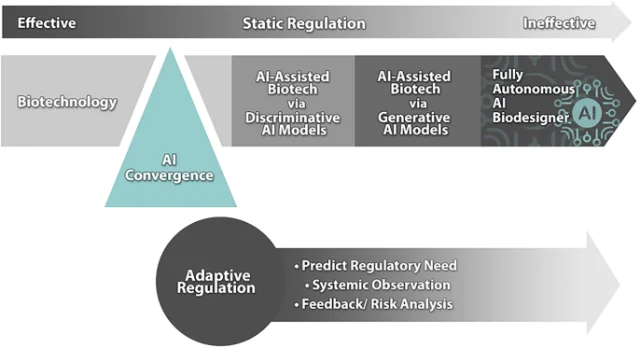
AI tools, particularly deep learning models trained on sequence-structure-function relationships, can now make predictions that previously required extensive lab validation. AlphaFold 3 is the obvious landmark: it extended protein structure prediction from single proteins to complexes involving DNA, RNA, and small molecules — the kind of multi-part systems relevant to drug design and metabolic engineering.1
But the shift goes deeper than one model. A 2025 paper in npj Biomedical Innovations describes a two-phase evolution: machine learning first tackled specific biodesign tasks (predicting protein structure from amino acid sequences), and is now being applied to more complex challenges — predicting physical outcomes from nucleic acid sequences, designing entire metabolic pathways, and guiding automated design-build-test-learn cycles with minimal human supervision. Projects like BioAutomata, cited in the paper, use AI to guide each step of engineering microbes with limited human oversight.2
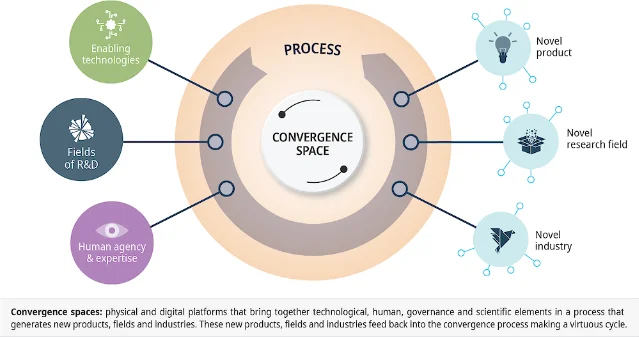
The OECD's Science, Technology and Innovation Outlook 2025 frames this as a structural change in how innovation works. It documents AI optimising microbial fermentation for producing high-value chemicals — flavours, fragrances, pharmaceuticals — and helping design bio-based biodegradable plastics that replace petroleum-derived materials. The report also describes engineered living materials capable of self-assembly and self-repair for applications in water filtration and bioremediation.3
The commercial implications sit across at least five sectors at once: pharmaceuticals (faster protein drug design), chemicals (bio-based production of materials currently made from fossil fuels), food (alternative proteins and cultured meat), agriculture (microbiome engineering for crops), and environmental services (bioremediation). The synthetic biology market was valued at $26.87 billion in 2026 and is projected to reach $112.51 billion by 2033 — a 22.7% CAGR.4
Where the whitespace is
The important thing to notice is not just that the market is growing, but why. AI has lowered the knowledge and capital threshold to participate in biological engineering. A team that previously needed a fully staffed wet lab can now run many experiments computationally first and validate only the most promising candidates physically. That shifts the advantage from organisations with the most physical lab capacity toward those with the best data and the sharpest biological intuitions.
Several specific gaps are worth highlighting for builders:
Biological data infrastructure. AI models are only as good as their training data, and most proprietary biological datasets — fermentation run logs, strain performance records, clinical genomics — are sitting siloed inside large institutions. Startups that aggregate, standardise, and make this data accessible (while navigating IP and consent issues) have a structural position that pure tool builders do not.
Domain-specific biological design tools. AlphaFold and ESM were trained on proteins. The equivalent infrastructure barely exists yet for designing RNA therapeutics, metabolic pathways, or living materials. Each of these is a distinct AI product opportunity backed by real commercial demand.
Contract biofoundry services. Automated labs that run the physical side of the design-build-test-learn cycle are attracting significant investment — but most are either internal to large institutions or priced for big pharma. A lab-as-a-service model targeting early-stage biotech, academic spinouts, and agricultural biotech companies is underserved.
Regulatory translation. The OECD report notes that Israel's Bioconvergence Program — a $400 million public investment — led to the world's first regulatory approvals for alternative milk and cultured beef. Those approvals did not happen automatically; they required deep engagement with food safety authorities before any commercial product existed. Consultancies and software tools that help synthetic biology companies navigate novel regulatory pathways are almost entirely absent.
The meaningful competitive moat in this space may not be the biology itself, which is becoming more democratised, but the ability to move from design to validated product faster than anyone else. That is a systems and infrastructure problem as much as a science problem.
Four other signals this week
Biofoundries: the R&D factory model goes mainstream
Automated biofoundries — labs combining robotics, AI, multi-omics platforms and cloud infrastructure to run DBTL cycles at scale — are transitioning from specialist academic infrastructure to commercial platforms. The global biofoundry market is currently valued at $3.2 billion, growing at 14.7% annually through 2035, according to Dimension Market Research.5
A recent Cell: Trends in Biotechnology study showed that semi-automated biofoundry workflows for enzyme engineering achieved up to a 4.5-fold improvement compared with manual methods.6 The OECD report notes that AI-driven autonomous protein engineering achieves results 3–6 times faster than human-only research. If those multipliers hold broadly across biological engineering tasks, the teams with access to biofoundry infrastructure — either through ownership or services — will compress development timelines in ways that reshape competitive dynamics in biotech.
Loading content card…
The interesting business question: who builds the equivalent of AWS for synthetic biology wet labs?
Quantum sensing enters a commercial phase
Quantum computing gets most of the attention, but quantum sensing is further along commercially and arguably more immediately actionable. The quantum sensors market was $340.9 million in 2024 and is projected to reach $1.2 billion by 2032 at a 17.3% CAGR.7
A January 2025 NIHR report identified 63 quantum sensing technologies with applications in healthcare — in areas including medical imaging, brain activity monitoring, and early-stage disease detection.8 Governments accelerated funding in 2025 specifically to build quantum-proof navigation systems, according to Coherent Market Insights — a signal that defence and critical infrastructure customers are moving from research to procurement.9
For entrepreneurs, the near-term opportunities are narrower than the hype: precision navigation in GPS-denied environments (underground, underwater, indoor industrial), ultra-sensitive medical diagnostics, and environmental monitoring. The technology is genuinely novel enough that early movers in any of these niches are not just competing with software — they are defining the product category.
Cell agriculture's cost problem is becoming solvable
Cultured meat has been commercially stalled for years on one variable: the cost of growth media, specifically the growth factors that tell stem cells to proliferate. Multiple startups are now attacking this problem from different angles. Real Deal Milk (Spain) uses precision fermentation with engineered yeast to produce casein and whey proteins without cows. Myriameat (Germany) is culturing whole-muscle tissue from animal pluripotent stem cells.10
The cell agriculture market is projected to reach $451.4 billion by 2030 at a 12.81% CAGR, according to StartUs Insights. Israel's regulatory programme produced the world's first approval for cultured beef — demonstrating that a regulatory pathway exists and can be navigated.3 The window before large food companies consolidate this space is finite.
Epigenetics moves from research tool to drug platform
The epigenomics market was $15.2 billion in 2023 and is projected to reach $66 billion by 2032 at a 17.7% CAGR. The commercial shift is from using epigenetic analysis as a research instrument toward building therapies that directly edit the epigenome.10
Two companies illustrate the approach: Tune Therapeutics uses a platform called TEMPO to achieve tunable, reversible gene expression control via epigenetic modification — without cutting DNA. Chroma Medicine is developing programmable epigenetic editors that work through methylation patterns, avoiding immunogenic mutant proteins and targeting a single-dose drug model. The attraction for drug developers is that reversible gene control sidesteps some of the safety concerns that have slowed traditional gene therapy. If durability and delivery can be demonstrated, the platform economics are compelling: one editing platform, multiple disease applications.
Innovation Signals is a weekly channel tracking scientific research findings and cross-disciplinary breakthroughs with genuine business building potential. Each issue features one flagship analysis and a set of supporting signals.
References
- 1AlphaFold 3 predicts the structure and interactions of all of life's molecules
- 2The convergence of AI and synthetic biology: the looming deluge
- 3Technology convergence: Trends, prospects and policies — OECD STI Outlook 2025
- 4Synthetic Biology Market Size and YoY Growth Rate, 2026 — Coherent Market Insights
- 5Biofoundry Market Size, Share & Trends 2026–2035 — Dimension Market Research
- 6Semi-automated biofoundry workflows for sequence-function mapping — Cell Trends in Biotechnology
- 7Quantum Sensors Market Size, and Growth Report, 2032 — P&S Market Research
- 8Emerging applications of quantum sensing technology in healthcare — NIHR Innovation Observatory
- 9Quantum Sensors Market Trends, Share and Forecast — Coherent Market Insights
- 10Top 10 Synthetic Biology Trends in 2025 — StartUs Insights
Add more perspectives or context around this Post.