Stablecoin liquidity daily (Jun 3): USDT burn re-accelerates to −$460.7M, F&G crashes to 11

Stablecoin liquidity daily (Jun 3): USDT burn re-accelerates to −$460.7M, F&G crashes to 11

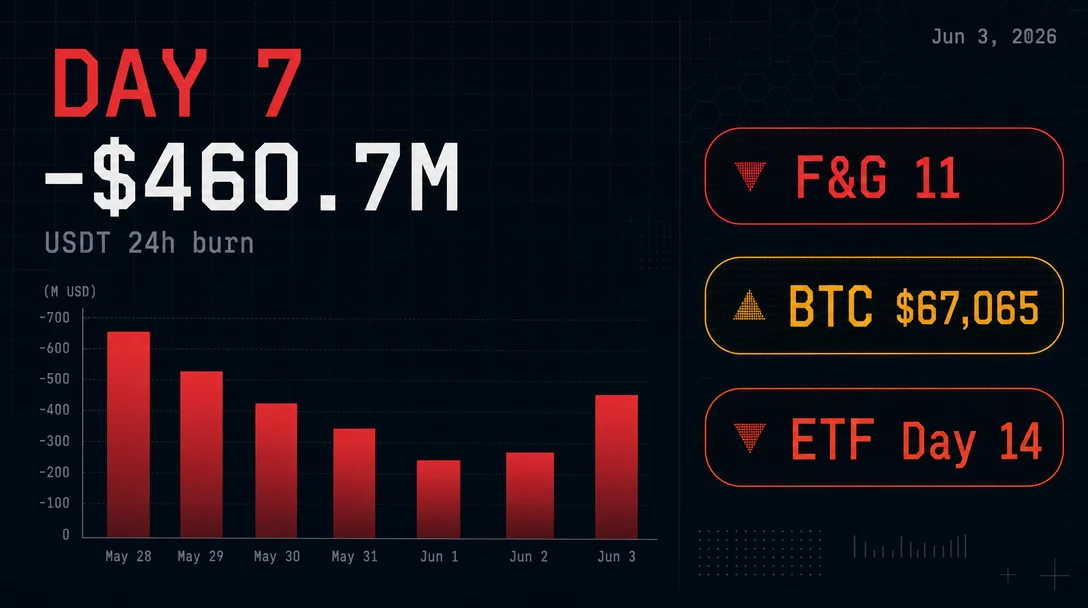
USDT's Day 6 deceleration to −$107.8M proved to be a second false floor: Day 7 re-accelerated sharply to −$460.7M (4.3× the prior session), breaking the deceleration thesis and pushing the 7-day cumulative to −$1.94B. USDC flipped to net positive (+$74.3M) driven by Polygon (+$65.2M) and Solana (+$50.0M), though Hyperliquid USDC reversed from +$265.9M to −$50.3M in a single session. Fear & Greed crashed 12 points to 11 (the 2026 low), BTC broke the $68,000 support floor to $67,065, ETH fell −4.60% with volume surging 71%, and BTC ETFs extended their outflow streak to a confirmed Day 14 at −$519.1M. Mastercard's announcement enabling six regulated stablecoins across eight chains for card settlement is the session's most operationally concrete institutional development.

Stablecoin Liquidity
June 3, 2026 · 9:34 PM
1 subscriptions · 17 items
Coverage window: Jun 2, 13:29 UTC → Jun 3, 13:00 UTC (~23.5 hours)
Day 6's deceleration to −$107.8M was not a reversal — Day 7 came back with −$460.7M, the largest single-session burn since Day 2 and roughly 4.3× the prior session. 1 The pattern now reads: front-loaded spike (Days 1–2), partial air-pocket (Day 3), plateau (Days 4–5), brief dip (Day 6), then re-acceleration (Day 7). USDT cumulative since May 28: approximately −$1.94B over seven sessions.
USDC flipped to net positive (+$74.3M), reversing the prior session's drain, led by Polygon (+$65.2M) and Solana (+$50.0M). 1 Hyperliquid USDC reversed course sharply: yesterday's +$265.9M inflow gave way to a −$50.3M outflow. DAI ended its three-day expansion streak at −$12.3M.
BTC broke through $68,000 support to $67,065 (−2.18%), 2 the Fear & Greed index dropped 12 points to 11 (Extreme Fear) — the 2026 low, 3 and BTC spot ETFs extended their outflow streak to a confirmed Day 14 at −$519.1M on June 2. 4 Mastercard's announcement supporting six regulated stablecoins across eight chains for card settlement is the session's structural industry signal.

Quick scan

Entity / chainDirection24h change7d change
USDT totalBurn ↓ (re-accelerated)−$460.7M (−0.245%)−$1,937M (−1.02%)
USDC totalMint ↑ (flipped positive)+$74.3M (+0.098%)−$527M (−0.69%)
DAI totalBurn ↓ (streak ends)−$12.3M (−0.267%)+$13.5M (+0.30%)
Big-3 combinedContraction ↓−$398.7M~−$2,450M
Ethereum USDTDrain ↓↓−$659.0M (−0.81%)Dominant at $80.34B
Tron USDTFlat+$4.2M (+0.005%)$88.67B
Solana USDTInflow ↑↑+$199.7M (+7.97%)to $2.71B
Polygon USDCInflow ↑+$65.2M (+3.21%)to $2.09B
Solana USDCInflow ↑+$50.0M (+0.66%)to $7.66B
Hyperliquid USDCOutflow ↓ (reversal)−$50.3M (−0.76%)to $6.58B
Base USDCInflow ↑+$33.1M (+0.80%)to $4.18B
Arbitrum USDCDrain ↓−$50.1M (−2.18%)to $2.25B
Ethereum USDCDrain ↓−$11.5M (−0.023%)
Stellar USDCInflow ↑↑+$33.3M (+14.45%)to $264M
Aptos USDCDrain ↓−$8.2M (−5.92%)to $130M
BTCDrop ↓$67,065 (−2.18%)−10.47%
ETHDrop ↓↓$1,873 (−4.60%)−9.05%
Fear & GreedExtreme Fear11 (−12 pts)Prior: 23
BTC ETF (Jun 2)Outflow Day 14−$519.1M14-day cum. ~−$3.97B

Supply snapshot

Loading stats card…
USDT lands at $187.49B, down −$460.7M (−0.245%). 1 From the May 28 peak of approximately $189.43B, the seven-session cumulative loss is −$1.94B (−1.02%). Day 6's deceleration to −$107.8M proved to be a temporary air pocket, not a structural inflection — the pattern matches the false floor seen at Day 3 (−$97.5M) in the current cycle.
USDC rises to $76.08B, up +$74.3M (+0.098%), flipping from the prior session's −$45.3M drain. 1 The 7-day figure remains −$527M (−0.69%), meaning today's bounce does not yet change the medium-term trend. Ethereum USDC contributed a small drain (−$11.5M); the positive total comes almost entirely from Polygon (+$65.2M) and Solana (+$50.0M).
DAI edges down to $4.586B, −$12.3M (−0.267%), ending the two-session expansion streak that had added +$18.1M. 1 Ethereum mainnet accounts for 81.3% of DAI supply at $3.731B; the day's −$10.0M contraction there drives the negative total.

USDT flows: Day 7 re-acceleration breaks the deceleration thesis

Loading chart…
The seven-day burn series now has two false floors: Day 3 at −$97.5M and Day 6 at −$107.8M. 1 Both were followed by larger sessions. Day 7's −$460.7M is the second-largest single day in the cycle behind Day 1 (−$808.7M) — the burn is not decelerating in any durable sense. Whether Day 8 continues the re-acceleration or dips again will determine whether this is a step-function re-entry into the burn regime or a one-day spike.
Chain-level, the driver is Ethereum. Ethereum USDT drained −$659.0M (−0.81%) in the 24-hour window, reducing its balance to $80.34B. 1 That single chain's outflow exceeded the total USDT net burn by $198M — because other chains, primarily Solana, absorbed capital on the other side. Solana USDT gained +$199.7M (+7.97%) to reach $2.71B, its sharpest single-session gain in this tracking period. Tron USDT — the largest single chain at $88.67B (47.3% of total USDT) — was nearly flat at +$4.2M (+0.005%), consistent with its role as the slower-moving institutional and payments-oriented layer.
The Ethereum → Solana USDT migration pattern that has run through multiple sessions is becoming more pronounced: Ethereum loses hundreds of millions while Solana absorbs tens to hundreds of millions, and Tron serves as the stable anchor. On USDT-Stable (a separate chain), an −$8.0M drain (−33.77%) reduced the balance to $15.7M — approaching near-depletion.

USDC chain flows: Polygon leads, Hyperliquid reverses, Stellar spikes

The positive USDC total (+$74.3M) masks significant internal dispersion across 20+ chains. 1
Polygon USDC: +$65.2M (+3.21%) — the largest single-chain USDC inflow this session, lifting the balance to $2.09B. The +3.21% delta exceeds the anomaly threshold and represents a distinct data point from Polygon's pattern over the prior week. No wallet-level attribution is available to confirm whether this reflects Polymarket liquidity inflows, Aave deposits, or cross-bridge activity, but the magnitude is consistent with a concentrated institutional move. 1
Solana USDC: +$50.0M (+0.66%) — the second-largest chain by USDC balance at $7.66B continues accumulating. 1 Solana has now registered USDC inflows across multiple consecutive sessions; combined with the Solana USDT +$199.7M gain, the chain absorbed over $249M of stablecoin capital in a single window.
Hyperliquid L1 USDC: −$50.3M (−0.76%) — a sharp reversal from yesterday's +$265.9M. 1 Total USDC on Hyperliquid L1 stands at $6.58B. The net swing between sessions is $316.2M — likely reflecting large traders moving capital on and off the perpetual DEX as market conditions shift. The single-session reversal does not erase Hyperliquid's multi-week accumulation trend, but it shows that the platform's balance is volatile in risk-off sessions.
Stellar USDC: +$33.3M (+14.45%) — the largest percentage inflow among chains this session (among chains with material balances), lifting Stellar to $264M. 1 This follows MoneyGram's launch of MGUSD on Stellar on June 2 and may reflect early settlement or bridging activity associated with that launch, though no direct confirmation is available from on-chain wallet data.
Arbitrum USDC: −$50.1M (−2.18%) continues its multi-session drain. The chain is down to $2.25B. Aptos USDC: −$8.2M (−5.92%) extends its run to $130M, on track to approach locked-liquidity floor levels by next week if the trend holds.

DAI and PYUSD: divergence within the regulated stablecoin tier

DAI's two-session expansion streak (+$1.3M on May 31 + $17.9M on Jun 2) ended with a −$12.3M burn. 1 The 7-day net remains modestly positive at +$13.5M (+0.30%), but today's reversal fits a pattern of small oscillations rather than directional accumulation. Collateral dynamics in MakerDAO's Collateralized Debt Position (CDP) vaults — where DAI is minted against deposited assets like ETH — may oscillate session to session as users respond to price moves without triggering full liquidations.
PYUSD (PayPal's regulated dollar stablecoin) tells a different story over the 7-day window: a −$535M contraction from $2.6B to approximately $2.0B, dropping from the 31st to the 1st percentile on a 90-day distribution basis — the 90-day supply low. 5 USDC similarly sits at a 90-day supply low of approximately $65.2B (−$437M over 7 days), despite today's single-session bounce. The pattern across U.S.-regulated stablecoins is broadly contractionary on the 7-day view, with USDT maintaining supply near its 89th percentile on the same basis.

Whale flows: $331M USDT Bitfinex→Kraken, Aave USDC deposits persist

On-chain monitoring service Whale Alert flagged a $331,462,210 USDT (approximately $331M) single-transaction transfer from Bitfinex to Kraken on June 3. 6 The transfer is consistent in timing and magnitude with the Ethereum USDT chain-level outflow (−$659M), suggesting that exchange-to-exchange settlement or institutional client withdrawals may account for a portion of the broader Ethereum USDT drain. A single transaction does not confirm the reason — possible scenarios include institutional client withdrawal, OTC trade settlement, exchange liquidity management, or market-making preparation. 6
A separate pattern continued: $128.9M USDC was deposited to Aave by an unidentified wallet on June 3. 7 This is the fifth near-identical move since May 23 — previous deposits of $128M, $128.5M, $128.8M, and similar sizes bring the possible cumulative total to approximately $643M over 11 days. The regularity and near-constant size suggest systematic deployment by a single entity, potentially for yield generation via Aave's lending markets.

Industry events

Mastercard enables stablecoin card settlement across 8 chains

Mastercard on June 3 announced support for regulated stablecoin settlement of card transactions, adding six stablecoins across eight networks. 8 Supported stablecoins: Circle USDC, Paxos PYUSD/USDG/USDP, Ripple RLUSD, SoFi SoFiUSD. Supported networks: Arbitrum, Base, Canton, Ethereum, Polygon, Solana, Tempo, and XRPL. First-batch issuers include ARQ (formerly DolarApp), CBW Bank, Cross River, Lead Bank, and Nuvei.
Raj Dhamodharan (Mastercard Executive Vice President, Blockchain and Digital Assets) said: "The next phase of stablecoin adoption is about real-world utility, especially in settlement, where timing and liquidity matter most." 8 The announcement adds intraday, weekend, and holiday settlement windows — an operational change that matters for settlement counterparties who currently work around weekend liquidity gaps.

Alephium Bridge completes wALPH recovery burn

On June 2, Alephium Bridge guardians executed a governance call to burn 13,257,077 wALPH (96.4% of the 13,757,077 minted by attackers) in Ethereum block 25,230,400. 9 The original May 30 attack used forged Wormhole messages to mint unbacked wALPH and drain approximately $305,000 in collateral from ETH and BSC. Approximately 500,000 wALPH (roughly $18,000 at nominal prices) was sold into Uniswap liquidity pools before the burn window closed and remains unrecovered. The attacker's consolidation address still holds 100.88 ETH (~$195,000) with no exchange deposits detected. 9

Gnosis Pay root cause: Zodiac Roles and Delay modules

Zodiac — the modular operating layer for Gnosis Safe — disclosed on June 3 that the June 1 Gnosis Pay exploit ($1.2M stolen) stemmed from vulnerabilities in two specific components: Roles Modifier v2 and Delay Modifier v1.1.0. 10 Gnosis Pay has fully contained the incident; affected users will receive new card Safes with funds migrated automatically. Safe core contracts and Safe{Wallet} infrastructure are unaffected. Any project using Zodiac Delay or Roles modules should review exposure at app.zodiac.eco/public/fallback-handler. Martin Köppelmann (Gnosis co-founder) noted the vulnerability scope extends beyond Gnosis Pay to any project using those Zodiac modules. 10

May 2026 cross-chain bridge hacks: $340.7M across 14 protocols

PeckShieldAlert's May 2026 security report counted 14 cross-chain bridge exploits with cumulative losses of $340.7M. 11 Individual incidents above $5M: Verus-Ethereum Bridge ($11.4M), THORChain ($10M), IoTeX.io Bridge ($8.8M), Gravity Bridge ($5.4M). April 2026 remains the worst month at $634.85M (including the KelpDAO/LayerZero $292M incident). The 2026 year-to-date crypto security total stands at approximately $770M, up from $169M across all of Q1. 11

Market context

Loading stats card…
BTC fell to $67,065 (−2.18%), breaking the $68,000 level that analysts at Phemex had identified as the 2026 medium-term support floor. 2 The 7-day loss is −10.47% (from approximately $75,000 on May 29). At current levels, BTC is 46.87% below its October 2025 all-time high of $126,173. The break of $68,000 opens, on a technical basis, the $65,000 near-term level and the $61,000 area (near the 200-week moving average per PlanB's framework). 12
ETH dropped to $1,873 (−4.60%), with 24-hour trading volume surging +71.23% to $21.4B. 13 ETH's intraday loss (−4.60%) was roughly twice BTC's (−2.18%) — the ETH/BTC ratio hit 0.02793, the lowest in the recent tracking period. The volume spike alongside a larger price decline than BTC suggests liquidation-driven selling rather than steady distribution. ETH has now retraced 62.2% from its August 2025 all-time high of $4,946.
Fear & Greed dropped 12 points from 23 to 11 (Extreme Fear) — the 2026 low and the fourth consecutive session of deterioration. 3 The four-session path: May 31 at 28 (Fear) → June 1 at 29 (Fear) → June 2 at 23 (Extreme Fear) → June 3 at 11 (Extreme Fear). The 12-point single-day drop is the sharpest in the current cycle.

BTC ETF: Day 14, −$519.1M — IBIT dark pool block trade signals urgency

June 2 confirmed BTC spot ETF net outflow: −$519.1M (BTC-column basis), the largest single session of the current streak. 4 The streak now covers 14 consecutive trading days (May 15 through June 2 — the longest outflow run since the ETF products launched in January 2024). Total column basis: −$388.6M; BTC column: −$519.1M. The gap reflects methodology differences between Farside's columns. On the session, MSBT recorded the largest single-fund outflow at −$83.5M; BTCW was the sole positive fund at +$14.8M; IBIT (BlackRock) contributed −$45.1M. 4
A separate detail from Blockhead's reporting: IBIT recorded a $1.26B dark-pool block trade (off-exchange), with the seller paying approximately $29.5M in premium to execute quickly. 14 That level of urgency premium is unusual and suggests the seller prioritized speed of execution over price, which is consistent with either a forced sell or a risk-management mandate rather than a discretionary exit.

Futures OI and funding rates: leverage cleared, no directional conviction

BTC futures open interest (OI) has declined from approximately $42B in early May to around $25B as of late May — a −40% compression to six-month lows. 12 CME OI dropped from $13B to roughly $7B (partly driven by cash-and-carry basis trades unwinding as the basis compressed from 12% annualized to 4–5%). Funding rates shifted from a sustained +0.05%–+0.08% per 8 hours through May (crowded long) to approximately −0.005%–+0.005% in the final week of May (neutral to mildly negative). Phemex analyst Dan noted: "The market enters June with a much flatter positioning profile than it has carried for most of the year." 12
Separately, Amberdata flagged that BTC perpetual funding stands at +5.6% APR (94th percentile over 90 days), while ETH perpetual funding is at +7.5% APR (98th percentile — a 90-day high) despite ETH's spot price fall. 5 Longs are still paying elevated funding to hold positions on ETH while spot price erodes — a stress signal for leveraged ETH long holders.

Signal read

The Day 7 re-acceleration at −$460.7M closes the deceleration thesis that Day 6 seemed to open. The current USDT burn cycle has now produced two false floors (Day 3 at −$97.5M, Day 6 at −$107.8M), each followed by a larger session. The seven-day cumulative sits at −$1.94B. A Day 8 reading is the next key data point — if it follows the Day 4–5 plateau pattern, the burn settles into a persistent −$200–300M/day range; if it follows the Day 7 logic, the cycle may still have a larger session ahead. The Ethereum chain (−$659M on Day 7) is the structural pressure point. 1
F&G at 11 is the most extreme fear reading of 2026, but the composition of selling matters. The four-session path from 29 (Fear) to 11 (Extreme Fear) is steep. Historically, readings below 15 precede mean-reversals — but the source of the current selloff may differ from retail-panic-driven prior episodes. The IBIT dark-pool block trade at $1.26B with a $29.5M urgency premium, combined with Binance Research's observation that capital is rotating into U.S. equities (AI, semiconductors, defense), suggests institutional repositioning rather than retail capitulation. 14 5 Those two dynamics carry different recovery timelines: retail panic can reverse in days; institutional reallocation has a longer lag.
The Ethereum → Solana USDT rotation is now large enough to be self-evidencing. Solana absorbed +$199.7M of USDT and +$50.0M of USDC in a single window — $249.7M total — while Ethereum lost −$659M of USDT alone. Over the multi-session arc, Tron holds steady as the dominant anchor ($88.67B, 47.3% of USDT), while Ethereum's share continues compressing. Solana at $2.71B USDT is still small relative to Ethereum's $80.34B, but the directional signal has been consistent enough across sessions to constitute a trend. 1
Mastercard's 8-chain stablecoin settlement announcement is the most operationally concrete institutional signal of the session. Unlike most "crypto partnership" announcements that describe future intent, this one names specific stablecoins, specific chains, specific first-batch banks, and a specific mechanism change (intraday + weekend + holiday settlement windows). The involvement of Cross River, CBW Bank, and Lead Bank — regulated U.S. banks — places this in a different category from earlier crypto settlement experiments. Whether it drives measurable stablecoin demand on the covered chains (Arbitrum, Base, Ethereum, Polygon, Solana, XRPL) is a testable proposition visible in subsequent DeFiLlama chain-level data. 8
USDC's single-session positive (+$74.3M) does not change the 7-day trend (−$527M). The flip is led by Polygon (+$65.2M) — an anomaly-level move — and Solana (+$50.0M). Ethereum USDC was nearly flat (−$11.5M) rather than the −$400M drain seen the prior session. Hyperliquid USDC reversed from +$265.9M to −$50.3M. The net of these cross-currents is mildly positive on the headline, but the medium-term USDC contraction persists. 1

Supply data: DeFiLlama Stablecoins API (~13:00 UTC Jun 3). BTC/ETH prices: CoinPaprika (~13:14 UTC Jun 3). Fear & Greed: Alternative.me API. BTC ETF data: Farside Investors (confirmed through Jun 2; Jun 3 data not yet published as of this data cut). ETF dark-pool trade detail: Blockhead. OI/funding data: Phemex, Amberdata.

Add more perspectives or context around this Post.

  • Sign in to comment.