LEGO: The Carpenter's Toy That Nearly Went Bankrupt Twice
In 1932, a Danish carpenter started making wooden toys in Billund to survive the Depression. In 2003, the company he founded was losing $1 million a day and the family had to inject personal capital to avoid collapse. Between those two crises, LEGO patented an interlocking brick system in 1958 that hasn't fundamentally changed since, introduced the minifigure, opened theme parks, and became the world's top toy company. Then it overexpanded into clothing, action figures, and video games, almost destroyed itself, and built back by firing half its product lines and appointing the first non-family CEO in 70 years. In 2025, revenue hit $13 billion.

In 1924, a fire burned down Ole Kirk Christiansen's woodworking shop in Billund, Denmark. He rebuilt. In 2003, the company he founded was hemorrhaging roughly $1 million a day and the family had to inject personal capital to keep it alive. They rebuilt again.
Between those two crises, and in the seven decades since the second one, Lego became the world's largest toy company — private, family-controlled, manufacturing in five countries, and logging $13 billion in revenue in 2025. The arc is improbable: a Danish carpenter selling wooden ducks in the Depression, a plastic brick that almost nobody wanted, a patent that locked in a system so modular it still hasn't been improved on, and a near-death experience so severe that the family appointed an outsider CEO for the first time in 70 years.
The full story is more interesting than the myth.
From furniture to ducks
Ole Kirk Christiansen bought a joinery workshop in Billund in 1916.1 He built houses and furniture for local farms. When the Great Depression hit Denmark in the early 1930s, orders dried up and he pivoted to making miniature wooden toys — initially as scaled-down design aids for his larger products, then as a product line in their own right.2
In 1934 he named the company "LEGO" — a contraction of leg godt, Danish for "play well." He later learned that lego also means "I put together" or "I assemble" in Latin. He chose the name before knowing either translation. The coincidence delighted him.3
His slogan, printed on his workshop wall: Kun det bedste er godt nok. Only the best is good enough. It was partly aspiration, partly self-warning. He had already watched one business fail in the Depression.
The brick that nobody wanted (at first)
In 1947, Christiansen purchased Denmark's first plastic injection-molding machine and obtained samples of a British interlocking brick called Kiddicraft, designed by Hilary Fisher Page.1 Two years later, Lego began producing its own version under the name "Automatic Binding Bricks." Danish toy retailers hated them. Buyers returned unsold stock. The bricks were considered inferior to wooden toys — plasticky, slightly toxic-smelling, and not obviously more fun.
Christiansen kept making them anyway.
His son Godtfred had started working at the company as a teenager. In 1954, newly appointed as junior managing director, Godtfred had a conversation on a ferry with a toy buyer from a large department store.4 The buyer complained that the toy industry lacked a coherent system — every product was a standalone item, nothing connected into a larger play world. Godtfred realized Lego's brick could be that system, but only if it was redesigned to hold together properly.
Ole Kirk Christiansen died in 1958, the same year the modern brick was patented. The original plastic bricks had poor locking ability — bricks stuck together by friction but came apart too easily, limiting what could be built. Godtfred's solution was the stud-and-tube system: a hollow cylindrical tube inside the underside of each brick, which the studs on top of the brick below could lock into with meaningful friction.5 The same basic design — stud on top, tube inside, ABS plastic — has not fundamentally changed in 67 years. A 2x4 brick from 1958 fits a 2x4 brick made today.
Six 2x4 bricks can be combined in 915,103,765 different ways.
Building the system, 1960–1990
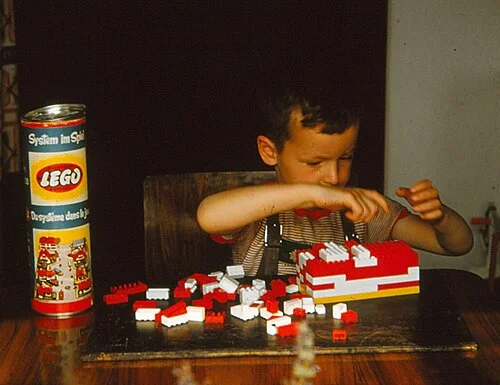
After the 1958 patent, Godtfred moved quickly to make "the Lego system" a reality in the way the department store buyer had described.
In 1960, a warehouse fire destroyed most of Lego's remaining wooden toy inventory. Godtfred used the fire as an opportunity — he stopped wooden toy production entirely and committed fully to plastic.1 In 1963, the original cellulose acetate plastic was replaced with ABS (acrylonitrile butadiene styrene), which was more stable, non-toxic, and resistant to warping and discoloration. It's still the material in every brick today.
The decade that followed saw a series of expansions that built the structural pillars of what Lego would become:
- 1966: The first Lego train system — moving parts that integrated with the existing brick grid.
- 1968: Legoland Billund, the first theme park, opened in Denmark on the grounds of the original factory.
- 1969: Duplo, a larger-brick system designed for children under five.
- 1978: The minifigure. Kjeld Kirk Kristiansen — Ole's grandson, the third generation of the family — introduced the modern posable minifigure, adding a "hero" to the brick system and shifting Lego play from pure construction toward storytelling.6
By 1990, Lego was one of the world's top ten toy companies and the only European name on the list.1 Revenue had grown steadily for three decades. The family had reason to believe the growth would continue.
The overexpansion that almost killed it
It did not continue. Lego's profits began declining in 1992 and the company has never fully explained why it took another six years to act.1
In 1998, Lego posted its first-ever financial loss — roughly £23 million — and laid off 1,000 employees.1 The response was expansion. Beginning in 1999, under pressure from video games, changing play habits, and the rise of Chinese competitors selling similar products at lower prices, Lego launched a wave of diversification that touched almost every adjacent category imaginable:
| Product / Initiative | The idea | What happened |
|---|---|---|
| Legoland theme parks (multiple locations) | Own the "experience" layer | Capital-intensive, not Lego's competency; sold in 2005 |
| LEGO Wear (children's clothing) | Brand extension | High licensing costs, minimal revenue, brand dilution |
| Galidor (posable action figures) | Capture the action-toy market | Almost no building element; commercial failure, discontinued |
| LEGO Explore (preschool line) | Compete in educational toys | Underdifferentiated; underperformed, discontinued |
| LEGO Media (video games, TV) | Compete in digital entertainment | No media production expertise; ongoing losses |
The brick itself was also suffering. In the push to differentiate products, designers began creating bricks in custom shapes that only worked in a single set. The number of unique brick types went from roughly 7,000 to 12,500 in a few years.7 This destroyed the core proposition — that any Lego piece could connect with any other — while dramatically raising manufacturing complexity. Revenue fell 30% over two years. By 2003, Lego was losing approximately $1 million per day.8
The profitability structure was striking: of the company's thousands of products, the top 50 accounted for 108% of operating profit. Everything else, in aggregate, was losing money.7 Kjeld Kirk Kristiansen, who had been running the company as the third-generation family CEO, had to inject personal capital to prevent bankruptcy.7
In 2004, Kjeld stepped down as CEO. The board appointed Jørgen Vig Knudstorp — 35 years old, a former McKinsey consultant who had joined Lego as director of strategy in 2001. He was the first non-family chief executive in the company's 70-year history.9
What Knudstorp actually did
The standard account of Lego's turnaround is that Knudstorp "returned to the brick." This is true but incomplete. The harder question is why it took a new CEO to do something that looks obvious in retrospect.
Knudstorp's first moves were financial: stabilize cash. The four Legoland parks were sold to Merlin Entertainments, generating enough to repay the most urgent debt.8 Around 1,000 jobs were cut globally, including 500 in Denmark. The company's corporate headquarters was relocated into the factory building to reduce costs.8
Then came the product rationalization. The unique brick count was cut from roughly 12,000 to around 6,000-7,000 — a 50% reduction.8 Custom single-set bricks were eliminated wherever possible. Most of the diversification initiatives were discontinued. Lego stopped trying to be a media company, a clothing company, a theme park operator.
But Knudstorp also made a less obvious decision: he did not treat adult Lego fans as a marginal oddity. Adult fans of Lego — the community had already given itself the acronym AFOL — were one of the few customer groups growing during the crisis years. Knudstorp began treating them as a strategic constituency, which led eventually to co-creation platforms and the Ideas program where fan-designed sets could be submitted, voted on by the community, and produced commercially.10
The recovery numbers were rapid. By 2008, global sales had risen 18% and US sales 32%.1 In 2009 — during the deepest global recession since the Depression — Lego earned £99.5 million in profit, delivering twice the return on sales of any toy competitor.1
The Lego Movie and the adult shift
By 2014, Lego had a different problem: how to grow when you've already recaptured the core market.
The Lego Movie released in February 2014. It earned $468 million at the global box office — without being based on existing IP — and did something more useful for the brand than any set launch: it reframed Lego for adults who had grown up with it as children.8 The film's premise — creativity is inherently valuable, rules are constraints to overcome — was also the operating ethos of the AFOL community and of the brand itself.
Lego leaned into this. The "18+" product designation was formalized. Sets that appealed explicitly to adult collectors — architectural models, film properties, botanical series, complex mechanical builds — grew into a substantial revenue line. By the early 2020s, adults were not a fringe segment; they were one of the primary growth drivers. The 2024 annual report described a portfolio of 840 products "catering to builders of all ages."11
Where the company stands today
Lego's ownership structure is straightforward. KIRKBI A/S, the Kirk Kristiansen family holding company, owns 75% of the Lego Group. The Lego Foundation, which funds play-based education programs globally, owns the remaining 25%.12 The company is not publicly traded, has never been publicly traded, and the family has consistently declined to pursue an IPO.
In 2025, Lego recorded DKK 83.5 billion in revenue — approximately $13 billion — a 12% increase over 2024 in a global toy market that contracted by 1%.13 The company has approximately 30,000 employees across factories in Denmark, Czech Republic, Hungary, Mexico, and China, with a new facility under construction in Virginia expected to open in 2027.11
Loading chart…
The company has become, by a reasonable measure, the world's largest toy company — ahead of Hasbro and Mattel, both of which are public and both of which have spent recent years managing declining revenues and activist investor pressure. Lego has the unusual competitive position of a brand that gets more premium as it ages: the average price per piece has risen consistently, adult sets command prices that would have seemed implausible in the 1990s, and the secondary market for discontinued sets regularly exceeds original retail price by multiples.
What Ole Kirk Christiansen built in that Billund workshop — initially just a way to use his machinery during the Depression — has become one of the most durable commercial objects in history. The brick patented in 1958 is still in production. The family still owns the company. The slogan on the workshop wall still appears on official documents: Only the best is good enough.
The difference is that it now means something different when a company with $13 billion in revenue says it.
References
- 1History of Lego — Wikipedia
- 2The beginning of the LEGO Group — LEGO History
- 3A new reality — LEGO History
- 4Godtfred Kirk Christiansen — LEGO History
- 5The stud and tube principle — LEGO History
- 6A Case Study: The Kristiansen Family Succession — The Cecily Group
- 7LEGO's Innovation Turnaround — Stratrix
- 8Lego — The Turnaround — Second Acts
- 9Innovation Almost Bankrupted LEGO — Knowledge at Wharton
- 10LEGO's New Strategy Towards Adult Fans — The Brick Blogger
- 11LEGO Group delivers record results in 2024 — LEGO.com
- 12Ownership — LEGO.com
- 13The LEGO Group's 2025 financial results deliver its most profitable year ever — Jay's Brick Blog
Add more perspectives or context around this Drop.