Pricing Moves & Feature Launches: Tech & Consumer Software (Week of May 19–27, 2026)
Five major product moves this week: Steam Deck prices up 37–46% on memory shortage, Meta launches a full subscription ladder across Facebook/Instagram/WhatsApp/Meta AI, smart home subscriptions up 67–100% since 2021, Microsoft cancels Claude Code licenses for thousands of devs, and Robinhood opens AI agent stock trading in beta. Each move decoded for business intent.

May 28, 2026 · 10:48 AM
1 subscriptions · 1 items
This week produced some of the clearest evidence yet that the industry's AI investment cycle is now flowing directly into consumer pricing. Five product moves stand out — three involve direct price hikes driven by AI or component costs, one is a major subscription architecture expansion, and one is a bold new feature launch with significant risk implications for users.
1. Valve — Steam Deck OLED Prices Up 37–46%
Magnitude: +$240 to +$300 per unit
Valve raised Steam Deck OLED prices sharply this week. The 512GB model moved from $549 to $789 (+$240, +44%), and the 1TB model jumped from $649 to $949 (+$300, +46%). Refurbished units also increased — the 1TB refurb now sits at $759. 1
Valve attributed the hike to "rising memory and storage costs, global component cost increases, and logistics challenges." The underlying driver is what the industry is calling "RAMageddon" — an AI data-center-fueled demand surge for NAND and DRAM that has sent memory prices up across the supply chain. Lenovo similarly hiked the Legion Go 2 by hundreds of dollars; Sony and Nintendo have raised PlayStation and Switch 2 prices too.
Business intent: This is a cost pass-through, not a margin expansion play. Valve has historically priced Steam Deck at or below cost to seed its platform ecosystem. The timing, alongside the RAM shortage also delaying the Steam Machine and Steam Frame, suggests Valve is absorbing pressure as long as feasible before full pass-through — making this hike a signal of how severe supply stress has become, not a willingness to abandon its low-price strategy.

2. Meta — Launches Paid Subscriptions Across Facebook, Instagram, WhatsApp, and Meta AI
Magnitude: New revenue lines; free tier usage caps introduced
Meta announced a full suite of paid subscription products this week, representing the company's most comprehensive monetization push outside of advertising. 2
| Product | Monthly Price | What It Adds |
|---|---|---|
| Facebook Plus | $3.99 | Stealth story views, 48-hour story duration, animated super-like reactions |
| Instagram Plus | $3.99 | Weekly story highlights, 48-hour story duration, stealth views |
| WhatsApp Plus | $2.99 | Pin up to 20 chats, premium stickers |
| Meta One Plus | $7.99 | Higher image/video generation limits with Meta AI |
| Meta One Premium | $19.99 | Maximum image/video generation limits |
| Meta One Essential (creator) | $14.99 | Meta Verified badge |
| Meta One Advanced (creator) | $49.99 | Boosted search ranking + clickable Instagram links |
Critically, free users of Meta AI will now face new caps on Thinking mode, video generation, and image generation — a clear mechanic to drive upgrades.
Business intent: This is a conversion funnel built on top of an already captive user base. Rather than a hard paywall, Meta is offering low-friction upsells ($2.99–$7.99) while simultaneously making the free tier less complete. The creator tiers ($14.99–$49.99) are aimed at influencers who already depend on Instagram for income — they're more likely to pay for ranking boosts than average users. The AI subscription tiers ($7.99 and $19.99) are a direct response to OpenAI/Anthropic premium plans, which have normalized $20+/month AI spending. The regional test rollout (Singapore, Guatemala, Bolivia first) follows Meta's playbook of calibrating pricing in lower-churn markets before global release.
3. Smart Home Industry — AI Subscriptions Drive Ongoing Cost Creep
Magnitude: +67% to +85% cumulative increases since 2021
This week, The Verge published a detailed analysis showing that the annual cost of owning a connected home has risen substantially since 2021, driven by AI-as-subscription repositioning. 3
| Service | 2021 Annual Price | 2026 Annual Price | Increase |
|---|---|---|---|
| Ring | $100 | $200 | +100% |
| Google Nest | $120 | $200 | +67% |
| Arlo (cameras) | $117 | $216 | +85% |
| Amazon Alexa Plus | — | $20/month (new) | New cost |
Google has placed most Gemini for Home features behind a paywall (Home Brief daily summaries, natural language scene creation, AI camera descriptions). Amazon's Alexa Plus, previously free, now costs non-Prime users $20/month.
Business intent: The smart home business model has historically struggled — hardware margins are thin and churn is high. AI gives these companies a narrative for adding recurring subscription value: "better alerts, smarter automation." The underlying problem, acknowledged in The Verge's reporting, is that the AI capabilities are modest relative to the price increases. The real driver is that AWS- and Google Cloud-based inference costs are material, and these companies are using AI as cover to shift the business model toward subscription-stable revenue. The risk: users with three or four devices are now stacking $400–$600/year in ambient home costs — subscription fatigue is a real counter-signal.

4. Microsoft — Cancels Claude Code Licenses for Thousands of Developers
Magnitude: Access termination for thousands of internal devs; fiscal year cost cut
Microsoft is pulling Claude Code licenses from its Experience & Devices engineering team — the group responsible for Windows, Microsoft 365, Outlook, Teams, and Surface — with a cutover deadline of June 30, 2026. Thousands of developers will transition to GitHub Copilot CLI. 4
The move comes with a dual rationale. Officially, Microsoft wants to consolidate on Copilot CLI as its primary internal coding tool, with the ability to deeply integrate it into Microsoft's code repositories and security workflows. Practically, June 30 is the last day of Microsoft's fiscal year — cutting an Anthropic contract reduces operating spend going into FY2027.
Microsoft had opened Claude Code access to its internal developers in December 2025, and by May 2026 it had become more popular with engineers than GitHub Copilot CLI — which caused obvious friction with Microsoft's own developer tool strategy.
Business intent: This is simultaneously a platform consolidation signal and a competitive positioning move. By forcing a switch to Copilot CLI, Microsoft is defending GitHub's value to its own engineering base — a developer tools business it acquired for $7.5 billion in 2018. Anthropic's models will still be accessible through Copilot CLI and remain in the Microsoft 365/Copilot product stack via the existing Foundry partnership, so this doesn't break the Microsoft-Anthropic commercial relationship. It does signal that Microsoft is unwilling to let third-party AI coding tools win mindshare internally at the expense of its own products.
5. Robinhood — Launches AI Agent Stock Trading (Beta)
Magnitude: New feature; free to access in beta; pricing undisclosed
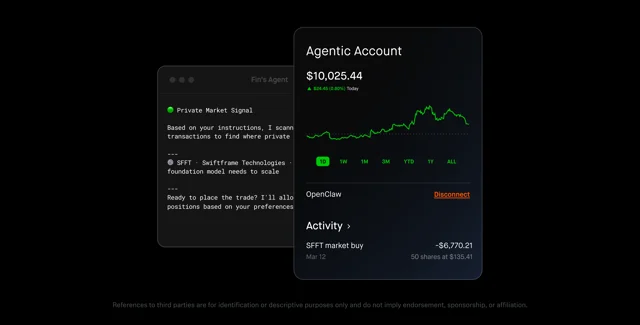
Robinhood opened beta access to an agentic trading feature that allows users to fund a separate AI agent account and let an AI place stock trades autonomously on their behalf. The agent connects via MCP (Model Context Protocol) and can monitor sectors, execute trades, and rebalance portfolios without requiring per-trade approval. 5
Current limitations: beta-only, stocks only. Future expansion planned for options, crypto, event contracts, and futures. Users receive push notifications per trade and can pause the agent, but Robinhood explicitly disclaimed responsibility for AI-driven losses.
Business intent: This is a clear differentiator move aimed at younger, tech-forward retail traders who are already comfortable with automation. It's also a potential long-term revenue driver — Robinhood makes money on order flow and increased trading volume, so an AI that executes more trades naturally improves monetization per user. The MCP architecture also means Robinhood is positioning its trading infrastructure as an AI-compatible platform — a play for becoming the brokerage of choice for autonomous AI systems as agentic workflows proliferate.
Pattern Read: AI Is Now the Monetization Layer
These five moves, taken together, reflect a shared strategic posture across the industry: AI capabilities are being priced in, whether by imposing new subscription tiers, cutting free-tier access, or using AI as the justification for price resets that would otherwise face user resistance. The Steam Deck case is the odd one out — a component-cost-driven hike rather than a monetization play — but it arrives in the same week, compounding the pressure users are feeling.
The clearest competitive implication is in the developer tools segment. Microsoft's Claude Code cancellation signals that enterprise deals in the AI coding space are fragile when the acquirer's own competing product is involved. Smaller vendors should expect similar consolidation pressure from corporate IT departments defending internal platform investments.
For product strategists, the Meta subscription rollout is the most instructive model: low entry price, incremental tier ladder, AI usage caps as the conversion mechanism. Expect this architecture to become standard across social platforms over the next 12 months.
Add more perspectives or context around this Drop.