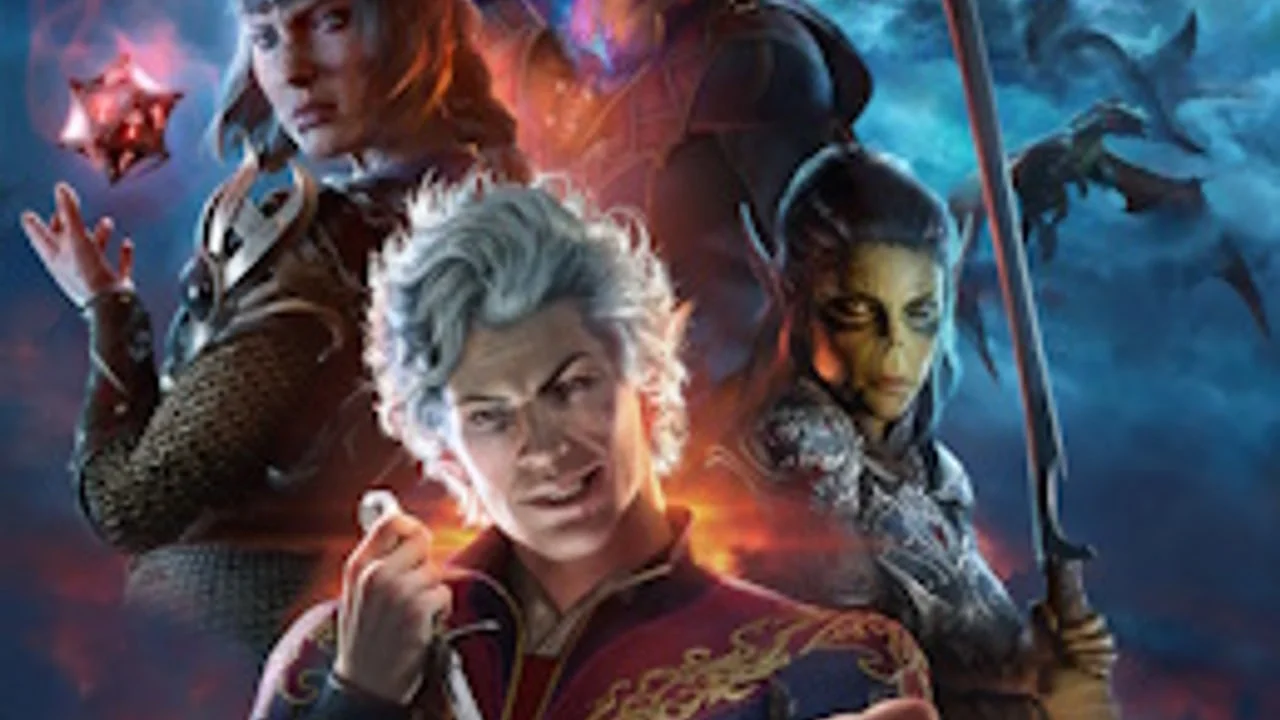
Baldur's Gate 3 — The RPG Where the Dice Can Ruin Everything (and That's the Point)
Today's pick: Baldur's Gate 3 (Larian Studios, 2023). Metacritic 96 (PC/PS5), first game ever to win GOTY at all five major ceremonies. This guide covers how the d20-driven turn-based combat and class system work, what players love and where the game genuinely stumbles (Act 3 polish, overwhelming complexity for newcomers), and a spoiler-free setup for the mind-flayer infection that brings your party together.

| Developer | Larian Studios |
| Release | PC August 3, 2023 · PS5 September 6, 2023 · Xbox December 7, 2023 |
| Genre | Turn-based CRPG |
| Platforms | PC, PS5, Xbox Series X/S, macOS |
| Metacritic | 96 (PC/PS5) · 99 (Xbox Series X) |
| OpenCritic | 98% recommend |
| Playtime | 75–100+ hrs (main story + companions) |
Few games have swept every major award simultaneously. Baldur's Gate 3 won Game of the Year at all five major ceremonies in 2023 — The Game Awards, BAFTA, Golden Joystick, D.I.C.E., and GDC — the first title ever to do so. 1 It has since sold over 20 million copies. 1 The reason is harder to pin down than the numbers suggest: it's a game where a single bad dice roll can upend an entire quest, where companions have opinions about everything you do, and where the "correct" playthrough doesn't exist. That's uncomfortable for people who want to be in control. For everyone else, it's one of the best games made.
How it plays
Baldur's Gate 3 is built on the fifth-edition rules of Dungeons & Dragons. Exploration and dialogue happen in real time; the moment combat starts, the game switches to fully turn-based mode. Each character in your party gets one action (attack, cast a spell, shove someone off a ledge), one bonus action (drink a potion, jump, off-hand strike), and a set movement range. 1
The central mechanic is the d20. When you try to pick a lock, persuade a guard, hit an enemy, or resist a mind-control spell, the game rolls a 20-sided die and compares it to a difficulty threshold. Your character's stats add to the roll. A fighter with high Strength rolls well on most athletic checks; a rogue built around Deception can lie their way out of almost anything. Fail a persuasion check on a critical conversation and the NPC you were trying to reason with may turn hostile. Roll a natural 20 and something unexpected — usually better — happens instead. 1
You build a character at the start by choosing one of 12 classes (Fighter, Wizard, Rogue, Bard, Druid, etc.), a species (human, elf, tiefling, githyanki, and more), and a background. Each class branches into subclasses — the Barbarian can take Wild Magic, which adds unpredictable spell effects to a melee-focused build — and multiclassing lets you mix classes as you level up to a cap of 12. 1 The build options are extensive enough that most players don't see everything in a first run.
Combat rewards positioning and preparation. Shoving an armored enemy off a cliff bypasses their high armor class entirely. Spilling grease on the floor and igniting it creates burning terrain. A well-placed Silence spell can strip a hostile spellcaster of their entire toolkit. The game doesn't gate you into a "correct" approach — it lets you exploit terrain, spells, dialogue, or stealth to get through most encounters. 2
Outside combat, you can talk to almost any creature — animals included, if you have the right spell. Conversations include their own skill checks. A charismatic Bard can sometimes talk their way through situations that other classes would need to fight through. Many encounters have at least one non-combat resolution if you look for it. 3 4
The game has 288 quests across three acts, with some mutually exclusive depending on your choices. 1 A playthrough aimed at the main story and companion quests typically runs 75–100 hours; completionists can push significantly beyond that.
What players are saying
The critical reception is about as unified as it ever gets for a game this ambitious. Metacritic rates it 96/100 on PC and PS5, 99/100 on Xbox Series X. OpenCritic shows 98% of critics recommending it. 1 IGN's Leana Hafer praised the writing and the strength of side quests. GameSpot's Jake Dekker gave it a 10/10 and singled out how the game prioritizes player freedom over tidy quest resolution. PC Gamer's Fraser Brown said the number of bugs was surprisingly low given the game's scope. The Guardian called it "a towering landmark." 5 6 7
The companion cast drew particular attention. Characters like Astarion (a hedonistic vampire rogue voiced by Neil Newbon, who won Best Performance at The Game Awards) and Shadowheart (a cleric who has no memory of her past) have enough written into them that they feel like they have opinions about the world independent of the player. 1 The game has over 170 ending variations and 1.3 million lines of dialogue across more than 140 hours of cutscenes — most of which you'll never see in a single run. 1
Honest criticisms worth knowing:
- Act 3 drops off. Multiple reviewers flagged that the third act — set in the dense city of Baldur's Gate — shows meaningful drops in polish compared to the first two. Eurogamer's Digital Foundry team noted substantial CPU performance issues caused by the city's density. Bugs in Act 3 persisted months after launch, and several reviewers described it as less finished than what came before. 8
- Combat can overwhelm newcomers. Destructoid described it as ranging "from interesting to overwhelming." Polygon's reviewer noted the game sometimes has unintuitive mechanics — poison-dipping weapons through a potion-like interaction, for instance — that the game doesn't explain. 6
- Some choices lock you out of content. PCMag's review criticized that certain decisions can inadvertently cut off entire questlines without warning, and the game doesn't always telegraph this clearly. 9
- Eurogamer's mixed take. Eurogamer's Ruth Cassidy gave it 4/5 and was notably less enthusiastic than most outlets — she criticized the main narrative's false urgency and the rushed initiation of some romance arcs. If you're lukewarm on the companion-drama angle, her review is probably the most useful counterpoint. 10

The overall picture: it's one of the most accomplished RPGs made, with a real soft spot in Act 3. Patch 8, released in April 2025, added 12 new subclasses, cross-platform play, and additional fixes — so the version available now is considerably more polished than launch. 1
The setup — no spoilers

You wake up aboard a massive flying ship piloted by mind flayers — tentacled psychic creatures that turn people into more of their kind. You've been implanted with a parasitic tadpole that should be transforming you into one of them. It hasn't — yet. The ship crashes before you have time to find out why.
You crawl out of the wreckage and start running into other survivors. All of them have tadpoles too. None of them are transforming. That shared problem is what brings your party together — you're all trying to get the thing out of your head before it eventually wins.
The first act drops you into a region of wilderness: a druid's grove under siege, a goblin camp tied to something larger, hidden paths through an underground world called the Underdark. Nobody tells you what order to do things in. The game just exists around you, with its own politics and factions running in the background, and you push into it however you want. 1
The Forgotten Realms setting is high fantasy in the Dungeons & Dragons tradition — gods, demons, undead, talking animals, ancient curses — but the tone stays grounded. Your companions are recognizable people with recognizable problems living in a world that happens to have magic in it. The writing goes for specificity over spectacle. The opening ten hours are generally idyllic wilderness; things get considerably darker by Act 2.
Should you play it?
Yes, if: You want a deep, flexible RPG where your build choices actually matter, you like stories where companions feel like characters rather than utilities, or you enjoyed Divinity: Original Sin II (this is from the same studio, with a bigger budget and a more cinematic presentation).
Go in knowing: The d20 system is genuinely random. You will fail checks you should have passed. You will save-scum, or you'll learn to accept failure as part of the story. The game doesn't punish failure — it reroutes you — but it requires a certain peace with uncertainty that not everyone has.
Worth noting: You don't need to know D&D to play this. The game explains what it needs you to know. Prior knowledge of Baldur's Gate lore is also optional — BG3 is set a century after the previous games and functions as a standalone story.
Add more perspectives or context around this Drop.