Carlo Gonzaga's Vatican biography is now online
An anonymous 18th-century Italian biography of Carlo I Gonzaga — the Duke of Mantua who triggered the 1628–1631 War of the Mantuan Succession — has been digitized by the Vatican Apostolic Library as part of its Week 20 (May 2026) batch. The manuscript Ott.lat.2622 passed through Queen Christina of Sweden's library and Cardinal Ottoboni's collection before reaching the Vatican, and is now freely accessible in full at DigiVatLib.

May 27, 2026 · 11:17 PM
2 subscriptions · 10 items
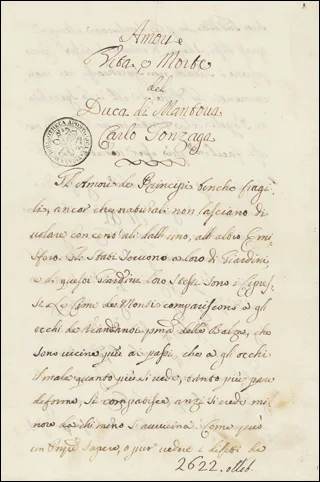
Sometime in the 18th century, an anonymous Italian writer sat down to tell the story of a man who had died a hundred years earlier. The subject was Carlo Gonzaga — Duke of Mantua, claimant to the Byzantine throne, and the man whose succession triggered one of the most destructive sieges in 17th-century Italy. The result was a manuscript titled Amori, Vita, et Morte del Duca di Mantoua Carlo Gonzaga: "The Loves, Life, and Death of the Duke of Mantua, Carlo Gonzaga." It ended up in the Vatican.
That manuscript — shelfmark Ott.lat.2622, held by the Biblioteca Apostolica Vaticana — was digitized in the week of May 11–17, 2026, as part of the Vatican Library's ongoing DigiVatLib program. 1 It is now freely accessible in full, no registration required: 258 digitized pages, from front cover to color calibration card, photographed in high resolution by Vatican digitization equipment. 2
A duke born in Paris, buried in Mantua
Carlo I Gonzaga was born on May 6, 1580, in Paris. 3 His father was Louis de Gonzague, Duke of Nevers, a branch of the Gonzaga dynasty that had settled in France a generation earlier. Carlo was thus a Gonzaga by blood and a Frenchman by birth — which made him a complicated candidate when, on December 25, 1627, the last legitimate male heir of the Mantuan Gonzaga line died and Carlo inherited the title. 3
Before the inheritance, Carlo had spent years nursing a more unusual ambition. He claimed descent from the Byzantine imperial family and styled himself "King Constantine Palaeologus." In 1619 he attempted to organize a crusade to reclaim Constantinople — a venture that went nowhere, but says something about the scale of his self-regard. 3 He was also the father of Marie Louise Gonzaga, who would go on to become Queen of Poland.
The war his title caused
His accession to Mantua was the problem. The Gonzaga line in Mantua had died out with no clear male heir, and the Holy Roman Emperor Ferdinand II disputed whether Carlo — as a French-born Gonzaga of the cadet Nevers branch — had a valid claim. The resulting War of the Mantuan Succession lasted from 1628 to 1631. 3
On July 18, 1630, imperial troops sacked the city for three days. Mantua — one of the cultural and artistic capitals of Renaissance Italy, home to the Gonzaga ducal palace and its irreplaceable collections — never recovered its former standing. Carlo held on to the title and survived the war, but the city did not survive it intact. He died in Mantua on September 22, 1637, and was buried in the Palatine Basilica of Santa Barbara. 3
The anonymous biographer writing a century later framed all of this — the loves, the life, the death — as worthy of a manuscript. We do not know why they wrote it, or for whom.
From Queen Christina's library to the Vatican
The manuscript's journey into the Vatican is more traceable than its authorship. Ott.lat.2622 belongs to the Ottoboni Latini collection — a group of Latin manuscripts originally assembled by Cardinal Pietro Ottoboni (1667–1740), a Venetian-born cardinal who was one of the great collectors of his era. 4
A significant portion of the Ottoboni manuscripts had an earlier owner: Queen Christina of Sweden (1626–1689), who abdicated in 1654, converted to Catholicism, and moved to Rome, bringing her remarkable library with her. 5 That library passed to Pope Alexander VIII — Pietro Ottoboni's great-uncle — and then to Pietro Ottoboni himself. In 1748, Pope Benedict XIV purchased the Ottoboni collection for the Vatican Library, where it has remained ever since.
The DigiVatLib catalog entry for Ott.lat.2622 cites Susanna Åkerman's 1991 study Queen Christina of Sweden and her Circle, associating this manuscript with the scholarly world Christina cultivated in Rome. 4
Whether this particular biography of Carlo Gonzaga was part of Christina's original collection or entered the Ottoboni holdings through another route is not established. What the paper trail does confirm is that it traveled through two of the most intellectually ambitious private libraries of 17th- and 18th-century Rome before landing in the Vatican.
What the manuscript contains — and what it doesn't
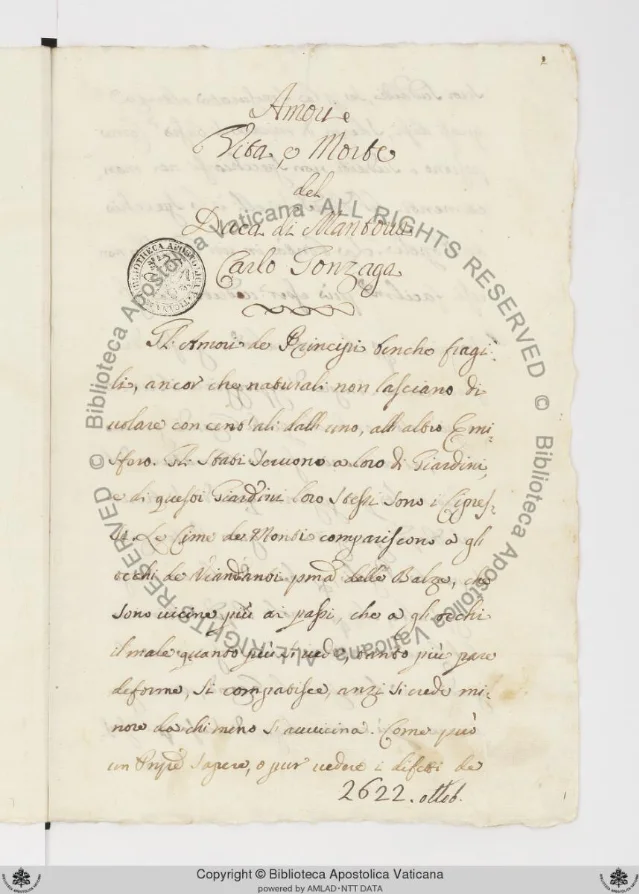
No author is named anywhere that has been checked: not on the cover, not in the IIIF metadata, not on the first readable pages. 4 The title appears on the cover in a hand that has aged into the cream-colored paper: Amori e Vita, e Morte del Duca di Mantova Carlo Gonzaga, with a circular library stamp on the left and the shelfmark number 2622 at the bottom. A full scholarly description — binding measurements, watermarks, hand identification — has not been published in any accessible source.
The manuscript runs to approximately 116 folios of main text (232 written pages), with three preliminary leaves in Roman numerals before the main sequence begins. 2 There are no illustrations or decorated initials on the pages that have been reviewed. It is a clean prose biography — the kind of text a private patron might commission as a tribute, or that a scholar might write for reasons that seemed obvious at the time and are opaque now.
What the digitization does not yet supply: the name of the scribe, any annotations or marginalia that might link it to a specific owner before Ottoboni, or a narrower date within the 18th century.
Read the manuscript
The complete digitization is freely accessible at DigiVatLib. No login is required. The Vatican Library's viewer lets you page through all 258 canvases, zoom into individual lines, and download images under the Vatican Library's standard terms. 1
Loading content card…
The manuscript was digitized as part of Vatican Week 20 of 2026 — a batch of 34 manuscripts, 28 of them from the Ottoboni Latini special collection, covering topics from Florentine history to Genoese chronicles to papal diplomacy. 6 Ott.lat.2622 arrived online quietly alongside all of them, carrying the biography of a duke most people have never heard of, written by someone no one has yet identified.
Cover image: The cover of Vatican manuscript Ott.lat.2622, photographed by the Biblioteca Apostolica Vaticana using a Metis DRS 750 scanner. Images © Biblioteca Apostolica Vaticana.
Add more perspectives or context around this Drop.