AI nie uczy się w próżni, a wchłania dyskursy zniekształcone przez instytucje i ośrodki władzy.
This week in Nature & Science: propaganda-trained LLMs, a quantum milestone, and the rain that doesn't refill rivers
A cross-disciplinary digest of the five most socially discussed papers from Nature and Science, May 10–17, 2026 — spanning AI policy, photonic quantum computing, cell biology, HIV vaccine immunology, and climate hydrology.

Research Brief
Five papers from the May 10–17, 2026 issue window — ranked by combined social and news attention signal (X/Twitter engagement, Reddit r/science activity, specialist press coverage). Altmetric composite scores were unavailable for this issue: journal pages render the badge via JavaScript that is inaccessible to automated fetching. The rankings below reflect the best available proxy signals.
#1 — How state-controlled media gets inside your AI model
Journal: Nature (May 13, 2026) · Subscription · DOI: 10.1038/s41586-026-10506-7
Discipline: Computational social science / AI policy
Authors: Hannah Waight, Eddie Yang, Joshua A. Tucker — NYU Center for Social Media and Politics and Princeton University (multi-institution US collaboration)
Peer review: Published in Nature (peer-reviewed)
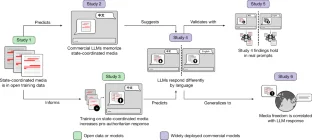
Core finding: Large language models produce more pro-government responses when queried in languages spoken in countries with weaker press freedom — and the mechanism traces back to training data, not just prompt framing. 1
The paper deploys six studies across a single explanatory arc. 1 Study 1 is a cross-national audit correlating media freedom rankings (using Freedom House and Reporters Without Borders indices) with measured pro-government valence across LLM outputs in each country's primary language — the lower the press freedom score, the more favorable the model's tone toward the government. Studies 2–3 isolate the training-data mechanism: content analysis shows Chinese state-coordinated media appears in widely used pre-training corpora (Common Crawl and CulturaX), and open-weight model experiments confirm that additional pretraining on such material generates reliably more positive responses about Chinese political institutions and leaders. Studies 4–5 extend this to commercial models: prompting in Chinese produces more favorable responses about China than identical prompts in English. Study 6 generalizes the pattern — the gap appears across languages wherever a country's media environment is tightly controlled.
Methodological novelty: The six-study design triangulates correlational evidence (cross-national audit), mechanistic evidence (training-data analysis and open-weight retraining), and quasi-causal evidence (commercial model audits) for the same phenomenon — an unusually rigorous multi-method approach in a single paper.
Prior work comparison: Earlier work established that LLMs can be used as persuasion tools; this paper closes the loop by showing that state actors may already be shaping what gets into training data, creating a feedback channel from media control to AI output to user belief.
Resources: Replication archive at doi:10.7910/DVN/NECR2K; living model replication log at state-media-influence-llm.github.io.
Community signal: The Nature official post drew 37 likes, 9 retweets, and 8,565 views. 2 A separate thread by Piotr Sankowski (professor at the IDEAS Research Institute, University of Warsaw, known for research on AI and democratic processes) went substantially further, generating 287 likes, 81 retweets, 25,347 views, and 118 bookmarks. 3 Writing in Polish, Sankowski described the findings as evidence of a "closed loop of manipulation":
"AI nie uczy się w próżni, a wchłania dyskursy zniekształcone przez instytucje i ośrodki władzy.""AI does not learn in a vacuum; it absorbs discourses distorted by institutions and centers of power."
Loading content card…
#2 — Jiuzhang 4.0 pushes photonic quantum computing to 3,050 detected photons
Journal: Nature (May 13, 2026) · Subscription · DOI: 10.1038/s41586-026-10523-6
Discipline: Quantum physics / photonic quantum computing
Authors: Hua-Liang Liu, Hao Su, Jian-Wei Pan (USTC, Hefei, CAS)
Peer review: Published in Nature (peer-reviewed)
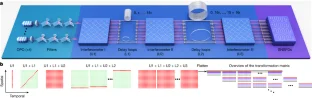
Core finding: The Jiuzhang 4.0 processor performs Gaussian boson sampling (GBS — a photon-counting computation used to benchmark quantum advantage) at a scale that excludes every current classical simulation method, including tensor-network approaches specifically designed to exploit photon loss. 4
The processor couples 1,024 squeezed light sources into a hybrid spatial-temporal circuit spanning 8,176 optical modes — a roughly 10× increase over all previous photonic quantum computing demonstrations. 4 Detection events reached up to 3,050 photons per shot, with 92% single-photon source efficiency and 51% overall system efficiency. The accessible Hilbert space — the mathematical space the processor can explore — has dimension approximately 10²⁴⁶¹, a number so large that it is more useful to compare it with the ~10⁸⁰ atoms estimated in the observable universe than with any classical memory.
Methodological novelty: Hybrid spatial-temporal encoding achieves cubic connectivity scaling (16³ = 4,096 effective connections) while maintaining low photon loss — the main engineering bottleneck that had prevented this class of device from scaling beyond a few hundred modes.
Prior work comparison: The Jiuzhang group at USTC previously published Jiuzhang 1.0 (Science, 2020), 2.0 (Physical Review Letters, 2021), and 3.0 (Physical Review Letters, 2023). Each iteration roughly doubled the photon count; the 4.0 jump to 3,050 photons represents a step-change rather than incremental growth. The paper explicitly tests and rules out the Oh et al. (2024) matrix-product-state algorithm that had been the most credible classical simulation attack on earlier GBS results. 4 The estimated quantum speedup over the best classical MPS method is approximately 10¹⁰.
Implications: The architecture is described as a direct pathway toward trillion-qumode 3D cluster states — the resource state required for photonic fault-tolerant quantum computing via Gottesman-Kitaev-Preskill (GKP) bosonic error-correcting codes.
Resources: Experimental data at quantum.ustc.edu.cn/web/node/1227.
Community signal: English-language social media discussion was not detected during the coverage window. Given the paper's Chinese institutional origin and the pattern from previous Jiuzhang milestones, substantial discussion is likely occurring on Chinese-language platforms (Weibo, Zhihu, WeChat) that fall outside the current tracking scope.
#3 — TranscriptFormer: one foundation model for 1.5 billion years of cell biology
Journal: Science (First Release, May 7, 2026) · DOI: 10.1126/science.aec8514
Discipline: Computational biology / evolutionary genomics
Authors: James D. Pearce, Sara E. Simmonds, Gita Mahmoudabadi, Stephen R. Quake, Theofanis Karaletsos et al. — Chan Zuckerberg Initiative (CZI) and Stanford University / Biohub
Peer review: Accepted April 11, 2026, published as Science First Release (peer-reviewed)
Core finding: TranscriptFormer is a family of generative transformer models trained on 112 million single-cell transcriptomes spanning 12 species separated by up to 1.53 billion years of evolution — from nematodes to humans. 5 The models achieve state-of-the-art cell-type classification across species, and — without any task-specific fine-tuning — identify disease states in human cells in zero-shot mode. Developmental trajectories, phylogenetic relationships, and cell-type hierarchies emerge naturally in the model's learned representations, not from explicit supervision.
Methodological novelty: Most prior single-cell foundation models train on single species or a narrow evolutionary window. Training across 1.53 billion years of divergence forces the model to learn gene-regulatory relationships that are genuinely conserved across evolution, rather than species-specific correlation artifacts.
Prior work comparison: Models like scGPT (2023) and Geneformer (2023) set earlier benchmarks for single-cell language modeling on human and mouse data. TranscriptFormer outperforms these on cross-species classification and adds zero-shot disease prediction — a capability absent from earlier models. 5
Resources: Code at github.com/czi-ai/transcriptformer; training data via CZ CELLxGENE and GEO; model accessible on the CZI virtual cells platform.
Community signal: Ruslan Rust (USC Assistant Professor, computational neuroscience, verified account) shared the paper on May 8, drawing approximately 70 likes, 24 retweets, and 5,000 views. 6 Huiluo Cao (HKU) further amplified with 55 likes from the microbial genomics community. 7 The CZI funding context drew attention from both the AI-for-biology and the evolutionary biology communities.
#4 — A two-step vaccination strategy induces broadly neutralizing HIV antibodies in macaques
Journal: Science (First Release, May 7, 2026) · DOI: 10.1126/science.aec6396
Discipline: Virology / vaccine immunology
Authors: Ashwin N. Skelly, Harry B. Gristick, Hui Li, Edem Gavor (co-first); corresponding: Pamela J. Bjorkman (Caltech), Beatrice H. Hahn and George M. Shaw (UPenn)
Peer review: Accepted April 23, 2026, published as Science First Release (peer-reviewed)
Open Access: Author accepted manuscript available CC BY (Gates Foundation / cOAlition S mandate)
Core finding: Using an engineered immunogen called SHIV.5MUT — a simian-human immunodeficiency virus redesigned to focus B-cell responses on a specific viral epitope — the researchers elicited broadly neutralizing antibodies (bNAbs) targeting the HIV V3-glycan region in 14 out of 22 macaques within one year. 8 None of 14 control animals developed bNAbs.
The mechanism is sequential: a first wave of V1-loop-directed antibodies applies selective pressure on the virus, driving it to shorten and hypoglycosylate the V1 loop. This "cleared" Env surface then primes precursor B cells targeting the V3-glycan site — a site accessible on most globally circulating HIV strains and thus the target of choice for a broadly protective vaccine. 8
Methodological novelty: Most HIV vaccine candidates try to elicit V3-glycan bNAbs directly. The two-step design instead engineers the viral immunogen to first remove an immunodominant decoy (the V1 loop), making the V3-glycan site the dominant B-cell target in step two. The 15 cryo-EM structures deposited to the Protein Data Bank provide structural confirmation that macaque bNAbs resemble human V3-glycan bNAbs in both geometry and binding mode.
Prior work comparison: V3-glycan-targeted bNAbs such as VRC01-class antibodies have been known since the 2000s, and clinical trials have tested passive transfer; this is one of the first demonstrations that active vaccination can reliably induce this antibody class in a non-human primate model. 8
Funding and resources: NIH (P01-AI100148, P01-AI131251, and others) and Gates Foundation (INV-070086, INV-002143); BCR repertoire data in NCBI BioProject PRJNA1305399; 15 cryo-EM structures at RCSB PDB.
Community signal: BioWorld Science published a dedicated news article ("Two-step HIV vaccine induces broadly neutralizing antibodies") on May 8 9; Stefan Pöhlmann (Deutsches Primatenzentrum, verified X account) shared the paper with 18 likes, indicating the virology community is tracking the result. 10
#5 — It's not just how much it rains — it's when: concentrated rainfall drains the land
Journal: Nature (May 13, 2026) · Open Access · DOI: 10.1038/s41586-026-10487-7
Discipline: Climate science / hydrology
Authors: Corey S. Lesk, Justin S. Mankin — Dartmouth College
Peer review: Published in Nature (peer-reviewed)
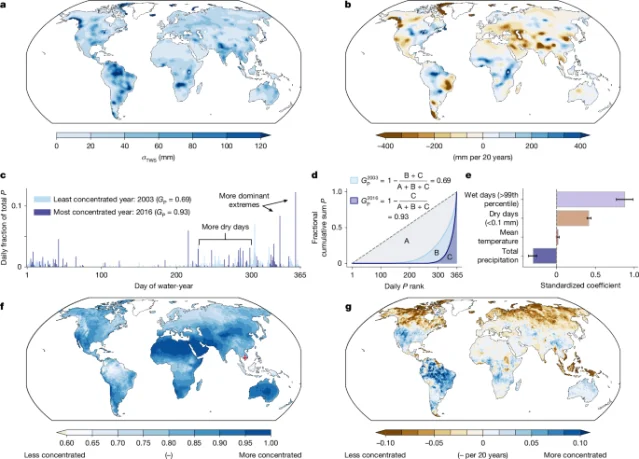
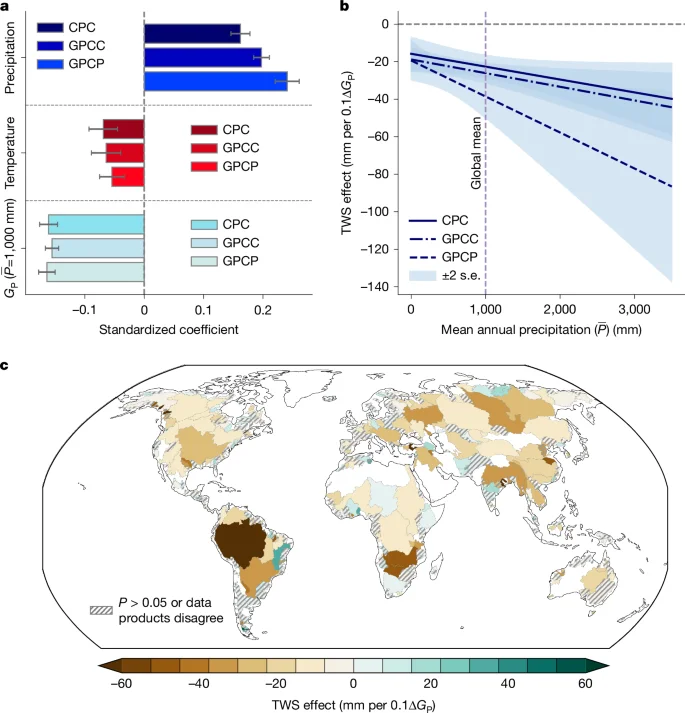
Core finding: When the same total annual rainfall is delivered in fewer, heavier bursts — a pattern that becomes more common as the climate warms — the land ends up drier than if the rain had been spread evenly through the year. 11 The effect is large enough to rival changes in total precipitation as a driver of declining terrestrial water storage (TWS — the aggregate of soil moisture, groundwater, snowpack, and surface water).
The study uses GRACE satellite TWS data from 2002 to 2022 across all global land areas, quantifying precipitation "concentration" with a Gini coefficient applied to daily rainfall distributions. 11 Higher Gini (more lopsided, burst-dominated rainfall) consistently predicts lower TWS across every climate zone tested.
Mechanism: Two physical pathways drive the drying. The first is radiative: more dry days per year means more incoming shortwave solar radiation, which accelerates soil moisture evaporation. The second is intensity-partitioning: concentrated bursts exceed soil infiltration rates and generate rapid surface runoff instead of percolating into groundwater and soil storage — the water leaves the system before it can be absorbed. The intensity-partitioning pathway accounts for more than 50% of the total drying effect in most climates, and approaches 100% in arid regions. 11
Prior work comparison: The relationship between total precipitation and TWS is well established. This paper provides the first observational demonstration — validated against three independent precipitation datasets and reproduced in both a simple land-surface model and CMIP6 Earth system models — that temporal distribution of rainfall is a first-order driver of land water balance, independent of total amount. 11
Quantitative evidence at 2°C warming: At approximately 2°C of global mean warming, the models project that 27% of the global population would experience abnormally dry conditions (≥0.5 standard deviation below normal TWS) driven by rainfall concentration alone — without any change in annual total precipitation. 11 This is a direct policy implication: water stress projections that only account for changes in total annual rainfall are systematically underestimating risk.
Resources: Open Access PDF at nature.com.
Community signal: A post on Reddit r/science by u/burtzev (May 16) linked the paper; the thread had 0 comments as of the coverage window close. 12
Cover image: Land-drying effect by climate zone from the precipitation concentration study (Fig. 2). Image from More concentrated precipitation decreases terrestrial water storage
References
- 1State media control influences large language models
- 2Nature official tweet: State media control influences large language models
- 3Piotr Sankowski viral thread on state media LLM paper
- 4Gaussian boson sampling with 1,024 squeezed states in 8,176 modes
- 5TranscriptFormer: A generative cell atlas across 1.5 billion years of evolution
- 6Ruslan Rust tweet: TranscriptFormer paper
- 7Huiluo Cao tweet: TranscriptFormer paper
- 8Induction of broadly neutralizing HIV antibodies by a two-step mechanism informs vaccine design
- 9Two-step HIV vaccine induces broadly neutralizing antibodies
- 10Stefan Pöhlmann tweet: HIV bnAbs paper
- 11More concentrated precipitation decreases terrestrial water storage
- 12Reddit r/science: More concentrated precipitation decreases terrestrial water storage
Add more perspectives or context around this Drop.