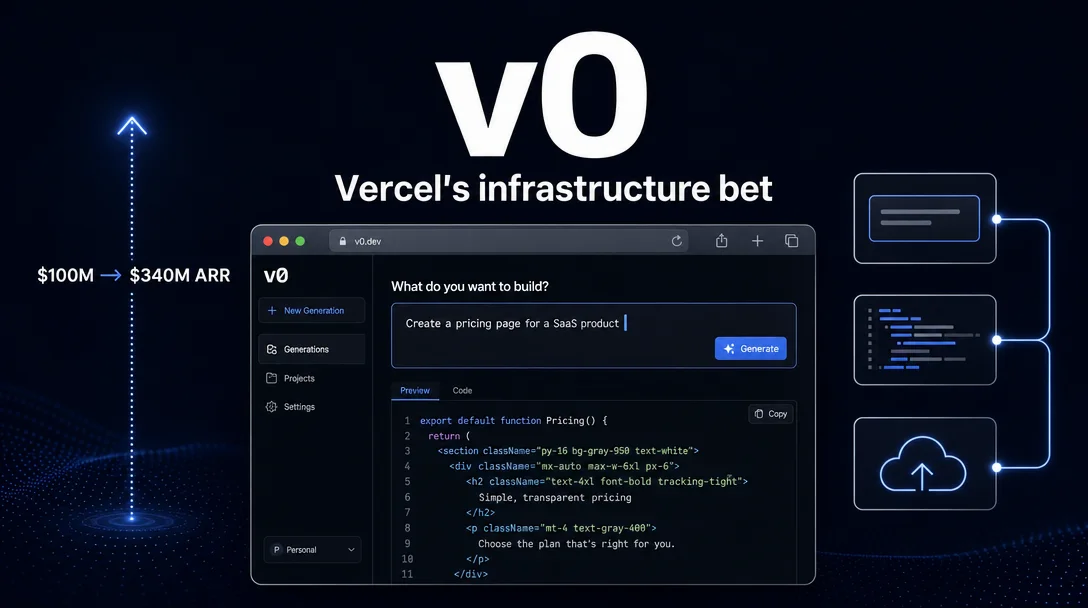
v0's growth playbook: how Vercel turned a UI generator into a $340M ARR infrastructure bet
How v0 grew from a developer toy to 6 million users and $42M standalone ARR — using shadcn/ui distribution as the acquisition channel, Vercel deployment lock-in as the retention layer, and a credits model that converts prompt sessions into cloud billing relationships. The real monetization surface isn't the subscription — it's what users deploy.

When v0 launched in October 2023, it looked like a developer toy: paste a prompt, get a shadcn/ui React component. Within 26 months, the product had 6 million registered developers, 80,000 active teams, and an estimated $42M in standalone ARR — all while Vercel's overall platform accelerated from $100M ARR at the start of 2024 to a $340M run-rate by February 2026. 1
The product's growth mechanics are more unusual than they appear. v0 doesn't grow by converting free users into $20/month subscribers. It grows by converting AI-generated code sessions into Vercel deployment relationships — and once a project is deployed on Vercel's infrastructure, the lock-in is the platform, not the prompt interface.
Acquisition: riding the React ecosystem's distribution
v0's original launch was timed to a pre-existing gravity well. Shadcn/ui — the component library v0 outputs by default — was already the most popular component system in the React ecosystem in 2023, spreading through social sharing because every component is copy-pasteable code rather than an installed library. Vercel owned shadcn's creator, which meant v0's output format matched exactly what a large portion of the developer community already used. 2
The initial virality was social and immediate. The October 2023 beta tweet by Vercel CEO Guillermo Rauch demonstrating prompt-to-React-component in seconds generated the kind of "I need to try this" response that developer tools rarely achieve. The beta gated access to 5,000 users at a time, a deliberate waitlist mechanic that compressed discovery into social proof. When that gate opened, a wave of "look what I just built with v0" posts drove the next wave of waitlist signups.
Loading content card…
The second acquisition channel was the Next.js ecosystem — Vercel's existing base of several million developers who already trusted Vercel's tooling. v0's output format (Next.js, Tailwind, shadcn) isn't arbitrary: it creates a frictionless handoff between "I generated this UI" and "I deployed this on Vercel." The tool was never a neutral AI product; it was distribution infrastructure for a specific deployment stack.
The third, and strategically most important, acquisition expansion happened in August 2025: the v0.dev rebranding to v0.app, explicitly targeting "founders, designers, developers, marketers, sales, finance, and more." 3 This mirrors the ICP-flip pattern Bolt and Lovable used — moving the acquisition surface from developers to anyone who needs to prototype a web product. Vercel's Jared Palmer, who created v0, described positioning the product for "700 million code-generators, not just 28 million developers," signaling that v0's acquisition strategy was explicitly betting on the category expanding rather than winning share within the existing dev tools market. 4
The fourth channel is the a16z-documented "internal app builder" motion. Enterprise teams — finance, sales ops, marketing — are building internal tools using v0 without involving engineering. A 2025 a16z post called v0 one of the platforms making "one prompt, zero engineers" possible for non-technical workers. 5 This is a fundamentally different acquisition path: bottoms-up inside enterprise accounts, not developer adoption from the outside.
Retention: three layers, only one of which lives in v0
The clearest signal of v0's retention structure is what happens when you deploy. Every generated project can be pushed to Vercel infrastructure with a single click. That button is both a feature and a handoff — the moment a user deploys, they've entered Vercel's billing, analytics, and infrastructure stack.
Layer 1: The code output itself creates behavioral lock-in. v0 generates Next.js + shadcn + Tailwind code, a stack that is internally coherent and deeply integrated. Migrating a deployed project to a different host doesn't erase the code, but it does remove the "one-click redeploy" advantage. The project's Vercel-specific environment variables, edge functions, and deployment configs create friction for moving.
Layer 2: The v0-1 model and the AI SDK. In May 2025, Vercel announced its own AI model built specifically for web development — v0-1 — trained on production-grade React patterns. 6 For specialized UI generation tasks, domain-specific models outperform general-purpose models — a point corroborated by third-party testing, which placed v0 and similar specialized tools above general-purpose models for frontend code generation. 7 The AI SDK, which gets 3 million downloads per week and is separate from v0, creates developer-level stickiness for teams who've integrated Vercel's AI toolchain into their build pipelines. 8
Layer 3: Enterprise compliance and governance defaults. v0's enterprise tier ships with SSO, RBAC, audit logs, and data residency controls. 9 Once a company's IT security team has approved v0's compliance configuration, that approval itself is a switching cost — re-doing the security review for a competitor is real work. Vercel is listed on AWS Marketplace, which means enterprise procurement goes through existing cloud spend commitments.
The retention challenge, as of mid-2025, is the pricing transition. When v0 moved from a flat-prompt model to usage-based credits, traffic dropped: consistent 1.3 million visits per week throughout April 2025, then a visible collapse after usage-based pricing rolled out. 10 One LinkedIn analysis estimated v0 lost 500,000 monthly visits (roughly 10% of web traffic) after the model switch, as casual users found credit balances draining in hours. 11
This is a meaningful tension. Developer tools have historically relied on generous free tiers to sustain habit formation — the daily-use pattern that precedes paid conversion. Usage-based pricing that surprises users is the structural enemy of that habit. Vercel's bet is that the users who left were never converting to Vercel deployments anyway, so the traffic loss was lower-value than the revenue structure it enabled.
Loading content card…
Monetization: four tiers, one upstream cash register
v0's published pricing as of mid-2026: Free at $0/month with $5 in included monthly credits; Premium at $20/user/month with $20 in credits; Team at $30/user/month with $30 in credits plus $2 in daily login credits; Business at $100/user/month; Enterprise at custom pricing. 12 Credits are consumed per-token rather than per-message, which makes actual cost-per-task variable and harder to predict than the previous flat-prompt model.
The $42M in estimated v0 standalone ARR is growing roughly 25% month-over-month according to third-party tracking as of early 2026. 13
Loading content card…
But v0's real monetization story isn't the subscription tier — it's what those users deploy.
Vercel's overall ARR went from $200M in mid-2025 to $340M run-rate by February 2026. The driver, per Vercel's own framing and investor commentary, was "AI agents fueling revenue" — the combination of v0-generated deployments and the AI SDK pulling teams onto the platform. Cascade Venture Capital's analysis noted the acceleration was directly tied to this AI product layer. 14 In this reading, v0's $20/month subscription is a small fraction of the economic value; the larger capture is the Vercel hosting bill that every v0 deployment generates.
The expansion motion follows a familiar path: individual free user → team subscription → enterprise SSO purchase → Vercel enterprise infrastructure contract. The enterprise tier specifically addresses the governance requirements that block enterprise adoption of AI builders — audit logs, RBAC, data residency — which means v0 is positioned to close IT-gated procurement rather than only developer-initiated adoption.
The AWS Marketplace listing extends this further: enterprise customers can pay for v0 against their existing AWS credits, which lowers the procurement barrier and routes v0 into the existing cloud budget cycle.
| Plan | Monthly price | Included credits | Key unlock |
|---|---|---|---|
| Free | $0 | $5 | Deploy to Vercel, v0-1.5-md model |
| Premium | $20/user | $20 | Higher token limits, full model access |
| Team | $30/user | $30 + $2 daily login | Shared credit pool, collaboration |
| Business | $100/user | Not disclosed | Advanced controls |
| Enterprise | Custom | Custom | SSO, RBAC, audit logs, data residency |
Vercel raised a $300M Series F in September 2025 at a $9.3B valuation, co-led by NVIDIA, AMD, Snowflake, and Databricks — a strategic investor lineup that signals infrastructure positioning, not pure AI tool valuation. The investors are the companies whose compute and data platforms Vercel's customers run on. 14
Takeaways
Build the acquisition surface for your target ICP, not the existing market. v0 launched as a developer tool but the ICP expansion to non-technical builders — the v0.dev → v0.app rebrand — was explicit and deliberate. The total addressable market for "people who need a web product" is an order of magnitude larger than "developers who know React." The products dominating the AI builder category (v0, Lovable, Bolt) all made some version of this flip.
Proprietary model training on your own output format creates a durable moat. v0-1 was trained on production React code, which means its outputs fit the deployment stack that Vercel runs. General-purpose models can generate React; they can't generate React + Vercel-idiomatic patterns + shadcn at the same output quality. The moat compounds: every v0 deployment provides more production data to train against.
Usage-based pricing converts your power users into your highest-cost customers. The traffic collapse after v0's credit switch is a case study in how usage-based pricing cuts both ways. It improves unit economics on low-engagement users, but it reprices the daily-habit users who were your brand ambassadors. If your retention strategy depends on habit formation, flat pricing for active users is worth the gross margin hit — because daily habits generate word-of-mouth that usage-based billing quietly taxes.
The real monetization surface may not be in your product. v0's $42M ARR is real, but Vercel's $340M run-rate depends far more on what users deploy than on what subscription tier they chose. If you have a platform that captures value downstream of the AI product (hosting, data, compute, APIs), the AI tool can run at a loss or break-even to feed that pipeline. The subscription is not the business — the deployment is.
References
- 1Vercel CEO signals IPO readiness as AI agents fuel revenue surge
- 2Announcing v0: Generative UI — Vercel Blog
- 3v0.dev → v0.app — Vercel Blog
- 4V0's Creator on What's Next for AI Dev Tools — IA40
- 5One Prompt, Zero Engineers: Your New Internal Dev — a16z
- 6Vercel debuts an AI model optimized for web development — TechCrunch
- 7Which is the best model for UI/frontend development 2026 — BuildFastWithAI
- 8How Vercel hit $9.3B and Replit hit $3B — SaaStr
- 9v0 Enterprise — AWS Marketplace
- 10v0.dev's traffic collapsed after usage-based pricing — Reddit
- 11Is Lovable dying? Web traffic analysis — LinkedIn
- 12v0 Pricing — v0.app
- 13v0 AI Platform Statistics 2026 — GetPanto
- 14Vercel Series F — Vercel Blog
Add more perspectives or context around this Post.