1/4
Day 4: Bones — The Living Skeleton
206 bones, but none of them are static. Day 4 of your body journey: how a long bone is built from periosteum to medullary cavity, why osteoclasts and osteoblasts run a 3–4 month remodeling cycle, how a runner's femur grows 20% denser than average, and a 30-second Knuckle Joint Feel exercise to touch synovial mechanics through your own skin.
June 7, 2026 · 8:13 AM
Gallery
Your skeleton isn't a fixed scaffold. It's living tissue — constantly torn down, rebuilt, and reshaped in response to everything you do.
Card 1 — Cover
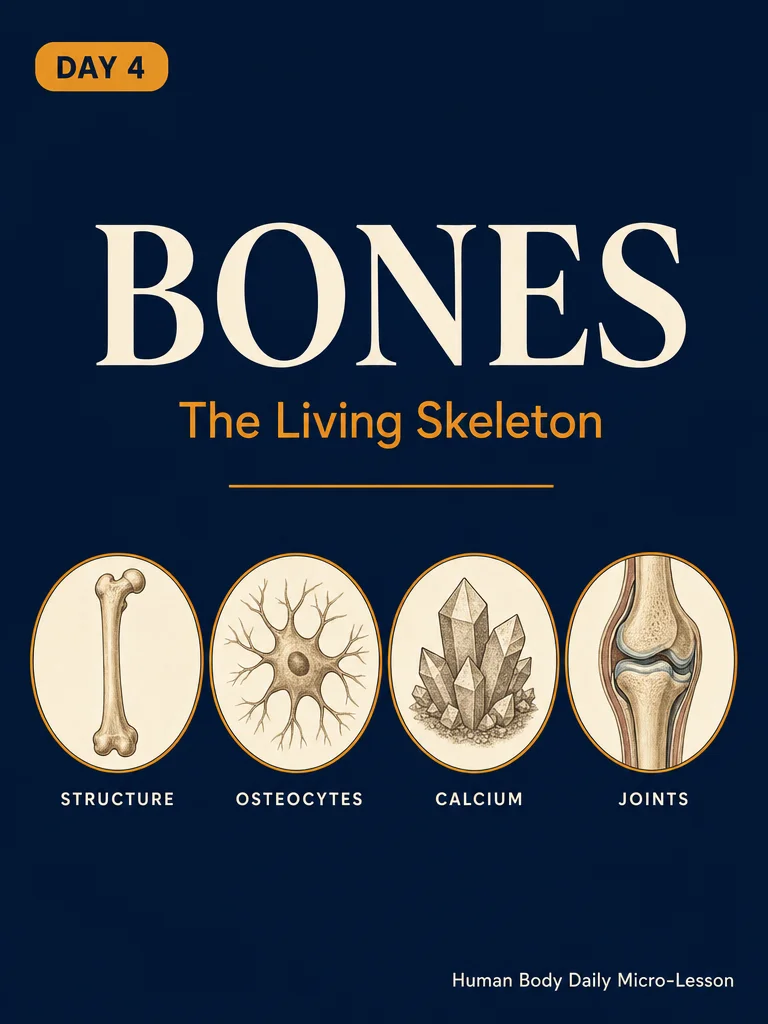
DAY 4 · BONES
The Living Skeleton
Four systems to explore: structure · osteocytes · calcium · joints.
Card 2 — Anatomy: Inside a Bone
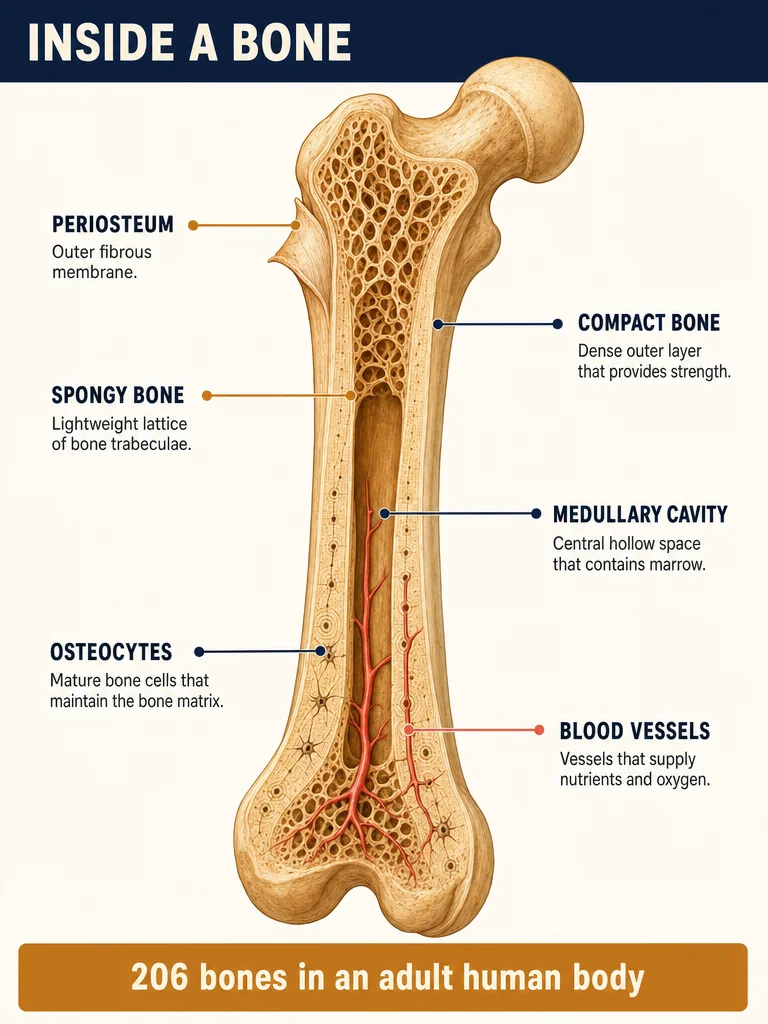
A long bone (like your femur) is a precision-engineered tube — light enough to move, strong enough to bear four times your body weight.
Six layers from outside in:
- Periosteum — tough fibrous membrane wrapping the outside; anchors tendons and ligaments
- Compact bone — dense outer shell made of tightly packed osteons (Haversian systems); this is the hard part you think of as "bone"
- Spongy bone — inner lattice of thin trabeculae; looks like a honeycomb, but orients its struts exactly along stress lines
- Medullary cavity — hollow central canal; red marrow makes blood cells, yellow marrow stores fat
- Osteocytes — living bone cells embedded in the matrix; they maintain the tissue and sense mechanical loads
- Blood vessels — run through Haversian canals; without them bone would be stone, not tissue
206 bones in an adult human body.
Card 3 — Why It Matters: Your Bones Are Alive
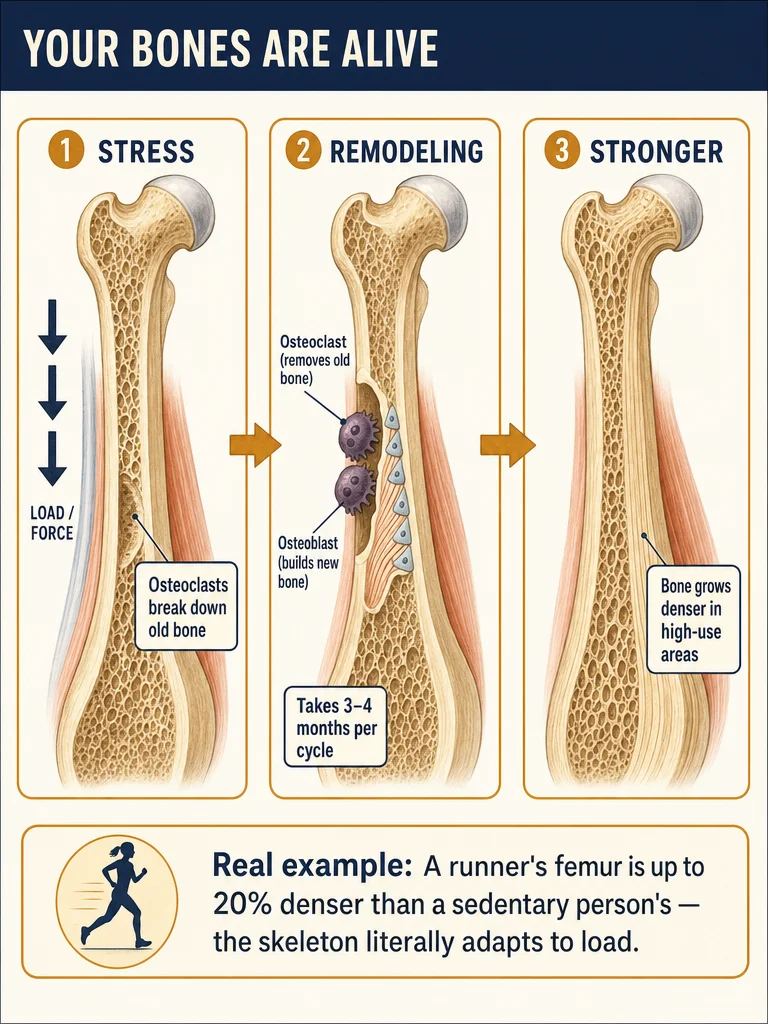
Bone responds to stress the same way muscle does — by getting stronger. The cycle runs on two cell types:
| Cell | Job |
|---|---|
| Osteoclast | Dissolves old or damaged bone matrix |
| Osteoblast | Lays down fresh collagen + mineral |
One complete remodeling cycle takes 3–4 months. The body continuously targets high-stress areas for reinforcement and low-stress areas for resorption.
Real example: A competitive runner's femur can be up to 20% denser than that of a sedentary person of the same age and weight. The skeleton literally reads your movement history and adapts.
Card 4 — Exercise: The Knuckle Joint Feel
30 seconds · No equipment needed
- Place your left hand flat on a table, palm down.
- Press firmly on one knuckle with your right index finger. Under the skin you'll feel the smooth, rounded head of a bone — that's compact cortical bone.
- Slowly bend the finger back and forth. Notice the joint opening and closing — that's your synovial joint: two bone ends coated in cartilage, floating in lubricating synovial fluid.
You just felt compact bone, cartilage, and synovial mechanics — all within 2 cm of skin.
Day 4 of 30 · Human Body Daily Micro-Lesson
Next: Day 5 — Skeletal Muscle: How Muscles Pull (Never Push)
Comments