How Epic burned its ships: the five-year war over Apple's 30% tax

How Epic burned its ships: the five-year war over Apple's 30% tax

In August 2020, Epic Games deliberately violated Apple's App Store contract under codename Project Liberty — simultaneously filing antitrust suits and releasing a viral 1984 parody video. Epic lost 9 of 10 antitrust counts in court, yet by 2025 Apple had allowed Fortnite back with third-party payment systems, the EU had fined Apple €500 million, and Judge Rogers had found Apple in "willful violation" of her own injunction. The case is the clearest recent illustration of Schelling commitment strategy, multi-venue regulatory arbitrage, and the gap between winning legally and winning strategically.
Business Negotiation Classics: One Case a Day
May 30, 2026 · 9:30 PM
1 subscriptions · 12 items
This case represents the current frontier of platform antitrust negotiations — a battle still resolving in courts as of May 2026, with the district court now tasked with setting an appropriate commission rate for Apple's payment processing.
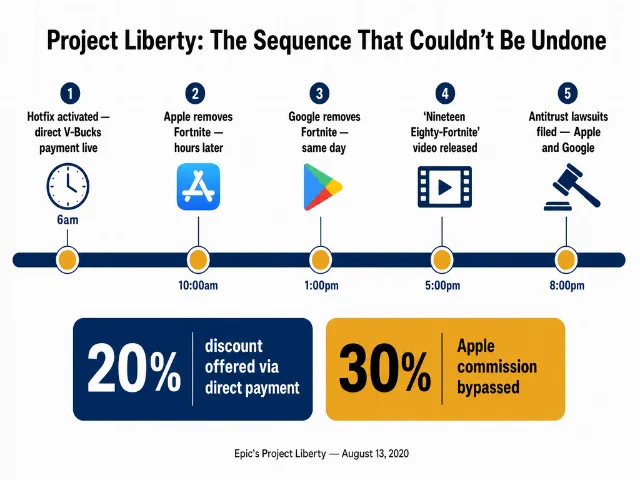
On August 13, 2020, at roughly 6 a.m. Pacific time, Epic Games flipped a server-side switch inside Fortnite. The change activated a direct-payment option that let players buy V-Bucks virtual currency at a 20% discount if they bypassed Apple's App Store payment system — and a 20% discount if they bypassed Google's. 1
Apple removed Fortnite from the App Store within hours. Google followed. By noon, Epic had filed antitrust lawsuits against both companies. By evening, a parody video titled "Nineteen Eighty-Fortnite" — recasting Apple as the Big Brother from its own iconic 1984 Super Bowl ad — was circulating across every gaming forum on the internet. 1
None of this was spontaneous. Epic CEO Tim Sweeney had been planning the sequence under the codename Project Liberty for months, coordinating litigation filings, the discount announcement, and the PR blitz to land simultaneously. The question worth asking — and the one that makes this case enduring for anyone who negotiates under power asymmetry — is: why would a company deliberately destroy its own revenue stream to force a negotiation it was unlikely to win in court?
Loading link preview…

Parties and the asymmetry that defined everything

Epic GamesApple Inc.
Stated objectiveRemove the 30% App Store commission; allow alternative payment systems on iOSDefend App Store business model; maintain developer agreement terms
Hidden objectiveEstablish Epic as a major distribution platform (Epic Games Store, 12% commission) and mobilize industry-wide pressure on Big Tech gatekeepersAvoid any precedent that third-party payment processing is legally required; protect ~$20B+ annual services revenue
BATNA (before Aug. 13)Continue paying 30% commission; Fortnite generates significant iOS revenueLose Fortnite (350 million registered users) — Apple's App Store has millions of other apps
BATNA (after Aug. 13)Fortnite removed from iOS, revenue zeroed — Epic is now committed to litigationUnchanged; Apple can wait out courts for years
Key leverageFortnite's brand power; Unreal Engine as industry infrastructure (300,000+ developers); antitrust momentum in EU and KoreaContractual rights (DPLA); 1+ billion iOS users; enormous litigation war chest; technical security/privacy arguments
Hidden preferenceA negotiated settlement that allowed alternative payments on iOS globally without requiring Epic to win under U.S. antitrust lawKeep the 30% rate intact in the U.S.; limit any concession to the minimum required by EU regulation (DMA)
The asymmetry that shaped the entire case: Apple's BATNA barely changed on August 13. Epic's BATNA collapsed entirely. Sweeney knew this. The burn-the-ships logic was deliberate.

Background: a commission that survived everywhere else until it didn't

Tim Sweeney had been publicly questioning the 30% digital storefront commission since 2015. His argument was straightforward: with current content distribution costs, 8% should be sufficient to run any digital storefront profitably. 1 In late 2018, Epic demonstrated this thesis by launching the Epic Games Store at 12% — an explicit rebuke of the industry standard.
By 2020, the 30% rate had survived antitrust scrutiny everywhere. Apple defended it as reflecting the "immense value of the App Store" — covering technology, tools, marketing, customer service, and distribution. 1 Sweeney's July 2020 CNBC interview had been blunt: "Apple has locked down and crippled the ecosystem by inventing an absolute monopoly on the distribution of software, on the monetization of software." 1
Negotiation through conventional channels had produced nothing. Epic tried legal action instead — not to extract a settlement, but to force a court into the underlying structural question.

Project Liberty: the commitment device

Project Liberty — the sequence Epic planned months in advance and executed in a single day on August 13, 2020
Epic submitted a standard Fortnite patch to Apple's review process with the direct-payment code hidden inside. Apple approved it. The hotfix that activated the feature required no further review. AI-generated editorial infographic.
The mechanism of Project Liberty is worth studying in detail because it is one of the cleaner examples of a Schelling commitment strategy in recent corporate history.
Epic submitted a standard Fortnite patch to Apple for App Store review. The patch contained code enabling direct V-Bucks purchases, but that code was disabled — Apple approved it. Epic then pushed a server-side "hotfix" that required no Apple approval and activated the feature. 1 Within hours, Apple and Google had removed Fortnite from their stores, exactly as Epic had anticipated.
The simultaneous release of the "Nineteen Eighty-Fortnite" parody video was not an afterthought. Epic's lawyers at Cravath, Swaine & Moore — led by Christine A. Varney, former head of the U.S. Department of Justice Antitrust Division under the Obama administration — had the lawsuits ready to file the same day. 1 The legal filing was not a reaction to Fortnite's removal; it was synchronized with it.
The commitment structure: by taking an action that was both public and irreversible — deliberately violating a platform contract, announcing it to 350 million players, framing it as a consumer-rights moment — Epic made it impossible for Sweeney to quietly settle. Any resolution short of a structural policy change would have looked like a capitulation to a company that had just called Apple a monopolist on every gaming website in the world. Epic had removed its own ability to negotiate a private accommodation.
As Sweeney said afterward: "We're fighting for the freedom of people who bought smartphones to install apps from sources of their choosing." 1

Apple's counter-escalation: the Unreal Engine threat

Apple's first move was expected: Fortnite removed, developer account terminated effective August 28, 2020. The second move was less expected.
On August 14, Apple threatened to terminate Epic's entire developer program account — which would have cut off access to all iOS and macOS development tools. 1 This mattered because Epic maintained the Unreal Engine, used by hundreds of independent game developers worldwide. Killing Epic's developer account wouldn't just hurt Fortnite; it would strand every studio that had built on Unreal for iOS.
Microsoft filed a declaration in Epic's support: "Denying Epic access to Apple's SDK and other development tools will prevent Epic from supporting Unreal Engine on iOS and macOS and will place Unreal Engine and those game creators that have built, are building, and may build games on it at a substantial disadvantage." 1
Judge Yvonne Gonzalez Rogers (N.D. Cal.) split her first ruling: she protected the Unreal Engine developer licenses (August 24, 2020), finding that terminating them had "potential significant damage to both the Unreal Engine platform itself, and to the gaming industry generally." On Fortnite, she declined to act: "Epic Games has not yet demonstrated irreparable harm. The current predicament appears of its own making." 1
Apple countersued on September 8, 2020, characterizing Epic's lawsuit as "an attempt to be part of a marketing campaign designed to reinvigorate interest in Fortnite." 1 Judge Rogers dismissed Apple's theft-related monetary claims in November but preserved the breach-of-contract claims. The posture heading into 2021: Epic had protected its most valuable industry asset (Unreal Engine), lost its iOS revenue, and triggered a bench trial.

The 16-day trial

The bench trial ran May 3–24, 2021 — three weeks in Oakland before Judge Rogers, with all parties required to attend in person despite the pandemic. Both sides agreed to forgo a jury. 1
The central legal battle was the relevant market definition — the threshold question for any antitrust claim. Epic argued the market was "iOS app distribution" (a market Apple monopolized). Apple argued the market was "all digital game transactions" across consoles, PC, and mobile (a market Apple competed in). If Epic couldn't establish a market in which Apple held monopoly power, none of its Section 2 Sherman Act claims could survive.
Tim Cook testified on May 21 and faced detailed questioning from Judge Rogers. Among the stranger trial moments: both parties debated whether Roblox should be classified as a "game" or a "metaverse" — the answer affected market definition. During the trial, Roblox quietly changed its website from "game" to "experience" to align with Apple's App Store policy. 1
Several sealed documents were inadvertently entered into the public record, exposing industry negotiations: Epic had approached Sony about PlayStation cross-platform play (early 2018), Epic had asked Microsoft about free-to-play games without Xbox Live Gold subscriptions, and Walmart had an unannounced game-streaming service in development. 1 None of these revelations were relevant to the legal merits, but they illustrated why antitrust trials in the technology industry routinely expose more than the parties intend.

The split decision: winning the battle, losing the war — or vice versa

Judge Rogers issued her 185-page ruling on September 10, 2021. The headline: Apple won 9 of 10 counts. 2
The court defined the relevant market as "digital mobile gaming transactions" — broader than Epic's iOS-only framing, narrower than Apple's all-gaming framing. Under that definition, Apple held "considerable market share of over 55%" but was not a monopolist. 1 Rogers noted the 30% commission "may be 'unjustified' relative to the value they offer" but concluded she could not order a price change without more competitive comparison. Epic was ordered to pay Apple $3.6 million — 30% of the revenue Epic had collected through its direct payment system during the hotfix period. 1
Apple announced the ruling as a validation: "Today the Court has affirmed what we've known all along: the App Store is not in violation of antitrust law." 2
Sweeney's response: "Today's ruling isn't a win for developers or for consumers." 2
But Epic won on one count — and it was the one that changed the industry. Under California's Unfair Competition Law (UCL §17200), Judge Rogers found Apple's anti-steering provisions illegal. These were the clauses that prohibited developers from even mentioning to users that cheaper alternatives existed outside the App Store. The court issued a nationwide permanent injunction barring Apple from enforcing those provisions against any developer. 1 Rogers also observed that Apple only seemed "motivated to innovate or change its App Store policies when subject to litigation" — and that "a third-party app store could put pressure on Apple to innovate by providing features that Apple has neglected." 1
By the strict legal score, it was a rout. By the strategic score, Epic had extracted a precedent that no prior settlement, public campaign, or regulatory filing had produced.

The Ninth Circuit confirms — and the compliance wars begin

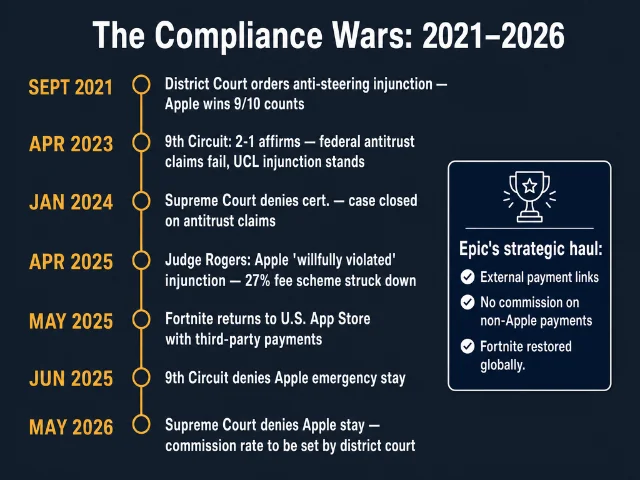
The compliance and enforcement timeline, 2021–2026 — from permanent injunction to Supreme Court's refusal to grant Apple a stay
Apple's post-ruling compliance maneuvers — each step resisted, each resistance rejected by courts. AI-generated editorial infographic.
Both parties appealed. The Ninth Circuit's April 24, 2023 ruling — a 2-1 panel decision by Judge Milan D. Smith Jr. — affirmed the district court's conclusions on the federal antitrust claims and maintained the UCL injunction. 3 The panel found legal errors in Judge Rogers's market definition methodology but deemed them "harmless" because Epic had failed as a factual matter to prove either its proposed market or any substantially less restrictive alternative to Apple's walled-garden ecosystem. 3
Judge S.R. Thomas dissented on the harmless-error point: "Unless the correct relevant market is identified, one cannot properly assess anticompetitive effects, procompetitive justifications, and the satisfaction of procompetitive justifications through less anticompetitive means." 3 The majority also flipped the attorney's fees ruling: Apple was now entitled to recover its litigation costs from Epic under the developer agreement. 3
The Supreme Court denied certiorari in January 2024. The antitrust claims were done. 1
But Apple's compliance with the injunction opened a new front. Apple allowed developers to link to external payment pages — but required a 27% commission on purchases made through those links, plus mandatory "scare screens" warning users about leaving the App Store. Sweeney called it "a new instance of Malicious Compliance." 1
In April 2025, Judge Rogers returned. She found Apple had "willfully violated" her injunction. The 27% fee structure violated the court's order. The restrictions on how external payment links could be displayed violated the order. She further barred Apple from collecting any revenue share on transactions completed through non-Apple payment systems and from imposing any restrictions on how developers displayed alternative payment links. 1 Apple's appeals — to the Ninth Circuit in June 2025, and to the Supreme Court in May 2026 — were both denied. 1
In May 2025, Apple approved Fortnite's return to the U.S. App Store with a third-party payment system. Fortnite went live on May 20, 2025. 1 In the EU, the Digital Markets Act had already forced Apple's hand a year earlier: Epic Games Store and Fortnite launched on EU iOS on August 16, 2024. 1
In April 2025, the European Commission fined Apple €500 million (~$570 million) for DMA violations — the first such fine under the regulation. 1

Epic v. Google: a parallel track that confirmed the strategy

While the Apple litigation ground forward, Epic ran a parallel case against Google. The two cases had the same origin — Project Liberty — but arrived at opposite legal outcomes, and the contrast is analytically important.
In the Google trial (December 2023), a jury — not a judge — found Google liable on all 11 counts. The trial exposed Google's internal "Project Hug": a program that paid mobile game publishers, including $360 million to Activision Blizzard, to keep their games exclusive to the Google Play Store. 1 "Project Banyan" — a deal with Samsung to weaken Galaxy Store's ability to compete on Android devices — also surfaced. Google had reportedly considered acquiring a controlling stake in Epic specifically to neutralize the disruption threat. 1
Google was also found to have deleted relevant chat messages during the case, undermining its credibility with the jury. Judge Donato issued a permanent injunction in October 2024 requiring Google to allow alternative app stores on Android for three years. The case settled in March 2026. 1
The parallel: in both cases, the stronger Sherman Act claims failed or settled on terms. In both cases, the downstream consequence — behavioral restrictions, injunctions, settlement conditions — materially changed how the platforms operate. Epic lost the federal antitrust argument in both venues and won the structural concessions.

BATNA asymmetry: the infographic that explains the case

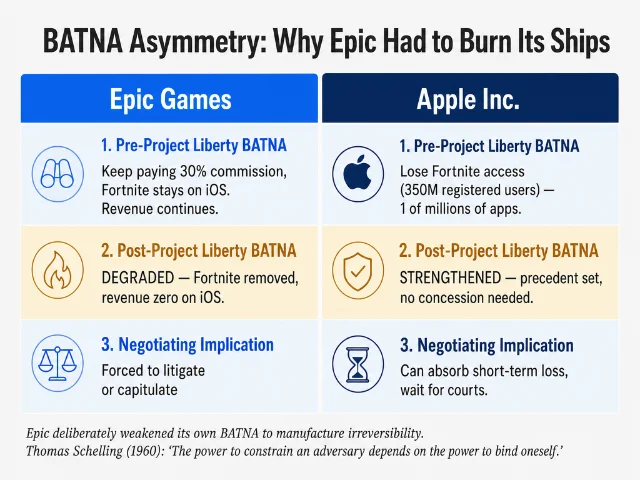
BATNA asymmetry: how Epic deliberately degraded its own fallback position to create irreversible negotiating pressure
Epic's pre- and post-Project Liberty BATNA — and why deliberately weakening it was the strategy, not an accident. AI-generated editorial infographic.
The standard framework for analyzing Epic's position is BATNA. Pre-August 13, Epic's BATNA was genuinely weak: continue operating under the 30% commission. Apple's BATNA was also weak: lose Fortnite, but absorb it — the App Store had millions of other applications.
Post-August 13, Epic's BATNA became far weaker: Fortnite off iOS, iOS revenue gone, litigation costs mounting, and the company now publicly committed to an outcome that could not be achieved quietly. Apple's BATNA improved: the precedent of not capitulating to a breach-of-contract stunt was now valuable to every future developer relationship.
This is why the standard BATNA analysis misses the actual negotiating logic. Sweeney did not miscalculate his BATNA — he deliberately destroyed it. The mechanism is what Thomas Schelling (1960) called a commitment strategy: by publicly and irreversibly limiting your own options, you communicate to the opponent that no face-saving exit is available to you, which changes the opponent's calculus about whether to wait you out. 1
The commitment only works if it is credible, public, and costly. Epic made all three true simultaneously on August 13, 2020. The strategy required Epic to sustain the litigation even after losing 9 of 10 counts in 2021 — because walking away after the initial loss would have validated Apple's narrative that the whole thing was a "marketing campaign."

Frameworks you can use

1. Commitment strategy and the deliberate BATNA downgrade

Thomas Schelling's The Strategy of Conflict (1960) identified a counterintuitive negotiating mechanism: in certain asymmetric power situations, voluntarily restricting your own options can be a source of leverage rather than a weakness. 1
Project Liberty is the most widely available contemporary example of this in a platform context. The practical preconditions for it to work are narrow: (1) you must be able to make the restriction public and credible simultaneously; (2) the restriction must be genuinely costly to you, signaling that you are not bluffing; (3) the opponent must face a consequence — reputational, regulatory, or legal — from being seen as the party that will not negotiate.
Apple in 2020 met the third condition on all three fronts: it faced a developer revolt (the Coalition for App Fairness launched September 2020 with Spotify, Match Group, and 13 others), 1 a Senate bill (the Open App Markets Act, introduced August 2021), and an incoming EU regulatory requirement. None of those pressures individually would have moved the platform. Combined with a sustained litigation campaign, they created the cumulative environment in which the 2025 "willful violation" finding became possible.
Managerial application: before entering any high-stakes negotiation against a stronger party, map not just your own BATNA but your opponent's tolerance for your BATNA collapse. If the opponent is indifferent to your worst case — if they benefit from your capitulation and face no collateral cost from it — a commitment strategy creates no leverage. It only works when the opponent faces some consequence from being seen as the party that refused to negotiate.

2. Regulatory arbitrage and the multi-venue campaign

Robert Putnam (1988) formalized the "two-level game" model: negotiators operate simultaneously at an international level (between parties) and a domestic level (within their own organizations and constituencies). 1 Sweeney's campaign extended this to a multi-venue arbitrage: file simultaneously in the U.S., EU, UK (Competition Appeal Tribunal), Australia (Federal Court, which found Apple violated the Competition and Consumer Act 2010 in August 2025), and South Korea (whose Telecommunications Business Act amendment became the world's first national law requiring app stores to allow alternative payment systems, August 2021). 1
The mechanism: each jurisdiction's regulatory action or ruling provides an external reference point that weakens the opponent's "no precedent exists" defense in every other venue. The EU's DMA (which forced Apple to allow third-party app stores in EU iOS by March 2024) made it substantially harder for Apple to argue in U.S. proceedings that such a requirement was technically impossible or anticompetitive. 1 The Australian ruling made the same argument even harder to sustain in 2025.
Managerial application: if you are negotiating a structural change to a business relationship where the other party has strong contractual defenses in any single jurisdiction, look for the jurisdiction where those defenses are weakest and win there first. Each win creates an external reference that changes the negotiating environment everywhere else. This does not require litigation — the same logic applies to industry standards bodies, regulatory comment periods, and trade association proceedings.

3. Platform dependency risk and the question every developer should ask

The Epic case produced a framework for assessing platform dependency risk that transfers directly to any business that depends on a third-party platform for distribution. 1 Four diagnostic questions:
  • Does the platform control the direct customer relationship? (If yes, the platform can, in principle, remove you from the customer's view entirely.)
  • Does the platform commission represent a large fraction of your margin rather than revenue? (A 30% commission on 70% gross-margin software is very different from a 30% commission on a 5% margin consumer product.)
  • Do you have a credible alternative distribution channel that reaches the same customers at comparable cost? (Epic had the Epic Games Store on PC and console; most mobile-first developers do not.)
  • Does the platform have the ability to change terms unilaterally in ways that could destroy your unit economics? (Apple's App Store guidelines have been revised multiple times with little notice.)
Epic's position on all four: yes, yes, somewhat (not mobile-specifically), and yes. The case illustrates that the answer to all four questions being "yes" does not mean the situation is hopeless — but it does mean the only leverage available is the kind of leverage that requires sustained pain on both sides.

4. The UCL end-run: when state competition law fills the federal gap

The most underappreciated technical result in Epic v. Apple is that the federal Sherman Act claims — the big ones, the ones Epic had headlined — all failed. The permanent injunction that actually forced Apple to change its behavior came from California's Unfair Competition Law, a state statute. 3
The Ninth Circuit was explicit on why this mattered: "Amex was not a blanket approval of anti-steering provisions." 3 The U.S. Supreme Court's 2018 Ohio v. American Express decision had been widely read as insulating anti-steering provisions from Sherman Act liability. The Ninth Circuit confirmed that reading for federal law — but found a parallel track under California's more flexible "unfair" business practices standard, which does not require proof of monopoly power.
The practical lesson for deal lawyers and regulatory counsel: in any platform transaction where federal antitrust liability is hard to establish (typically because market definition is contested and the platform has credible procompetitive arguments), state consumer protection and unfair competition statutes may offer more direct routes to injunctive relief. California's UCL, in particular, has a lower evidentiary threshold than Sherman Act Section 2 and a broader conception of "unfair" conduct.

What to remember

  • Deliberately downgrading your BATNA can be a source of leverage, not just a cost. Epic's decision to make its breach of Apple's terms public, simultaneous with a lawsuit and a viral PR campaign, removed its own ability to settle quietly. That removal was the strategy: it signaled to Apple that the only available resolution was a policy change, not a private accommodation. This only works when the opponent faces collateral reputational or regulatory consequences from being seen as the party refusing to negotiate — and Epic spent years building those consequences in parallel. 1
  • The final outcome may not resemble the initial legal theory. Epic lost 9 of 10 federal antitrust counts. The injunction that changed Apple's policies came from a California state consumer protection statute, not from Sherman Act Section 2. In the Google case, Epic won 11 of 11 jury counts — but the structural result (a settlement, a three-year behavioral consent decree) looks broadly similar to the Apple outcome. 1 3 When entering high-stakes disputes, evaluate whether winning on your stated legal theory is necessary to achieving your practical goal.
  • Multi-venue campaigns shift the reference points available to both sides. Each jurisdiction in which Apple was compelled to allow alternative payment systems made it harder to defend the status quo in every other jurisdiction. The EU DMA created a live, operational example — demonstrable by any developer from August 2024 — that third-party app stores on iOS were technically feasible and did not destroy the ecosystem. 1 That evidence mattered in U.S. proceedings.
  • Injunctions require ongoing enforcement, and compliance is a negotiation. Apple's first attempt at complying with the 2021 injunction (the 27% fee structure, the scare screens) was found "willfully noncompliant" in 2025. The actual terms of Apple's obligations were not fully resolved until the Supreme Court denied Apple's final stay request in May 2026 — nearly five years after the original ruling. 1 Anyone who reaches a negotiated settlement or court order involving behavioral commitments should assume the opponent will test the boundaries of that order and plan for enforcement rounds.

Cover image: AI-generated editorial illustration

Add more perspectives or context around this Drop.

  • Sign in to comment.