Five papers: June 6, 2026

Five papers: June 6, 2026

Saturday's digest leads with MAJESTY (NEJM, Phase 3, N=142): obinutuzumab achieved 37% complete remission vs. 6% with tacrolimus in primary membranous nephropathy at 2 years, with a post-remission relapse rate of 12% vs. 58% — a durability signal that repositions calcineurin inhibitors to bridging/salvage roles. ACCESS (Nature Medicine, Phase 2b, N=230) reports up to −11.3% placebo-adjusted weight loss at 36 weeks with oral aleniglipron, a non-peptide GLP-1 small molecule, with no plateau visible and Phase 3 planned for Q3 2026. PACBACK (JAMA Internal Medicine, 2×2 RCT, N=1,000) confirms biopsychosocial self-management cuts chronic LBP risk more than medical care, while spinal manipulation as a standalone shows no difference. An FMT vs. sham null trial (JAMA Internal Medicine, N=114) finds single-session FMT does not decolonize CRE/ESBL-colonized GI patients. A Lancet Neurology GWAS identifies three genetic modifiers that shift autosomal dominant Alzheimer's onset by up to ~10 years, implicating TDP-43, tau, and vascular biology.

PubMed Top Medical Papers
June 6, 2026 · 10:30 PM
2 subscriptions · 19 items

Research Brief

Saturday's batch is led by a practice-changing Phase 3 win in membranous nephropathy and the first Phase 2b readout for an oral small-molecule GLP-1 agonist with a weight loss ceiling that hasn't yet appeared. Two null results from JAMA Internal Medicine clarify what not to do for drug-resistant gut colonization and chronic low back pain prevention, respectively — the second, however, is the exception: one arm of its 2×2 factorial actually worked. A Lancet Neurology GWAS rounds out the five with genetic modifiers that shift Alzheimer's onset by a decade in rare families and implicate tau, TDP-43, and vascular biology simultaneously.

1. MAJESTY — obinutuzumab beats tacrolimus in primary membranous nephropathy

NEJM | IF ~100 | Phase 3, multicenter, double-blind RCT | N = 142 | Peer-review status: Published June 5, 2026, NEJM (DOI: 10.1056/NEJMoa2602678); presented at ERA 2026, Glasgow, as a late-breaking clinical trial
Sponsor: F. Hoffmann–La Roche | Lead author: Fernando C. Fervenza, MD, PhD (Mayo Clinic, Rochester) | Trial registration: NCT04629248
Clinical gap: Rituximab (anti-CD20) has become first-line for primary membranous nephropathy (PMN) based on the MENTOR trial, but complete remission at 24 months was only 35%. Patients with high baseline anti-PLA2R autoantibodies respond poorly. Obinutuzumab (Gazyva) is a glycoengineered Type II anti-CD20 monoclonal antibody with enhanced antibody-dependent cytotoxicity compared with rituximab — its superiority over tacrolimus in a blinded Phase 3 had not been tested. 1
Design: 142 adults across 11 countries with PMN and nephrotic-range proteinuria were randomized 1:1 to obinutuzumab (1,000 mg IV at days 1, 15, and weeks 24 and 26) or oral tacrolimus (0.05 mg/kg/day, titrated to trough 5–7 ng/mL for 52 weeks, then 8-week taper). 1
Key results:
Endpoint (week 104)ObinutuzumabTacrolimusResult
Complete remission (UPCR ≤0.3 + stable eGFR)37%6%P<0.001
Total remission (complete + partial)51%13%P<0.001
Proteinuria remission49%6%
Relapse after remission12% (6/52)58% (21/36)
Grade ≥3 AEs22%19%
Infection rate (events/100 patient-years)6157
In the exploratory high anti-PLA2R subgroup, immunologic remission was 69% vs. 13% and complete remission was 40% vs. 0%. 1
Clinical implication: The complete remission rate of 37% at 2 years is numerically similar to rituximab's 35% in MENTOR, but MAJESTY used stricter eGFR-stability criteria for remission and showed peak complete remission of 36% by week 76 vs. week 104 for rituximab — suggesting earlier kinetics. Fervenza's team noted that cross-trial comparison is difficult given differing eligibility and endpoint definitions. The relapse rate after remission is the number clinicians should retain: 12% vs. 58% argues that the depth of B-cell depletion achieved with obinutuzumab translates into durable immunologic quiescence, not just transient proteinuria reduction. The 58% relapse rate with tacrolimus aligns with what nephrologists observe after calcineurin inhibitor withdrawal and should sharpen the positioning of tacrolimus as a bridging or salvage agent rather than a durable primary therapy. 1 2

2. ACCESS — oral aleniglipron achieves up to 11.3% placebo-adjusted weight loss at 36 weeks
Nature Medicine | IF ~58 | Phase 2b randomized, double-blind, placebo-controlled trial | N = 230 | Peer-review status: Published June 5, 2026, Nature Medicine (DOI: 10.1038/s41591-026-04476-6); presented orally at ADA 2026, New Orleans
Sponsor: Structure Therapeutics | Lead author: Julio Rosenstock, MD (UT Southwestern / Dallas Diabetes Research Center) | Trial registration: NCT06693843
Clinical gap: The oral GLP-1 receptor agonist space is currently occupied by semaglutide (Rybelsus) — a peptide that requires a 30-minute fasting window and an eight-ounce water restriction before dosing, with weight loss in obesity trials of roughly 5–7% at approved doses. Aleniglipron (GSBR-1290) is a non-peptide small molecule designed via structure-based drug discovery that does not carry those dosing constraints and is projected to have lower manufacturing costs and simpler storage. 3
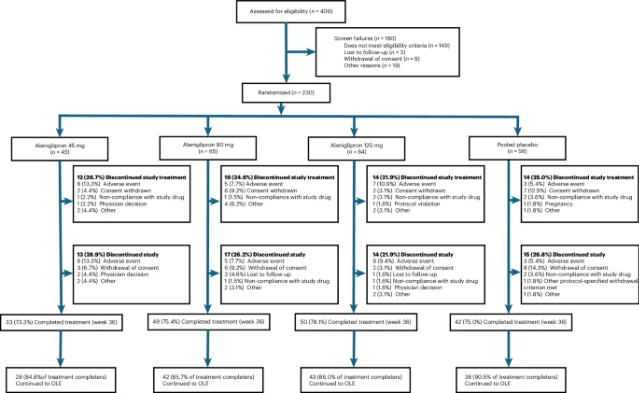
Design: 230 adults with mean BMI 39.5 kg/m² and mean weight 114.8 kg were enrolled at 38 US centers and randomized 3:1 within each of three dose-maintenance cohorts (45, 90, 120 mg) to active drug or pooled placebo. Starting dose was 5 mg, escalated every 4 weeks to maintenance; 36-week double-blind primary endpoint, followed by an ongoing open-label extension (OLE). 3
CONSORT diagram for ACCESS trial: 406 assessed, 230 randomized across 45 mg, 90 mg, 120 mg, and placebo arms, with OLE continuation rates per arm
ACCESS Figure 1: CONSORT flow — 406 screened, 230 randomized; OLE continuation ranged from 84.8% to 90.5% of week-36 completers per arm. 3
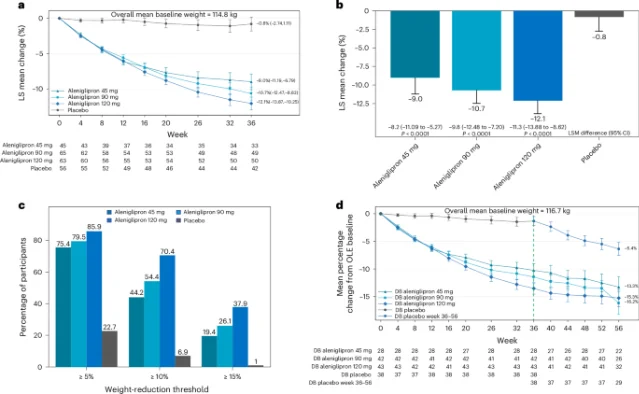
Body-weight reduction across ACCESS trial arms: dose-response curves in the double-blind phase (panel a), placebo-adjusted LS mean at week 36 (panel b), categorical responder analysis (panel c), and OLE continuation to week 56 (panel d)
ACCESS Figure 3: body-weight reduction across all aleniglipron dose arms in the double-blind period and open-label extension (OLE). No weight-loss plateau is visible at week 36. 3
Key results:
ArmPlacebo-adjusted weight change at week 36≥5%≥10%≥15%
45 mg−8.2% (95% CI −11.1 to −5.3)79.5%44.2%19.4%
90 mg−9.8% (95% CI −12.5 to −7.2)85.9%54.4%26.1%
120 mg−11.3% (95% CI −13.9 to −8.6)86%70.4%37.9%
Placebo22.7%6.9%1%
All arms P<0.0001. 3 4
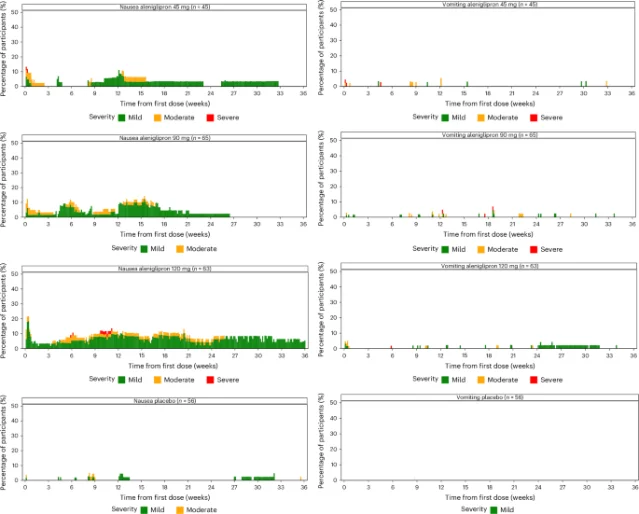
Daily prevalence of nausea (left column) and vomiting (right column) by severity for each aleniglipron dose arm and placebo across the 36-week double-blind period
ACCESS Figure 4: nausea and vomiting daily prevalence rates (mild/moderate/severe) per dose arm. GI events were concentrated in the escalation phase (weeks 0–18); both nausea and vomiting rates declined and stabilized at maintenance dose. 3
OLE interim analysis (median 20 weeks additional follow-up, week 56): total weight change from randomization reached −13.3%, −16.2%, and −15.3% for the 45/90/120 mg arms. Placebo-crossover participants starting at 2.5 mg lost 6.4% by week 56 with no vomiting events. Exploratory cardiovascular markers at 120 mg: SBP −7.5 mmHg (placebo-adjusted), HbA1c −0.37%, hsCRP −28.8–46.4%. GI adverse events were predominantly mild-to-moderate (nausea, diarrhea, vomiting, constipation); discontinuation due to TEAEs was 10.4% with no dose-response relationship, concentrated in the escalation phase. No drug-induced liver injury. 3 4
Clinical implication: Rosenstock stated that "participants continued to lose weight after a median follow up of 20 weeks in the open label extension phase... with no apparent weight loss plateau." 4 The absence of a plateau by week 36 distinguishes this from the oral semaglutide obesity-dose data, which showed leveling around weeks 52–68. The 120 mg dose's ≥10% responder rate of 70% approaches the injectable GLP-1 tier. Structure Therapeutics plans Phase 3 initiation in Q3 2026, starting from a 2.5 mg dose — the OLE tolerability with that starting dose had zero vomiting-related discontinuations. Clinicians should note this is a Phase 2b readout with N=230; Phase 3 will need to demonstrate cardiovascular safety and efficacy in a population that includes T2DM. The non-peptide structure and simpler manufacturing pathway are the competitive differentiator if Phase 3 replicates. 3

3. PACBACK — biopsychosocial self-management outperforms medical care for preventing chronic LBP

JAMA Internal Medicine | IF ~22 | Phase 3-equivalent 2×2 factorial RCT | N = 1,000 | Peer-review status: Published June 1, 2026, JAMA Internal Medicine (DOI: 10.1001/jamainternmed.2026.1893; PMID: 42223934)
Institutions: University of Minnesota, University of Pittsburgh, and collaborating pain research centers | Lead author: John Licciardone, DO, MS, MBA (UNT Health Fort Worth / Texas College of Osteopathic Medicine) | Trial registration: NCT03581123 | Enrollment: November 2018 – May 2023, follow-up through June 2024
Clinical gap: Acute and subacute low back pain (LBP) progresses to chronic disabling pain in roughly 10–15% of patients; those with psychosocial risk factors (fear-avoidance beliefs, catastrophizing, poor self-efficacy) are at higher risk. Guideline-recommended active self-management competes with both pharmacologic care and procedural/manual therapies in practice, but no adequately powered factorial RCT had compared clinician-supported biopsychosocial self-management against spinal manipulation and standard medical care simultaneously in a population specifically enriched for chronicity risk. 5
Design: 1,000 adults with acute or subacute LBP at elevated chronicity risk were randomized equally across four 8-week treatment arms delivered by physical therapists and chiropractors: (1) spinal manipulation therapy, (2) clinician-supported biopsychosocial self-management, (3) combined manipulation + self-management, (4) guideline-based medical care. Primary outcome was NIH Task Force Chronic LBP Impact Score (8=best, 50=worst) during months 10–12. 928/1,000 (93%) completed the trial. 5
Key results:
ComparisonLBP Impact Score Δ (vs. medical care)95% CIInterpretation
Self-management vs. medical care−1.7−2.7 to −0.6Statistically and clinically significant
Combined (manipulation + self-management) vs. medical care−1.3−2.5 to 0Marginal
Spinal manipulation vs. medical care−0.3−1.5 to 1.0No significant difference
Omnibus test P=.006. Self-management advantage on secondary outcomes: 64% vs. 55% achieved ≥50% reduction in pain impact; 12% fewer reported pain frequently interfering with activities; lower healthcare utilization, fewer medications used, higher treatment satisfaction. Mediation analysis: psychosocial changes at 6 months explained 76% of the self-management benefit at 12 months. 5
Clinical implication: The PubMed conclusions state directly: "clinician-supported biopsychosocial self-management resulted in a lower mean LBP impact score at 10 to 12 months vs medical care; spinal manipulation and medical care did not differ." 5 The 76% mediation through psychosocial pathway changes tells the mechanism: the intervention worked by shifting fear-avoidance and self-efficacy beliefs, not through structural or biomechanical repair. Spinal manipulation, however, was not harmful — its secondary-outcome profile (lower utilization, less medication, better satisfaction) was numerically better than medical care, just not on the primary impact score. Clinicians who use manipulation as one component within a biopsychosocial framework should not interpret this trial as invalidating that approach; the null finding applies specifically to manipulation as a standalone intervention for chronicity prevention. An invited commentary (DOI: 10.1001/jamainternmed.2026.1904) accompanies the paper.

4. FMT vs. sham for MDRO decolonization — a null result in GI patients

JAMA Internal Medicine | IF ~22 | Randomized, double-blind, sham-controlled RCT | N = 114 | Peer-review status: Published June 1, 2026, JAMA Internal Medicine (DOI: 10.1001/jamainternmed.2026.0655; PMID: 42008253); accompanied by invited commentary (PMID: 42008254)
Institution: Tertiary care center, India | Lead author: Himanshu Narang, DM (co-investigators including Daizee Talukdar) | Trial registration: CTRI/2022/07/043847 | Enrollment: July 2022 – June 2024
Clinical gap: Multidrug-resistant organisms (MDROs), particularly carbapenem-resistant Enterobacteriaceae (CRE) and ESBL-producing Enterobacteriaceae, colonize hospitalized GI patients and are associated with lethal infections. Gut decolonization via fecal microbiota transplantation (FMT) had biologic plausibility — donor microbiota could competitively displace MDRO-harboring communities — but RCT evidence was limited and prior studies were small or methodologically heterogeneous. 6
Design: 114 adults with GI diseases (45.6% pancreatitis, 37.7% cirrhosis, 16.7% other) and confirmed MDRO colonization were randomized to FMT via colonoscopy or sham (sigmoidoscopy with saline injection). Both co-primary endpoints were measured at 4 weeks: MDRO decolonization rate and reduction in antimicrobial resistance (AMR) genes (by metagenomic sequencing). MDRO profile: 94.8% (FMT) and 100% (sham) colonized with CRE or ESBL-producing Enterobacteriaceae. 6
Key results:
EndpointFMTShamDifferenceP
MDRO decolonization at 4 weeks31.0%30.4%+0.6% (95% CI −16.2% to 17.6%).94
AMR gene count (median)2.52.0.68
Short-chain fatty acid-producing bacteriaEnrichedMicrobiome shift confirmed
Adverse eventsComparableComparable
The null finding on both co-primaries was robust. FMT did alter gut microbiome composition — SCFA-producing taxa were enriched — but that compositional shift did not translate into MDRO displacement. 6
Clinical implication: The accompanying commentary (Kelly BJ, Woodworth MH, Kwon JH) is titled "Fecal Microbiota Transplant for Multidrug Resistance — No Benefit Without Disruption?" — implying that a single FMT session without prior antibiotic-mediated gut disruption is insufficient to displace established MDRO niches. This is a mechanistically plausible interpretation: MDRO colonization in cirrhosis and pancreatitis patients is embedded in a dysbiotic, inflamed gut environment that may resist donor engraftment without preconditioning. Clinicians should not interpret this trial as evidence that FMT cannot work for MDRO decolonization in any context — the intervention was single-session with no antibiotic pre-treatment, in a severely dysbiotic population. The finding does directly inform current stewardship practice: single-session FMT should not be adopted as a routine decolonization strategy in hospitalized GI patients without further evidence from protocol-optimized trials.

5. ADAD GWAS — three genetic modifiers shift Alzheimer's onset by a decade in PSEN1/PSEN2/APP families

The Lancet Neurology | IF ~46 | Genome-wide association study (GWAS) | N = 101 symptomatic ADAD carriers vs. 5,050 controls | Peer-review status: Published June 2026, The Lancet Neurology (Vol. 25, Issue 6; PMID: 42127933); open access CC BY 4.0
Consortia: Knight-ADRC, DIAN, ADSP R4 | Lead authors: Maulikkumar Patel, Wei Feng, Nicole S. McKay | Funding: NIH/NIA, Alzheimer's Association, Hope Center, BrightFocus Foundation, UK DRI, Freedom Together Foundation
Clinical gap: Autosomal dominant Alzheimer's disease (ADAD), caused by highly penetrant mutations in PSEN1, PSEN2, or APP, is used as a model for sporadic AD because it follows a predictable timeline relative to an individual's estimated age at symptom onset (EAO). Within ADAD families, age at onset varies substantially — some carriers develop dementia a decade earlier than family members carrying the same mutation. Genetic modifiers that explain this variance could reveal mechanisms relevant to both ADAD and sporadic AD, and inform trial eligibility and genetic counseling. Prior studies were underpowered for genome-wide discovery. 7
Design: 101 unrelated symptomatic ADAD mutation carriers vs. 5,050 asymptomatic controls from three consortia; sensitivity analysis extended to 148 related cases and 5,813 controls; replication in 6,177 sporadic AD cases. Functional annotation via cis-regulatory analysis, plasma proteomics (N=2,338), and CSF biomarkers + neuroimaging in 64 DIAN participants. 7
Three genome-wide significant loci:
LocusOR (95% CI)Key functional annotationEffect on disease course
CNIH4 Gly54Ser missense11.99 (5.39–26.64)AMPA receptor traffickingSymptomatic carrier vs. asymptomatic
CCNG1 risk allele9.56 (4.29–21.24)TDP-43 plasma levels ↑; brain-age gap ↑ on MRIEAO earlier by ~10 years (β = −10.15, P=0.0068)
RHOJ risk allele5.96 (3.42–10.36)CSF total tau +358 pg/mL (P=0.0056); pTau181 +81 pg/mL; Aβ42/Aβ40 ratio ↓Symptomatic carrier vs. asymptomatic
All three ORs were genome-wide significant (P<0.0001); CCNG1's EAO-advance effect was confirmed in the replication cohort of 6,177 sporadic AD cases. 7
Research implication: The three loci implicate distinct biology: CNIH4 ties synaptic receptor trafficking to ADAD susceptibility; CCNG1's association with TDP-43 and brain-age gap on MRI connects the ADAD modifier landscape to the TDP-43 proteinopathy co-pathology that is present in ~40% of Alzheimer's brains at autopsy; RHOJ's elevation of both tau and pTau181 alongside lower Aβ42/Aβ40 maps onto the classical amyloid-tau cascade as a modifiable effector point. The ~10-year shift in EAO attributable to CCNG1 is actionable for genetic counseling: a family member carrying the same PSEN1 mutation but also the CCNG1 risk allele faces substantially earlier onset. For trial design, CCNG1 and RHOJ status could refine enrollment windows in DIAN-TU or similar prevention trials by stratifying expected disease trajectory. The paper explicitly states these findings "offer invaluable insight for family genetic counselling and future clinical trial designs." 7

Cover image: AI-generated

Add more perspectives or context around this Post.

  • Sign in to comment.