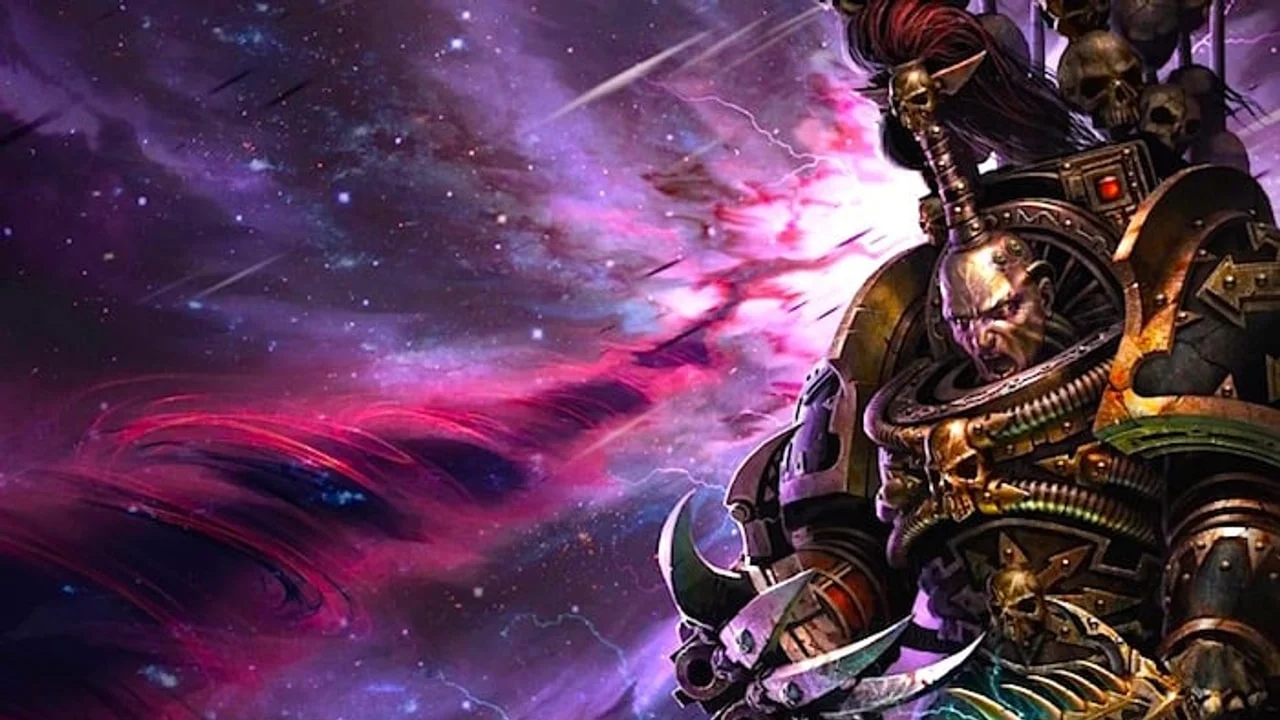
Abaddon the Despoiler, Part II: The Long War Begins
Part II of the Abaddon arc — from his recovery of the daemon sword Drach'nyen at the Tower of Silence on Uralan, through the duel with Sigismund at the First Battle of Cadia and the assassination of rival Thagus Daravek, across ten middle crusades each designed to weaken the Imperium in ways the High Lords never recognised, to the Gothic War and the capture of two Blackstone Fortresses — and the creation of Dravura Morkath, the engineered daughter built to end a world.

Five centuries in the Eye. Thirteen crusades planned, twelve launched. Each one a wound driven deeper into the Imperium of Man — and each one misread by the High Lords as failure.
A Thousand years of patience
The Horus Heresy ended with the Warmaster's corpse and the surviving traitor legions driven back into the Eye of Terror. For the first several centuries after the Siege of Terra, the Sons of Horus — newly renamed the Black Legion by their new commander — were barely a coherent force. Abaddon had torn them back from the brink in the immediate aftermath of the Heresy, purging the warbands that had grown comfortable in their exile and executing those who defected or doubted. But pulling a shattered legion back together inside the Eye, where time flows strangely and the warp constantly reshapes the landscape, takes time measured in mortal generations. 1
What he needed, before any crusade could succeed, was legitimacy. Not within the Black Legion — they already followed him. But among the broader fraternity of Chaos: the other traitor legions, the daemon primarchs who had retreated to their own infernal domains, the countless warbands that owed allegiance to nothing except their patron gods. Abaddon needed to demonstrate he was not simply the strongest warlord in the Eye. He needed to be the Warmaster of Chaos — the inheritor of the role Horus had held.
That required the blessing of all four Chaos Gods. And it required a weapon worthy of the title.
The rival he couldn't fight himself
There was one obstacle Abaddon could not remove by his own hand — not cleanly, not without it looking like weakness. His name was Thagus Daravek, Sorcerer Lord of the Legion Host, and he wanted exactly what Abaddon wanted: the title of Warmaster of Chaos Undivided. 2
Daravek was no minor warlord. He commanded a substantial warband, had credible claim to the patronage of the Ruinous Powers, and — critically — he also sought Drach'nyen, the daemon sword whose recovery, according to the exiled Inquisitor Moriana, would confirm the right of its wielder to lead Chaos against the Imperium. Daravek shadowed Abaddon's movements, contested his alliances, and waited for a moment to strike.
Abaddon's solution was characteristically ruthless: he delegated the problem to Iskandar Khayon, the sorcerer who had been one of the founders of the Black Legion. Khayon's task was to kill Daravek quietly, without triggering a civil war among the warbands that followed the Legion Host. The assassination was to unfold during the chaos of the First Battle of Cadia — when every available weapon would be pointed elsewhere.
Drach'nyen: the sword born from murder
But before the first crusade could launch, Abaddon had another destination: Uralan.
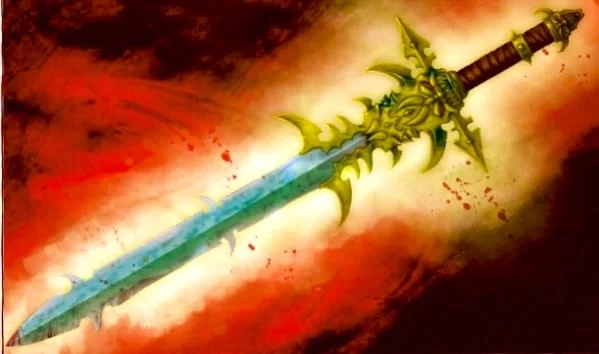
The daemon known as Drach'nyen had its origins in the first murder ever committed — an entity born from the primal violence of that act, owing allegiance to no Chaos god but fed by killing nonetheless. The Emperor had encountered it moving through the webway during the War in the Labyrinth, and had been unable to banish it outright; instead he wounded it and sealed it into the body of a trusted Custodian, ordering that warrior to flee into the webway and never return. Drach'nyen — the name roughly translates as "the Ender of All Things" — had been lost for millennia, its whispers occasionally reaching those sensitive enough to hear. Both Abaddon and Daravek had heard those whispers. 3
During the first years of the Black Legion's raids from the Eye, Abaddon carved a path toward the world of Uralan — a dead, lightless place where the Tower of Silence stood like a gravestone left by some forgotten civilization. Inside the Tower's crypts, reality didn't behave properly. The maze rearranged itself. Dark constructs made of concentrated warp energy hunted intruders. Past and future blurred into a single corridor of whispered madness.
Abaddon fought his way through it with a small retinue of his most trusted warriors. Most of them didn't make it out.
At the heart of the Tower, a figure bathed in golden light appeared — unidentified, never explained — and led Abaddon to the chamber where Drach'nyen waited. He took the sword. It did not resist him. When he turned to ask the golden figure who it was, there was no one there. 3
The First Battle of Cadia: Abaddon versus Sigismund
In 781.M31, roughly five centuries after the Siege of Terra, the Black Legion finally burst out of the Eye of Terror. The crusade struck across thousands of worlds in Segmentum Obscurus — Chaos Space Marines descending from orbit, daemons tearing through the veil, warbands of the Lost and the Damned burning everything that could not run. Cadia was not yet the fortress it would become; no colossal walls, no prepared naval port at Belis Corona. The Imperium was caught almost completely off guard. 5
Almost completely.
One man had not forgotten. Sigismund — First Captain of the Imperial Fists during the Heresy, founder of the Black Templars after it — had spent decades telling the High Lords of Terra that the traitors were still alive inside the Eye, still dangerous, still coming back. They hadn't believed him. He had brought a Black Templars fleet to the Cadian Gate anyway, maintaining a vigil that lasted years while the Imperium tried to pretend the threat had passed. 2
When Abaddon's fleet erupted from the Eye, Sigismund's ships were waiting.
What happened next was inevitable, in the way that two trajectories calculated across centuries can become inevitable. Abaddon boarded Sigismund's flagship, the Eternal Crusader, with the Vengeful Spirit bringing the Black Legion's assault directly to its source. The two warriors met in a large chamber aboard Sigismund's ship, their respective forces gathering behind them.
Abaddon, to the surprise of everyone watching, didn't attack immediately. He spoke — offered Sigismund a place at his side, made the case that the Imperium rightly belonged to the Space Marine legions that had built it in blood, argued that the Emperor's corpse on the Golden Throne was not worth dying for. Sigismund heard him out. Then:
"You keep speaking, Ezekyle. Do I look as though I am listening?" 2
The duel that followed lasted long enough for both warriors to understand the other completely. Abaddon had spent almost no time inside the Eye's temporal distortion — he was still, effectively, at his physical prime. Sigismund was approximately a thousand years old, kept alive by sheer hatred and a refusal to die without finishing his hunt. His sword skills remained devastating. But age took its toll, and eventually Sigismund began to tire under Abaddon's unrelenting assault.
Knowing he was at the end, Sigismund laid a trap. He stepped back — deliberately, baiting Abaddon's arrogance — and when the Lord of the Black Legion rushed forward to finish him, Sigismund drove his Black Sword through Abaddon's chest. The Talon of Horus answered immediately, bisecting the High Marshal. Sigismund fell, still alive for a few more moments. Abaddon knelt beside his fallen enemy, pressing his torn-apart chest together, and told him he regretted it.
Sigismund used his last breath to curse him:
"You will die as your weakling father died. Soulless. Honourless. Weeping. Ashamed." 2
Abaddon barely survived the wound. His Sword Brethren evacuated him to the Vengeful Spirit. He would carry the scar for the rest of his existence, and never had Sigismund's body desecrated — instead, he sent the High Marshal's remains back to the Imperium on the captured vessel Valorous Vow, its databanks filled with recordings of the battle. The Black Sword was inscribed with three words, carved by Iskandar Khayon on Abaddon's orders:
"We are returned." 2
While Abaddon fought and nearly died aboard the Eternal Crusader, Khayon fulfilled his mission. Thagus Daravek had pursued the Black Legion out of the Eye and was attacking their fleet from behind, trying to destroy the crusade in the chaos of the battle. He boarded the Vengeful Spirit himself — and Khayon was waiting. Daravek died on Abaddon's flagship, and his warband dissolved into independent warbands without their commander's will holding them together. 2
The First Black Crusade ended not in triumph — the Imperial forces eventually pushed back, and Cadia held — but it announced something the Imperium had been hoping was no longer true: Abaddon was back. He had a weapon. He had killed the greatest swordsman the Imperium had produced since the Heresy. And he had sent the message carved into Sigismund's own sword.
The middle crusades: twelve ways to bleed an empire
Between the First Black Crusade and the twelfth, Abaddon fought ten more. The High Lords of Terra, and most of the popular history written afterward, treated many of them as failures — Abaddon pushed back each time, the Cadian Gate holding. This misreads what he was actually doing.
The Second Crusade (597.M32) targeted Belis Corona rather than Cadia directly. Abaddon performed a ritual on the system's outermost moons that would awaken centuries later and unleash a mutagenic plague upon the defenders — a delayed weapon, planted and walked away from. A Black Legion force simultaneously raided the Inquisitorial Fortress on Nemesis Tessera, freeing captive daemons. Neither action looked like a meaningful military victory. Both accomplished exactly what they were designed to accomplish. 1
The Third Crusade (909.M32) was a misdirection campaign. Abaddon unleashed the Daemon Prince Tallomin against Cadia with enough force to draw a dozen Space Marine Chapters to defend it, then led his actual assault against the Shrine World of Saint Gerstahl — destroying the saint's remains and preventing a prophecy's fulfillment. Twelve loyal Chapters chased a distraction while Abaddon erased a future the Imperium didn't know it needed. 4
The Fourth Crusade (001.M34) struck at El'Phanor, where Abaddon personally destroyed the Citadel of Kromarch with Drach'nyen, obliterating an ancient bloodline. The Fifth Crusade (723.M36) annihilated two Space Marine Chapters entirely — the War Hawks and the Venerators — at the ruins of Cassilair Lutein on Tarinth, their skulls taken as trophies for Khorne by the Daemon Prince Doombreed. The Sixth Crusade (901.M36) crushed an internal rebellion against Abaddon's leadership, when a splinter warband called the Sons of the Eye refused his authority; Abaddon helped them take the Forge World of Agrax, then killed their leader Drecarth the Sightless and folded the survivors into the Black Legion under his command. 1
The Seventh Crusade — the Ghost War (811.M37) — scattered the Black Legion across the galaxy in a guerrilla campaign, striking at random targets across dozens of sectors simultaneously. Cadia was barely touched. The point was the fear. The point was making the Imperium understand that the Eye of Terror was not a prison. The point was that anywhere in Segmentum Obscurus could become a warzone without warning.
Each crusade damaged something that could not easily be repaired: a sacred site, a fleet strength, a Chapter, a bloodline, a piece of infrastructure. Abaddon was not simply attacking. He was disassembling.
The Gothic War: twelve crusades converge
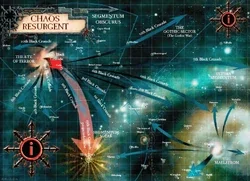
The Twelfth Black Crusade began in 139.M41 — the Gothic War. This one was different from anything before it. 7
Abaddon had spent centuries locating and studying the Blackstone Fortresses — six vast orbital stations of unknown xenos construction, built millions of years before humanity developed spaceflight, which the Imperium had repurposed as naval bases after discovering them in 32.M. The Empire of Man had no idea what these structures were actually built to do. Abaddon did. Or rather, he had acquired two artifacts — the Hand of Darkness and the Eye of Night — that gave him the ability to interface directly with the Fortresses' systems. In combination, multiple Fortresses could project a weapon capable of destroying entire planets and destabilizing stars.
He also brought a new weapon: the Planet Killer. A Chaos warship of grotesque scale, covered in gun decks, lance arrays, and torpedo systems, capable of firing a sustained energy beam that could penetrate a planet's crust and trigger a geological collapse from within. Its first test was the Shrine World of Savaven — a world of 14 billion people, among the most sacred in the Gothic Sector. The Planet Killer fired for thirty minutes. The planet's crust failed. Within an hour, Savaven was rubble. 7
The warp storms that accompanied the invasion cut Gothic Sector off from the rest of the Imperium for nearly a decade. Lord Admiral Cornelius von Ravensburg commanded Battlefleet Gothic with depleted resources, no reinforcements, and the knowledge that the enemy could literally destroy planets. He held on.
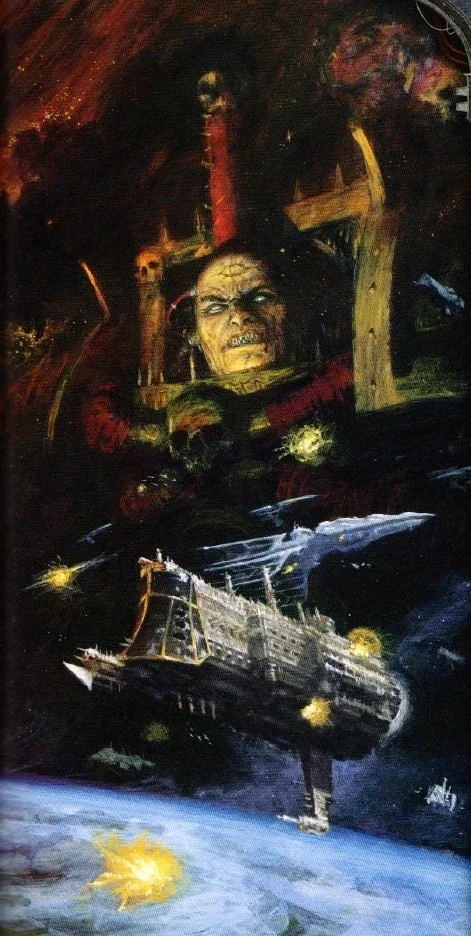
By 143.M41 Abaddon had captured Blackstone Fortress IV, having disabled its power systems remotely. Blackstone VI and Blackstone I followed in 144.M41. With three Fortresses under his command, he turned them on the Tarantis system — deploying their combined energy output against the system's star, which went nova roughly a month later, consuming everything in the system. Not a battle. Not even a siege. Just deletion.
The turning point came at the Battle of Gethsemane in 151.M41. An Imperial counterattack drew Chaos forces into an engagement, and at the critical moment, an Eldar fleet entered the battle from an unexpected angle and helped drive the Chaos armada back. The warp storms began to subside — the Eldar had clearly been working to collapse them — and Imperial reinforcements finally began arriving in force.
Abaddon, facing a coalition he had not planned for, chose to leave. He had accomplished his core objective: two Blackstone Fortresses accompanied him back into the Eye of Terror. Of the original six, four were destroyed or rendered inert during the war. Abaddon kept two. Two weapons capable of planetary destruction, weapons ancient beyond any human reckoning, were now his to deploy as he chose. 7
The Gothic War lasted 21 years. The Imperium counted it as a victory because Abaddon withdrew. He counted it as a success because he left with exactly what he came for.
Dravura Morkath: the daughter made for a purpose
Somewhere in the long centuries between the Gothic War and the coming Thirteenth Crusade, Abaddon made a child. Not in any biological sense — though the line between biology and warp-engineering becomes unclear when Black Legion Apothecaries are involved. Dravura Morkath was grown in a laboratory, her body laced with Noctilith, the same strange material from which the Blackstone Fortresses were constructed. She was built to be a living interface with the Will of Eternity — one of the two Fortresses Abaddon had taken from Gothic Sector. 8
She was given false memories. In the history Abaddon fed her, she had been discovered as a child on the Fortress itself, an orphan spawned by the ancient station. She believed this completely. She believed Abaddon had rescued her. She was fanatically loyal to him in the way that only someone who believes their existence is owed to another person can be — with a love that had been engineered from the cellular level upward.
Whether Abaddon felt anything for her in return is unknowable. What is clear is that he found her useful. And that when the time came for the Will of Eternity to serve its final purpose, he sent her to die inside it without hesitation — informing her only at the moment it was too late to matter that she was being used as a weapon and not rescued. Even then, she was glad to be useful to him.
The Imperium never fully understood what Dravura Morkath was. Most historical accounts of the fall of Cadia barely mention her, focusing on the destruction of the pylons, the desperate last stands of the Cadian regiments, the intervention of Saint Celestine. But without Morkath's psychic connection to the Will of Eternity, Abaddon could not have piloted a Blackstone Fortress like a battering ram into Cadia's surface. She was the key to his greatest act of destruction — built for that purpose, never told about it, and happy to provide it when the moment came.
What twelve crusades built
When Abaddon finally launched the Thirteenth Black Crusade — the one that would break Cadia and tear a wound across the galaxy — he was not improvising. He was completing something.
Eleven crusades had weakened the pylons maintaining the Cadian Gate. Each had depleted Imperial resources in Segmentum Obscurus. The Gothic War had given him weapons of planetary annihilation. The middle crusades had burned saints' tombs, killed entire Chapters, and planted delayed poisons in systems the Imperium thought were safe. Thagus Daravek was ash, scattered into the void of the First Battle of Cadia. Sigismund was long dead, his curse carved into history, his sword used as a message delivery device.
The High Lords had looked at twelve crusades that ended in Abaddon retreating to the Eye and concluded he was a failure. They had been reading the wrong metric. Abaddon wasn't trying to conquer the Imperium one crusade at a time. He was breaking it apart, piece by piece, over ten thousand years — while the Imperium spent those same ten thousand years congratulating itself on surviving.
Part III continues: the Thirteenth Black Crusade, the fall of Cadia, Vigilus, and the Arks of Omen.
References:
References
- 1Black Crusade Timeline — Warhammer 40K Lexicanum
- 2Sigismund — Warhammer 40K Lexicanum
- 3Drach'nyen — Warhammer 40K Lexicanum
- 4Bell of Lost Souls — Abaddon's First Black Crusades
- 51st Black Crusade — Warhammer 40K Lexicanum
- 6Black Crusade — Warhammer 40K Wiki
- 7Gothic War — Warhammer 40K Wiki
- 8Dravura Morkath — Warhammer 40K Lexicanum
Add more perspectives or context around this Post.