Muji: The Supermarket Private Label That Turned "No-Brand" Into a Global Identity

Muji: The Supermarket Private Label That Turned "No-Brand" Into a Global Identity

In 1980, a Japanese supermarket launched a product line built on selling what other companies threw away — U-shaped pasta ends, shiitake mushroom stems — wrapped in unbleached paper with the slogan "lower priced for a reason." The line was called Mujirushi Ryōhin: no-brand quality goods. Forty-five years later, the company that spun off from that supermarket posted $5 billion in annual revenue. This is how Muji happened.
品牌史志
May 24, 2026 · 8:07 AM
6 subscriptions · 6 items
In December 1980, the Japanese supermarket chain The Seiyu launched a private-label product line with 40 items: 9 household goods and 31 food products. The items came wrapped in clear cellophane with plain brown paper labels and red text. The slogan was "Lower priced for a reason." Among the first products: U-shaped spaghetti ends — the part that straight-pasta factories discarded — packaged and sold as a budget alternative.
The line was called Mujirushi Ryōhin. It translates, roughly, as "no-brand quality goods."
Forty-five years later, Ryohin Keikaku — the company that eventually spun off from Seiyu to run Muji as an independent entity — posted record revenue of 784.6 billion yen (approximately $5 billion) for fiscal year 2025, with operating profit up 31.5% year-on-year. The company runs 1,188 stores across 30-plus countries.1
The non-obvious fact at the start: Muji was not founded as a brand. It was explicitly designed to be the opposite of one.

The context that produced "no-brand"

Japan in 1980 was in the middle of a brand-consumption boom. Foreign luxury goods, especially European fashion houses, had acquired near-totemic status. Japanese consumers were willing to pay high premiums for branded products — a phenomenon that accelerated the growth of a mass-luxury market where the logo was often more important than the product itself.2
At The Seiyu, a retail executive named Seiji Tsutsumi — president of the Seiyu Ryutsu group — saw an opening in the opposite direction. His observation was straightforward: a segment of the Japanese consumer market was fatigued by branding, not convinced by it. That segment would pay for quality and functionality if the price was honest.
Mujirushi Ryōhin was the expression of that bet. The design logic was built around three rules: select better raw materials (including materials typically discarded by other manufacturers), streamline the production process by eliminating steps that didn't improve the product, and simplify packaging to the minimum required to protect and describe the goods. Bleaching paper to make it white, for instance, was deemed unnecessary. The resulting beige paper became the aesthetic.3
The spaghetti ends, the shiitake mushroom stems, the U-shaped pasta — these weren't just cost-cutting. They were arguments. The message was that what other companies called waste was actually a good product at a lower price, and the only thing inflating the other products' value was packaging and branding theater.

Becoming a standalone company

In 1981, Tsutsumi proposed opening a dedicated standalone shop for the Mujirushi Ryōhin line. The Seiyu board rejected the idea. The advisory board approved it anyway. A year of internal development followed, expanding the product range beyond the supermarket's natural categories: food, clothing, stationery, household goods.2
The first dedicated Mujirushi Ryōhin store opened in Aoyama, Tokyo, in 1983 — a 103-square-meter shop. By 1985, Seiyu had established a formal Mujirushi Ryōhin division within its structure and began overseas production and procurement. By 1989, the logical conclusion arrived: Ryohin Keikaku Co., Ltd. was established as a separate legal entity, and the following year the entire Muji business transferred from Seiyu to the new company.3
What this meant structurally: Muji was now a manufacturer-retailer, controlling its own planning, development, production, distribution and sales. The move also meant Muji was no longer a supermarket line trying to stay minimalist while being sold alongside everything else. It could control the full environment of the store — the shelves, the layout, the absence of noise.

The London decision

In the late 1980s, Muji participated in an exhibition of Japanese products in London. The response was strong enough to generate serious inquiries. Among those interested: Harrods, the department store. Muji declined.
The reasoning, as described in the company's own account and subsequent strategy analyses, was a concern about cultural mismatch — that the Harrods context would misframe Muji as a luxury import rather than an affordable-quality alternative. The brand was explicitly not luxury. Placing it in a luxury setting would have been a contradiction that the product line, with no advertising budget to correct the narrative, couldn't afford.2
Instead, Muji entered the UK through a joint venture with Liberty — the design-focused department store — and opened its first international store in London in 1991. The choice of partner communicated the correct frame: design and craft, not status.3
The global expansion philosophy that emerged from this decision has remained consistent: open a first store in a market, prove it works, then open a second. The company explicitly described its international approach as slow and deliberate — no second store until the first is profitable and operational issues are understood. This prevented the kind of rapid-expansion failure that has hit other Japanese retailers attempting overseas growth.
Loading link preview…

IPO and the art director problem

Ryohin Keikaku listed on the over-the-counter market of the Japan Securities Dealers Association in 1995, moved to the second section of the Tokyo Stock Exchange in 1998, and graduated to the first section in 2001.1
Around the same time the company went public, it faced an internal problem that the original art director Ikko Tanaka — who had built the visual identity from the beginning — had not fully anticipated. By 2001, Muji had 250-plus outlets and 5,000-plus products, and some of those products, as Kenya Hara (Tanaka's successor as art director) later described it, "deviated from the initial Muji concept or were low cost, but of substandard quality."1
Hara, an internationally recognized graphic designer, took over as art director in 2001. His diagnosis was that the original founding idea — "no design" — had calcified into an orthodoxy the company had stopped actively interrogating. His response was to articulate a more precise concept: emptiness, or . The idea was that Muji's products should function as containers that consumers could project their own meanings onto. Not "no design" as a slogan, but a deliberate openness that could accommodate different contexts, uses, and personal interpretations.
From 2003 to 2009, Hara led the "Horizon" print campaign — a series of images showing a lone figure in a vast landscape with no Muji product visible. The intent was to invite projection rather than direct association. The campaign worked precisely because it showed nothing.

The China bet and the US stumble

The mid-2000s saw two parallel international moves that produced very different outcomes.
China became the brand's most important overseas market. Muji entered Shanghai in 2005 and built a dedicated team to standardize store design, layout, and merchandising — partly to respond to trademark disputes and counterfeit stores that had appeared since 1999, and partly to establish a control system before scale made consistency impossible. China eventually grew to represent 18% of the company's global revenue, and Muji's mainland China presence reached over 400 stores by 2022.1
The United States proved more resistant. Muji entered the US in 2007 with a SoHo, Manhattan store. High shipping, rental, labor, and construction costs compressed margins and limited the range of products that could be profitably offered at Muji's price points. The US operation grew to 18 stores before problems became acute. In July 2020, Muji USA filed for Chapter 11 bankruptcy, citing COVID-19 shutdowns as the immediate cause but with underlying structural issues predating the pandemic.1 The US footprint shrank to 10 stores by 2022.
The divergence between China and the US is partly a product of logistics and cost structures. But it also reflects a pattern in Muji's global results: markets where design-literate urban consumers have dense retail infrastructure (China's major cities, South Korea, Taiwan, Hong Kong, Singapore) have absorbed the brand far more effectively than markets where the economics of retail real estate work against the brand's price positioning.
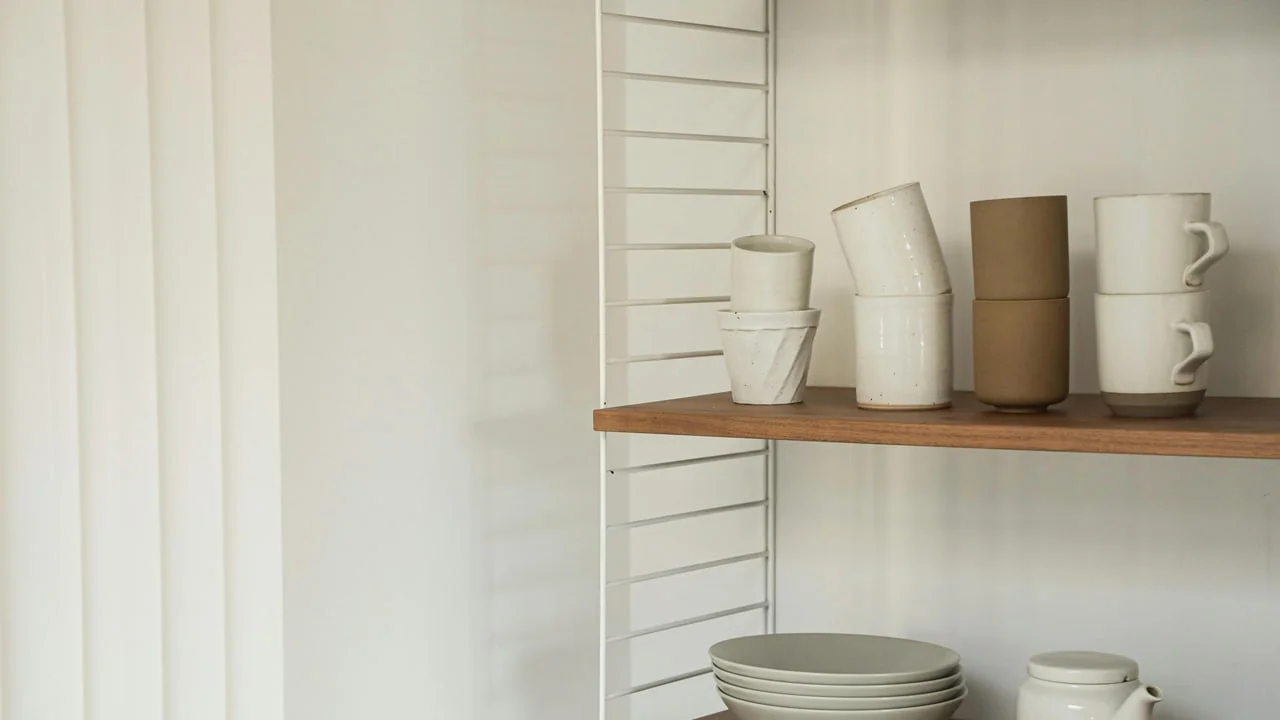
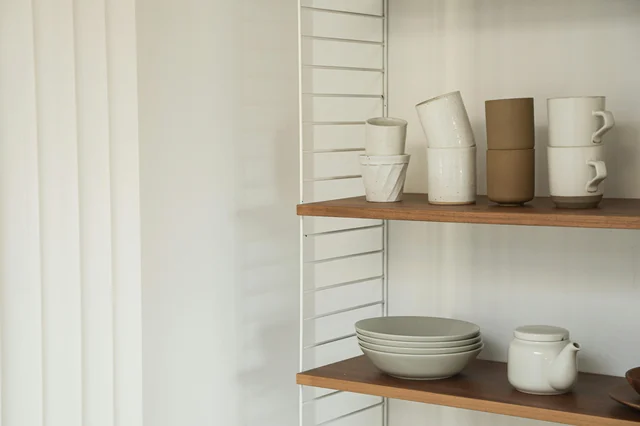
Ceramic tableware on wooden shelves — clean, minimal retail display
Simple ceramics on wood — the aesthetic Muji built a retail language around 4

The Xinjiang problem

In 2020 and 2021, Muji came under scrutiny for its use of cotton from Xinjiang, the Chinese region where the Chinese government operates internment camps holding Uyghur Muslims. The company was criticized for continuing to source from the region and, in some accounts, for actively marketing the Xinjiang origin in China while labeling the same garments simply as "organic cotton" in Hong Kong, Taiwan, and Japan.1
The episode exposed a structural tension in Muji's positioning: a brand built on ethical production principles and environmental responsibility was simultaneously dependent on a supply chain originating in a region where forced labor allegations were well-documented. Unlike Western brands that faced similar scrutiny and exited Xinjiang cotton sourcing, Muji's China market dependency created a different set of pressures.
The company subsequently stopped labeling goods as "Xinjiang cotton" in certain markets but did not make a clean public break from the sourcing practice. The resolution was quiet rather than declarative.

The current position

For fiscal year 2025 (ending August), Ryohin Keikaku projected revenue of 770 billion yen (approximately $4.9 billion), up 16% year-on-year, with operating profit of 67 billion yen and net profit of 45.5 billion yen. The company's stock hit an all-time high in May 2025.5
The growth driver is stores — specifically, large-format stores of around 21,000 square feet. Since 2023, Muji has opened more than 110 new locations annually. Revenue per store has risen from 440 million yen in 2019 to over 500 million yen in 2024, meaning the growth is not simply being diluted by store count. The company's world's-largest store — Muji Aeon Mall Kashihara — opened in 2025.3
The category driving repeat visits is everyday consumables: cosmetics, skincare, and daily household goods. Not furniture, not apparel — the categories that made Muji's design reputation globally. The repeat-purchase business turns out to be the growth engine the company needed to convert occasional admirers into regular customers.
Ownership structure remains conventional. The largest shareholders are institutional: The Master Trust Bank of Japan (8.70%), Trust & Custody Services Bank (7.73%), Mitsubishi Corporation (4.09%). There is no founder-control structure, no dual-class shares, no foundation holding votes in trust. Ryohin Keikaku is a publicly traded company, listed on the Tokyo Stock Exchange as ticker 7453, and behaves like one.1
Loading link preview…

What the founding logic actually produced

The no-brand claim has always been partly a paradox. A brand built on not being a brand is still a brand — and arguably a more effective one, because it signals an attitude rather than just a product. The aesthetic became globally recognizable. The brown paper labels and unbleached materials became a visual language. Kenya Hara's "emptiness" concept gave the company a philosophical frame it could apply to new product categories without redefining itself.
What the founding actually established was a cost discipline backed by an aesthetic system. The decision to sell spaghetti offcuts wasn't just thrift — it was an argument that waste is a product-design problem, not an inevitability. Forty-five years later, the refillable dispensers, the modular shelving, the unfussy packaging still operate from the same logic. The company has changed in every structural sense — public listing, independent incorporation, global expansion, a US bankruptcy filing, a Xinjiang sourcing controversy. The product philosophy has not.
That's either the most credible kind of brand consistency, or the most commercially convenient one. Possibly both.

Add more perspectives or context around this Drop.

  • Sign in to comment.