The Broadcaster Who Walked 300 Miles Because He Said He Would
On June 8, 1989, Jim Rooker promised to walk home if the Pirates lost after scoring 10 first-inning runs — then did it.

June 8, 2026 · 10:19 PM
5 subscriptions · 21 items
On June 8, 1989, the Pittsburgh Pirates walked into Veterans Stadium in Philadelphia and promptly scored 10 runs in the first inning. Their color commentator on KDKA Radio, a 46-year-old former pitcher named Jim Rooker (who had a 103-win MLB career and a 1979 World Series ring), leaned into the microphone and said something he would spend the next four months regretting.
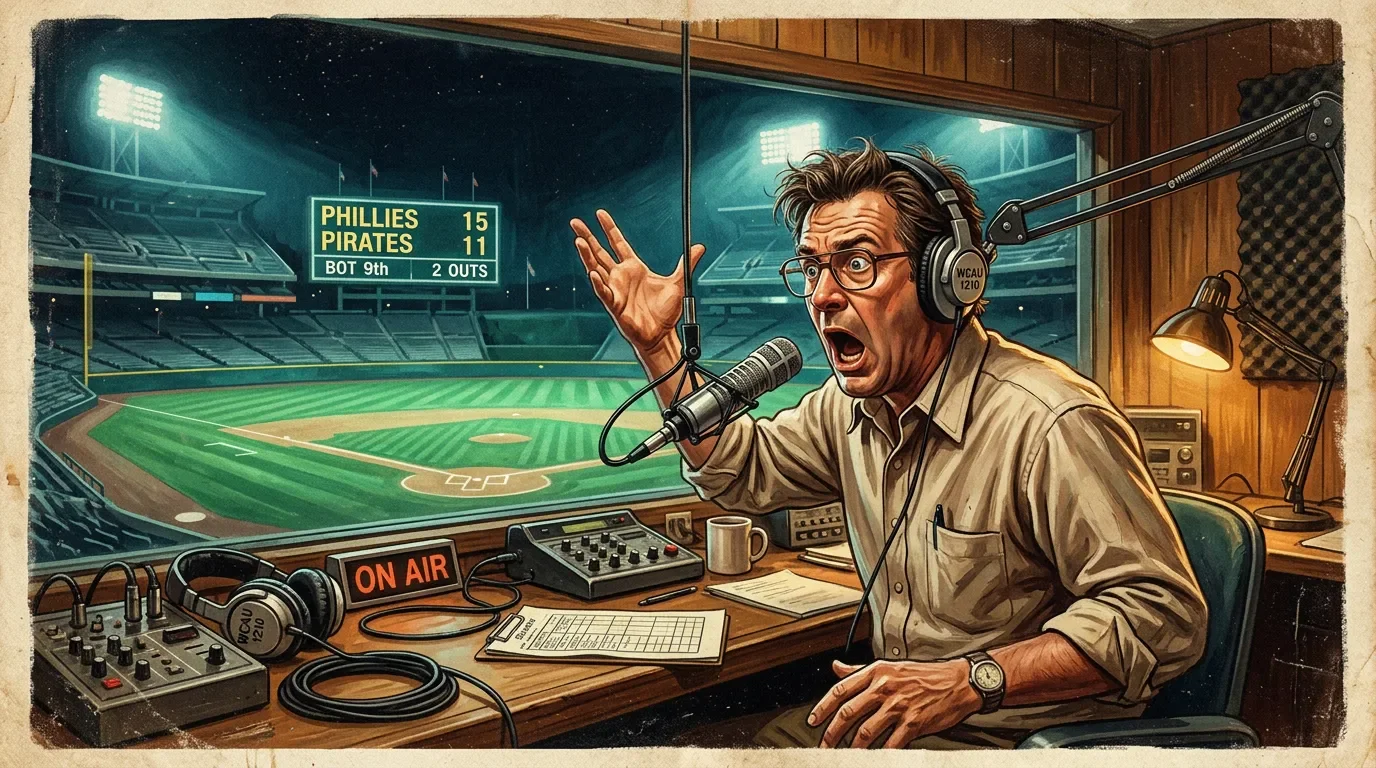
"If we don't win this one, I don't think I'd want to be on that plane ride home. Matter of fact, if we lose this game, I'll walk back to Pittsburgh." 1
The Phillies won 15–11.
The game that should have been over in the first inning
The Pirates sent 16 batters to the plate in the top of the first. Barry Bonds — 24 years old, in just his fourth MLB season — hit a three-run home run, his 10th of the year. 2 Starting pitcher Bob Walk, whose job was to throw the ball, also hit a two-run single. Andy Van Slyke drove in a run. Rey Quinones added a two-run double. Philadelphia starter Larry McWilliams lasted 0.1 innings. When the smoke cleared, it was Pirates 10, Phillies 0.
Both teams entered the game 20–34, tied for last in the NL East. 2 The Pirates were on a 7-game losing streak, winless on their entire 8-game road trip. This game, logic said, was the one they finally had to win.
That logic did not survive contact with Steve Jeltz.
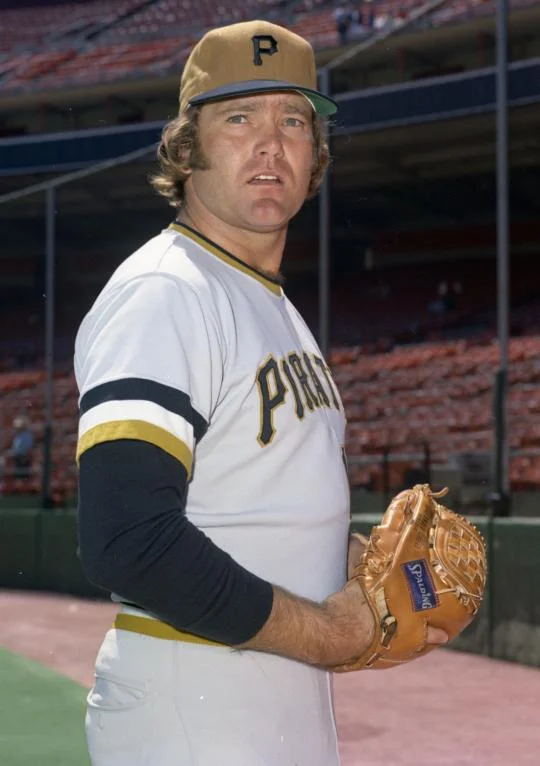
Steve Jeltz, accidental destroyer of promises
Steve Jeltz was, by every objective measure, one of the worst hitters in professional baseball. In eight major league seasons, he batted .210 with a career OPS+ of 61 (100 is average). He was a 30-year-old light-hitting shortstop who, entering June 8, 1989, owned exactly one career home run in 537 games and 1,612 plate appearances. 4
In the fourth inning, with the Pirates still leading 10–2, Jeltz stepped in from the left side and hit a two-run shot off right-hander Bob Walk, making it 10–4.
In the sixth inning, with the game now at 11–9, Jeltz stepped in from the right side — he had quietly taught himself to switch-hit — and launched a three-run home run off left-hander Bob Kipper. Phillies 12, Pirates 11.
Two home runs, from both sides of the plate, in the same game — a franchise first in the Phillies' then 107-year history. 5 When those two homers are set against his career total of five, it means that 40% of every home run Jeltz ever hit came in a single game, on one evening in Philadelphia, against a team that had scored 10 runs before he'd even batted once.
Von Hayes hit two-run home runs in the first and third innings. 2 In the eighth, John Kruk (4-for-5 on the night) scored the tying run on a wild pitch by Jeff Robinson. Darren Daulton delivered a go-ahead two-run single. Curt Ford hit a two-run triple. Final score: Phillies 15, Pirates 11.
According to Baseball-Reference data later surfaced by statistician Katie Sharp, out of more than a quarter million MLB games played since 1915, this was only the 28th time a team had scored 10 or more runs in the first inning — and the Pirates were the first to do it and lose. 6
In the press lounge afterward, Phillies broadcaster Harry Kalas — Hall of Fame voice of "it's outta here" — greeted Rooker warmly: "Well, Rook, it looks like you stuck your foot in your mouth on this one, huh?" 6 On the team plane back, Pirates manager Jim Leyland walked past and delivered a two-word verdict: "Nice goin', Rook."
Rook's Unintentional Walk
The next morning, Pittsburgh radio host Goose Goslin called Rooker and asked him to come on air. KDKA's switchboard, and the Pirates' offices, were flooded with listeners demanding he keep his word. Rooker agreed — on one condition. "Let's get some charities involved, a sponsor. Let's have some reason to do it."
The event was formally announced on August 30, 1989, and billed as "Rook's Unintentional Walk." His companion for the journey would be Carl Dozzi, a Pittsburgh businessman and friend. Dozzi, upon learning of the plan, apparently told Rooker: "How can you walk from Philly to Pittsburgh? You have trouble walking from ground level to the announcers' booth."
On October 5, 1989, with ABC's Good Morning America covering the departure ceremony, Jim Rooker stepped away from Veterans Stadium and turned his face toward Pittsburgh. The route: U.S. Route 30, the Lincoln Highway, straight across Pennsylvania — four mountain crossings, narrow shoulders, trucks doing 55 mph, 24 miles per day, eight to five, every day for 13 days.
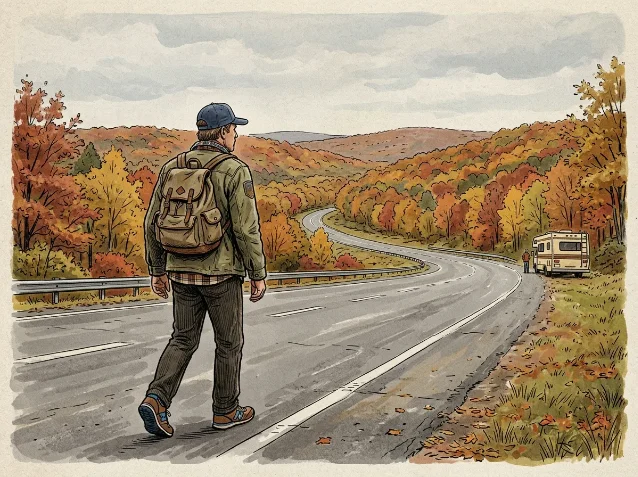
His feet swelled through three progressively larger shoe sizes. A podiatrist accompanied the group for the first three days to teach them how to soak their feet and apply Vaseline. "It got to be torture," Rooker later said. "Like stepping on a bed of nails." 6
Near Sideling Hill on Route 30, an 18-wheeler drifted onto the shoulder. Rooker's instinct to step off the road a beat before it happened likely saved both men's lives. Later he described the psychological toll with a phrase he coined himself: "Two o'clock mad" — the irritability that arrived every afternoon like clockwork.
They also crashed a polka festival at Seven Springs, leaving with their pockets stuffed with cash and checks for the charity fund.
On October 17, Rooker and Dozzi were escorted into Pittsburgh by a police motorcade, welcomed at Three Rivers Stadium by a crowd, champagne, balloons, and a portable foot bath decorated with footprints painted by Rooker's grandsons. The walk had covered somewhere between 308 and 327 miles, depending on the source — estimates vary across contemporaneous accounts. 7 What everyone agrees on: it raised approximately $81,000 for Children's Hospital of Pittsburgh, along with $10,000 for former minor league teammate Al Ricciuti, who was battling multiple sclerosis and needed a van equipped with a wheelchair lift. 8
Asked afterward if he'd do it again: "Now that it's over, I'm glad I did it. It's a lot of fun thinking about it and reminiscing. But would I do it again? No, never, never, never, never!" 6
The walk lives on
Rooker spent 13 seasons as the Pirates' color analyst (1981–1993) before moving to ESPN through 1997. He went on to run a sports bar, write children's books, and run for political office twice. The walk gradually became the thing he was most remembered for — more than his 103 wins, more than his 1979 World Series start.
"A lot of people I've run into since I've been out of baseball say, 'Oh, wait, you're the guy who did that walk,'" he told TribLive in 2014. "I have to remind them I won quite a few games in the big leagues, too." 9
In 2022, Jon Bois and Alex Rubenstein of Secret Base released a 36-minute documentary on the game and the walk — "How to score 10 runs in the first inning and lose | Dorktown" — which has since passed 1.25 million views on YouTube. 10
Loading content card…
Bois's thesis: astronomically improbable events attract each other. The Pirates scored 10 runs in the first inning for only the 28th time in 74 years of baseball. The man who taunted fate on air happened to be doing so on the specific night that a .210-hitting shortstop hit two home runs from both sides of the plate for the first time in franchise history. And when the baseball gods heard a careless broadcaster's boast, they delivered.
There is also one final irony that no writer could resist: the Pirates' starting pitcher on June 8, 1989 — the man whose team's collapse set this all in motion — was named Bob Walk. Five years later, Walk replaced Rooker in the KDKA radio booth. 6
What Rooker actually learned: The lesson wasn't about improbability — it was about the gap between a careless word and its consequences. Ten days after the loss, the Pirates jumped out to a 10–0 lead in St. Louis. Play-by-play man Lanny Frattare turned to Rooker: "And if we lose this game?" Rooker replied: "Yes, if we lose this game…our road record will be 11-23." 1 He had learned, precisely and only, what was necessary.
Cover image: AI-generated illustration of the June 8, 1989 broadcast moment.
References
- 1Wikipedia: Jim Rooker
- 2Baseball-Reference: Pirates vs. Phillies, June 8, 1989
- 3National Baseball Hall of Fame: Jim Rooker
- 4Baseball-Reference: Steve Jeltz
- 5The Good Phight: 30 years ago Steve Jeltz made Jim Rooker walk home
- 6MLB.com: Jim Rooker's journey to 'Rook's Unintentional Walk'
- 7Seamheads.com: Jim Rooker the Unintentional Walk
- 8UPI Archives: Rooker's charity walk ends
- 9TribLive: 25 years later, Rooker made good
- 10YouTube / Secret Base: Dorktown — How to score 10 runs in the first inning and lose
Add more perspectives or context around this Post.