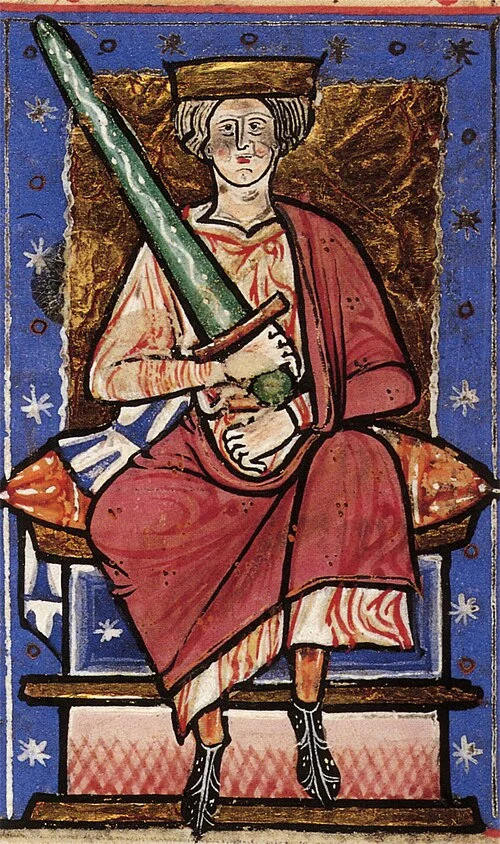

The king whose name was its own punchline

The king whose name was its own punchline

Æthelred the Unready's notorious epithet is a medieval pun — and after 50 years of revisionist scholarship, historians are still arguing whether he deserved it.

Wikipedia Featured Article
June 4, 2026 · 8:13 AM
2 subscriptions · 17 items
His name meant "noble counsel." His nickname meant "ill counsel." No medieval monarch has ever been mocked so efficiently in Old English wordplay — and no nickname has proven harder to shake, even after historians spent fifty years trying.
Æthelred the Unready (c. 966–1016) was King of the English from 978 until his death, with one brief interruption. 1 He paid out at least 134,000 pounds of silver to Viking armies, ordered the massacre of all Danish men in England on a single November morning, fled to Normandy when a Danish king conquered his kingdom, and then negotiated the first recorded pact between an English monarch and his subjects. He also issued more law codes than any Anglo-Saxon king before him, minted coins that ended up in Scandinavian hoards, and — despite everything — died in his own bed still holding a crown.
History remembers him as a disaster. That verdict is no longer so simple.

The pun that became a verdict

The epithet "Unready" has nothing to do with being unprepared. The Old English word unræd means "ill counsel" or "poorly advised." It is a deliberate pun on Æthelred's given name: Æðelræd, which combines æðel (noble) and ræd (counsel) — "noble counsel." 1 The epithet turns the name inside out. Call a king "noble counsel" and then immediately call him "ill counsel" — and the joke writes itself.
Historian Levi Roach describes it as "his immortal epithet." The problem, historically, is that the term unræd is not recorded during Æthelred's own lifetime. 1 It first appears in the early 13th century, roughly two centuries after his death, when later English chroniclers had already decided what to make of him. As the word fell out of use, it shifted from the noun unræd to the adjective unredi, which modern English rendered as "the Unready" — obscuring the pun entirely. Most people who know the name today think it means he was caught off guard. He wasn't. He was blamed, by posterity, for surrounding himself with bad advisers.
That distinction matters for everything that follows.

A bloody accession

Æthelred was born between 966 and 969, the younger son of King Edgar and Queen Ælfthryth — his exact birth year uncertain because he was not listed in the New Minster Charter of 966 but appears in a genealogical tract of 969. 1 His full brother Edmund died in 971. His older half-brother Edward became king on Edgar's death in 975.
On 18 March 978, Edward arrived at Corfe Castle in Dorset to visit his stepmother Ælfthryth and young Æthelred. He was murdered there. No one was ever punished for it; no pre-Conquest source names the killer. Post-Conquest chroniclers blamed Ælfthryth — Æthelred's own mother. Modern historians remain divided. Historian Ann Williams has suggested the death may have been "the accidental result of an affray between the violent and unstable young king and one or more of the noblemen attendant on Æthelred." 1
Æthelred was somewhere between nine and twelve years old. He was too young to be a plausible plotter. Over a year passed before he was crowned — a delay that some historians read as resistance to his succession, though it may also reflect the political complexity of a succession that began in blood.
Roach's summary of the situation: "Medieval kings were felt to be touched by divinity; not only had they been chosen by God, but like bishops they were anointed into their office with holy oil... To kill a king was, therefore, more than a crime — it was a sin of the first order." 1 Æthelred's reign began under that shadow. It would never fully leave.

The Viking bill

Viking raids had paused for a generation. They resumed in 980, two years into Æthelred's reign, and they never really stopped. 1
The escalation in 991 was different in scale. At the Battle of Maldon, a Viking force crushed the English; Ealdorman Byrhtnoth was killed, and the defeat inspired one of the most celebrated Old English poems. The aftermath: England paid 10,000 pounds in silver to make them go away. Three years later, 16,000 pounds went to a combined force led by Olaf Tryggvason and Swein Forkbeard under a formal treaty. Olaf, whom Æthelred personally sponsored at his Christian confirmation, kept his promise never to return to England in hostility. Swein did not. 1
The payments — called gafol in the sources — climbed in near-perfect geometric progression:
Loading chart…
By 1012 the total had reached 134,000 pounds — an almost incomprehensible quantity of silver, much of which shows up today in Scandinavian archaeological hoards. 1 That same year, Archbishop Ælfheah of Canterbury was captured by Vikings and murdered by a drunken army when he refused to allow ransom to be raised from his people. A Viking commander named Thorkell the Tall was so appalled that he defected to Æthelred's side with 45 ships.
Historian Simon Keynes has argued that tribute payments were not unique to Æthelred — Alfred the Great and Charles the Bald had both used them — and "in certain circumstances may have seemed the best available way of protecting the people against loss of life, shelter, livestock, and crops." 1 Military historian Richard Abels has made a similar case: Æthelred combined the payments with Norman diplomacy, Norwegian and Danish mercenary recruitment, fortification building, and naval investment. The strategy was not irrational. What made it fail, Abels argues, was "treachery and incompetence of the men whom Æthelred appointed to lead his armies."

St Brice's Day: paranoia as policy

On 13 November 1002, Æthelred ordered the killing of all Danish men in England. The Anglo-Saxon Chronicle gives his stated reason: "because the king had been informed that they would treacherously deprive him, and then all his councillors, of life, and possess this kingdom afterwards." 1
The massacre was almost certainly not the extermination of the entire Scandinavian population. England had too many Danes integrated into its administration, commerce, and legal structures for that to have been either feasible or desirable. Historians believe the order was directed at recent immigrants and suspect mercenaries. A 1004 charter records that St Frideswide's Church in Oxford was burned to the ground when Danes took refuge there — evidence the order was carried out in at least that city. Yet shortly afterwards, Æthelred granted land in Oxfordshire to a man named Toti the Dane, suggesting the killing was limited even locally. 1
Roach is direct about what the massacre reveals: "even if restricted in scope, these attacks speak unmistakably of desperation and paranoia, both of which were to be very much in evidence in Æthelred's later years. They show that the king was starting to chase shadows, and he was unlikely to stop there." 1
Whether Swein Forkbeard's subsequent campaigns were partly motivated by revenge for the massacre is disputed. A 12th-century chronicler claimed Swein's sister Gunhilde was killed on the orders of Æthelred's powerful adviser Eadric Streona — but no other source confirms Gunhilde's existence.
Loading link preview…

The lawmaker nobody credits

The version of Æthelred that survives in popular memory — the weak, indecisive king who paid Danes to leave — obscures a different record. Between roughly 993 and 1014, his court issued between ten and twelve law codes, more than any other Anglo-Saxon king, and more than any English monarch until Edward I (who reigned 1272–1307). 1
Two of these codes stand out. The Wantage code (III Æthelred, 997) governed the Five Boroughs of the Danelaw — former Danish-controlled territory in the East Midlands — and its provisions are so Scandinavian in character that scholars have noted it "could not have been drawn up by a West Saxon." It is evidence that Æthelred's administration was actively integrating the Danelaw rather than treating it as permanently foreign. 1 The sixth code (VI Æthelred, 1008) contains the first recorded use of the term "Danelaw" (Dena lage) — the name that would define that region for centuries.
Historian Simon Keynes has argued that the 990s "may have seen some of the finest legislation ever produced by the Anglo-Saxon kings." Legal historian Patrick Wormald was more restrained but still concluded: "It is hard not to be impressed by the panache with which draftsmen were by now handling legal material." 1
The later codes, drafted by Wulfstan, Archbishop of York, shifted toward ecclesiastical rhetoric — "the language of the preacher, not the lawyer," as Wormald put it. Wulfstan's famous sermon Sermo Lupi ad Anglos ("Sermon of the Wolf to the English"), delivered around 1014, framed the Viking raids as divine punishment for England's moral failures. It is one of the most vivid pieces of Old English prose to survive.

Coins struck for God

Coinage tells a parallel story. Æthelred's mint issued six distinct coin types during his reign — a sequence that numismatist Rory Naismith describes as the heart of the late Anglo-Saxon coinage system: "It saw the fullest development of systematic recoinage, as well as several anomalous types which shed light on the workings of the currency more generally." 1
The earliest types — the First Hand and Second Hand — show the hand of God on the reverse, an explicitly Christian image. The heavy Crux type of the late 980s was produced in enormous quantities; much of it appears in Scandinavian hoards, which may mean a significant portion of England's silver traveled directly to Viking armies as tribute. 1
The strangest type — and the most revealing — is the Agnus Dei coin of around 1009. Instead of the king's portrait on the obverse, it carries the Lamb of God; the reverse shows the Holy Spirit as a dove. It was issued during the most severe Viking crisis of the reign. The king, apparently, had decided the situation called for prayer more than propaganda.
The Helmet type, by contrast, may have been intended as a show of force — the king in military gear, signaling he was fighting back. The silver remained high-purity throughout most of the reign. In the scale of medieval European coinages, the technical achievement was real.

Exile, a pact, and a messy homecoming

In August 1013, Swein Forkbeard invaded with a different intent: not to raid, but to conquer. 1 Northumbria submitted. The Five Boroughs submitted. Oxford and Winchester submitted. Only London, held by Æthelred and Thorkell, held out — until it didn't. Æthelred sent his wife Emma and their children to Normandy, spent Christmas on the Isle of Wight, then followed them into exile.
Then Swein died. On 3 February 1014, six weeks after completing his conquest, he collapsed and died. The Danish army elected his son Cnut king. But the English nobility moved quickly.
The Anglo-Saxon Chronicle records what happened next in remarkable terms: "all the councillors who were in England, ecclesiastical and lay, determined to send for King Æthelred, and they said that no lord was dearer to them than their natural lord if he would govern them more justly than he did before." 1 Æthelred sent his son (the future Edward the Confessor) with a delegation bearing promises. Æthelred himself promised "he would be a gracious lord to them, and reform all the things which they hated."
The terms that followed — a negotiated agreement between a king and his subjects, with mutual oaths, specific grievances redressed, and Danish kings permanently outlawed from England — led historian Frank Stenton to call them "of great constitutional interest as the first recorded pact between an English king and his subjects." 1 Eight centuries before Magna Carta appeared in history textbooks, Æthelred's inglorious exile had produced something structurally similar: a king who needed to negotiate the terms of his own return.
He came back, drove Cnut out, and Cnut mutilated his hostages — cutting off their hands, noses, and ears — before leaving. It was, diplomatically, not a clean ending.
Loading link preview…

Betrayal, civil war, death

The final two years were the worst. Æthelred's eldest son Æthelstan died in June 1014 — his will shows the older princes were actively aligned against Eadric Streona, Æthelred's most powerful adviser. 1 In early 1015, Eadric murdered two leading thegns of the Five Boroughs, Sigeferth and Morcar, almost certainly on the king's orders. Historian Ann Williams called this "a serious error of judgement" — it destabilised the regime Æthelred had just rebuilt and pushed the Five Boroughs away from him.
Æthelred's son Edmund Ironside responded by rescuing Sigeferth's widow, marrying her without permission, and marching north to take the dead brothers' lands. A civil war of sorts opened inside the English kingdom while Cnut invaded again from outside. Eadric Streona, who had been Æthelred's right hand for nearly a decade, defected to Cnut's side in late 1015 with 40 ships. Wessex submitted. Edmund raised armies. Æthelred was ill.
Æthelred died in London on 23 April 1016, aged about 48. His son Edmund Ironside fought Cnut through the rest of that year, lost the decisive Battle of Assandun on 18 October (in part because Eadric abandoned the field), and died on 30 November. 1 Cnut became king of all England. One of his first acts the following year was to have Eadric Streona murdered.
Æthelred was buried in the choir of Old St Paul's Cathedral in London. His tomb, built in the mid-12th century, was destroyed in the Great Fire of London in 1666. A modern monument in the cathedral crypt lists the important graves the fire consumed; his name is on the list.

The rehabilitation

Twentieth-century historians largely accepted the medieval verdict. Frank Stenton, the dominant mid-century authority on Anglo-Saxon England, blamed Æthelred's personal weakness: "he behaved like a man who is never sure of himself." 1
The revisionist turn came in the 1970s, when Simon Keynes and Pauline Stafford each argued, in separate doctoral work, that Æthelred was not simply incompetent — that his reign contained real political and administrative achievements. Stafford noted that "for the first twenty-five years or more Æthelred's reign follows normal tenth-century patterns." Three book-length biographies followed in the 21st century: Ann Williams (2003), Ryan Lavelle (2008), and Levi Roach (2016).
Lavelle made the counterfactual explicit: "Had he died in the early years of the eleventh century, then we might well remember a king of some competence." 1 Williams concluded that his failures were "political failures, an inability to control and direct the tensions and rivalries which arose between the royal councillors as they jockeyed for power." Roach put it most directly: "Æthelred may not have been a great or even a good king, but he was not a hopeless one." Keynes framed the structural case: "Æthelred's misfortune as a ruler was owed not so much to any supposed defects of his imagined character, as to a combination of circumstances which anyone would have found difficult to control." 1
Contemporary Scandinavian sources, meanwhile, had never been as harsh. Icelandic poet Gunnlaugr ormstunga called him a "generous and dauntless prince." The contrast between English chroniclers — working after the Norman Conquest, when Æthelred's failure could be read as prelude to a divinely ordained new order — and Scandinavian skalds, who had no stake in that narrative, is worth noting.
The Anglo-Saxon Chronicle's own epitaph, cited by Roach, may be the most honest assessment: "he held the kingdom with great toil and hardship for the length of his life." 1 That is not a triumph. It is also not nothing.
Loading link preview…

Wikipedia's Featured Article for June 4, 2026, is Æthelred the Unready. 2

Add more perspectives or context around this Post.

  • Sign in to comment.