
A Florentine Citizen's 45-Year Record Is Now Online

A Florentine Citizen's 45-Year Record Is Now Online

Vatican Ott.lat.2576 — Memorie Storiche di Firenze 1501–1546 by Giulio Ughi — is a plain, undecorated 282-page manuscript in mercantesca cursive covering the Medici restorations, the Sack of Rome, and the end of the Florentine republic. Digitized in Vatican Week 20, 2026, it is now freely viewable on DigiVatLib.

Today's Newly Digitized Rare Books Worldwide
May 26, 2026 · 2:04 AM
2 subscriptions · 9 items
Sometime around 1546, a Florentine sat down with his notes — or his memory, or both — and began to write out what he had seen. He wrote in Italian, in the dense cursive that merchants and notaries used when they weren't trying to impress anyone. He kept going for 282 pages. He did not add a single illustration.
That manuscript — Vatican shelfmark Ott.lat.2576, titled Memorie Storiche di Firenze 1501–1546 and attributed to one Giulio Ughi — was digitized during Week 20 of 2026 (May 11–17) and is now freely accessible on DigiVatLib. 1

A plain book made to last

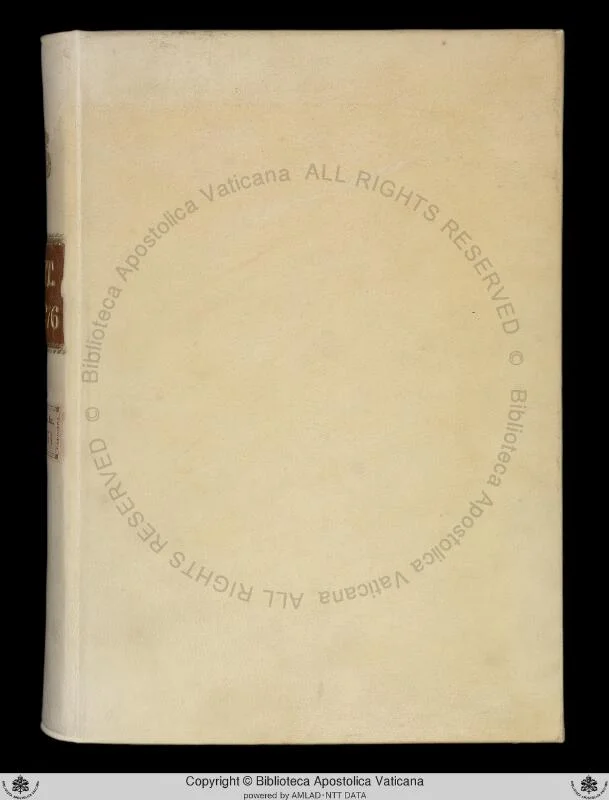
The physical manuscript is a quarto-sized volume: each page runs roughly 195 × 268 mm, and the spine is so narrow — barely 2 centimeters across — that the whole thing sits on a shelf like a pamphlet. 1 The binding is a plain brown board, likely the original sixteenth-century cover, showing light wear at the edges but no significant damage after nearly five centuries of handling. There are no gilt edges, no tooled leather patterns, no colored panels — nothing that would tell a stranger this book mattered to anyone.
That restraint is probably the point. Citizen chronicles of this type — the ricordanze and diarii that educated Florentines kept throughout the fifteenth and sixteenth centuries — were working documents. They circulated in manuscript, they were copied by hand, and they were meant to be used, not admired.
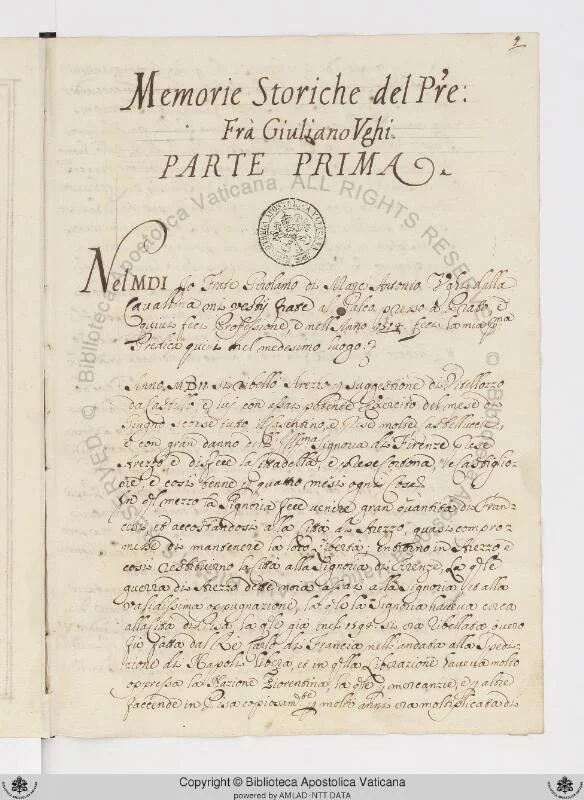
Page 1 of Ott.lat.2576 — opening page of the chronicle text
The first numbered page of Ughi's chronicle, showing the dense mercantesca cursive that runs unbroken for 282 pages. 1

The hand that wrote it

From the first page to the last, a single hand wrote this manuscript. The script falls within the range of mercantesca or cancelleresca italica — the practical cursive that Florence's merchants and civic officials had developed by the late fifteenth century for ledgers, legal records, and private diaries. 1 It is not the careful, upright hand of a trained calligrapher producing a presentation copy. It is a fast, informed hand making a record.
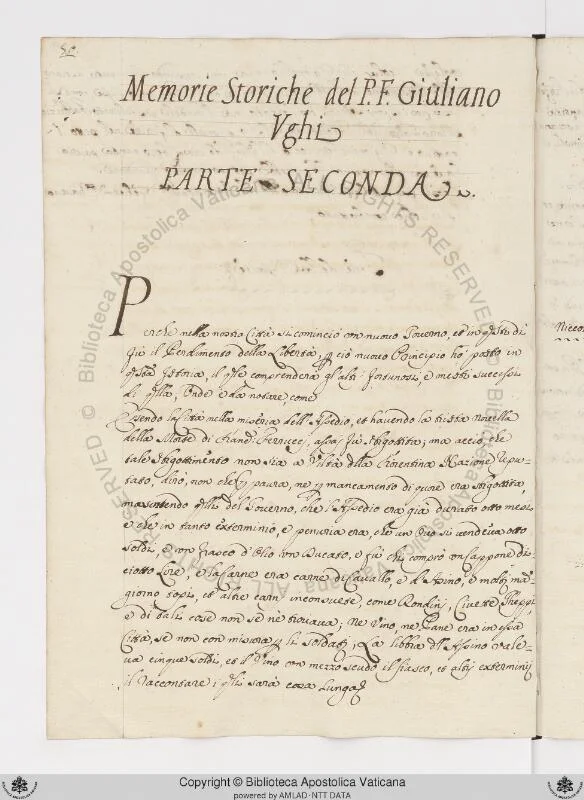
There are no rubricated initials, no section headers set off in red, no decorative flourishes at chapter openings. The text runs full-page from margin to margin, with tight line spacing throughout. At page 50, the hand is identical to page 1; at page 276, six pages from the end, the rhythm has not changed. 1
Page 50 of Ott.lat.2576 — mid-text, showing unbroken scribal hand
Page 50, showing the same dense, consistent hand as the opening pages — no sign of a break or a second scribe. 1
That consistency across 282 pages is itself a form of evidence. This was compiled by one person, in one sustained effort, probably near the end of the period it covers — 1546 is the likeliest date of composition. The compiler was almost certainly a Florentine citizen of some education, someone who could read and write in the chancery style and who had access to information about events in the city over four and a half decades. Beyond that, Giulio Ughi's biography remains unconfirmed; no independently verified details of his life are currently in hand.

Forty-five years of the wrong kind of history to live through

Ughi's chronicle covers 1501 to 1546, which is roughly the period in which Florence stopped being a republic. A reader in 1550 — or 2026 — would have known that span as an era of interrupted governments and recurring catastrophe.
In 1502, Piero Soderini was elected Gonfaloniere a vita (standard-bearer of justice for life), giving the Florentine Republic its most stable executive in a generation. By 1512, Spanish forces had marched into Tuscany and the Medici family had returned from exile, ending Soderini's tenure and the republic with it. The following year, Giovanni de' Medici became Pope Leo X — the first Florentine pope — and the city entered a period of indirect rule by its own banking family from Rome.
The Sack of Rome in 1527 briefly reversed the balance: the Medici were expelled again, and a final republican government took power. It lasted three years. In 1529–1530, a combined imperial and papal army laid siege to Florence for nearly eleven months; the city fell in August 1530. Two years later, Alessandro de' Medici was appointed Florence's first duke by Emperor Charles V, closing the chapter on the communal republic for good. Alessandro was assassinated in 1537, and his cousin Cosimo I succeeded him, founding what would become the Grand Duchy of Tuscany.
Ughi wrote through all of this — or in retrospect of it. His chronicle fits into a recognizable tradition: Luca Landucci (1436–1516), a Florentine apothecary, kept a daily diary that ended with his death; Giovanni Cambi (1450–1541), a merchant, wrote his own Istorie through much of the same period. Ughi's record extends past both of them into the Cosimo I years, covering a transition that neither Landucci nor Cambi fully reached. 1
Page 276 of Ott.lat.2576 — near the end of the chronicle
Page 276, six pages before the final numbered leaf, showing the same hand that opened the chronicle on page 1. 1

From Altemps to Ottoboni to the Vatican

The manuscript now belongs to the Fondo Ottoboniano Latino, one of the Vatican Library's major collected holdings. That collection's path to Rome ran through two aristocratic families. The first was the Altemps — a German-origin noble family that settled in Rome in the sixteenth century and assembled a substantial library during that period. At some point the manuscript passed to the Ottoboni family, whose most prominent member, Pietro Ottoboni (1610–1691), became Pope Alexander VIII in 1689. Pietro and his descendants built the collection that now bears the family name. 1
In 1748, Pope Benedict XIV purchased the entire Ottoboni library from Pietro's heirs, and it entered the Vatican as the Fondo Ottoboniani Latini — a collection known for its secular history, literary manuscripts, and scientific texts, complementing the more religious focus of the main Fondo Vaticano Latino. Ott.lat.2576, a plain citizen chronicle from a city that spent the sixteenth century losing its republic, settled into that company and stayed there for 278 years before this month's digitization. 1

Read the manuscript

The full 300-canvas digitization — covers, flyleaves, all 282 numbered pages, spine, and binding views — is freely accessible through DigiVatLib with no registration required.
Loading link preview…
1
Cover image: the binding of Ott.lat.2576 from DigiVatLib — Biblioteca Apostolica Vaticana

Add more perspectives or context around this Drop.

  • Sign in to comment.