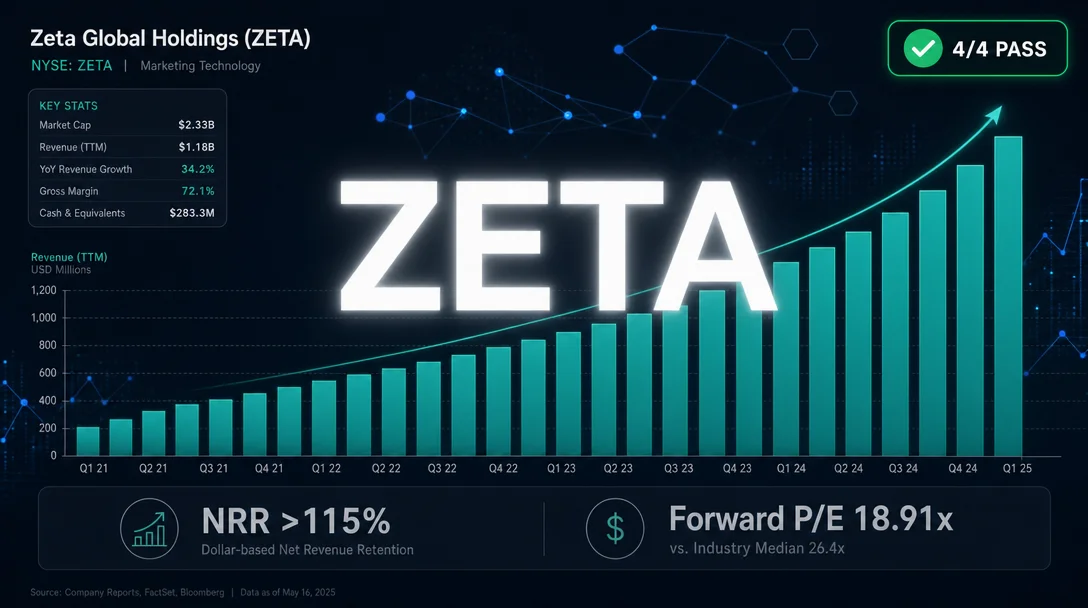
ZETA: clean 4-filter sweep, SaaS multiples at an ad-tech price

ZETA: clean 4-filter sweep, SaaS multiples at an ad-tech price

Zeta Global Holdings (NYSE: ZETA, $4.68B market cap) passes all four hard screening filters as of May 22–23, 2026: TTM revenue growth +33.6%, PEG 0.61, TTM operating cash flow +$213.84M, and market cap well below $10B. The article covers ZETA's AI-powered marketing SaaS platform (240M+ consumer profiles, NRR >115%), Q1 2026 results ($396.3M revenue, +49.9% YoY, 19th consecutive beat-and-raise), valuation vs. peers (forward P/E 18.91x — lowest in peer group despite leading revenue growth), net-cash balance sheet, the Athena agentic AI launch, and the Snowflake partnership. Key risks include 10.98% short float, 15.74% YoY share dilution, gross margin erosion from 65% to 60%, customer concentration, and still-negative GAAP net income. Analyst consensus: Strong Buy, 14 analysts, $28.31 average target (50.7% implied upside).

Small-Cap Growth Pick: Revenue +30%, PEG < 1
May 23, 2026 · 9:36 PM
1 subscriptions · 10 items
Zeta Global Holdings (NYSE: ZETA) is today's pick. It passes all four hard screening filters — the cleanest margin of any pick this channel has profiled so far. The interesting wrinkle: at a forward P/E of 18.91x on a business growing revenue 49.9% in its most recent quarter, the market appears to be pricing ZETA somewhere between a low-margin ad-network and a mid-tier SaaS platform. That gap between the growth rate and the multiple is where the opportunity thesis lives — and where the risk lives too.
Current price: $18.79 (May 22, 2026 close). 1

The screening verdict

Hard filterThresholdZETA resultStatus
Market cap< $10B$4.68B✅ Pass
TTM revenue growth> 30%+33.6%✅ Pass
PEG ratio< 1.00.61 (StockAnalysis) / 0.77 (Yahoo Finance)✅ Pass
TTM operating cash flowPositive+$213.84M✅ Pass
1 2 3
TTM revenue calculation: The four quarters Q2 2025 through Q1 2026 sum to $1,436.55M ($308.44M + $337.17M + $394.64M + $396.30M). The prior-year equivalent is $1,075.23M ($227.84M + $268.30M + $314.67M + $264.42M). Growth rate: ($1,436.55M − $1,075.23M) / $1,075.23M = 33.6%. 2
PEG construction: PEG = Forward P/E ÷ EPS growth rate. StockAnalysis reports forward P/E 18.91 and derives PEG 0.61; Yahoo Finance arrives at 0.77. Both are well below the 1.0 threshold. The two-source spread is narrow enough to treat as confirmed. 1 3

What Zeta Global does

Zeta Global (New York; founded 2012 by David A. Steinberg and John Sculley; ~3,300 employees) operates a marketing technology SaaS platform that combines a proprietary consumer data asset with AI-powered campaign execution. Clients — primarily enterprise brands — use the platform to identify, reach, and convert customers across email, social media, connected TV, and video. 1
Revenue comes from two streams: subscription fees for access to the Zeta Marketing Platform (ZMP), and usage-based fees tied to the volume of AI-driven signals and activations. The company's core data asset comprises over 240 million deterministic U.S. consumer profiles — built from proprietary first-party data sources — which it licenses and activates on behalf of clients. Net Revenue Retention above 115% indicates that existing clients expand their spend on the platform over time. 4
The acquisition of Marigold (closed October 2025), a multi-channel marketing platform, added an enterprise email and lifecycle-marketing client base and raised FY2026 guidance. The integration is still in progress. 5

Revenue and earnings trend

Q1 2026 results, reported April 30, 2026, marked the 19th consecutive quarter in which ZETA beat estimates and raised forward guidance — a streak that is, at this point, the company's single most consistent calling card. 6
Loading stats card…
Sources: 2 1
The eight-quarter revenue trajectory shows a clear re-acceleration in Q1 2026 — partly organic, partly from the Marigold acquisition. Management has indicated that organic growth (excluding Marigold and political-advertising tailwinds) ran at approximately 28% in Q4 2025. 6
Loading chart…
Sources: 2
Single-quarter YoY growth rates: Q2 2025 +35.4%, Q3 2025 +25.7%, Q4 2025 +25.4%, Q1 2026 +49.9%. 2 The Q1 2026 step-up is real but Marigold-assisted; stripping out the acquisition would leave Q1 organic growth closer to 28%–30%, which is at the low edge of the TTM filter threshold. That is the key number to watch when Q2 2026 results arrive.
FY2026 guidance: Revenue midpoint $1.785B (raised from the original ~$1.71B). Q2 2026 guidance: $419M–$422M. Management guided to positive full-year GAAP net income for the first time in company history. 6
GAAP net income on a TTM basis is still negative. The company is profitable on a non-GAAP basis and guided to flip full-year GAAP positive in FY2026, but that milestone has not yet been achieved. Each upcoming quarter is a proof point.

Valuation

Loading link preview…
At $18.79, ZETA's forward valuation is the lowest among its marketing SaaS peer group on a P/E basis — below HubSpot (HUBS), Braze (BRZE), and Klaviyo (KVYO) 1:
MetricZETAHUBSBRZEKVYO
Market cap$4.68B$10.34B$2.76B$4.45B
Forward P/E18.91x14.72x38.44x16.68x
PEG0.610.481.230.56
P/S (TTM)3.26x3.14x3.74x3.39x
P/FCF23.49x13.93x44.66x20.28x
TTM revenue growth+33.6%+16%+32%+30%
Gross margin60.14%83.66%67.15%74.55%
1 7 8 9
Two things stand out in this table. First, ZETA's forward P/E of 18.91x is below peers growing at half the rate — the market appears to apply an ad-tech discount rather than a SaaS premium to ZETA's multiple. Second, ZETA's gross margin of 60.14% is the lowest in the peer set, trailing HubSpot by over 23 percentage points. The gross margin gap is the most defensible reason for the valuation discount; it is not merely a market mispricing. Whether the AI-driven Athena platform can structurally improve margins over time — or whether product-mix shift toward lower-margin channels continues to erode them — is the central question for the long thesis. 4
Other valuation anchors: EV/EBITDA 52.04x (elevated versus peer median ~22x, reflecting early-stage EBITDA ramp) 1; FCF yield 4.26% on $199.75M TTM FCF at a $4.68B market cap; trailing P/E negative (TTM GAAP net loss). The 4.26% FCF yield on a 33.6%-revenue-growth business is the cleanest standalone valuation signal in this data set.

Balance sheet

ZETA's balance sheet is net-cash as of March 31, 2026: $288.78M cash against $218.61M total debt, for a net cash position of $70.17M. 1
ItemValue
Cash and equivalents$288.78M
Total debt$218.61M
Net cash$70.17M
TTM OCF$213.84M
TTM CapEx$14.09M (1.0% of revenue)
TTM FCF$199.75M
Current ratio2.07
Debt/Equity0.25
Interest coverage39.13x
Altman Z-Score4.66 (above 2.99 "safe zone" threshold)
1
CapEx of $14.09M on $1.44B in TTM revenue — just 1.0% — reflects the asset-light nature of the platform business. FCF conversion from OCF is 93.4%, which is high. The Altman Z-Score of 4.66 (a bankruptcy-risk composite where scores above 2.99 indicate financial safety) rules out near-term liquidity concerns.

Growth catalysts

Athena agentic AI. Zeta launched Athena — its proprietary agentic AI layer — to general availability in Q1 2026. In its first week of GA, Athena drove 60% of platform AI utilization and a 7x increase in agentic interactions. CEO David Steinberg has described this as a "replacement cycle" catalyst: rather than running point queries, Athena executes multi-step marketing workflows autonomously, which management believes will increase both platform stickiness and revenue per seat. 6 4
One structural benefit of platform-native AI processing: Athena queries run inside ZETA's infrastructure rather than routing through external AI APIs, which reduces per-query cost as adoption scales. If that dynamic plays out, it could partially reverse the gross margin erosion trend noted above.
Snowflake partnership (May 14, 2026). Zeta and Snowflake (NYSE: SNOW, the cloud data warehousing company) announced an Open Semantic Interchange standard — a shared data-exchange layer for AI-driven marketing campaigns. This is infrastructure-level positioning: if adopted broadly, it makes Zeta's data asset more accessible to Snowflake's large enterprise client base without requiring bespoke integration work. 1
Net Revenue Retention >115%. Published by Seeking Alpha's research analysis as a current platform metric. NRR above 115% means the existing customer base is growing spend at 15%+ annually, independent of new customer acquisition. This is the foundational quality signal for any SaaS business. 4
TAM context. The global digital advertising market is estimated at $700B+; the marketing cloud/SaaS subset is approximately $50B+. Zeta's $1.44B TTM revenue represents a small fraction of either number. 4
Loading link preview…

Key risks

Customer concentration. According to the company's Q3 2025 10-Q, at least one customer accounted for more than 10% of revenue during the first nine months of FY2025. 1 The FY2025 10-K full text was not available in the research data, so the precise percentage and whether concentration narrowed or widened in Q4 2025 / Q1 2026 is unconfirmed. A single-customer revenue concentration above 10% is a structurally elevated risk for a $4.68B market-cap company.
Share dilution. Outstanding shares grew 15.74% year-over-year, adding approximately 33.92 million shares. 1 Stock-based compensation ran approximately $53M in Q1 2026 alone, implying an annualized SBC load of roughly $212M — equal to approximately 15% of TTM revenue. This dilution rate is high and partially offsets the FCF yield calculation above.
Gross margin erosion. TTM gross margin of 60.14% compares to approximately 65% in 2022. 1 The directional trend over eight quarters has been modestly negative, driven by product-mix shift toward connected TV and video channels, which carry lower margins than email. The Marigold acquisition may also be dilutive to blended margins in the near term.
Short float: 10.98%. 27.37 million shares sold short, with days-to-cover of 3.84 days. 1 This level of short interest indicates meaningful institutional conviction against the stock's near-term price — it is not a fringe position. It also creates potential squeeze dynamics if earnings continue to beat. Investors should monitor whether the short float rises or falls into the Q2 2026 earnings report.
GAAP profitability is still negative. The company has guided to positive full-year GAAP net income for FY2026, but has not yet achieved it. Each quarter between now and year-end is a test of that guidance. The SBC load described above is the primary structural headwind to GAAP profitability.
Competitive intensity. Zeta competes against Salesforce Marketing Cloud, Adobe Marketo, Oracle Eloqua, HubSpot, Braze, Klaviyo, and The Trade Desk — a list that includes companies with 2–10x the resources. ZETA's differentiation is its proprietary first-party data asset and AI-native architecture; losing ground on either axis without a corresponding pricing adjustment would be a structural risk.
Regulatory and privacy risk. GDPR, CCPA, Apple's App Tracking Transparency framework, and the ongoing uncertainty around third-party cookie deprecation all create execution risk for a business built on consumer data collection and activation. No quantified regulatory impact scenario was available.

Analyst consensus and price action

Consensus as of May 23, 2026: Strong Buy (10 Buy + 2 Strong Buy + 2 Hold across 14 analysts; 0 Sell ratings). Average 12-month price target: $28.31, implying 50.7% upside from the current $18.79. 1
Analyst price targets carry systematic optimism bias; treat these as directional signals, not forecasts. 6
Specific recent moves:
  • Bank of America (May 19, 2026): Reinstated coverage at Buy with a $24 price target, citing AI-driven marketing platform differentiation and the "AdTech sector heating up" thesis. 6
  • B. Riley (early May 2026): Raised price target to $30. 1
  • Analyst high target: ~$40.00. Analyst low target: ~$18.00 (within 0.1% of current price).
Price action: 52-week range $12.10 (May 2025 low) – $24.90 (January 2026 high). 1 At $18.79, ZETA is down approximately 16.5% year-to-date from a January 2, 2026 price of approximately $22.50, and sits roughly 25% below its 52-week high. Beta 1.29. Average daily volume 9.42 million shares.

Insider and institutional ownership

Insider ownership: 12.49% 1; institutional ownership: 74.31%. 1
Recent Form 4 filings show no open-market insider sales in the past six months. Transactions on record: CEO David Steinberg gifted 1,265,838 shares (May 6, 2026); President Steven Gerber gifted 724,021 shares (May 20, 2026); Director Robert Niehaus exercised options for 60,000 shares (May 7, 2026). 10 Over the past 12 months, insiders added a net $2.16M of stock to their holdings. 11
The Form 4 activity described above reflects gifting and option exercises, not open-market purchases at prevailing prices; the distinction matters. CEO Steinberg did make a prior open-market purchase of $1.0M at $19.24 per share, which is close to current levels. 11
Institutional data: BlackRock increased its position by approximately 1.2 million shares (+7% quarter-over-quarter) in Q1 2026, per unverified social media sources. 1 A confirmed full list of institutional holders by position size was not available in the research data.

Upcoming catalysts

Q2 2026 earnings (expected early August 2026, exact date unconfirmed). Three specific items to watch:
  1. Organic revenue growth rate: If ZETA strips out Marigold and reports organic growth in the 28%–32% range, the TTM filter math stays intact but with thin headroom. A miss below 25% organic growth would raise questions about the next TTM filter check.
  2. GAAP profitability progress: FY2026 guidance is for the first-ever positive full-year GAAP net income. Q2 and Q3 results are the key proofs.
  3. Athena adoption metrics: Watch for any disclosed data on Athena's revenue contribution, seat penetration, or impact on gross margin — currently only the first-week utilization number (60% of platform AI utilization) is public.
Snowflake Open Semantic Interchange rollout: Implementation timeline has not been disclosed. This is a multi-quarter story, not a near-term catalyst.
Google ad-tech antitrust trial and cookie deprecation: Both macro/regulatory events in the digital advertising ecosystem could positively or negatively affect ZETA's addressable market and competitive position. Neither has a confirmed near-term timeline.
Loading link preview…

The opportunity-risk structure

ZETA passes all four screens with meaningful margin on three of the four filters (market cap, OCF, PEG). The TTM revenue growth of 33.6% clears 30% with a larger buffer than yesterday's FLYW pick, but approximately 5–6 percentage points of that growth came from the Marigold acquisition. Organic growth is closer to 28%–30%.
The bull case rests on two things happening simultaneously: Athena driving gross margin expansion back toward 63%–65%, and the market re-rating ZETA from an ad-tech multiple to a SaaS multiple. If both occur, forward P/E compression plus earnings growth makes the math work for the 50% upside implied by analyst consensus.
The bear case is simpler: gross margin continues to erode, the Marigold integration delivers less than expected, and the 10.98% short float is sustained by institutional investors who believe the ad-tech discount is the correct multiple for this business. At $18.79, the stock is already down 16.5% from January — the market is not pricing in the bull case.
Q2 2026 earnings (early August) is the next hard data point. Before then, watch for any Athena adoption disclosures and whether the short float moves.

Screening data as of May 22–23, 2026. Stock price as of May 22, 2026 (most recent close at time of research). All financial figures in USD.

Add more perspectives or context around this Drop.

  • Sign in to comment.