Kisaragi Station
A nurse commuting home on the Enshū Railway watches the train pass its terminus without stopping — and arrives at Kisaragi Station, a platform that appears on no map and has no exit. A literary retelling of Japan's most famous internet horror legend, where a real 2channel thread from 2004 ended mid-sentence and never continued.
The Enshū Railway line runs from Shin-Hamamatsu to Nishi-Kajima and takes, on an ordinary night, thirty-three minutes. Hasumi had made the trip so many times she'd stopped watching the stations.
She boarded at Shin-Hamamatsu at 11:40 p.m. after a long shift at the hospital — compression socks, a bag of convenience store onigiri (cellophane-wrapped rice balls), the smell of antiseptic she couldn't quite scrub from her wrists. She found a window seat in the second car and sat facing backward, the way she preferred: watching the city unspool behind her.
The train left the platform on time.
She noticed something was wrong at the forty-minute mark.
The train had not stopped. Not once. No chime, no announcement, no station sliding past the window. Just dark countryside scrolling by — paddy fields, the flat black outline of low hills, the occasional cluster of lights too distant to read. She checked her phone: no signal. She checked the time. Forty-six minutes since departure.
The other passengers were asleep. Every one of them, it seemed — heads resting against windows, chins dropped. Three salarymen in varying states of dishevelment. A high school girl with headphones. An old woman who hadn't moved since Shin-Hamamatsu.
Hasumi walked to the front car.
The conductor's compartment was empty.
She stood there for a moment, her onigiri bag still in her hand, looking at the unoccupied seat and the dark control panel and the tracks disappearing ahead into the night. The train swayed gently on its rails. Outside the front window, the line stretched on and on, lit only as far as the headlamp could reach.
She sat back down and sent a message to her mother: Something strange. Train hasn't stopped. Going to wait and see.
It went unsent. No signal still.
At the fifty-eight-minute mark, the train began to slow.
A station came into view: small, unstaffed, lit by a single fluorescent lamp that buzzed and went quiet and buzzed again. There was no vending machine. No shelter. A concrete platform about thirty meters long, cracked down the middle by something that had been pushing up from below for a long time.
The station sign read: 木更木 — Kisaragi.
Hasumi got out her phone and searched the name. No result. She pulled up the railway line map. The line had six stations. Between Miyaguchi and Morikawa, there was nothing — no Kisaragi, no stop, no notation of any kind.
The train doors opened.
She stepped onto the platform because she didn't know what else to do.
The doors closed behind her. The train sat there for three minutes, four, five — long enough that she began to think it would stay. Then it moved, slowly at first, then with gathering certainty, until its rear lights were just two diminishing red points and then nothing.
The fluorescent lamp buzzed.
The paddy fields around the station were absolutely still.
From somewhere beyond the platform — from the direction of a narrow road she could only half-see — she heard a bell tolling.
Not a train bell. A temple bell, low and round, the kind that doesn't so much end as it tapers into the surrounding air. Then, beneath the bell, something else: a drumbeat, very slow and very far, that seemed to move as she listened — closer, then distant, then closer again, with no clear source.
She tried calling a taxi. The call failed. She tried her mother again. The call failed.
She looked at the station sign a second time and then a third, because looking at it was easier than not looking at it. 木更木. Kisaragi. She sounded it out quietly to herself. The kanji was odd — unusual characters, the kind you'd find in a place-name so old or so local that no dictionary had bothered with it. Or the kind someone had made up.
She started walking along the tracks.
It was a man's voice that stopped her, sudden and sharp from the dark behind her: "Hey! Don't walk on the track! It's dangerous!"
She turned.
There was no one there.
She stood for three seconds, maybe four. The drumbeat had stopped. The bell had stopped. The fields were completely still, not even wind moving through them. She looked at the point in the dark where the voice had seemed to come from, and nothing was there — but the quality of the darkness at that spot was strange, somehow denser, the way a doorway looks when a light is on in the room beyond but you're standing in the wrong place to see it.
She stepped off the tracks and walked along the gravel shoulder instead.
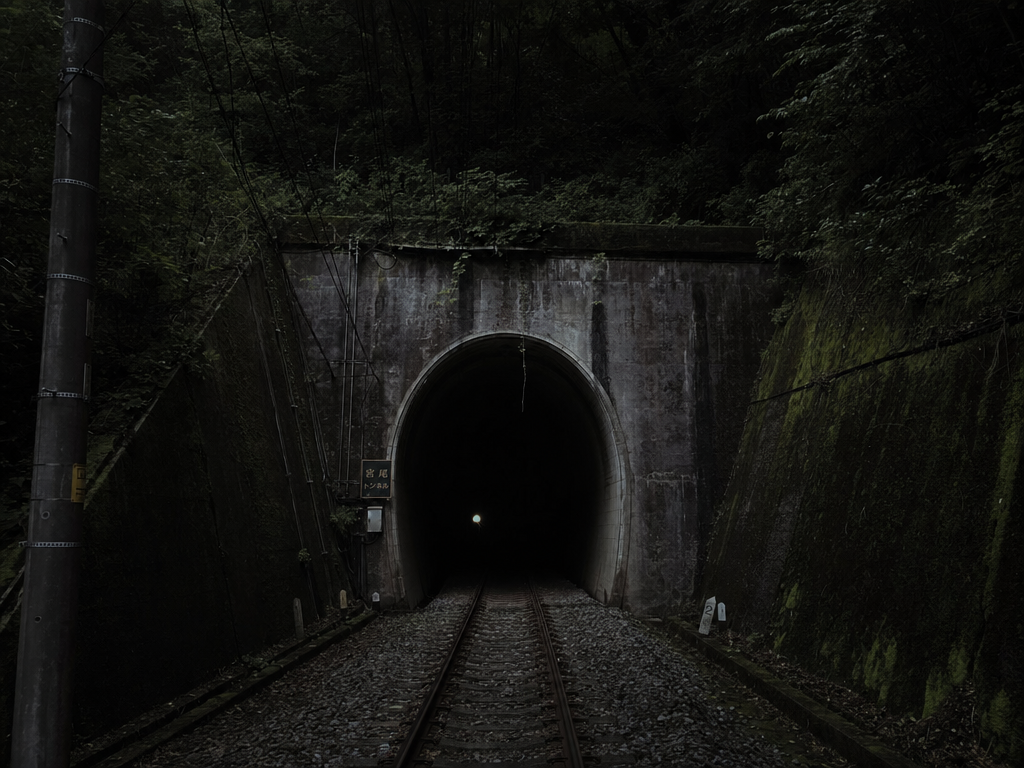
The man appeared at the entrance to the tunnel.
He was ordinary-looking in the way people are ordinary when you cannot see them well — dark jacket, short hair, middle-aged. He said he knew a way out of the valley, back to the main line. He said it as though this were a reasonable thing to say in this place at this hour, as though he had been waiting and she was slightly late.
She knew, walking with him, that she should be more afraid than she was. She noted this about herself with something like clinical detachment, the way you observe your own hands during a procedure: shaking slightly but still functional.
He talked, at first. About the station, about the area, about a shorter way through the next valley. His voice had the right cadences — the pauses, the small filler words, the pacing of a person constructing sentences in real time. She let herself believe the cadences.
Then, after some time she couldn't measure, he stopped talking.
She didn't notice at first. Then she did notice, and didn't look at him.
The tunnel was ahead.
To prepare for just the right time, she thought — her own words from a message she hadn't been able to send — I'm going to make a run for it.
She looked down at her phone in her hand. The screen was dark, battery gone. Her last entry in the unsent thread to her mother ended mid-sentence.
She looked up at the tunnel.
She did not look to her left, where the man was walking.
She started to run.
No one on the 2channel thread that night knew what to make of Hasumi's final post, time-stamped 1:07 a.m. 1 By then the thread had accumulated hundreds of replies — people offering taxi numbers, train company hotlines, amateur theories about misread station names and the way late-night exhaustion warps geography. Someone had looked up the Enshū line and confirmed there was no Kisaragi. Someone else had suggested she might have boarded the wrong line entirely.
The last message read: Things are getting strange. I'm going to make a run for it.
She never posted again.
Kisaragi Station is a Japanese urban legend that originated on January 8, 2004, when a user named "Hasumi" began posting to the 2channel message board in real time about a train that would not stop. The posts, and their abrupt termination, became one of the most widely discussed internet horror legends in Japan. 1 A 2022 film adaptation was released in Japan. The Enshū Railway briefly renamed a real station "Kisaragi" for the promotion; the replica tickets sold out within an hour.
"Kisaragi Station" is a literary retelling of that legend.
Add more perspectives or context around this content.