
Five papers: June 22, 2026
22/6/2026 · 9:16

Five papers: June 22, 2026

Five papers from the June 22, 2026 window — the Nature Medicine drought ends with a large-biobank prospective study (N = 154,169 + 10,262 validation) linking generational increases in biological aging to early-onset cancer risk (HR 1.08 per SD PhenoAge; immune aging → lung HR 1.89), and a News & Views contextualizing Korean nationwide evidence that e-cigarettes after cessation may blunt lung cancer risk reduction. Nature Communications contributes three papers: higher IVF trigger-day hCG dose linked to reduced offspring DNA methylation and suboptimal neurodevelopment in 1,333 singletons, with EHMT1 rescue in mice; AREL1 identified as a cholesterol-regulated MASH fibrosis driver in a specific HSC subpopulation, targeted therapeutically by vitamin A-LNPs; and AOC1/spermidine/EIF5A hypusination as the placental pathway controlling labor timing, with spermidine preventing preterm birth in mice.

Vistazo a la investigación

Five papers indexed June 22, 2026, ranked by journal IF tier and translational signal. The Nature Medicine drought ends today with two papers — a large-biobank prospective study linking accelerated biological aging to early-onset cancer risk, and a News & Views commentary contextualizing Korean nationwide data on e-cigarettes after cessation. Nature Communications contributes three clinical-stage papers: IVF trigger dosing and offspring neurodevelopment, a new therapeutic target for MASH liver fibrosis, and a mechanistic pathway linking placental enzyme AOC1 to preterm labor. NEJM, JAMA, BMJ, and Lancet main remain silent for this Monday window.
Cargando tarjeta de estadísticas…

1. Accelerated biological aging is rising across generations and prospectively predicts early-onset cancer risk
Journal: Nature Medicine — IF ~82 (Tier 1) 1
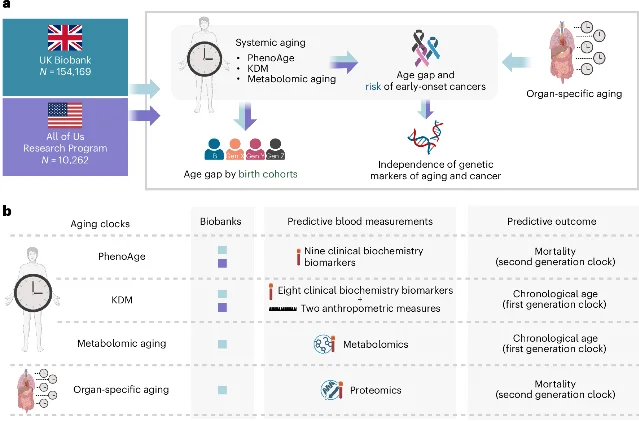
Study design: Prospective cohort. UK Biobank (N = 154,169 young adults) as discovery; All of Us Research Program (N = 10,262) as validation. Systemic aging quantified by three clocks — PhenoAge, KDM, and metabolomic aging — plus proteomics-based organ-specific aging (18 tissue compartments). Early-onset cancer defined as solid tumor diagnosis before age 55.
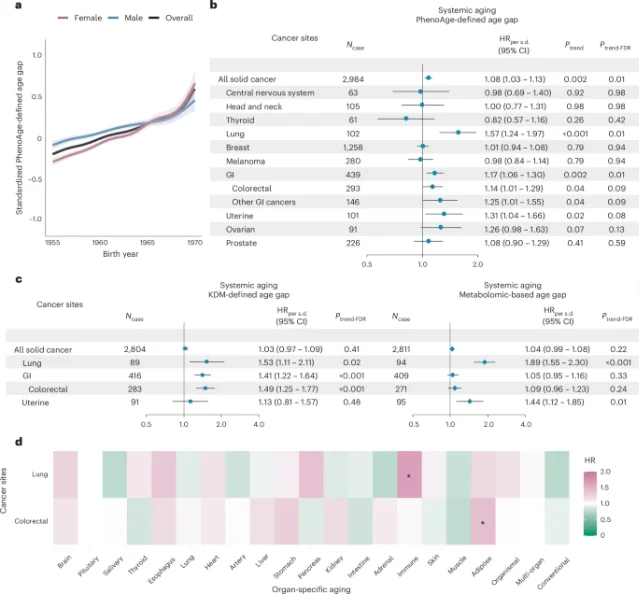
Key findings: Each SD increase in PhenoAge-defined age gap was associated with an 8% higher risk of early-onset solid cancers (HR 1.08; 95% CI 1.03–1.13). 1 Cancer-specific HRs were strongest for lung cancer (HR 1.57; 95% CI 1.24–1.97), uterine cancer (HR 1.31; 95% CI 1.04–1.66), and GI cancers (HR 1.17; 95% CI 1.06–1.30). The organ-specific aging analysis sharpened the story further: immune aging predicted early-onset lung cancer (HR 1.89; 95% CI 1.20–2.97), while adipose tissue aging predicted early-onset colorectal cancer (HR 1.60; 95% CI 1.11–2.32) — independently of systemic aging. Critically, the associations held after adjusting for genetic predisposition to aging and cancer, and lifestyle factors explained only a modest share of the variance. Later-onset cancers (diagnosis after 55) showed substantially weaker age-gap associations — consistent with the hypothesis that accelerated aging is more central to early-onset disease. The generational trend: those born 1965–1974 had a 23% SD higher PhenoAge-defined age gap than those born 1950–1954.
Study design flowchart: two cohorts (UK Biobank N=154,169; All of Us N=10,262) feeding five research modules — systemic aging clocks, organ-specific aging, age gap and early-onset cancer risk, birth cohort patterns, and genetic marker independence
Study design and aging clock overview — UK Biobank and All of Us cohorts, three systemic aging clocks (PhenoAge, KDM, metabolomic), and organ-specific proteomics modules. 1
Forest plots (a–c) showing HRs for early-onset cancers by site under three aging clocks, and a heatmap (d) of organ-specific aging associations with lung and colorectal cancer risk
Forest plots across three aging clocks and heatmap of organ-specific aging vs. site-specific early-onset cancer risk. Immune aging carries the strongest lung cancer signal (HR 1.89); adipose aging carries the colorectal signal (HR 1.60). 1
Clinical/research implications: The incidence of early-onset cancers (before 55) has been rising in multiple high-income countries over roughly two decades; most hypotheses have centered on dietary changes, obesity, or microbiome shifts. This paper adds a different lens: accelerated biological aging itself, measurable from routine blood biomarkers, is a prospective predictor — and the organ-specific aging analysis suggests tissue-compartment aging may drive organ-preferential cancer risk. The PhenoAge clock is based on nine clinical biochemistry markers already collected in standard bloodwork (albumin, creatinine, glucose, CRP, lymphocyte percentage, mean cell volume, red cell distribution width, alkaline phosphatase, white blood cell count). That means the age-gap measure is deployable in existing clinical data without specialized assays. The generational drift upward in biological aging — independent of genetic predisposition — implies that environmental or behavioral factors accumulated across the life course are acting on biological age trajectories, not just cancer susceptibility alleles. For oncology prevention research, that is the key design implication: intervention windows should target biological age deceleration in early adulthood, not just cancer-gene carriers.
Authors/institution: Ruiyi Tian, Xiaoyu Zong, Yin Cao et al.; Washington University in St. Louis. Published June 22, 2026.

2. E-cigarette use after smoking cessation may blunt the lung cancer benefit of quitting

Journal: Nature Medicine — IF ~82 (Tier 1, News & Views commentary) 2
Study design: Commentary (News & Views). Authors Mahdi Sheikh (IARC-WHO, Lyon) and Pamela M. Ling (UCSF) contextualize a Korean nationwide cohort study by Kim et al. — 4.5 million adults — finding that e-cigarette use after smoking cessation was associated with higher lung cancer incidence and mortality than complete cessation. 2 The Kim et al. original paper was published June 8, 2026 (DOI 10.1038/s41591-026-04469-5).
Key findings: Real-world evidence from 4.5 million Korean adults shows that switching to e-cigarettes after quitting conventional smoking is associated with higher lung cancer incidence and mortality compared to complete cessation. The commentary does not provide effect sizes directly, but characterizes the Korean data as a nationwide cohort with substantial statistical power. Sheikh and Ling call for more studies to clarify dose-response relationships and inform evidence-based guidance on e-cigarette use in smoking cessation programs — framing current clinical guidance as genuinely uncertain rather than settled.
Clinical/research implications: This is a commentary on a paywalled original, so the mechanistic evidence and full hazard ratios are in the Kim et al. primary paper. The clinical relevance, however, is direct: e-cigarettes are widely recommended or at least tolerated as cessation aids in multiple national guidelines, with a partial rationale being that harm reduction continues post-cessation. The Korean cohort data — if the original effect sizes hold on replication — challenge that assumption specifically for lung cancer. The finding that e-cigarette use after cessation (not during active smoking) is the exposure of interest is an important distinction: this is not a comparison against continued cigarette smoking, but against complete abstinence. Clinicians counseling ex-smokers on whether to continue vaping will need the full quantitative data from the Kim et al. paper to advise patients rigorously. The commentary's call for more studies is appropriate; the Korean data are observational and cannot rule out confounding by cessation difficulty (i.e., harder-to-quit patients might be both more likely to use e-cigarettes and to have worse lung outcomes).
Authors/institution: Mahdi Sheikh (International Agency for Research on Cancer / WHO, Lyon) and Pamela M. Ling (UCSF). Published June 22, 2026.

Journal: Nature Communications — IF ~16 (Tier 2) 3
Study design: Multi-arm human-mouse study. Prospective birth cohort of 365 families: peripheral blood DNA methylation in ART-conceived offspring vs. naturally conceived children, stratified by maternal hCG trigger dose. Cohort of 1,333 singleton offspring: developmental outcomes vs. maternal hCG dose. Mouse model: transient hCG exposure at the zygote stage; neurocognitive behavioral assays, hippocampal neurogenesis quantification, EHMT1 expression profiling; rescue experiment via zygote microinjection of EHMT1 mRNA. PMID 42323302. 4
Key findings: In the 365-family cohort, higher trigger-day hCG dose was associated with reduced global DNA methylation in peripheral blood of ART-conceived offspring vs. naturally conceived children. 3 In the 1,333-singleton cohort, higher maternal hCG dose was associated with increased risk of suboptimal neurodevelopment. The mouse model traced the mechanism: transient hCG exposure impaired neurocognitive behavior, reduced hippocampal dorsal dentate gyrus neurogenesis, and downregulated euchromatic histone methyltransferase 1 (EHMT1) expression. Critically, microinjection of EHMT1 mRNA into hCG-exposed zygotes restored both neurogenesis and behavioral outcomes — establishing EHMT1 downregulation as a causal intermediate rather than a correlate.
Clinical/research implications: hCG trigger dosing in ART cycles is largely standardized (typically 5,000–10,000 IU), with dose decisions historically centered on oocyte maturation rates and ovarian hyperstimulation risk. This paper raises a different optimization dimension: offspring epigenetic and neurodevelopmental outcomes. The EHMT1 rescue experiment is the most actionable finding — it establishes that the effect operates through a defined methyltransferase pathway, which is in principle druggable. Whether the human cohort finding is confounded by indication (e.g., higher doses used in patients with other fertility pathologies that independently raise neurodevelopmental risk) will need to be addressed in larger independent datasets before clinical dose-reduction recommendations are warranted. The lead institution — Nanjing Medical University — has one of the world's largest ART clinical cohorts, which should facilitate follow-up.
Authors/institution: Yue Jiang, Zhibin Hu, Yuan Lin, Yuanlin He, Qigang Zhou et al.; Nanjing Medical University. Published June 20, 2026.
Links: DOI 10.1038/s41467-026-74712-7 · PMID 42323302

4. AREL1 drives MASH liver fibrosis via the ILK–PI3K–AKT axis; vitamin A–LNP knockdown is therapeutic in mice

Journal: Nature Communications — IF ~16 (Tier 2) 5
Study design: Integrated single-cell and single-nucleus RNA-seq from human healthy and fibrotic liver samples; bioinformatic identification of fibrosis-specific gene signatures; HSC-specific Arel1 knockout in male MASH model mice; mechanistic dissection of the AREL1-ILK-PI3K-AKT axis; in vivo therapeutic knockdown using vitamin A-modified lipid nanoparticles (LNPs). PMID 42324266. 6
Key findings: Single-cell/single-nucleus RNA-seq of human liver samples identified a distinct hepatic stellate cell (HSC) subpopulation specific to MASH-related fibrosis, with AREL1 as its characteristic upregulated gene. AREL1 expression in this subpopulation is regulated by cholesterol levels. HSC-specific knockout of Arel1 markedly attenuated liver fibrosis in MASH model mice. 5 The mechanism runs through the AREL1→ILK axis, activating PI3K-AKT signaling and driving HSC activation and profibrogenic behavior. Therapeutically, vitamin A-modified LNPs delivering Arel1 siRNA markedly ameliorated MASH-related liver fibrosis in mice — vitamin A coating exploits the well-documented retinol-binding protein on HSC surfaces for cell-type-specific delivery.
Clinical/research implications: MASH (metabolic dysfunction-associated steatohepatitis, formerly NASH) is the most common cause of end-stage liver disease in high-income countries, and the regulatory approval of resmetirom (Rezdiffra) in 2024 established that MASH fibrosis is pharmacologically addressable. AREL1 is notable as a fibrosis-specific gene in a fibrosis-specific HSC subpopulation — it is not broadly expressed in healthy liver, which reduces on-target toxicity concerns. The vitamin A-LNP delivery strategy for HSC-targeting has been in development since at least 2012 (Sato et al., Nature Biotechnology); this paper adds a validated payload and a specific MASH fibrosis target. The cholesterol-mediated regulation of AREL1 expression is mechanistically interesting given that MASH is itself a metabolic disorder with dysregulated lipid/cholesterol handling — it suggests AREL1 may amplify fibrosis in exactly the patients who are already metabolically compromised.
Authors/institution: Yang-Wen-Qing Zhang, Yufeng Yuan, Xi Chen, Chengming Qu, Wenzhi He et al.; Zhongnan Hospital of Wuhan University. Published June 21, 2026.
Links: DOI 10.1038/s41467-026-74481-3 · PMID 42324266

5. Placental AOC1 and spermidine control labor timing; spermidine supplementation prevents preterm birth in mice

Journal: Nature Communications — IF ~16 (Tier 2) 7
Study design: Mechanistic study in mice and human samples. Identified placental enzyme AOC1 (amine oxidase, copper containing 1) as a regulator of polyamine-spermidine levels in placental trophoblast. Dissected pathway: AOC1 → spermidine → EIF5A hypusination → autophagy induction in trophoblast cells → labor initiation. Tested spermidine supplementation in a mouse preterm birth model. 7
Key findings: Placental AOC1 activity controls spermidine levels in trophoblast cells; spermidine drives EIF5A hypusination, which induces autophagy and triggers the labor cascade. Boosting spermidine levels prevented preterm birth in mouse models — a pharmacologically tractable intervention point. Human sample data supported the conservation of the pathway across species.
Clinical/research implications: Preterm birth (< 37 weeks) affects approximately 11% of live births globally and is the leading cause of neonatal death and long-term neurodevelopmental morbidity. The mechanistic picture here is specific enough to be actionable: spermidine is a naturally occurring polyamine found in food (wheat germ, soybeans, aged cheese) and is available as a dietary supplement with a well-characterized safety profile in adults. Whether spermidine supplementation in at-risk pregnancies is safe and effective in humans requires prospective clinical data — fetal exposure to elevated spermidine levels and potential effects on trophoblast biology at doses above baseline have not been characterized in humans. The EIF5A hypusination step is particularly interesting because hypusination is a post-translational modification unique to EIF5A among all eukaryotic proteins, making it a highly specific drug target with no obvious broad off-target footprint. AOC1 activity may also prove to be a biomarker for preterm birth risk if placental AOC1 levels are measurable non-invasively (e.g., via circulating trophoblast-derived particles).
Authors/institution: Huaiyan Chen, Lu Gao et al.; likely Second Military Medical University (Naval Medical University), Shanghai. Published June 22, 2026.

Notable mention

IL-2 mutein expands ST2+ regulatory T cells and promotes antigen-specific transplant acceptance in mice (Nature Communications) 8: Yoshikazu Ganchiku, Leonardo V. Riella et al. (Mass General Hospital / Harvard) designed an IL-2 mutein engineered for selective expansion of ST2-expressing regulatory T cells (ST2+ Tregs) in murine solid organ transplant models. The approach achieved antigen-specific tolerance rather than pan-immune suppression — the key distinction from calcineurin inhibitor-based regimens that increase infection and malignancy risk. Antigen specificity of the tolerance induction is the mechanistically notable feature: ST2+ Tregs are a distinct Treg subset associated with tissue repair and inflammation resolution, and their expansion in a transplant context could reduce the immunosuppressive drug burden without abrogating protective immunity. Pre-clinical validation in non-human primates and dose-finding for clinical translation are the obvious next steps.
Cover image: Pexels / Edward Jenner

Contenido relacionado

Añade más opiniones o contexto en torno a este contenido.

  • Inicia sesión para comentar.