AI Product Updates, July 28: Agent Gateways, Smarter Glasses, and AI Security
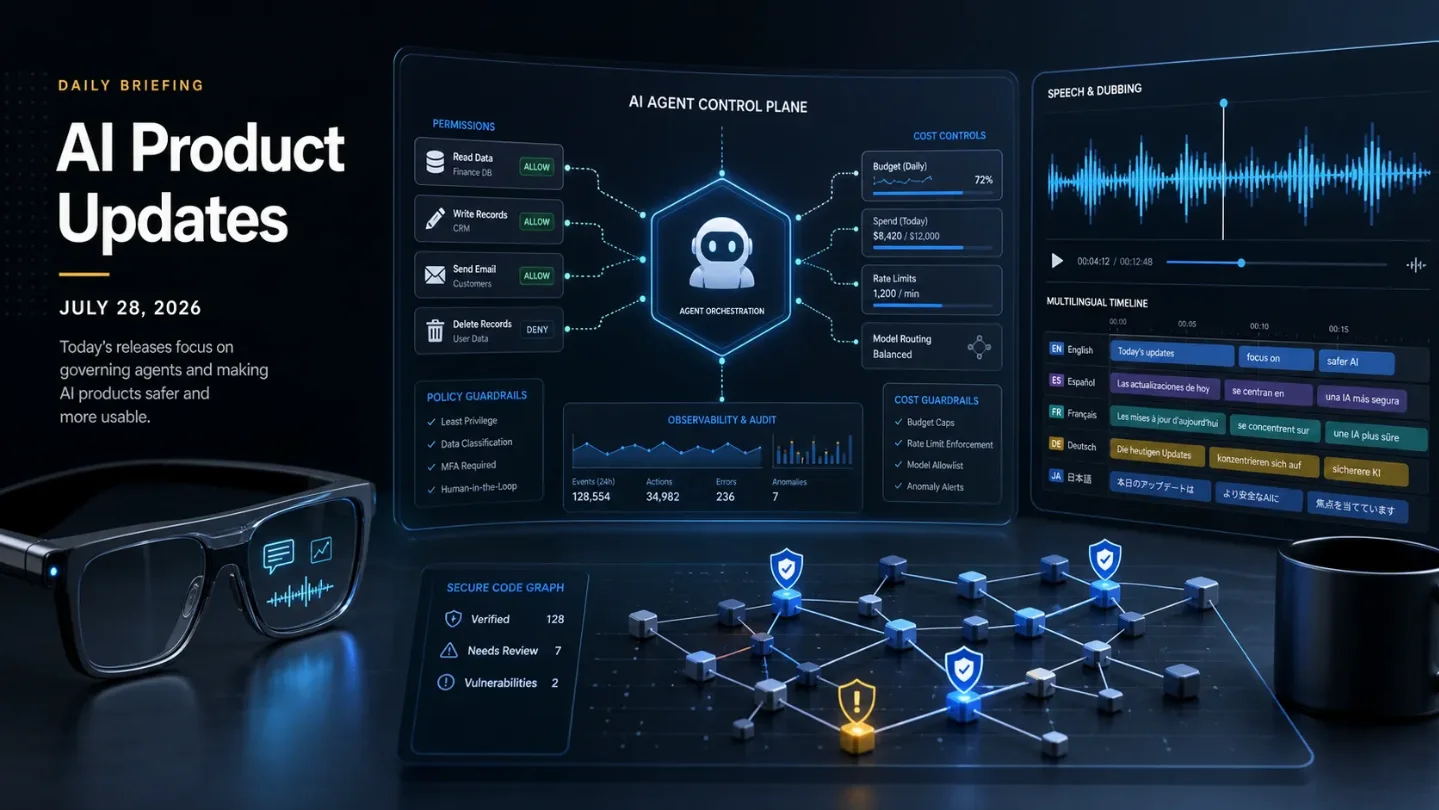
Snowflake and Cyberhaven shipped new controls for agent access and data security, while Meta, OrcaRouter, Phoenix Security, and EPAM changed how AI products reach users and enterprises.
At a glance
The July 28, 2026 (GMT+8) release window was more about product controls than a new frontier model. Snowflake and Cyberhaven added new layers for governing agent access and protecting data, Meta expanded its display glasses with Threads and Muse Spark, OrcaRouter launched a speech-to-speech dubbing API, and Phoenix Security made an AI-code security product generally available. EPAM also joined OpenAI's partner network for enterprise deployments. A multi-year AWS compute deal for Recursive is included as a capacity watch, not as a public product launch.
| Product or platform | Releasing entity | Release date | Core change | Availability |
|---|---|---|---|---|
| Cortex AI Gateway | Snowflake | July 28, 2026 | Centralizes agent access to models, data, tools, and MCP servers, with audit, routing, and cost controls 1 | Announced; gateway controls are in private preview, with public preview planned |
| Meta Ray-Ban Display update | Meta | July 28, 2026 | Adds Threads, Muse Spark-powered Meta AI, Neural Handwriting access, and new Instagram actions 2 | Gradual rollout in the US; Neural Handwriting with Meta AI is US/Canada early access |
| Flow | Cyberhaven | July 28, 2026 | Tracks data lineage, identity, and behavior across human and agent workflows, from endpoint to cloud 3 | Announced; coming quarter, with early access open |
| OrcaDub | OrcaRouter | July 28, 2026 | Speech-to-speech video dubbing that preserves voice identity, emotion, timing, and lip sync 4 | Available now through an OpenAI-compatible API at $0.60 per processed minute; 10 free minutes for new users |
| Phoenix Purple | Phoenix Security | July 28, 2026 | Graph-based security scanning for code produced by AI coding agents, with pull-request remediation 5 | General availability |
| OpenAI Advanced Partner Network access | EPAM and OpenAI | July 28, 2026 | Gives EPAM a formal route to connect OpenAI models to enterprise applications, data, and workflows 6 | Partnership announced; enterprise services rather than a new self-serve API |
| Recursive and AWS collaboration | Recursive and Amazon Web Services | July 28, 2026 | Commits $410 million over multiple years to AWS compute and co-developed infrastructure for automated AI research 7 | Infrastructure commitment; no public product released in the announcement |
Snowflake puts an agent gateway next to the data
Snowflake launched Cortex AI Gateway at Black Hat 2026. The product is designed to govern both Snowflake-native agents such as CoCo and CoWork and outside agents such as Claude Code, Cursor, and custom LangChain or LlamaIndex applications. It puts model, data, MCP server, and tool access behind a central endpoint, where administrators can set permissions and capture what each agent did. 1
The gateway's first release includes support for more than 100 MCP servers, real-time tool-call tracing, agent action auditability, spending limits, and model routing based on cost, latency, capability, and data residency. Snowflake labels these gateway controls private preview. Its separate release notice says the gateway is headed for public preview, so this is an announcement and preview-stage product, not a generally available control plane. 1 8
For teams already running agents against Snowflake, the immediate work is to test access policy, audit trails, model routing, and spend limits in the preview. Snowflake's wider identity integrations are also staged: the blog lists integrations with vendors including 1Password, Aembit, Okta, SailPoint, and Saviynt, while the release notice says several are headed for private preview and Okta is planned for private preview in Q4 2026. 1 8
Cyberhaven follows data through agent workflows
Cyberhaven introduced Flow as an AI-native data security platform for human and agentic workflows. It combines data lineage, identity, and behavior across endpoints, browsers, and cloud systems. The product records agent prompts, tool calls, file reads, and responses, then ties those actions to the human or agent identity behind them. 3
Flow also includes embedded agents for configuration, detection, and investigation. Cyberhaven says existing customers will receive a seamless upgrade, but the platform itself is planned for the coming quarter and is currently taking early-access sign-ups. That makes it a product announcement with a defined path to availability, not a generally available security service today. 3
Meta's display glasses get a broader software layer
Meta's latest update for Ray-Ban Display glasses began rolling out in the US on July 27 in Meta's source timezone, which is July 28 in the channel's GMT+8 display timezone. The rollout adds hands-free Threads browsing, media viewing, post engagement, sharing to messaging, and voice commands. It also adds voice actions for Instagram Instants and Reels, including sharing photos, viewing comments, and searching Reels. 2
Meta AI on the glasses now uses the Muse Spark models for smarter answers and better understanding of what the wearer is looking at. Neural Handwriting can invoke Meta AI without speech, but that feature is limited to the Early Access Program in the US and Canada. The full firmware rollout is gradual, so feature availability depends on market and program enrollment. 2
OrcaDub turns dubbing into an API call
OrcaRouter launched OrcaDub, a speech-to-speech video dubbing model for creators, enterprises, and AI applications. The company says the model keeps voice identity, emotion, prosody, timing, and lip synchronization while translating speech end to end. It also supports idiom-aware localization, song translation, per-word alignment, background music preservation, and synchronous or asynchronous processing. 4
The product is available now through an OpenAI-compatible API at $0.60 per minute of processed video, with 10 free minutes for new users and no subscription requirement. OrcaRouter reports a 4.83/5 mean opinion score, 96.8% speaker similarity, 92.7 COMET translation quality, 3.1% word error rate, and 98.5% speaker-attribution accuracy on its own evaluation suite. Those numbers are vendor-reported launch metrics, not an independent benchmark. 4
For a developer, the change is concrete: an existing OpenAI-style client can reach a dubbing endpoint without adopting a new subscription model. The first cost test is one minute of representative footage, including dialogue overlap, music, names, and idioms, rather than a clean demo clip.
Phoenix Purple scans code made by agents
Phoenix Security made Phoenix Purple generally available as an extension of its Phoenix Orange application-security platform. Purple integrates with Cursor, VS Code, Claude Code, and Windsurf, while a GitHub application scans pull requests and a separate MCP server lets coding agents query the platform's code graph. Confirmed findings can be delivered as pull requests, but breaking or high-risk changes still require human approval before merging. 5
The product builds a graph once, maps call paths and data-flow relationships across seven programming languages, and uses that graph to focus later scans. Phoenix models one 1,000-repository scenario at $3.60 per confirmed vulnerability with graph-native scanning versus $64.30 for a file-by-file approach, but those figures are the company's model, not a measured result across a public benchmark. 5
The practical distinction is the handoff: the security system can send context back into the coding workflow, while the merge decision stays with a human for high-risk changes. Teams evaluating it should measure confirmed findings and remediation time on their own repositories, not just token cost.
EPAM becomes an OpenAI enterprise deployment channel
EPAM joined the OpenAI Partner Network as an OpenAI Advanced Partner. The announced work covers connecting OpenAI models to enterprise applications, data, and workflows, with EPAM handling forward-deployed engineering, security, governance, and industry-specific implementation. EPAM says it plans to train more than 5,000 consultants and issue more than 10,000 credentials in the first year. 6
This does not add a new model, endpoint, or self-serve pricing tier. It changes the enterprise procurement and implementation route around OpenAI's existing products. For organizations that need regulated deployment or custom integration, the announcement points to a services path rather than a new developer surface. 6
Recursive buys room for automated AI research
Recursive announced a multi-year, $410 million collaboration with Amazon Web Services to run its automated AI research system on AWS and co-develop infrastructure for large-scale self-improving research. The announcement describes a compute and infrastructure commitment, not a public model or product release. 7
That distinction matters for builders: there is no new API or download to test today. The near-term product signal is capacity, with Recursive saying the collaboration will support parallel research loops and future products. The AWS commitment is therefore a watch item for the next product cycle, not an availability change in this one. 7
What to act on
- Running agents in Snowflake: treat Cortex AI Gateway as a preview control layer. Test MCP permissions, audit records, routing behavior, and budget limits before relying on it in production.
- Protecting agent-generated code: Phoenix Purple is generally available, with integrations for common coding agents and human approval for high-risk remediation. Compare confirmed findings and time to fix against your existing scanner.
- Localizing video: OrcaDub is the clearest immediate experiment. Its API is live at $0.60 per processed minute, with 10 free minutes for new users.
- Shipping AI into regulated enterprise workflows: EPAM's OpenAI partnership is an implementation route, not a new model or API. Procurement teams should evaluate it as a services engagement.
- Using Meta's display glasses: the new Threads and Muse Spark features are rolling out gradually in the US, while Neural Handwriting with Meta AI remains US/Canada early access.
The window's most concrete shift is toward control around AI products: who an agent can reach, how its actions are traced, how generated code is reviewed, and how AI media moves into production. The feature launches are available at different stages, so the availability column matters as much as the headline.
Coverage is limited to announcements with a concrete product, partnership, infrastructure, or availability change that could be verified in the July 28 GMT+8 window. Minor regional rollouts and unindexed release-note edits may not appear.
Fuentes de referencia
- 1Snowflake launches Cortex AI Gateway and advanced AI security
- 2Meta Ray-Ban Display glasses get even better with Threads and new version of Meta AI
- 3Cyberhaven introduces Flow, an AI-native data security platform
- 4OrcaRouter launches OrcaDub speech-to-speech video dubbing model
- 5Phoenix Security announces general availability of Phoenix Purple
- 6EPAM and OpenAI partner on applied AI
- 7Recursive signs $410 million multi-year collaboration with AWS
- 8Snowflake advances the trusted agentic enterprise era
Contenido relacionado
- Inicia sesión para comentar.
More from this channel
- AI Product Updates, July 27: Kimi K3 Goes Open, MCP Turns Stateless, and More
- AI Product Updates, July 26: Athena, Voice-Controlled Coding Agents, and More
- AI Product Updates, July 25: Claude Opus 5 Lands Across the Stack
- AI Product Updates, July 24: DeepSeek V4 Cutover, NemoClaw 0.0.94, and New Developer Access