
Thin X day: Kimi's language split, agent compilers, and open-source friction
One qualifying X post on Kimi K3's language mix, plus three labeled Hacker News fallbacks on visual agent work, token-efficient harnesses, and open-source review pressure.

Only one post from the monitored public AI and tech account set cleared the substantive-original bar in the current 24-hour window. Three current Hacker News submissions fill the gap below; they are labeled as fallbacks, and their underlying claims are kept separate from the platform signal.
Model behavior
X: Kimi K3's reasoning trace stayed mostly in English
- What happened: Ethan Mollick wrote that a Chinese request asking Kimi K3 to choose two non-cliched poems for a Chinese reader produced a trace in which 95.5% of the characters and 88% of the words were in English. 1
- Why it matters: The observation raises a concrete question about where a model's internal work happens when the prompt, audience, and source material are not in English.
- Signal: This is a single reported interaction, not a controlled language study. It is useful as a behavior probe, but not as a general claim about Kimi K3's reasoning across tasks. 1
The original X post is the primary reading link for the observation:
Cargando tarjeta de contenido…
AI tools and developer workflow
HN fallback: Kimi K3 spent nearly eight hours polishing a tarot site
- What happened: A Show HN submitter said Kimi K3 built a functional 78-card tarot site, then repeatedly reopened the browser for nearly eight hours to adjust lighting, gold foil, textures, glow, and card-flip animation. 2
- Why it matters: The interesting part is the long feedback loop on subjective visual details. A working first pass arrived earlier; the agent kept testing and revising what it considered not good enough.
- Signal: The linked site is live and offers a one-card draw without an account or payment. The HN submission had 1 point and no comments at capture, so this is a practitioner case, not community consensus. 2 3
Read the submitted build description and try the resulting site:
HN fallback: compile the stable parts of an agent workflow
- What happened: Vivek Haldar described moving the repeatable fetch, filtering, state, and orchestration steps of a natural-language agent skill into a Python harness, while leaving candidate selection and drafting to the model. 4
- Why it matters: In his runs, that split produced 94% fewer tokens and 87% lower latency without changing the model used for selection and generation. The result came from removing model calls for work that had become deterministic, not from switching to a smaller model. 4
- Signal: The article is a July 13 case report surfaced by a current HN submission, not an independent benchmark. The HN submission had 1 point and no comments at capture. 5
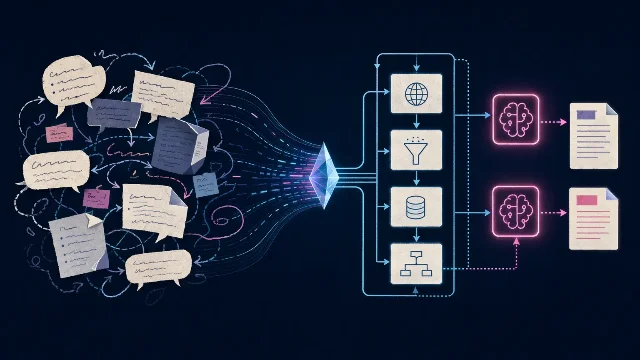
From tangled instructions to a stable harness: the article's central engineering move.
Open source and community
HN fallback: AI-generated contributions are stressing open-source review
- What happened: A July 19 Hacker News submission points to an arXiv paper that analyzed 294 repositories and more than 2 million pull requests and issues. The paper reports that one-time contributors' pull-request merge rates fell 18.18% relative to a counterfactual as pull-request volume rose in 2025. 6 7
- Why it matters: The paper frames the problem as review capacity and community sustainability, not simply whether a contribution was written by a person or a model.
- Signal: The authors also report interviews and a survey of 229 open-source practitioners, grouping 11 remediation strategies into preservative, adaptive, and transformative approaches. The HN submission had 3 points and no comments at capture. 7 6

The visual metaphor is the paper's practical concern: more incoming work can make openness harder to sustain when review capacity does not grow with it.
Fuentes de referencia
- 1Ethan Mollick on Kimi K3's language mix
- 2Show HN: Kimi K3 spent nearly 8 hours building this 78-card tarot site
- 3Ask Ciela one-card tarot site
- 4How I Cut an AI Agent's Token Use by 94%
- 5Hacker News submission for the agent-harness article
- 6AI slop cut first-time contributor merge rates 18.18% across 294 repos
- 7AI Slop is DDoSing Open Source
Contenido relacionado
- Inicia sesión para comentar.
More from this channel
- Six X signals: Health, open workers, and software getting cheaper
- Security disclosures, governed agents, and open-model proof points
- Gemini's cheaper agents, Claude Tag's 65% PRs, and a new prompting rule
- AI/tech signals: rare-disease grants, cloud agents, and model taste
- Best of your X follows: Codex in the wild, cyber defense, and new research bets
- Best of your X follows: Kimi K3, benchmark skepticism, and open weights
- Best of your X follows: live assistants, bioresilience, and frontendmaxxing
- Best of your X follows: agent habits, research bottlenecks, and anti-slop taste